Clear the Old Growth

Scripture Focus: Isaiah 10.33-34
33 See, the Lord, the Lord Almighty, 
will lop off the boughs with great power. 
The lofty trees will be felled, 
the tall ones will be brought low. 
34 He will cut down the forest thickets with an ax; 
Lebanon will fall before the Mighty One.

Matthew 3.10b
10b Every tree that does not produce good fruit will be cut down and thrown into the fire.

Reflection: Clear the Old Growth
By John Tillman

I worked, for a few weeks, as a lumber surveyor’s assistant in the piney woods of East Texas.

I would drive a stake in the ground and then plow as straight a path as possible along a compass heading, dragging a long, smooth strip of hard plastic, called a “chain.” I wasn’t to turn to the left or the right. Unless it was impossible, I had to push straight through brush, bushes, or thorns. 

The surveyor would step on the chain to stop me when the tape reached the stake. Then, I would drive another stake and wait. By tugging on the chain, he would signal me to continue straight or turn 90 degrees left or right. In this way, we marked off squares of wooded land, and calculated the value of its trees based on the ratio of “quality” trees to trees that were not useful or valuable.

In Macbeth, the wicked-hearted king is given a prophecy that he cannot be defeated until Birnam Wood comes to Dunsinane. Macbeth assumes he is invincible. For when does a wood travel?

Similarly, Assyria grew overconfident. Sennacherib knew God’s word well enough to twist its meaning in his threats to Jerusalem, yet he had no respect for God. He thought he was a god and all other gods were idols. He expected to overwhelm Jerusalem as easily as Samaria. Sennacherib’s army was an impossible, forest-like foe, covering the ground and overwhelming the land. 

The foes we face don’t determine our fate. Like Hezekiah, we can turn them over to God. Isaiah promised that the Assyrian army would be cut down in a day. The “lofty” and “tall” trees would fall before God’s ax. 

In the ancient near east, trees were valuable and important—especially the highly valued cedars of Lebanon. Yet no earthly value or importance will stop God’s judgment. God’s ax “is already at the root of the trees.” (Matthew 3.10)

Instead of focusing on outward enemies we have little control over, let us survey our inner forest and the foes we find there. With sober judgment, let us clear the old growth, turning neither to the left nor the right, cutting down pride, selfishness, hatred, fear, greed, and lusts so that better fruits may flourish in the forests of our hearts. 

“Every tree that does not produce good fruit will be cut down and thrown into the fire.”

Divine Hours Prayer: The Refrain for the Morning Lessons
Those who are planted in the house of the Lord shall flourish in the courts of our god. — Psalm 92.12

Today’s Readings
Isaiah 10.5-34 (Listen – 5:13)
Matthew 24 (Listen – 5:59)

Read more about Uprooting and Replanting
People uproot thornbushes and burn them. Then they plant fruitful vines in their place.

Read more about The Ever-Patient Agriculturalist
God wants to give us every opportunity to flourish. We, however, can put a halt to his husbandry…uproot in our hearts what he plants…

The Mountain of the Lord

Scripture Focus: Isaiah 2.1-2
1 This is what Isaiah son of Amoz saw concerning Judah and Jerusalem: 
2 In the last days 
the mountain of the Lord’s temple will be established 
as the highest of the mountains; 
it will be exalted above the hills, 
and all nations will stream to it. 
3 Many peoples will come and say, 
“Come, let us go up to the mountain of the Lord, 
to the temple of the God of Jacob. 
He will teach us his ways, 
so that we may walk in his paths.” 
The law will go out from Zion, 
the word of the Lord from Jerusalem.

Matthew 17.1-2
1 After six days Jesus took with him Peter, James and John the brother of James, and led them up a high mountain by themselves. 2 There he was transfigured before them. His face shone like the sun, and his clothes became as white as the light. 3 Just then there appeared before them Moses and Elijah, talking with Jesus. 
4 Peter said to Jesus, “Lord, it is good for us to be here. If you wish, I will put up three shelters—one for you, one for Moses and one for Elijah.” 

Music:Mountains” — Interstellar, by Hans Zimmer
Reflection: The Mountain of the Lord
By John Tillman

Mountains were believed to be places where heaven and earth overlapped or touched. Every religion in the ancient near east put temples on hills. Even if the “temple” was just a hasty shrine under a spreading tree. (2 Kings 17.10; Deuteronomy 12.2) Peter wanted to set one up for Jesus after the Transfiguration. 

If there weren’t grand enough mountains, people built them. Towers, pyramids, and ziggurats reached toward not just the stars but the heavens.

Today, we don’t believe mountains touch heaven. Not exactly. But we do call our towers “skyscrapers” and we come close to worshiping those who dwell or work there. We are not so different from the ancients as we think.

Isaiah foresaw the mountain of God’s temple exalted and “established as the highest of the mountains.” 

Jerusalem is already situated on a high point. Mount Zion’s elevation is 2500 feet. Geographically, however, it is not the highest mountain in the region. It’s neighbor, The Mount of Olives, from which Jesus wept over the city, tops it by 200 feet. 

Is Isaiah speaking of a cataclysmic geological event, raising Zion higher than Everest?

Isaiah is speaking theologically, not geologically, but that does not mean there has not been a cataclysmic event. The cataclysm that overthrew the powers of this world was the cross. (Colossians 2.15) On the cross, Jesus descended to the lowest place and was raised to the highest. Jesus is the mountain, the Temple, that is exalted over all other gods, rulers, and authorities. (Ephesians 1.20–22)

We have only a foretaste of Isaiah’s promises. Jesus is exalted, yet we still languish. Humans glorify and enrich themselves through oppression. Powers rule over us. However, Isaiah’s promises will come to fullness. Every human leader holding themselves up for worship will have their legs cut from beneath them. Every oppressor will be thrown down. Every spiritual power will be crushed by the heel of our God.

In many images of the City of God, a river is depicted flowing from the city. In Isaiah we see a stream flowing uphill instead of down. It is a stream of people, from all nations, who are being drawn, against the gravity of this world, to Jesus.

Let our gravity be changed. Let every other “mountain” in our lives, by faith, be cast into the sea as we are drawn up.

“Come. Let us go up to the mountain of the Lord.”
Divine Hours Prayer: The Call to Prayer
Sing praise to the Lord who dwells in Zion; proclaim to the peoples the things he has done. — Psalm 9.11


Today’s Readings

Isaiah 2 (Listen – 3:00)
Matthew 17 (Listen – 3:46)

Read more about The Sin Which Fells Nations
From Isaiah we can learn that what looks like a great and powerful nation may actually be a spiritual wasteland of pride and greed.

Read more about Way of the Cross
How uncomfortable does the suffering servant make you?
Everyone rejected the suffering Christ—even the closest of his disciples.

From Esau To Jacob

Scripture Focus: Malachi 1.2-3
2 “I have loved you,” says the Lord. 
“But you ask, ‘How have you loved us?’ 
“Was not Esau Jacob’s brother?” declares the Lord. “Yet I have loved Jacob, 3 but Esau I have hated, and I have turned his hill country into a wasteland and left his inheritance to the desert jackals.”

Matthew 12.48-50
48 He replied to him, “Who is my mother, and who are my brothers?” 49 Pointing to his disciples, he said, “Here are my mother and my brothers. 50 For whoever does the will of my Father in heaven is my brother and sister and mother.” 

Romans 5.8
…God demonstrates his own love for us in this: While we were still sinners, Christ died for us.

Reflection: From Esau To Jacob
By John Tillman

“Esau I have hated.”

We may wonder: Does God randomly hate people? Am I one of those arbitrarily hated by God?

It is normal to struggle with difficult passages, especially those that have been misused. For example, some passages in Malachi 1, including this one, have been twisted to support slavery. Those who did this surrendered to culture and profit and selfishness, all the while proclaiming themselves wise, biblical, and superior. May we not make similar mistakes.

It’s impossible in a 400-word devotional to unpack a difficult passage like this. I won’t attempt it. Let us simply meditate on a few details from scripture.

  1. “Esau” doesn’t mean the individual. God is using these names as collective nouns to speak to the descendants of these brothers, not the brothers themselves. We don’t do this much in our culture. The closest thing we might understand is using the name of a country’s leader to refer to actions of that nation. For example, “Volodymyr Zelensky” meaning Ukraine, or “Xi Jinping” meaning China.
  2. God’s “hatred” isn’t arbitrary. It refers to justice for Edom’s actions—what they collectively did and continued to do. Esau, the individual, while reconciled to his brother, enjoyed God’s blessing. His descendants continually opposed Israel throughout their history and came to represent, poetically, all people opposed to God and God’s people.
  3. God’s “hatred” is not absolute. Edomites are not arbitrarily cursed or hated throughout history or in totality. In many places, God implies hope for Edom. He shows he cares for them, gives them their own land, and commands that no Israelite should despise an Edomite. (Deuteronomy 2.1-8, 12; 23.7)
  4. This statement’s purpose is to show love, not hatred. God speaks poetically to reassure his people. He points to justice done on their behalf, which proves his love. To Micah’s readers, this justice was the downfall of “The Wicked Land” (Malachi 1.4) that harmed them.

We can be assured of God’s love and justice. We are not innocent. Yet, we are not hated. We are loved. This is demonstrated in Christ as God turns “Esaus” into “Jacobs.”

God loved us when we were like Esau—sinners, rebels, and persecutors. (Romans 5.8) All of us have been children of Esau, but by God’s grace, we can become children of Jacob and brothers and sisters of Christ (Matthew 12.50). Through Jesus, we cry “Abba, father,” (Romans 8.15; Galatians 4.6; Mark 14.36) for “Jacob, have I loved.” (Malachi 1.2)

Divine Hours Prayer: The Refrain for the Morning Lessons
I will walk in the presence of the Lord in the land of the living. — Psalm 116.8

Today’s Readings

Malachi 1 (Listen – 2:47)
Matthew 12 (Listen – 6:41)

Read more about Identity Lost, Identity Gained
God, our father, longs to bless us…No one who comes to him will need cry, “Do you have only one blessing, my father?”

Read more about Running to Forgive
In this moment, in a limited way, Esau demonstrates the welcome of the gospel. The wronged party shows undeserved mercy.

Waves of Mercy

Scripture Focus: Jonah 1.4-6
4 Then the Lord sent a great wind on the sea, and such a violent storm arose that the ship threatened to break up. 5 All the sailors were afraid and each cried out to his own god. And they threw the cargo into the sea to lighten the ship.
But Jonah had gone below deck, where he lay down and fell into a deep sleep. 6 The captain went to him and said, “How can you sleep? Get up and call on your god! Maybe he will take notice of us so that we will not perish.”

Matthew 8.24-26
24 Suddenly a furious storm came up on the lake, so that the waves swept over the boat. But Jesus was sleeping. 25 The disciples went and woke him, saying, “Lord, save us! We’re going to drown!”
26 He replied, “You of little faith, why are you so afraid?” Then he got up and rebuked the winds and the waves, and it was completely calm.

Reflection: Waves of Mercy
By Erin Newton

Jonah is the story of the “scandal of God’s mercy” (William Brown). As a prophet during the reign of Jeroboam II, Jonah was sent to Nineveh to preach repentance. The Assyrian kingdom was notorious for their warfare and ruthless tactics. Ancient depictions from statues and reliefs show actions that would be considered war crimes today. It is no wonder Jonah wished for their judgment rather than their repentance.

On his path to avoid bringing peace to his enemy, Jonah finds himself aboard a ship tossed about by the chaotic sea. Turbulent waters are referenced on a number of occasions to highlight the presence of unrestrained chaos, threatening uncertainty, and the frailty of humanity. God let loose the waves around Jonah’s boat and the people were terrified. Jonah is fast asleep, oblivious to the threats and pleas of the crew around him. When he is woken up, they beg him to join in praying to any deity who will save them from their peril.

The mercy of God is shown in the calming of the storm once Jonah is thrown into the sea. The prophet, a unique chosen person by God, should have been the blessed recipient of God’s grace. Instead, he is swallowed by a fish entering into days of darkness (perhaps even death). The sailors, on the other hand, experience the immediate relief of chaos.

Another man was found sleeping in a boat during a violent storm at sea. When Jesus’ disciples were filled with terror at the possibility of their boat capsizing and drowning at sea, they made similar pleas as we see in Jonah 1. With a word, the waves are restrained and the waters are stilled. Jesus is not thrown overboard but would soon enter into days of darkness and death. This “sign of Jonah” would bring salvation to the enemies of God.

While the book of Jonah highlights the reluctance of a prophet to bring good news to a people he considered unworthy, the larger message is the scope of God’s mercy. It is a story about how we all wish to see vengeance and justice in our time. Yet, if we read the story with eyes focused only on humanity, we miss the far more important truth about God. He loves those we find repulsive. Those we label “unfit” for mercy are the exact people he calms the sea to save.

Divine Hours Prayer: The Refrain for the Morning Lessons
The Lord is near to those who call upon him, to all who call upon him faithfully. — Psalm 145.19

Today’s Readings
Jonah 1 (Listen – 2:29)
John 13 (Listen – 5:06)

Read more about The Sign of Jonah and The Cross
Jonah’s emotional path is like a photo negative of Christ’s.

Read more about Prayer for Older Brothers
God, your mercy is a mystery to me.
I see the sins of others and I am scandalized.
How could such a one be accepted?

We Three Kings — Carols of Epiphany

Scripture Focus: Psalm 10.16
The Lord is King forever and ever;
    the nations will perish from his land.

Matthew 2.1-2, 11
1 After Jesus was born in Bethlehem in Judea, during the time of King Herod, Magi from the east came to Jerusalem 2 and asked, “Where is the one who has been born king of the Jews? We saw his star when it rose and have come to worship him.”

11 On coming to the house, they saw the child with his mother Mary, and they bowed down and worshiped him. Then they opened their treasures and presented him with gifts of gold, frankincense and myrrh.

From John: We are thrilled to have a “bonus” carol from Jon Polk today, on Epiphany, sometimes called, “Three Kings Day” or the twelfth day of Christmas. Epiphany is the true conclusion of the season of Christmas, called Christmastide, and the true purpose of the incarnation is revealed to us in it. Christ is a gift to all people but today, he receives gifts fit for worship.

Reflection: We Three Kings — Carols of Epiphany
By Jon Polk

Have you ever been to a birthday party where guests received gifts but not the one having the birthday?

January 6 on the Christian calendar is known as Epiphany, the celebration of the gifts and journey of the Magi.

“We Three Kings” was the first widely popular carol written in America. Composed in 1857 by Episcopal minister and church music instructor at General Theological Seminary in New York, John Henry Hopkins, Jr., the song was created for a Nativity pageant at the seminary. 

We three kings of Orient are;
Bearing gifts we traverse afar,
Field and fountain, moor and mountain,
Following yonder star.

For dramatic purposes, Hopkins assigned a gift and a verse to three Magi, traditionally named Caspar, Melchior and Balthazar. Note that Matthew’s account mentions three gifts, not three men. In some Christian traditions, they are twelve in number.

Furthermore, there is no indication in Matthew that they were kings. The word magi refers to astrologers, thus their interest in following a star. Not royalty, but most certainly foreigners, these Magi were likely familiar with Hebrew prophecies.

Despite these slight missteps the carol makes, Hopkins does a fine job describing the symbolism of the gifts.

Born a King on Bethlehem’s plain,
gold I bring to crown him again

Gold is the most frequently mentioned valuable metal in scripture, used as currency but also for making jewelry, ornaments, and utensils for royalty. This gift is fit for a king.

Frankincense to offer have I
Incense owns a Deity nigh

Frankincense, derived from Boswellia tree resin, produces a sweet odor when burned and was part of the incense allowed on the altar. This gift is fit for worship.

Myrrh is mine; its bitter perfume
Breathes a life of gathering gloom

Myrrh, sap from a small tree in Arabia, was used as a perfume and to stifle the smell of a dead body before burial. This gift is fit for death.

As astrologers, not royalty, the gifts came at a significant financial cost to the Magi. Traveling from as far away as Persia, a two-year journey, required time and energy. These gifts were sacrificial, intended for worship.

However, what do we do at Christmas time? We give gifts to everyone but the guest of honor himself.

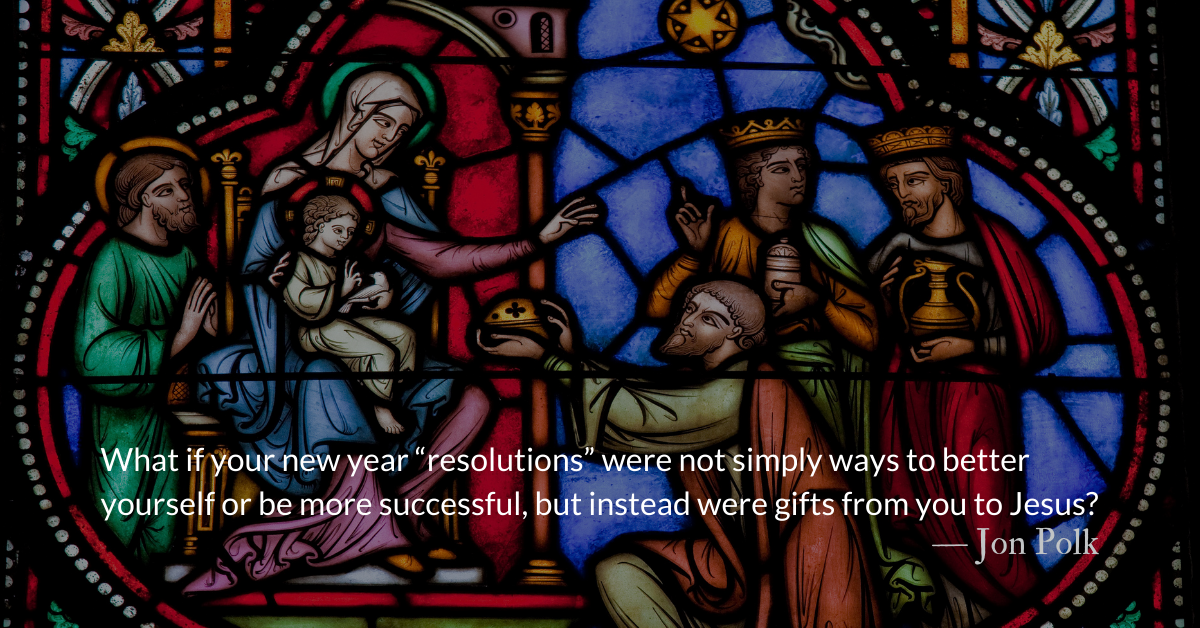
What if this year you begin a new tradition? What if your new year “resolutions” were not simply ways to better yourself or be more successful, but instead were gifts from you to Jesus?

What present would you give Jesus? More time in prayer or Bible study? Kicking a habit that is holding back your spiritual growth? Focusing attention less on yourself and more on those around you?

If you give Jesus a gift this year, what will it be? Following the example of the Magi, let it be sacrificial and intended for worship.

Listen: We Three Kings by Tenth Avenue North and Britt Nicole
Read: Lyrics from Hymnary.org

Divine Hours Prayer: The Call to Prayer
Sing to the Lord and bless his Name; proclaim the good news of his salvation from day to day.
Declare his glory among the nations and his wonders among all peoples.
For great is the Lord and greatly to be praised; his is more to be feared than all gods. — Psalm 96.2-4

– From The Divine Hours: Prayers for Autumn and Wintertime by Phyllis Tickle.

Today’s Readings
Job 6 (Listen – 2:56) 
Psalm 10 (Listen – 2:13)

Join us! Walk through the Bible with us…
Walk with friends through God’s Word this year… Read, Reflect, Pray… Repeat.
https://mailchi.mp/theparkforum/m-f-daily-email-devotional

Read more about Unwrapping Christ’s Gifts :: Epiphany
May we wear Christ’s gifts prominently, like new…clothing. Through the wearing, may we allow them to transform us into the manifestation of the giver.