Beside Still Waters

Scripture Focus: 1 Kings 7.25-26
25 The Sea stood on twelve bulls, three facing north, three facing west, three facing south and three facing east. The Sea rested on top of them, and their hindquarters were toward the center. 26 It was a handbreadth in thickness, and its rim was like the rim of a cup, like a lily blossom. It held two thousand baths.

Job 7.12
12 Am I the sea, or the monster of the deep,
     that you put me under guard?

Matthew 8.27
27 The men were amazed and asked, “What kind of man is this? Even the winds and the waves obey him!”

Reflection: Beside Still Waters
By Erin Newton

I’m quite terrified of the ocean. Maybe I watch too many documentaries or movies about the dangers of the open waters. Too many threats lurk beneath—rip currents, undertows, great white sharks, killer whales, and dare I say, Leviathan.

The sea plays a role in many stories of the Bible, usually as a formidable foe that threatens God’s people: the Red Sea, the raging sea that sends Jonah overboard, and stormy seas threatening the disciples on more than one occasion.

Solomon’s Temple contained features that reflected nature, perhaps the Garden of Eden where God walked among his creation unrestrained. Among the temple furnishings stood a large bronze basin. The enormous size of the bowl was a feat for the Israelite metallurgist. It stood in a fixed location in the Temple—a heavy bronze basin filled with water used for purification and cleansing—and it was called the “Sea.”

The name of the basin is a figurative term for such a large bowl of water, but it strikes at the fearsome image they knew all too well. This Sea, however, is contained, bound, motionless. There are no thrashing waves.

The water served to cleanse the priests (Lev. 8.6) or wash the organs of sacrificed animals (Lev. 8.21). The Sea was no longer a threat, but placed under the watchful eye of God with a renewed purpose. The basin was crowned with gourds and nestled upon the backs of bulls, symbols of life that flow from the cleansing waters.

In the depths of Job’s grief, he calls out to God, asking if he was also constrained like the sea. He recognized the usual threat of the waters but knew that God spoke to the sea and said, “This far you may come and no farther” (Job 38.11).

When a furious storm rolls upon the lake with waves sweeping over the boat, the sea surrenders to the voice of Jesus. Even the winds and the waves obey him.

So why, again, is the Sea in the Temple? Apart from its practical purpose of serving the priests, I think the Sea sits still within the Temple as a reminder—God has this whole world in his hands.

As you enter his presence through prayer, worship, meditation, or reading, look to your left and behold the still waters. The image heralds the supremacy of our God.

Holy, holy, holy is the God of all creation!

Divine Hours Prayer: The Greeting
In you, O Lord, have I taken refuge; let me never be put to shame; deliver me in your righteousness. — Psalm 31.1

– From The Divine Hours: Prayers for Summertime by Phyllis Tickle.


Today’s Readings
1 Kings 7 (Listen 7:47)
Psalms 25 (Listen 2:18)

Read more about Counting Waves
The disciples urged Jesus to awake, their voices strained with fear. “Teacher, do you not care if we drown?”

Read more about Supporting Our Work
Donate today to support ad-free content that brings biblical devotionals to inboxes across the world.
Who May Ascend?

Scripture Focus: 1 Kings 6.11-13
11 The word of the Lord came to Solomon: 12 “As for this temple you are building, if you follow my decrees, observe my laws and keep all my commands and obey them, I will fulfill through you the promise I gave to David your father. 13 And I will live among the Israelites and will not abandon my people Israel.” 

Psalm 24.3-7
3 Who may ascend the mountain of the Lord? 
Who may stand in his holy place? 
4 The one who has clean hands and a pure heart, 
who does not trust in an idol 
or swear by a false god. 
5 They will receive blessing from the Lord 
and vindication from God their Savior. 
6 Such is the generation of those who seek him, 
who seek your face, God of Jacob., 
7 Lift up your heads, you gates; 
be lifted up, you ancient doors, 
that the King of glory may come in. 


Reflection: Who May Ascend?
By John Tillman

It is not the Temple that causes God to live among his people. “Follow my decrees,” God says. “Observe my laws…keep my commands and obey them.” God will live among his people, not because the building is grand but because the people are holy.

God wants us, like Solomon, to build him a temple, a meeting place in our lives. Not a meeting place of gold but one of time. Not situated on top of a mountain but situated in the reading of his word. Not filled with cedar and incense but filled with his Holy Spirit. But how?

“Who can stand in the holy place?” the psalmist asks. Solomon is not holy. Neither was David. Neither are we. How can they or we be holy?

It is not because of our holiness or the holiness of a place that we may ascend the mountain of the Lord. It is because there is a God who makes the humble holy. We receive blessing and vindication from Jesus, the King of Glory. 

He is the one who has clean hands that were pierced in our place.
He is the one who has a pure heart that was pierced in our place.
He is the one who would not trust in the idols offered to him:
He rejected the idol of physical appetites.
He rejected the idol of religious adoration.
He rejected the idol of the power of the nations.

He would not swear by false gods demanding he kneel:
He rejected the false god of making worship a commodity to be sold.
He rejected the false god of Ceasar’s coins and those of the Temple.
He rejected the false god of political machination and the false god of rebellious, retributive violence.

Jesus walked weary and weeping in Gethsemane so we can return, rejoicing and leaping to a new Eden.
Jesus ascended Golgotha, the mountain of death, so we can ascend the mountain of God to life.
Jesus broke open the ancient doors of death and Hell so we can enter freely the Heavenly gates of the Ancient of Days.

The blessings we receive and the vindication we win come through Jesus. Let us lean on the grace of Jesus, follow the example of Jesus, and trust the power of Jesus.
Once Jesus, the King of Glory, enters our gates, he lifts up our heads, and together we ascend.

Divine Hours Prayer: The Request for Presence
May God be merciful to us and bless us, show us the light of his countenance, and come to us. — Psalm 67.1

– From The Divine Hours: Prayers for Summertime by Phyllis Tickle.


Today’s Readings
1 Kings 6 (Listen 5:10)
Psalms 23-24 (Listen 2:03)

Read more about Neither Despair Nor Nostalgia
In many ways, Solomon’s era was the golden age of Israel’s covenant with God, but…In golden ages, we often find excesses that will bankrupt the future.

Read more about Gods of Ruin and Ridicule
The gods of this world bring ruin and ridicule. However, if we abide in Christ, we enjoy the benefit of God’s presence.

Rosy Idealism vs Gritty Reality

Scripture Focus: 1 Kings 4.20, 25
20 The people of Judah and Israel were as numerous as the sand on the seashore; they ate, they drank and they were happy…25 During Solomon’s lifetime Judah and Israel, from Dan to Beersheba, lived in safety, everyone under their own vine and under their own fig tree.

1 Kings 5.13-18
13 King Solomon conscripted laborers from all Israel—thirty thousand men. 14 He sent them off to Lebanon in shifts of ten thousand a month, so that they spent one month in Lebanon and two months at home. Adoniram was in charge of the forced labor. 15 Solomon had seventy thousand carriers and eighty thousand stonecutters in the hills, 16 as well as thirty-three hundred foremen who supervised the project and directed the workers. 17 At the king’s command they removed from the quarry large blocks of high-grade stone to provide a foundation of dressed stone for the temple. 18 The craftsmen of Solomon and Hiram and workers from Byblos cut and prepared the timber and stone for the building of the temple. 

Reflection: Rosy Idealism vs Gritty Reality
By John Tillman

One chapter paints a glowing, idealistic picture of Solomon’s reign, packed with prophetic references. The people are “numerous as the sand on the seashore,” referencing God’s promise to Abraham. (Genesis 22.17) They ate, drank, and were happy, with “peace on every side,” as promised to their ancestors. (Joshua 21.44) They lived in safety, everyone “under their own vine and fig tree,” an idyllic state that would be referenced by the prophet Micah and many others. (Micah 4.4)

The next chapter is a reality check. The idyllic portrait was a partial picture. For at least 30,000 Israelites, the reality included forced labor. Everyone lived under their own vine and fig tree for two out of three months. The other month, they were slaves.

The version of slavery in the Bible was less brutal than the North Atlantic slave trade, yet God opposed even the gentler version. God liberated Israel from slavery. Scripture cites this experience as part of their identity. “For you were slaves in Egypt” is a frequent refrain. God commanded that they never enslave another Israelite. God commanded that they prevent fellow Israelites from being enslaved by outsiders. God commanded that they always set free escaped slaves. Yet, here is Solomon, building a Temple for God by breaking these rules.

Societies supported by slavery always have a rosy, sanitized vision of themselves. They say things like, “Slaves were like family,” “slaves learned skills,” “slaves lived happy lives,” and “slaves were rarely mistreated.” Even if these are or were always true, it doesn’t change God’s opinion of slavery as a practice to avoid and oppose. 

Pointing fingers at the past is not scripture’s intention. Jesus condemned those who looked to the past and claimed they would not have joined their forebears’ sins. (Luke 11.47-48) He would say the same to us. It does no spiritual good to claim we would have opposed past wrongs. Spiritual good comes from sober examination of our present.

Do we have a rosy, glowing, idealistic, and sanitized vision of ourselves? Have we allowed a “gentler version” of slavery to rise up, unnoticed, except by the tens of thousands trapped in it? Or if not slavery, a gentler version of empire, greed, or lust?

Recognizing the sins of the past is important, but not without repenting of the sins of today. God, wipe away rosy idealism. Grant us the mercy to see gritty reality and repent of today’s sins.

Divine Hours Prayer: The Refrain for the Morning Lessons
The heaven of heavens is the Lord’s, but he entrusted the earth to its peoples. — Psalm 115.16

– From The Divine Hours: Prayers for Summertime by Phyllis Tickle.


Today’s Readings

1 Kings 4-5 (Listen 7:21)
Psalms 22 (Listen 3:49)

Read more about Better Temples
Jesus is our Temple and Solomon’s prayers are better answered in Jesus than in the structure Solomon built.

Read more about Supporting Our Work
Please consider becoming a donor. Support ad-free content that brings biblical devotionals to inboxes across the world.
Who Is the True King?

Scripture Focus: 1 Kings 1.50-53
50 But Adonijah, in fear of Solomon, went and took hold of the horns of the altar. 51 Then Solomon was told, “Adonijah is afraid of King Solomon and is clinging to the horns of the altar. He says, ‘Let King Solomon swear to me today that he will not put his servant to death with the sword.’ ” 
52 Solomon replied, “If he shows himself to be worthy, not a hair of his head will fall to the ground; but if evil is found in him, he will die.” 53 Then King Solomon sent men, and they brought him down from the altar. And Adonijah came and bowed down to King Solomon, and Solomon said, “Go to your home.” 

Reflection: Who Is the True King?
By John Tillman

David is rightly remembered as the greatest of Israel’s kings. For generations, every good king will be described as following in David’s footsteps, and every bad king will be described as forsaking them. But David’s reign and personal life are far from perfect. The writers of the scrolls of Samuel, Kings, and Chronicles go out of their way to show us that even the “man after God’s own heart” fell short.

The cracks caused by David’s flaws showed early. David’s taking of multiple wives and concubines and his inability or unwillingness to deal justly with crimes and corruption within his family explode into bloodshed over and over.

At the end of David’s reign, Israel found itself with two would-be kings. Which one is lawful? Which one is the usurper? Did Adonijah know David planned to place Solomon on the throne? Did David forget? Did Bathsheba or Nathan deceive David, making him think he forgot a promise he never made? Palace intrigue and conspiracy theories are always interesting to us.

Adonijah’s three older brothers were dead. According to tradition, he was the rightful heir. The writer carefully points out David’s failure to correct Adonijah or warn him about his presumptions. Adonijah and his supporters may have taken this as David’s tacit approval.

Some have proposed that Nathan and Bathsheba plotted against Adonijah by manipulating poor, old, senile David. However, David doesn’t seem weak or senile in his response. In addition, Chronicles has a fuller account of David’s public declaration that Solomon would be the next king. This public knowledge makes it hard to see Adonijah as innocent.

The sins of a normal person harm the individual, friends, and family. But even the tiniest flaws in rulers are multiplied by their wealth, influence, and power—and they slay multitudes. The warning tremors of instability we see during David’s lifetime grew after his death. Solomon’s reign would end with a nation-splitting earthquake of a civil war that cost tens of thousands of lives.

More powerful rulers are more likely to do greater harm, even with good intentions.

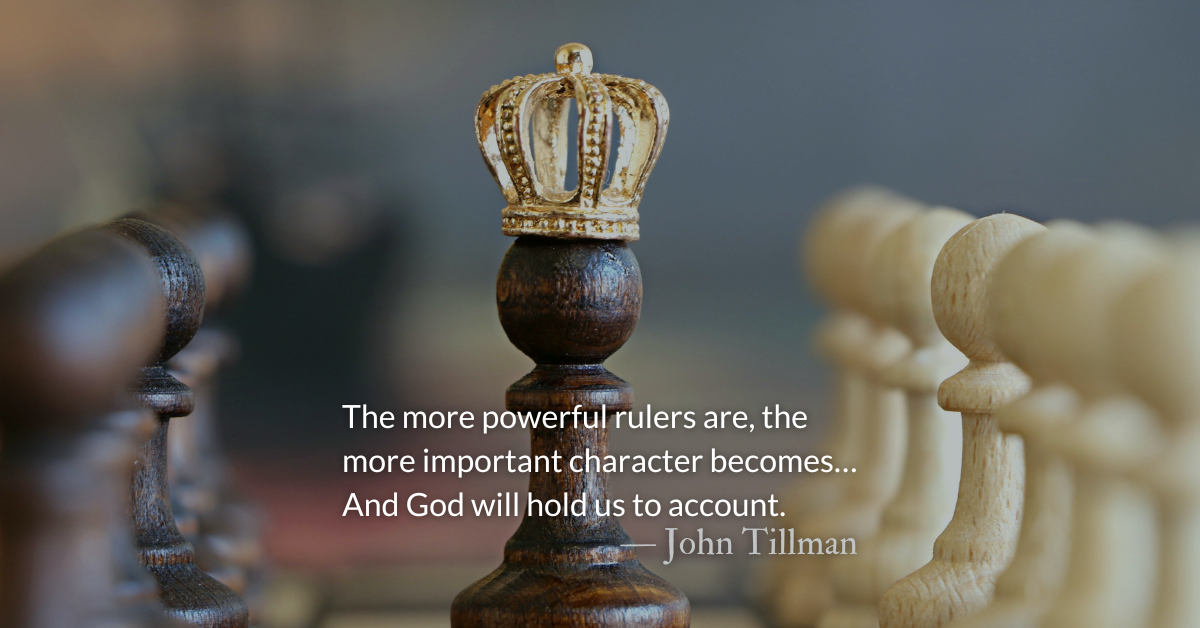
There are no perfect rulers on Earth, but that doesn’t mean character is a poor political strategy or that victory outweighs virtue. As we select rulers, remember: The more powerful rulers are, the more important character becomes. And in a democracy, the true king is the voter. And God will hold us to account.


Divine Hours Prayer: The Greeting
Hosanna, Lord, hosanna!… Blessed is he who comes in the name of the Lord; we bless you from the house of the Lord — Psalm 118.25-26

– From The Divine Hours: Prayers for Summertime by Phyllis Tickle.


Today’s Readings
1 Kings 1 (Listen 7:52)
Psalms 18 (Listen 5:47)

This Weekend’s Readings
1 Kings 2 (Listen 7:45), Psalms 19 (Listen 1:52)
1 Kings 3 (Listen 4:29), Psalms 20-21 (Listen 2:37)

Read more about Limits of Human Grace
On his deathbed, David sounded hurt, petty, vindictive…David, left Solomon a mix of things, including a hit list.

Read more about Supporting Our Work
Our work needs your support. Ad-free content isn’t free to produce. Please consider becoming a donor.

Open Heart Examination

Scripture Focus: Psalm 17.3-5
3 Though you probe my heart,
     though you examine me at night and test me,
 you will find that I have planned no evil;
     my mouth has not transgressed.
 4 Though people tried to bribe me,
     I have kept myself from the ways of the violent
     through what your lips have commanded.
 5 My steps have held to your paths;
     my feet have not stumbled.

Reflection: Open Heart Examination
By Erin Newton

I’ve been rewatching a sitcom about a genius who pretends to be a lawyer in New York. The main character spends every day on the precipice of disaster as he struggles to keep his lie hidden. One episode opens with the song lyrics, “You’re a fraud and you know it…It’s always been a smoke and mirrors game.” Season after season, he bears the weight of his guilty conscience.

A different story plays out in Psalm 17. There is no fraud. The psalmist opens his heart, shining a light onto any hidden corner. No smoke and mirrors. He is steadfast, firmly confident that God will find no guilt in him. This psalm is a stark contrast to the sitcom.

Each psalm reveals a scene from life and makes proclamations about psalmist, enemies, and God that reflect a moment in time. The psalmist here is not universally guiltless. This is not a mirror of perfection left for us to imitate. In this moment, whatever causes this critical crisis of the psalmist’s life, he is innocent. He is confident because he has actively rejected opportunities for sin.

Hearts are not always willingly exposed.

The heart can be a labyrinth, twisting and turning with various desires. The heart can be a catacomb hiding the proverbial skeletons in our closet. 

And yet, the heart can be the home of wisdom. The heart that trusts in God can be an open book.  

God is able to navigate the complexity of the human heart. Other verses in the book of Psalms invite God to examine the heart (Ps. 17.3, 26.2, 139.23) and others proclaim God’s ability to do so (Ps. 7.9, 33.15, 44.21). Like a skilled surgeon, God can open our hearts and assess their health. There are no dark corners obscured from divine examination.

The psalmist is confident in his innocence in this matter. People have tried to bribe him and he refused. People have tempted him toward violence and he has rejected their offer. He follows the road less traveled, God’s paths of righteousness.

It is a tender and humble request to ask God to examine your heart. We know what lies within the crevices of our souls, things we wish to keep hidden. But like the fraud in that sitcom, disaster crouches at the door and reality becomes smoke and mirrors.

God is able and has already examined your heart. He has loved you regardless. 


Divine Hours Prayer: The Refrain for the Morning Lessons
Blessed are they which do hunger and thirst after righteousness: for they will be filled. — Mathew 5.6

– From The Divine Hours: Prayers for Summertime by Phyllis Tickle.


Today’s Readings
2 Samuel 24 (Listen 4:48)
Psalms 17 (Listen 1:58)

Read more about Judging Our Hearts
If the tree is sickened at its heart, the fruit will be sickened as well.

Read more about Choices and Hard Hearts
Hardened hearts happen in stages. Our choices matter. Our hearts are hardened or softened day after day.