The Prodigal Woman

Scripture Focus: Hosea 2.7-8
7 She will chase after her lovers but not catch them;
     she will look for them but not find them.
 Then she will say,
     ‘I will go back to my husband as at first,
     for then I was better off than now.’
 8 She has not acknowledged that I was the one
     who gave her the grain, the new wine and oil,
 who lavished on her the silver and gold—
     which they used for Baal.

Luke 15.17-18
17 “When he came to his senses, he said, ‘How many of my father’s hired servants have food to spare, and here I am starving to death! 18 I will set out and go back to my father and say to him: Father, I have sinned against heaven and against you. 

Reflection: The Prodigal Woman
By Erin Newton

As a writer, I struggle with doubt: “How can I say anything that is new?” The teacher in Ecclesiastes would say, “Yeah. There is nothing new under the sun.” Despite this reality, the Bible often reminds me that some good truths are worth repeating.

Many times in the Old Testament we see themes and stories that find a similar counterpart in the New Testament. We see similar tales of watery depths stilled at creation (Genesis 1.2, 9-10) and at the hush of the waves from the voice of Jesus (Luke 8.24-25). There are temptations in the deserts of Egypt and Israel (Exodus 16.1-3; Matthew 4.1-4). In fact, Jesus often responds to questions, “You’ve heard it said…” implying that some truths are worth telling again.

The prophets’ messages were not random, ground-breaking new realities for the people. They spoke messages that reminded people of the truth they already knew. The call to repentance is an ancient word that still speaks today.

The prophet Hosea uses the image of a wayward spouse to speak about the unfaithfulness of Israel. His message compares the divine-human relationship to a marriage. What is expected in such a relationship? Loyalty, love, commitment, and exclusivity. 

Through this analogy, Israel is revealed as disloyal, unloving, uncommitted, and corrupt. The object of her wayward affection is Baal, the god of her neighbors—a deity depicted as a violent storm god engaged in wars for power. She is compelled by her lust and forgets where her substance and beauty come from.

“Well, good thing I would never be a harlot! Never would I worship an idol!” We convince ourselves that we are too sophisticated to be compared to a scandalous woman involved in idolatry.

But Jesus takes the same message and reconfigures the image. No longer is it a spousal relationship. It is father and son. It is not a woman financially dependent on a man but a son who is already destined to receive a future inheritance. It is not Baal who tempts but greed.

This story hits a little closer to home. It sounds like our own testimonies.

Both the woman and the son follow their passions instead of the Provider. Yet both are received within the arms of the one who has always loved them.

God always loved Israel. The father never stopped loving his son. Christ forever loves you.
There is always room to tell this same story—our story—one more time. 


Divine Hours Prayer: The Small Verse
My soul thirsts for the strong, living God and all that is within me cries out to him. 

– From The Divine Hours: Prayers for Summertime by Phyllis Tickle.

​Today’s Readings
Hosea 2 (Listen 3:48
Matthew 7 (Listen 3:31)

Read more about A Chiaroscuro Parable
Like a Rembrandt chiaroscuro painting, with exaggerated lights and darks, Hosea shows the darkness of sin and the bright, hopeful gleams of God’s love

Read more about Trouble and Hope
How does trouble turn into hope? How does the punishment of disobedience become a beacon of mercy in the wilderness?

Heavy Loads Lifted

Scripture Focus: Matthew 6.24-34
24 “No one can serve two masters. Either you will hate the one and love the other, or you will be devoted to the one and despise the other. You cannot serve both God and money. 25 “Therefore I tell you, do not worry about your life, what you will eat or drink; or about your body, what you will wear. Is not life more than food, and the body more than clothes? 26 Look at the birds of the air; they do not sow or reap or store away in barns, and yet your heavenly Father feeds them. Are you not much more valuable than they? 27 Can any one of you by worrying add a single hour to your life? 

28 “And why do you worry about clothes? See how the flowers of the field grow. They do not labor or spin. 29 Yet I tell you that not even Solomon in all his splendor was dressed like one of these. 30 If that is how God clothes the grass of the field, which is here today and tomorrow is thrown into the fire, will he not much more clothe you—you of little faith? 31 So do not worry, saying, ‘What shall we eat?’ or ‘What shall we drink?’ or ‘What shall we wear?’ 32 For the pagans run after all these things, and your heavenly Father knows that you need them. 33 But seek first his kingdom and his righteousness, and all these things will be given to you as well. 34 Therefore do not worry about tomorrow, for tomorrow will worry about itself. Each day has enough trouble of its own. 

Reflection: Heavy Loads Lifted
By John Tillman

Christ’s moral teachings are the most popular thing about him.

The Sermon on the Mount is recognized worldwide as an aspirational description of a beautiful way to live. Even non-Christians recognize the Sermon on the Mount as the most astute moral teachings ever produced in the history of the world.

It may be a beautiful way to live, but isn’t it impossible? Rich Mullins confronts this humorously in the bridge of his song, “Hard.

“Well His eye’s on the sparrow
And the lilies of the field I’ve heard
And He will watch over you and He will watch over me
So we can dress like flowers and eat like birds.”

It is hard to be like Jesus describes in these teachings. 

Jesus generally commended the Pharisees’ moral teaching. “Do what they say…Don’t do what they do.” He critiqued the Pharisees for tying up “heavy loads” of moral requirements but not lifting them themselves or helping people live them out. (Matthew 23.4)

Aren’t Jesus’ hard moral teachings “heavy loads”?

Who can dress like a flower?
Eat like a bird?
Continually turn the other cheek? 
Go the extra mile? 
Give unrestrainedly to the needy? 
Surrender our security for another’s shelter and safety?

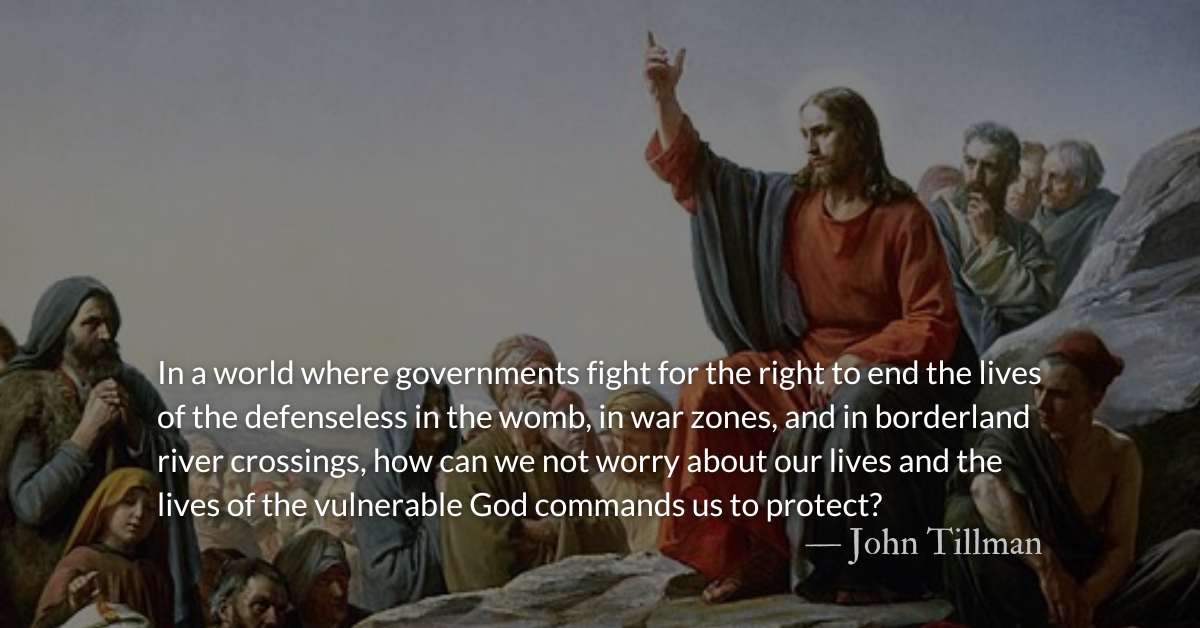
In Mammon’s empire, how can we survive without accumulating wealth? In a world that denigrates the poor, how can we be unconcerned with clothing, food, and shelter? In a world where governments fight for the right to end the lives of the defenseless in the womb, the defenseless in war zones, and the defenseless in borderland river crossings, how can we not worry about our lives and the lives of the vulnerable God commands us to protect?

Who can carry this load? Who can “be perfect” as our Heavenly Father is perfect? (Matthew 5.48; 19.21) Not us. Only Jesus.

Jesus tied this load for his own back. He carried it perfectly. He carries it for us. The teaching of the Sermon on the Mount glimpses the Kingdom of Heaven. One day, we will arrive.

It is too simplistic to say, “We don’t have to do it. Jesus did it.” However, we can say, “Jesus did it for me, and he is doing it within me now.” Together with the same power that raised Christ from the dead, strain toward heavenly living today. (Ephesians 1.19-21; Philippians 3:12-14) Don’t walk away discouraged or sad. “With God, all things are possible.” (Matthew 19.21-26) Heavy loads can be lifted.

Divine Hours Prayer: The Refrain for the Morning Lesons
I will bear witness that the Lord is righteous; I will praise the Name of the Lord Most High. — Psalm 7.18

– From The Divine Hours: Prayers for Summertime by Phyllis Tickle.

​Today’s Readings
Hosea 1 (Listen 2:08
Matthew 6 (Listen 4:35)

Read more about Hope In the Tree of the Cross
At the roots of the tree of the cross, we find healing, peace, and power. As we follow Christ, we will become like this tree.

Read more about Pause To Read
Listen to our bonus Easter episode that came out Sunday morning! Subscribe and share some episodes with friends.

Maimed Yet Made Whole

Scripture Focus: Matthew 5.29-30
29 If your right eye causes you to stumble, gouge it out and throw it away. It is better for you to lose one part of your body than for your whole body to be thrown into hell. 30 And if your right hand causes you to stumble, cut it off and throw it away. It is better for you to lose one part of your body than for your whole body to go into hell.

Matthew 18.7-9
7 Woe to the world because of the things that cause people to stumble! Such things must come, but woe to the person through whom they come! 8 If your hand or your foot causes you to stumble, cut it off and throw it away. It is better for you to enter life maimed or crippled than to have two hands or two feet and be thrown into eternal fire. 9 And if your eye causes you to stumble, gouge it out and throw it away. It is better for you to enter life with one eye than to have two eyes and be thrown into the fire of hell.

Reflection: Maimed Yet Made Whole
By John Tillman

Christ’s resurrected body was glorious and mysterious in many ways. Tangible, yet able to move intangibly from place to place. Physically identifiable, yet at times unrecognizable. Living, yet bearing deadly wounds.

So then, would our wounds persist if we took Christ’s words about removing hands or eyes literally? Will we “enter life” maimed?

If we attempt to interpret our Heavenly existence by these words, we have turned the instrument the wrong way around. This saying is not a telescope for looking into Heaven but a microscope for examining our hearts. It does not tell us what Heaven will be like. It tells us how to live on Earth until the resurrection comes. Yet, reflecting on the resurrection can help us live now.

The life we live now, in the body, we live by faith in the Son of God. In the resurrection body, we will live face-to-face with the Son of God. In this life we must discipline our bodies, our flesh, conforming it to the image of Christ. We begin and continue this work in faith partnered with the Holy Spirit but completion only comes at the resurrection. 

The point of the resurrection is not that life will continue as it is now. Thank God. After tasting this life, would we really say, “More, please.”? If we would, the fault lies in our limited palates and imaginations. There is a better world. A banquet worth indulging in.

The resurrection does not condemn the physical; it redeems it. Our bodies are not evil and our spirits good. The resurrection reclaims and restores our full nature as simultaneously physical AND spiritual. 

What we will be is yet to be known, but we will be like Jesus. Our bodies will be so mysteriously glorious that C.S Lewis said if we could see the average human now as we will be, we would be tempted to worship that glorious being as a god.

Resurrection life will be mysterious and unrecognizable to us now. We see through a mirror darkly, yet we know we will be changed. We will be like the angels. We will be as Christ is, transfigured and resurrected, maimed yet made whole.

Let us live now, straining toward what is ahead, with no regrets for what is behind but with wonder at what is to come. This life will maim us, yet we will enter life made whole.

Divine Hours Prayer: The Cry of the Church
Christ has died. Christ has risen. Christ will come again!

– From The Divine Hours: Prayers for Summertime by Phyllis Tickle.

​Today’s Readings
Song of Songs 8 (Listen 2:23
Matthew 5 (Listen 6:03)

Read more about Amazing Jesus
Every person healed in the Bible, died eventually. Every one of them will be ultimately healed at the resurrection.

Read more about Pause To Read
We published a surprise Easter episode Sunday morning! Subscribe and share some episodes with friends.

Why The Cross?

Scripture Focus: Matthew 2.13
13 When they had gone, an angel of the Lord appeared to Joseph in a dream. “Get up,” he said, “take the child and his mother and escape to Egypt. Stay there until I tell you, for Herod is going to search for the child to kill him.” 

Galatians 4.4-5
4 But when the set time had fully come, God sent his Son, born of a woman, born under the law, 5 to redeem those under the law, that we might receive adoption to sonship.

Romans 5.7
6 You see, at just the right time, when we were still powerless, Christ died for the ungodly.

Reflection: Why The Cross?
By John Tillman

If salvation merely needed the blood of the sinless one, then any death would do. Herod’s soldiers could have killed two-year-old Jesus. He could have leaped from the top of the Temple as he was tempted by Satan. His friends and neighbors could have thrown him off of a cliff. He could have been stoned. He could have been beaten with clubs or killed with the sword.

Why the cross?

Inside and outside Christianity, people express discomfort with the cross. “Isn’t it gross?” “Isn’t it violent?”

Ancient people agreed. Perhaps the first historical depiction of Jesus’ crucifixion is the Alexamenos graffito, dated to about 200 AD. It scoffs, “Alexamenos worships his god,” under the image of a donkey-headed crucified man. 

I saw a set of memes recently from a former Christian who is now a skeptic/atheist. The AI-generated images showed life if Rome used guillotines rather than crosses. In a beautiful cathedral, a guillotine hung in shafts of stained glass-colored light during a wedding. Monks carried a flower-bedecked guillotine through festival streets. Elaborate guillotines decorated headstones and crypts in a peaceful graveyard.

Why is the cross worthy of architectural enshrinement in our places of worship? Why is it worthy of remembrance in festivals, jewelry, and decor? Why is it worthy of being a symbol of reverent hope on headstones? Why obsess over a gruesome instrument of torture?

In his sovereignty, out of all places, all times, and all means, Jesus chose the cross to bring the greatest good out of the greatest evil. (Romans 5.6; Galatians 4.4-5

Jesus did many good things before the cross. Healing. Teaching. Serving. Jesus did many good things after the cross. The harrowing of Hell. The resurrection. The ascension. The coming of the Holy Spirit. But on the cross is where he accomplished the ultimate good he came for. 

Every good thing before the cross pointed to it. Every good thing after the cross is evidence of the power broken on it.

On the cross, God was in Christ, reconciling us to himself (2 Corinthians 5.18-19), accomplishing all that scripture promised. Sin dead. Death defeated. Satan vanquished. 

The cross is worthy because of the work Jesus did on it: “It is finished.” (John 19.30) So, we are not ashamed of the gospel revealed on the cross. Let us continue to remind ourselves of it, center our teaching on it, and reverence it in every appropriate way.

Divine Hours Prayer: The Refrain for the Morning Lessons
My God, my God, why have you forsaken me? And are so far from my cry and from the words of my distress? — Psalm 22.1

– From The Divine Hours: Prayers for Summertime by Phyllis Tickle.

​Today’s Readings
Song of Songs 5 (Listen 2:43)
Matthew 2 (Listen 3:18)

This Weekend’s Readings
Song of Songs 6 (Listen 1:48Matthew 3 (Listen 2:17)
Song of Songs 7 (Listen 1:55Matthew 4 (Listen 3:09)

Read more about The Moon and the Cross
He is about to die on their behalf. The one who hung the moon will hang on a cross.

Read more about The Prayer From the Cross
Jesus knew that most of his audience would recognize the quote and understand that he was referencing the entire psalm.

Inaugurating The Era of the Servant

Scripture Focus: Matthew 1.20-21
20 But after he had considered this, an angel of the Lord appeared to him in a dream and said, “Joseph son of David, do not be afraid to take Mary home as your wife, because what is conceived in her is from the Holy Spirit. 21 She will give birth to a son, and you are to give him the name Jesus, because he will save his people from their sins.”

John 13.34
34 “A new command I give you: Love one another. As I have loved you, so you must love one another.”

From John: The “Maundy” of Maundy Thursday comes from the Latin word mandatum, or commandment, reflecting Jesus’ words “I give you a new commandment.” May we walk in this commandment, in this new era of love and service.

Reflection: Inaugurating The Era of the Servant
By John Tillman

The three sections of Matthew 1’s genealogy mark important eras in the history of God’s presence with and relationship to his people.

Beginning with Abraham’s era, God was a promise-maker and promise-keeper. He promised children, kings, nations, and a blessing that would be for all people. God brought Abraham’s family closer and closer to himself, revealing more and more of his nature. He became their God, and they became his people. He made with them a covenant, a promise of promises, to be their faithful God.

Beginning with David’s era, God was the mighty king, dispensing justice and wisdom. In this era, he defeated monstrous animals, enemies, and empires. Even when human kings were flawed, unfaithful, and wicked, God was the faithful, righteous ruler.

Through the exilic era, God judged and punished his people’s wickedness but also protected and preserved the righteous remnant and was the redeemer who brought his people home. Exiled for their sins, this remnant took God’s presence and blessing with them, even into the bellies of the beastly empires that swallowed them. God brought judgment on those beasts in due time and brought his people out from captivity again.

A new era is announced to Mary and Joseph. Jesus is proclaimed as one who will save his people from their sins. Sin wrecked every era of existence. Sin broke the promises of the covenant. Sin turned the wisdom and power of kings to wickedness. Sin still haunted the hints of former glory in the restored Temple and the wicked rule of the string of Herods who called themselves kings of the Jews.

In this time, in this place, among these people, God revealed himself in Jesus as the savior, the Lamb of God, who would take away the sins of the world.

Jesus inaugurated the next era on the night of the Passover meal. Jesus washed the disciples’ feet and declared afterward ​​“A new command I give you: Love one another. As I have loved you, so you must love one another.” (John 13.34)

What era speaks to you? The promise-keeper? The King of Kings? The Redeemer? The Savior? The Servant? Jesus is the fulfillment of every era and every need. Today, his body, the church, is called to live out the era of love and service. Let us love one another so that the world can recognize who we are.

Divine Hours Prayer: The Refrain for the Morning Lessons
Do not let your hearts be troubled. You trust in God, trust also in me. — John 14.1

– From The Divine Hours: Prayers for Summertime by Phyllis Tickle.


​Today’s Readings

Song of Songs 4 (Listen 2:46)
Matthew 1 (Listen 3:29)

Read more about Pause To Read
Coming tomorrow, a new podcast from Erin for Good Friday. Subscribe using one of the links on our site and share some episodes with friends.

https://spotifyanchor-web.app.link/e/uJMxq7gTZHb

PTR-coverart-fullcolor

Read more about Dirty Feet
If you knew that you were going to die tomorrow, what would you do?…Jesus washed each of the disciples’ feet…even Judas’s.

Show Buttons
Hide Buttons
Spur a spiritual rhythm of refreshment right in your inbox
By joining this email list you are giving us permission to send you devotional emails each weekday and to communicate occasionally regarding other aspects of the ministry.
100% Privacy. We don't spam.