God, Can You Hear Me?

Scripture Focus: Habakkuk 1.2
2 How long, Lord, must I call for help,
    but you do not listen?
Or cry out to you, “Violence!”
    but you do not save?

Mark 6.27
27 So he immediately sent an executioner with orders to bring John’s head. The man went, beheaded John in the prison…

Reflection: God, Can You Hear Me?
By Erin Newton

Recently, Beth Moore posted on Twitter, “Aren’t there times when you raise your face to the sky and say, Lord, do you care that you have nearly killed me??” The post gained quick responses of affirmation and personal anecdotes of others in pain. This honest reflection on suffering is how the book of Habakkuk opens.

The prophet looked at the culture around him and saw only violence, destruction, injustice, and strife. The heart of the prophet cried out to God. Was God deaf to his pain? The legal system which was meant to bring wholeness, peace, and justice was perverted and paralyzed. It was a world much like our society today.

The Lord answered the prophet with a forecast of something unpredictable. The future was going to continue to be painful. What dreadful news! The prophet struggled to make sense of it all. Tolerating evil was the antithesis to the character of God.

This perplexing tolerance of injustice can be felt at the individual level. In the gospels, John the Baptist is imprisoned for his criticism of Herod. In prison, he likely doubted if he had risked his life for false hope. He sent his messengers to inquire of Jesus, “Are you the Messiah?” Jesus responds with tales of the miraculous healings that had taken place, fulfillments of the messianic prophecies. Jesus proclaimed his omnipotence. He was the Messiah. But John remained in prison. The Lord, all-powerful and all-knowing, healed the sick but allowed his friend to be bound by an oppressor. His answer was also a future of more pain.

In her book, Gold by Moonlight, Amy Carmichael reflects on the question John the Baptist sent to Jesus and Jesus’ answer in return. “That is the word for you. The Father trusts His broken child to trust.” It is a hard word to hear. We want God to answer with pleasant words. We call out to the Good Shepherd hoping that he will let us rest beside still waters. We despair and cry out, “Are you really God?”

It can feel like God is slow to respond. We confuse the patience of God as the endorsement of evil. Habakkuk struggled with God’s answer because it didn’t seem to fit his character. In the end, he will praise God and trust that God is still good.

When we are broken, may our faith sustain us as we trust in his timing.

Divine Hours Prayer: The Refrain for the Morning Lessons
I will bear witness that the Lord is righteous; I will praise the Name of the Lord Most High. — Psalm 7.18

Today’s Readings
Habakkuk (Listen – 2:39)
Mark 6 (Listen – 7:23)

Read more about Ordinary Measure of Faithfulness
The Shunammite woman is a tale of the slow, quiet, and ordinary walk of faithfulness.

Read more about Occupation of Meditation
Meditation and occupation with God’s Word can bring us peace in our frustrations, and give us power to oppose evil and help the suffering in this world.
Already But Not Yet

Scripture Focus: Micah 4.3-4
3 He will judge between many peoples
    and will settle disputes for strong nations far and wide.
They will beat their swords into plowshares
    and their spears into pruning hooks.
Nation will not take up sword against nation,
    nor will they train for war anymore.
4 Everyone will sit under their own vine
    and under their own fig tree,
and no one will make them afraid,
    for the Lord Almighty has spoken.

John 20.21-22
21 Again Jesus said, “Peace be with you! As the Father has sent me, I am sending you.” 22 And with that he breathed on them and said, “Receive the Holy Spirit.”

Reflection: Already But Not Yet
By Erin Newton

The Israelites were rebuked for their idolatry, injustice, envy, theft, false prophets, and sexual immorality. They were about to reap the consequences of their sin, but God did not leave them in despair. This window of hope is a glimpse into the mercy of God. They would need these words in the hard days ahead. 

They were forced to be exiles. Suffering and warfare were before them. The mercy and love of God moved the prophet to declare that God will restore them in that day. The forecast of peace is a balm to those who know calamity is coming. 

It is a vision of a heavenly future: fair justice, cessation of warfare, peace. Fear is abolished. People can rest and sleep under the trees. Weapons of war are turned into agricultural tools. It is a transition from death-dealing to life-giving activities. 

In that day, peace will come. It was a future event, something for the Israelites to cling to as they persevered in suffering. It is sometimes called “The Day of the Lord” and usually depicts an apocalyptic time of worldwide peace and restoration under the reign of God alone. 

It is good to hope for the future reign of peace. It can be a comfort in times of turmoil to know that the world will not always be full of injustice and war. Death will turn into life. That day will come with the full restoration of peace and justice that we see in the end of Revelation.  Whispers of the future are scattered throughout the prophetic books. However, that day has not been entirely fulfilled. 

Even though we long for that day, do we just sit around and wait for God to intervene? What do we do today? It is a day that is already but not yet, partially fulfilled in the coming of Jesus and his death and resurrection.

John 20 tells us how Jesus breathed on the disciples and they received the Holy Spirit. Just like the breath that gave life in the Garden of Eden, new life is given to the disciples. They are then commissioned to go and give life to others. 

The commission of Christ demands that we cease combativeness and pursue restoration. We have an opportunity to bring a glimpse of this future peace into reality today. Jesus commands us to bring life now.

Divine Hours Prayer: The Call to Prayer
Praise God from whom all blessings flow; praise him, all creatures here below; praise him above, you heavenly hosts; praise Father, Son, and Holy Ghost. — Traditional Doxology

Today’s Readings
Micah 4 (Listen – 2:33)
John 20 (Listen – 4:17)

Read more about God Is The Hero, not Us
We are separated from God by our sins, yet he is with us and longing for us at the same time. The already and the not yet are side-by-side.

Read more about Restoration Begins
Restoration begins with repentance. Exile and slavery are not the end for God’s people. They’re more like a restart.

Waves of Mercy

Scripture Focus: Jonah 1.4-6
4 Then the Lord sent a great wind on the sea, and such a violent storm arose that the ship threatened to break up. 5 All the sailors were afraid and each cried out to his own god. And they threw the cargo into the sea to lighten the ship.
But Jonah had gone below deck, where he lay down and fell into a deep sleep. 6 The captain went to him and said, “How can you sleep? Get up and call on your god! Maybe he will take notice of us so that we will not perish.”

Matthew 8.24-26
24 Suddenly a furious storm came up on the lake, so that the waves swept over the boat. But Jesus was sleeping. 25 The disciples went and woke him, saying, “Lord, save us! We’re going to drown!”
26 He replied, “You of little faith, why are you so afraid?” Then he got up and rebuked the winds and the waves, and it was completely calm.

Reflection: Waves of Mercy
By Erin Newton

Jonah is the story of the “scandal of God’s mercy” (William Brown). As a prophet during the reign of Jeroboam II, Jonah was sent to Nineveh to preach repentance. The Assyrian kingdom was notorious for their warfare and ruthless tactics. Ancient depictions from statues and reliefs show actions that would be considered war crimes today. It is no wonder Jonah wished for their judgment rather than their repentance.

On his path to avoid bringing peace to his enemy, Jonah finds himself aboard a ship tossed about by the chaotic sea. Turbulent waters are referenced on a number of occasions to highlight the presence of unrestrained chaos, threatening uncertainty, and the frailty of humanity. God let loose the waves around Jonah’s boat and the people were terrified. Jonah is fast asleep, oblivious to the threats and pleas of the crew around him. When he is woken up, they beg him to join in praying to any deity who will save them from their peril.

The mercy of God is shown in the calming of the storm once Jonah is thrown into the sea. The prophet, a unique chosen person by God, should have been the blessed recipient of God’s grace. Instead, he is swallowed by a fish entering into days of darkness (perhaps even death). The sailors, on the other hand, experience the immediate relief of chaos.

Another man was found sleeping in a boat during a violent storm at sea. When Jesus’ disciples were filled with terror at the possibility of their boat capsizing and drowning at sea, they made similar pleas as we see in Jonah 1. With a word, the waves are restrained and the waters are stilled. Jesus is not thrown overboard but would soon enter into days of darkness and death. This “sign of Jonah” would bring salvation to the enemies of God.

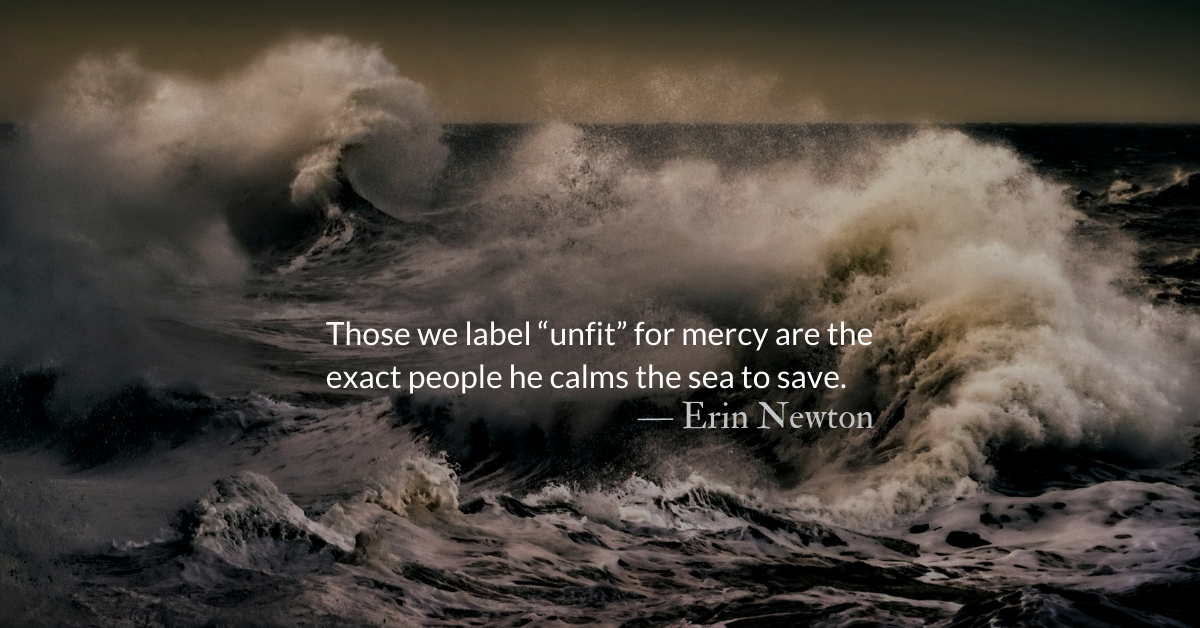
While the book of Jonah highlights the reluctance of a prophet to bring good news to a people he considered unworthy, the larger message is the scope of God’s mercy. It is a story about how we all wish to see vengeance and justice in our time. Yet, if we read the story with eyes focused only on humanity, we miss the far more important truth about God. He loves those we find repulsive. Those we label “unfit” for mercy are the exact people he calms the sea to save.

Divine Hours Prayer: The Refrain for the Morning Lessons
The Lord is near to those who call upon him, to all who call upon him faithfully. — Psalm 145.19

Today’s Readings
Jonah 1 (Listen – 2:29)
John 13 (Listen – 5:06)

Read more about The Sign of Jonah and The Cross
Jonah’s emotional path is like a photo negative of Christ’s.

Read more about Prayer for Older Brothers
God, your mercy is a mystery to me.
I see the sins of others and I am scandalized.
How could such a one be accepted?

Prepared to Meet God

Scripture Focus: Amos 4.12
“Therefore this is what I will do to you, Israel,
    and because I will do this to you, Israel,
    prepare to meet your God.”

Luke 24.32, 36
They asked each other, “Were not our hearts burning within us while he talked with us on the road and opened the Scriptures to us?”

While they were still talking about this, Jesus himself stood among them and said to them, ‘Peace be with you.”

Reflection: Prepared to Meet God
By Erin Newton

We have entered into another prophetic book, Amos. Considered one of the first writing prophets, his prophetic period overlaps the ministries of Hosea, Isaiah, and Micah. Amos opens with a list of Israel’s, and various nations’ sins: social injustice, inequality, idolatry, and every form of corruption possible. 

God let the people suffer through hardships with hopes of their repentance. Instead the people trusted in their own success. Their hearts lusted after other gods. They saw the poor and abused their weakness. 

Their hard hearts refused to be swayed by pain and discomfort to call out to God. In return, God declares the coming force of his presence. The ominous phrase, “Prepare to meet your God,” is meant to strike fear. The omnipotent God of creation is ready to meet humanity face to face. But humanity isn’t ready.  The proximity of humanity to the presence of God could result in death.  Soldiers died with a mere touch of the Ark of the Covenant (2 Sam 6.6). Priests were in immediate danger by their access to the Holy of Holies (Ex 28.35). Now God warns the people to prepare themselves for this fateful encounter. 

Only God could protect the lives of those who asked to see him face to face. 

Yet, this changed with the incarnation of Jesus. Just as it was in the beginning, God and humanity could walk together, talk together, and break bread together without the imminent threat of death. Death was conquered through the crucifixion. Peace came through the death and resurrection of Jesus. In the days following the resurrection, God the Son continued to meet with the disciples. 

Instead of the threat of God coming in full force to judge the sins of the people, the people marvel at their experience with Jesus. Their hearts burn within them feeling the vibrancy of life and excitement of connection with Spirit. Jesus comes not riding upon the clouds as a warrior of wrath. He speaks words to calm their hearts. They see the face of God and he tells them, Peace. 

Amos records the warning from God for the people to prepare to meet him. It is still a message to us today. Through the mediation of Jesus, we can prepare to meet God with confidence. Our sins have been atoned and the wrath of God has been paid.

Divine Hours Prayer: The Greeting
Your love, O Lord, reaches to the heavens, and your faithfulness to the clouds. — Psalm 36.5

Today’s Readings
Amos 4 (Listen – 2:21)
John 6 (Listen – 8:27)

Read more about Prayer, Our Tent of Meeting
When we pray as Jesus taught, we enter into God’s presence through the torn curtain of the Tent of Meeting, and hear his voice because of his atoning sacrifice.

Read more about The Last Shall be First—Resurrection Appearances
Paul describes himself as the “last” to see the risen Jesus and the least of the apostles but he became much more than that.

The First “Last Supper”

Scripture Focus: Hosea 14.2, 4
2 Take words with you
    and return to the Lord.
Say to him:
    “Forgive all our sins
and receive us graciously,
    that we may offer the fruit of our lips.

4 “I will heal their waywardness
    and love them freely,
    for my anger has turned away from them.

Reflection: The First “Last Supper”
By Erin Newton

Each year, my dad texts me to say The Ten Commandments is on TV. A 1956 classic (although flawed in many ways), this movie was my favorite. Many Christians know of the story of Moses and the plagues but forget how that relates to the New Testament story of the death of Jesus.

The Hebrews were connected to God in a special way, covenanted to him through their lineage from Abraham. They were God’s chosen people, promised a blessing of land, progeny, and honor. But as time tends to reveal, the errors of a few people created ripple effects among the whole. Despite the promise of blessing, they became slaves to a brutal nation.

From Egyptian oppression, God heard their prayers for help. He raised up Moses to lead the people. Plagues tormented the land. With each plague, the Pharaoh continued to harden his heart until he became an immovable force. The final plague would cost the life of each firstborn child. It was to be the greatest tragedy of their day, “There will be loud wailing throughout Egypt—worse than there has ever been or ever will be again” (Exodus 11.6).

But there was hope for the Israelites. Despite the edict that death would visit every family, a way of salvation was given. God told the people to sacrifice an unblemished lamb spreading the blood on their doors. The lamb would die so they could live. This day was to be remembered for generations. “And when your children ask you, ‘What does this ceremony mean to you?’ then tell them, ‘It is the Passover sacrifice to the Lord, who passed over the houses of the Israelites in Egypt and spared our homes when he struck down the Egyptians’” (Exodus 12.26-27a).

The Feast of Unleavened Bread and Passover honored the day which God looked upon the blood of an innocent lamb and averted his wrathful judgment. This same meal is what Jesus and his disciples celebrated at the Last Supper.

As Good Friday approaches, remember Passover. This celebration was given as a picture of atonement that would one day be fulfilled in the death of Jesus Christ. Because of his death, judgment passes over us. We are safe, veiled behind the blood of the Lamb.

Let us pray just as the book of Hosea ends, taking words of praise to God. He loves us freely and his wrath has turned away.

Divine Hours Prayer: The Greeting
Let them know that this is your hand, that you, O Lord, have done it. — Psalm 109.26

Today’s Readings

Hosea 14  Listen – 1:39)
Psalm 148  (Listen -1:28)

Read more about Fasting and Feasting
The one biblical feast most Christians know about is Passover or Pesach. This celebration is a combination of fasting and feasting.

Read more about Names of Jesus—Priest, Lamb, and Vine
He is called lamb, because of his perfect innocence; a sheep, to symbolize his Passion.

Show Buttons
Hide Buttons
Spur a spiritual rhythm of refreshment right in your inbox
By joining this email list you are giving us permission to send you devotional emails each weekday and to communicate occasionally regarding other aspects of the ministry.
100% Privacy. We don't spam.