King on the Mountain, King on the Cross

Scripture Focus: Exodus 20.18-23
18 When the people saw the thunder and lightning and heard the trumpet and saw the mountain in smoke, they trembled with fear. They stayed at a distance 19 and said to Moses, “Speak to us yourself and we will listen. But do not have God speak to us or we will die.” 
20 Moses said to the people, “Do not be afraid. God has come to test you, so that the fear of God will be with you to keep you from sinning.” 
21 The people remained at a distance, while Moses approached the thick darkness where God was. 

22 Then the Lord said to Moses, “Tell the Israelites this: ‘You have seen for yourselves that I have spoken to you from heaven: 23 Do not make any gods to be alongside me; do not make for yourselves gods of silver or gods of gold. 

Luke 23.38-43
38 There was a written notice above him, which read: this is the king of the jews. 
39 One of the criminals who hung there hurled insults at him: “Aren’t you the Messiah? Save yourself and us!” 
40 But the other criminal rebuked him. “Don’t you fear God,” he said, “since you are under the same sentence? 41 We are punished justly, for we are getting what our deeds deserve. But this man has done nothing wrong.” 
42 Then he said, “Jesus, remember me when you come into your kingdom.” 
43 Jesus answered him, “Truly I tell you, today you will be with me in paradise.” 

Reflection: King on the Mountain, King on the Cross
By John Tillman

God presents himself to the former slaves as a glorious heavenly king.

There are many linguistic similarities between ancient vassal treaties between kings and subjects and the covenant language given to Moses. God tends to speak to us using language we are familiar with. 

Moses calls this a test. Will the people be faithful to this king? Will they trust God? Will they become God’s “firstborn son” that he calls them to become? (Exodus 4.22) The desert experience and hundreds of years of judges and kings would prove that Israel would fail to live up to the covenant until God sent the true “firstborn son” to fulfill the covenant. 

Israel fell into sin in the desert. Jesus would resist sin in the desert. Everything that Israel had lost or failed to do, Jesus would accomplish, including being a light to the Gentile nations.

When Jesus was on the cross, Pilate wrote “King of the Jews” and placed the sign over Christ’s head. The religious leaders objected to this. They did not want this naked, abused, bleeding man to be called their king. They wanted the intimidating king from the mountain, not the homeless carpenter from Nazareth.

If only their eyes could be opened and ours as well. The king on the mountain and king on the cross are the same king. 

The king from the exalted mountain, was exalted on the cross.
The king on the mountain demanded righteousness. The king on the cross provided it.
The king on the mountain made it a holy place by his presence. The king on the cross made it a holy altar by his blood.

Our God is a king, unlike other kings. 
Israel expected a king fitted for war. He came fitted to serve. 
They expected a king observing their laws. He came pointing out their sins.
They expected a king to cast out the Romans. He cast out the moneychangers.
They expected a king to banish the cursed outcasts and sinners. He brought them in and blessed them.
This is the kind of kingdom God is building because it is the only kind of kingdom we could be allowed into, sinners that we are.

The days of peering at God on a distant mountain top are over. Now, Jesus calls us close to his cross that he may save us and take us into his kingdom. (Hebrews 12.18-24)

Divine Hours Prayer: The Request for Presence
O god of hosts, show the light of your countenance, and we shall be saved. — Psalm 80.7

– From The Divine Hours: Prayers for Springtime by Phyllis Tickle.

Today’s Reading
Exodus 20 (Listen 3:21)
Luke 2(Listen 6:11)

Read more about Unveiled
Seeing the glory of God can be discomforting. But Moses and Israel hadn’t seen anything yet…

Read The Bible With Us
Walk with us through God’s Word and find beauty revealed by a slower, more reflective, two-year pace.

https://mailchi.mp/theparkforum/m-f-daily-email-devotional

In the Face of the Impossible

Scripture Focus: Luke 1.18, 34, 37
Zechariah asked the angel, “How can I be sure of this?”
“How will this be,” Mary asked the angel, “since I am a virgin?”
“…no word from God will ever fail.”

Reflection: In the Face of the Impossible
By John Tillman

Luke plunges into visionary tales of the impossible and people who, to one degree or another, expressed doubts, reservations, and fears, and felt themselves unqualified for the task.
Madeleine L’Engle, in her book, Walking on Water marvels at how often God gave glorious visions and impossible tasks to those who were ill equipped.

“We are all asked to do more than we can do. Every hero and heroine of the Bible does more than he would have thought it possible to do, from Gideon, to Esther, to Mary. Jacob, one of my favorite characters, certainly wasn’t qualified. He was a liar and a cheat; and yet he was given the extraordinary vision of angels and archangels ascending and descending a ladder which reached from earth to heaven.

In the first chapter of John’s Gospel, Nathanael is given a glimpse of what Jacob saw, or a promise of it, and he wasn’t qualified, either. He was narrow-minded and unimaginative, and when Philip told him that Jesus of Nazareth was the one they sought, his rather cynical response was, “Can anything good come out of Nazareth?” And yet it was to Nathanael that Jesus promised the vision of angels and archangels ascending and descending upon the son of man.”

God chooses to do the impossible with the unqualified, to frustrate the wise with the foolish, and to overthrow the strong with the weak. He subverts the systems we rely on and reminds us that our competence is an illusion and his grace shown through us comprises all that is good in the world.

We face the impossible, like Zechariah, when the world sees us as cursed and broken.
We face the impossible, like Mary, when the world strives to keep us powerless and vulnerable.
In the face of the impossible we are forced to keep our faith where it always should have been—on God. We are not qualified, but, L’Engle concludes, God will be glorified.

“In a very real sense, not one of us is qualified, but it seems that God continually chooses the most unqualified to do his work, to bear his glory. If we are qualified, we tend to think that we have done the job ourselves. If we are forced to accept our evident lack of qualification, then there’s no danger that we will confuse God’s work with our own, or God’s glory with our own.“

Divine Hours Prayer: The Greeting
Not to us, O Lord, not to us, but to your Name give glory; because of your love and because of your faithfulness. — Psalm 115.1

– From The Divine Hours: Prayers for Springtime by Phyllis Tickle.

Today’s Reading
Exodus 18 (Listen 3:54)
Luke 1.1-38 (Listen 9:26)

Read more about Angelic Visions Require Childlike Faith
Madeleine L’Engle was often perplexed at the tendency of scholarly Christians to hold at arm’s length the angels and miracles of the Bible.

Read The Bible With Us
Our Bible reading plan is immersive with a sustainable, two-year pace. Walk with us through God’s Word and reflect on the beauty revealed by a slower pace.

https://mailchi.mp/theparkforum/m-f-daily-email-devotional

The Lowly and the Lofty — Peace of Advent

Scripture Focus: Nehemiah 3.5
5 The next section was repaired by the men of Tekoa, but their nobles would not put their shoulders to the work under their supervisors.

Luke 2.8-15
8 And there were shepherds living out in the fields nearby, keeping watch over their flocks at night. 9 An angel of the Lord appeared to them, and the glory of the Lord shone around them, and they were terrified. 10 But the angel said to them, “Do not be afraid. I bring you good news that will cause great joy for all the people. 11 Today in the town of David a Savior has been born to you; he is the Messiah, the Lord. 12 This will be a sign to you: You will find a baby wrapped in cloths and lying in a manger.”

13 Suddenly a great company of the heavenly host appeared with the angel, praising God and saying,

14 “Glory to God in the highest heaven,
    and on earth peace to those on whom his favor rests.”

15 When the angels had left them and gone into heaven, the shepherds said to one another, “Let’s go to Bethlehem and see this thing that has happened, which the Lord has told us about.”

Reflection: The Lowly and the Lofty — Peace of Advent
By John Tillman

Nehemiah’s list of the community’s work is not just a list of laborers. It lists those who put their faith into action. Their faith shaped stone and lifted beams. Their faith smoothed mortar and set gates on their hinges.

Hidden in the list are stories. In one place, Hassenaah works with his sons to set the beams and bolts of the Fish Gate. (Nehemiah 3.3) In another place, Shallum (a ruler of Jerusalem) works with his daughters to repair a section of the wall. (Nehemiah 3.12) The project is a family affair and no one is excluded except those who exclude themselves. Such were the nobles of Tekoa.

Workers and supervisors came from Tekoa, but the nobles abstain. They “would not put their shoulders to the work.” This wasn’t laziness or a disdain for labor. It was their hearts, not their shoulders, that weren’t up to the task. It was a failure of faith not a failure of physicality.

Tekoa, near Jerusalem, was a notable place. It was known for strength. One of David’s mighty men was from Tekoa. (2 Samuel 23.8, 26) It was known for wisdom. The “wise woman” of Tekoa spoke before King David. (2 Samuel 14.1-3) However, the most famous resident of Tekoa was the prophet Amos, who called himself one of the “shepherds of Tekoa.” (Amos 1.1) And from the hillsides of Tekoa, the town of Bethlehem can be seen only six miles away. The shepherds who came to the manger of Jesus, may have traveled from the fields between Tekoa and Bethlehem. (Luke 2.15)

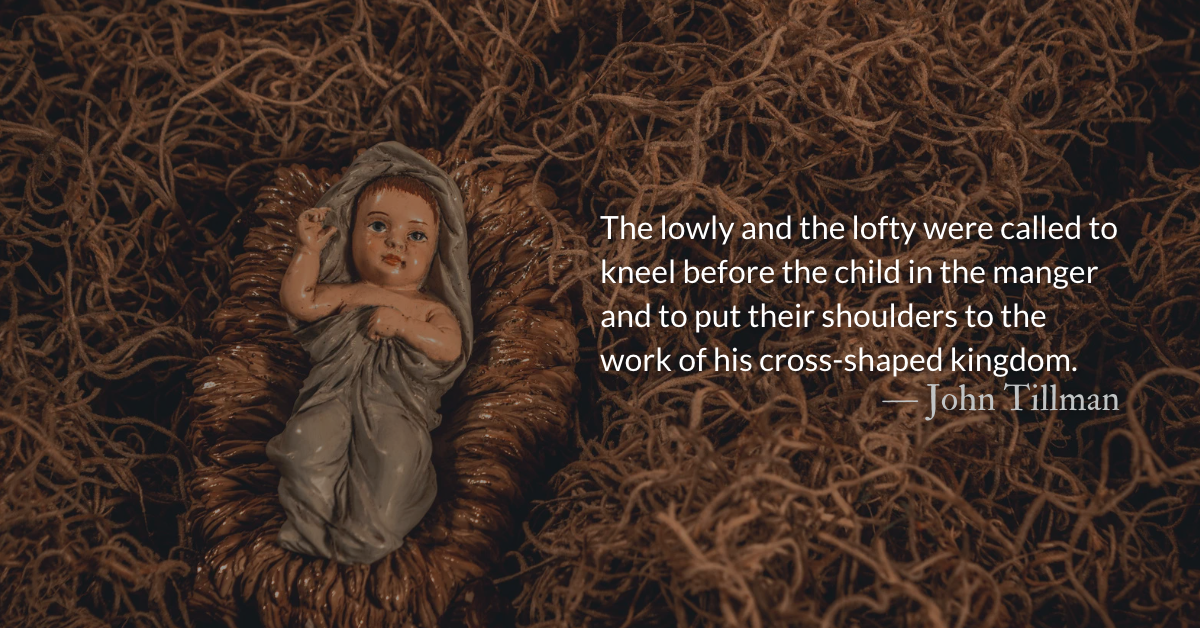
The lowly and the lofty were called by Nehemiah to work on the wall. The nobles of Tekoa abstained. The lowly and the lofty were called to kneel before the child in the manger and to put their shoulders to the work of his cross-shaped kingdom.

To the shepherds, God came by a miraculous vision of angels. To King Herod and the Magi, God’s message came through scholarship, prophecy, or privilege. The shepherds and the Magi responded in humility. (Luke 2.16-20; Matthew 2.11) Herod responded with pride and violence. (Matthew 2.16)

Whether lofty or lowly, we each must respond to the call to peace and peacemaking this Advent. How has God’s message come to you? Will you put your shoulder to the work or abstain? Will you put your faith into action to shape stone, lift beams, and set gates on their hinges so that through Jesus, the gate, (John 10.6-9) people may enter God’s city of peace?

Divine Hours Prayer: The Request for Presence
Send out your light and your truth, that they may lead me, and bring me to your holy hill and to your dwelling; 
That I may go to the altar of God, to the God of my joy and gladness; and on the harp I will give thanks to you, O God my god. — Psalm 43.3-4

Today’s Readings
Nehemiah 3 (Listen 5:43)  
Revelation 12 (Listen 2:58)

Read more about Supporting Our Work
Ad-free content is rare and our donors make that possible! Please consider becoming a one-time or monthly donor!

Read more about Peace from Uncertainty
The questions will always come but the story reminds us that nothing has ever been outside of his control.

Humility and Joy — Joy of Advent

Scripture Focus: Ezra 8:22-23
22 I was ashamed to ask the king for soldiers and horsemen to protect us from enemies on the road, because we had told the king, “The gracious hand of our God is on everyone who looks to him, but his great anger is against all who forsake him.” 23 So we fasted and petitioned our God about this, and he answered our prayer.

Luke 1:46-48
46 And Mary said:
“My soul glorifies the Lord
47     and my spirit rejoices in God my Savior,
48 for he has been mindful
    of the humble state of his servant.

Reflection: Humility and Joy—Joy of Advent
By Erin Newton

Before the group of families began the journey from Babylon to Jerusalem, Ezra called them to prayer and fasting. They sought God’s protection for the perilous road ahead.

Ezra knew that he could trust God. He had studied all the great acts of God in history. He knew God watched over him and prepared the way. But he also knew of the stories of danger and tragedy in the past. It is one thing to know that God is trustworthy and another thing to step out into the wild world.

Ezra felt the depths of his need for God’s provision. He fasted. He prayed. He denied himself the comfort of food so he could seek God with humility.

Four and a half centuries later, a young girl would begin a journey that would change the course of the world. Mary was chosen to carry the world’s greatest gift. With each step, she walked along a path of faithfulness to her call.

Ezra’s journey was a path back to worship at the newly built temple. Mary’s journey was the unpretentious path from one trimester to another. But Mary did not travel to worship God, he tabernacled within her.

Ezra and Mary sought a spirit of humility as they spoke to God. Both were blessed by the hand of God through miraculous protection.

Humility involves emptying oneself. It requires letting go of our plans and self-confidence. It requires the ability to be misunderstood and uncomfortable.

Ezra and his companions arrived in Jerusalem overloaded with treasures and offerings. For decades in captivity, they had been unable to present sacrifices to God. Nearly 200 animals were sacrificed upon their return. A joyous return to the house of worship.

Mary faithfully carried the incarnate deity within her womb. She laid aside her own plans and became the Lord’s servant. She knew that whatever God said would come to pass and she trusted in that promise.

The joy of Advent requires humility.

The road ahead of us is difficult. There are scars of past trauma and reminders of grief yet healed. We stop every few steps and question the journey itself. Why us? Why this path? We need his eye and hand upon us. 

God’s humble servant, Mary, prayed to God in her womb, “My soul glorifies the Lord, and my spirit rejoices in God my Savior.” May we seek God this Advent with humble hearts. 

Divine Hours Prayer: The Call to Prayer
I will call upon God, and the Lord will deliver me.
In the evening, in the morning, and at noonday, I will complain and lament, and he will hear my voice.
He will bring me safely back…God, who is enthroned of old, will hear me. — Psalm 55.17

Today’s Readings
Ezra 8 (Listen 5:40
Revelation 7 (Listen 2:56)

This Weekend’s Readings
Ezra 9 (Listen 3:19)  Revelation 8 (Listen 2:15)
Ezra 10 (Listen 6:19)  Revelation 9 (Listen 3:30)

Read more about Supporting Our Work
Support ad-free biblical content throughout the year. About 50% of our support is monthly donations and 50% end of year. Consider joining one of these groups.

Read more about Saccharine Joy — Joy of Advent
Artificial sweeteners don’t destroy our ability to taste sugar or honey, but our addiction to ecstasy and luxury makes us insensitive to and unsatisfied by true joy.

Devotion and Joy — Joy of Advent

Scripture Focus: Ezra 7:10
10 For Ezra had devoted himself to the study and observance of the Law of the Lord, and to teaching its decrees and laws in Israel.

Luke 1:42-44
42 In a loud voice she exclaimed: “Blessed are you among women, and blessed is the child you will bear! 43 But why am I so favored, that the mother of my Lord should come to me? 44 As soon as the sound of your greeting reached my ears, the baby in my womb leaped for joy.

Reflection: Devotion and Joy — Joy of Advent
By Erin Newton

The blessing of God continued as the second round of exiles returned to Jerusalem. Leading them was Ezra, a trained priest and scribe. Ezra was well-versed in the Law and trusted to deliver more gold and silver to the Israelites. Under his leadership, they carried their gifts to present before God.

Ezra was not only born into the lineage of the High Priest but devoted himself to learning about God. He committed time and effort. In an age when literacy rates were low, Ezra was among a privileged class who could read and write. His heritage granted him the ability to do what others could not.

This gift of circumstance was shared among his community. As instructed by the king, he taught others about the laws of God.

Each year at Advent, neglected Bibles are opened. Artwork depicting the manger scene covers a few shop windows or appears in yard decorations around town. As a scientific anomaly, the virgin birth is the most well-known aspect of the story. Is that all there is to know?

The story of Jesus is not just about his miraculous conception and mediocre place of birth. Everything about Jesus defies common sense. He is weak when people expect him to be strong. He is friendly when the religious think he should shun. He dies when the disciples expect him to wage war.

The complexity of who God is and how he intervenes in human history has been a subject of study long before Luke wrote his gospel or Ezra returned to Jerusalem.

I imagine Ezra, as he sat in Babylon, studying about the Red Sea crossing. Maybe with the letter from Artaxerxes in one hand and the song of the sea (Exodus 15) in the other, he was about to embark on a similar journey. Both blessed by foreign kings, he too would bring gold and silver to worship God. A joyous journey ahead.

Luke also devoted himself to the study of God. He begins his Gospel with the story of John in utero. Separated by wombs, John leapt for joy at the mere proximity of Jesus.

These stories are known by those who spend time learning about God. It is a story worth more than a highlight reel on major holidays. 

The joy of Advent is knowing him. Devote yourself to know more than his birth. Leap for joy as you draw near.

Divine Hours Prayer: The Refrain for the Morning Lessons
Truly, his salvation is very near to those who fear him, that his glory may dwell in our land. — Psalm 85.9

Today’s Readings
Ezra 7 (Listen 4:39
Revelation 6 (Listen 3:12)

Read more about Supporting Our Work
God works through the Bible to change Christians and change the world. Help us provide free biblical content throughout the year to this end.

Read more about Consolation and Patience — Joy of Advent
The very reason for Christ’s delay is that more may be saved. The greater number of people we bring with us, the greater our joy will be.