When God Wants to Quit Church

Links for today’s readings:

Jun 2  Read: Malachi 1 Listen: (2:47) Read: Luke 24 Listen: (6:16)

Scripture Focus: Malachi 1.10-11

10 “Oh, that one of you would shut the temple doors, so that you would not light useless fires on my altar! I am not pleased with you,” says the Lord Almighty, “and I will accept no offering from your hands. 11 My name will be great among the nations, from where the sun rises to where it sets. In every place incense and pure offerings will be brought to me, because my name will be great among the nations,” says the Lord Almighty.

Reflection: When God Wants to Quit Church

By John Tillman

Imagine facing dangerous obstacles and making huge sacrifices to build a church where none exists. Then, when it is up and running, God says, “Lock the doors. Stop coming.”

That’s the opening chapter of Malachi.

It was a moving and inspiring moment when the rebuilt and rededicated temple was functioning again. (Ezra 6.15-18) But soon after temple worship resumed, God wanted to close the temple doors.

What happens when even God doesn’t want to attend worship? What makes God quit church?

Despite all they did to build the building, the people became indifferent and apathetic and treated the temple, and by extension God, with contempt.

One example of contempt, which Malachi highlighted, was sacrificing unacceptable and valueless animals. A main element of temple worship was eating sacrifices in the Lord’s presence, which also provided food for the priests. Israel brought animals so flawed and sickly, no one could, or wanted to, eat them!

That wasn’t all. Malachi went on to condemn witchcraft, adultery, lies, defrauding workers, oppressing the vulnerable, and depriving immigrants and foreigners of justice (Mal 3.5).

The people’s sacrifices broke faith with God and the temple and their actions in the community broke faith with those God loves and protects. They selfishly kept the best of everything for themselves, leaving the vulnerable desperate and the temple defiled. God will quit or close churches with contempt for the vulnerable.

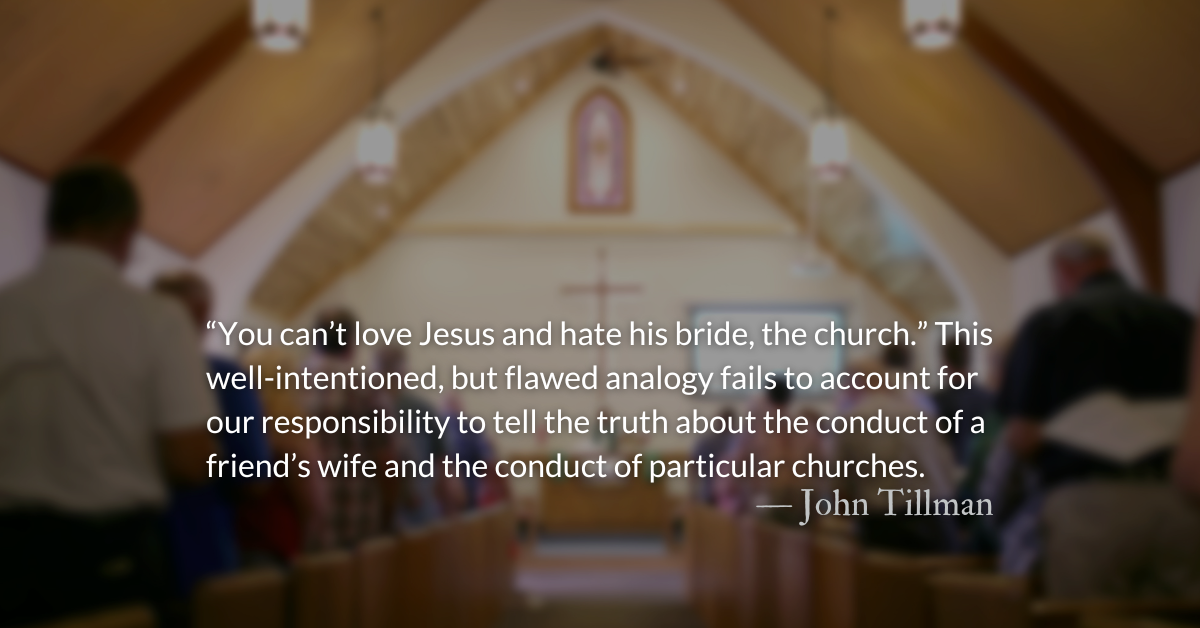
Often (especially when promoting church attendance and involvement), leaders say something similar to, “Just like you can’t love me and hate my wife, you can’t love Jesus and hate his bride, the church.” This well-intentioned, but flawed analogy fails to account for our responsibility to tell the truth about the conduct of a friend’s wife and the conduct of particular churches. If a friend or family member’s spouse is abusive, an addict, cruel, corrupt, or manipulative, love obligates you to address those problems, not pretend they don’t exist.

If you love Jesus, you should love the church as Jesus does, sacrificing and serving her. This part of the analogy is accurate. But when churches operate in wicked or abusive ways, they don’t get a pass. God tells the truth about his temple and Jesus tells the truth about his churches. Love compels us to tell the truth, not ignore it.

Build churches God wants to keep open, remembering that honest critique is not betrayal but love and love rejoices at repentance.

Divine Hours Prayer: The Greeting

Out of Zion, perfect in its beauty, God reveals himself in glory.
Let the heavens declare the rightness of his cause; for God himself is judge. — Psalm 50.2,6

– From The Divine Hours: Prayers for Summertime by Phyllis Tickle.

Read more: All Roads Lead to Jerusalem

We must face our Jerusalem…What shall we say, “Deliver us from this hour?” No. We must say, as Jesus did, “Father, glorify your name!”

Read more: Examine Your Sacrifices

We are still called to works of sacrifice…feed the hungry…welcome the stranger…visit the sick and the prisoner.

If History Rhymes, What Will Your Verse Be?

Links for today’s readings:

Jun 1  Read: Zechariah 14 Listen: (3:52) Read: Luke 23 Listen: (6:39)

Scripture Focus: Zechariah 13.3-9

3 Then the Lord will go out and fight against those nations, as he fights on a day of battle. 4 On that day his feet will stand on the Mount of Olives, east of Jerusalem, and the Mount of Olives will be split in two from east to west, forming a great valley, with half of the mountain moving north and half moving south. 5 You will flee by my mountain valley, for it will extend to Azel. You will flee as you fled from the earthquake in the days of Uzziah king of Judah. Then the Lord my God will come, and all the holy ones with him. 
6 On that day there will be neither sunlight nor cold, frosty darkness. 7 It will be a unique day—a day known only to the Lord—with no distinction between day and night. When evening comes, there will be light. 
8 On that day living water will flow out from Jerusalem, half of it east to the Dead Sea and half of it west to the Mediterranean Sea, in summer and in winter. 9 The Lord will be king over the whole earth. On that day there will be one Lord, and his name the only name.

Reflection: If History Rhymes, What Will Your Verse Be?

By John Tillman

Mark Twain is (probably falsely) credited with the aphorism, “History rhymes.” This is a more nuanced truism than “History Repeating.” The “rhyming” of history does not mean that events are precisely replicated, but that similar events repeat in regular patterns, like poetry.

Like history, biblical prophecy rhymes.

Prophets, like Zechariah, wrote primarily to their contemporary audience about their immediate or not-too-distant future. But these events have layered meanings that were, or will be, fulfilled in the life of Jesus, in our lives today, and in the last days of our cosmos at the renewing of Heaven and Earth.

God parted the sea for Israel to escape from Egypt through the waters. (Ex 14.21-22; Neh 9.11; Isa 63.12) In Zechariah’s vision, God will part a mountain for Jerusalem to escape through a narrow valley. What will God part for us?

In the creation story, God divided the waters to create the waters of the sky and the waters of the seas. (Gen 1.6-7) In Zechariah’s vision, God will cause living waters to flow from Jerusalem, dividing those waters to flow both east and west to all peoples in all directions. What will God provide through us?

Most of Zechariah’s visions focused on the rebuilding and restoration following the devastation of Jerusalem in his day. But he also wrote about the coming devastation and restoration of the cosmos. Like the post-exilic Jews Zechariah wrote to, we know a final catastrophe and victory are coming, but until then, we have a rebuilding and restoration mission (2 Cor 5.18-19). 

Obstacles, whether uncrossable seas or immovable mountains, cannot keep God’s people from his purposes or keep God from coming to us. God makes the way. Nothing can or will separate us from God’s love or from the eternal fellowship of God’s people to come. No catastrophe, consequence, or calamity now or in the final days will compare to the joy and glory to come. (Rom 8.18) After everything, we will be with God, and he will be with us. So what will you do until that day?

Prophets lay down beats that echo in the future and step to the mic, dropping verses about events of their moment. But the beat will go on in our moment and in moments yet to come. What will we say and do when the mic passes to us?

“The powerful play goes on, and you may contribute a verse.” (“O Me! O Life!”)

What will your verse be?

Divine Hours Prayer: The Refrain for the Morning Lessons

My heart is firmly fixed, O God, my heart is fixed; I will sing and make melody. — Psalm 57.7


– From The Divine Hours: Prayers for Summertime by Phyllis Tickle.

Read more: The End of Evil

While it feels like our world is “always winter and never spring” God is coming to make an end of evil.

Read more: Save Yourself (And Us)

We live in a “save yourself” culture. We put ourselves first and save ourselves from everything. This is one reason Jesus is foolish to our culture.

Show Buttons
Hide Buttons
Spur a spiritual rhythm of refreshment right in your inbox
By joining this email list you are giving us permission to send you devotional emails each weekday and to communicate occasionally regarding other aspects of the ministry.
100% Privacy. We don't spam.