

Links for today’s readings:
Jun 26 Read: Isaiah 25 Listen: (1:59) Read: Acts 12 Listen: (3:49)
Links for this weekend’s readings:
Jun 27 Read: Isaiah 26 Listen: (2:58) Read: Acts 13 Listen: (7:36)
Jun 28 Read: Isaiah 27 Listen: (2:16) Read: Acts 14 Listen: (3:54)
Scripture Focus: Isaiah 25.4-8
4 You have been a refuge for the poor,
a refuge for the needy in their distress,
a shelter from the storm
and a shade from the heat.
For the breath of the ruthless
is like a storm driving against a wall
5 and like the heat of the desert.
You silence the uproar of foreigners;
as heat is reduced by the shadow of a cloud,
so the song of the ruthless is stilled.
6 On this mountain the Lord Almighty will prepare
a feast of rich food for all peoples,
a banquet of aged wine—
the best of meats and the finest of wines.
7 On this mountain he will destroy
the shroud that enfolds all peoples,
the sheet that covers all nations;
8 he will swallow up death forever.
The Sovereign Lord will wipe away the tears
from all faces;
he will remove his people’s disgrace
from all the earth.
The Lord has spoken.
Reflection: A Garden City
By John Tillman
In the beginning, God made a garden. After the fall and rebellion, humans made cities. But that doesn’t mean cities are always evil and gardens are always good.
Cities are intended to provide shelter, protection, justice, and community. However, not every city is a “shining city on a hill.” (Matt 5.14) Cities often become places of cruelty, violence, corruption, and oppression. Places of darkness, wickedness, and death.
Cities of darkness and death are symbols of human rebellion against God and a declaration of independence and self-reliance. When Cain is cast out into the wilderness, he builds a city (Genesis 4.17). Cain’s city and his descendants become violent leaders and their cities known for violence (Genesis 4.19-24).
When humans began to rebuild society after the flood, they sought new technology to build a city with a tower that reached to the heavens, far above the threat of any flood. (Genesis 11.2-4) This city, Babylon, is both a historical city and a symbol of human pride, sin, and rebellion. Babylon appears historically and symbolically throughout the Bible, right to the very last pages (Rev 18.2).
In the re-beginning, when God ends evil and restores the world, we will live with God, not in a garden as we did at the beginning, but in a heavenly city (Rev 21.2-3). God scattered the nations after Babel, in the re-beginning, he will gather all nations to his city to live with him forever (Rev 21.23-26). God’s city is a garden where good things grow. God’s garden is a city where every branch provides food, healing, and shelter (Rev 22.1-3).
In the meantime, what are we to do? Plant gardens? Build cities? Should we scatter into the wilderness? Or gather in concrete and glass canyons?
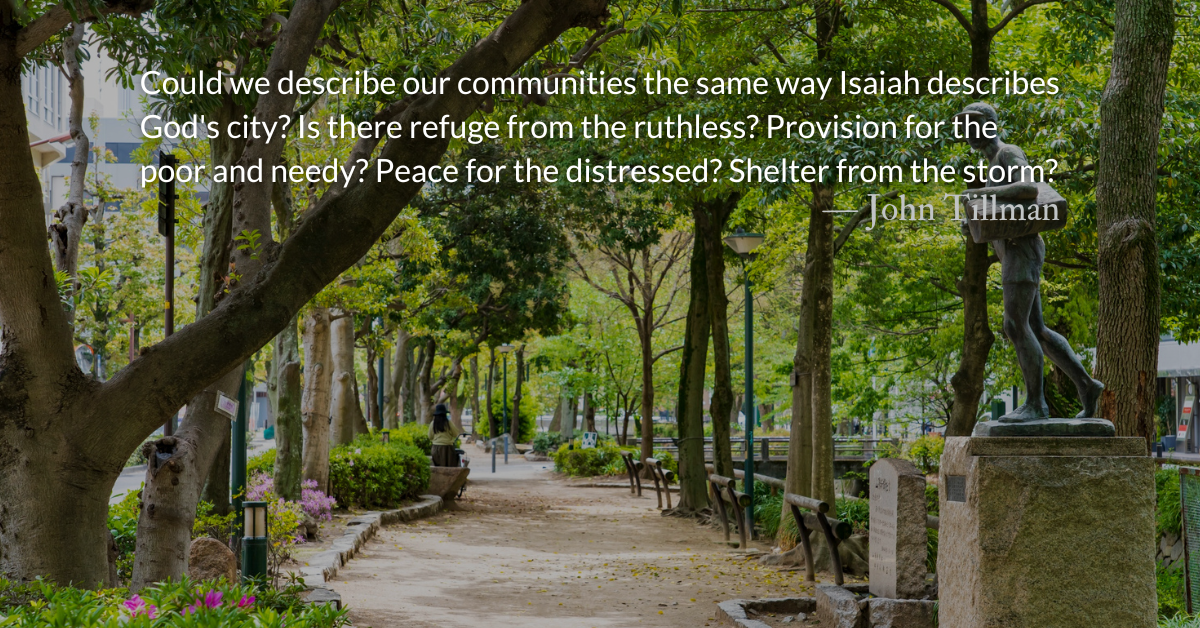
Whether in the city or the country, use scripture’s descriptions of the city of God, like in Isaiah, as examples of the communities we should build. Could we describe our communities the same way Isaiah describes God’s city (Isaiah 25.4-8)?
Is there refuge from the ruthless? Provision for the poor and needy? Peace for the distressed?
Shelter from the storm? Shade from the heat? Windbreaks for the windblown? Silence to escape uproar? Quiet that drowns songs of violence?
No human city or community can be perfect. We can’t build Heaven on earth, but we must not use that to excuse inaction, apathy, or greed. We are called to establish good things in God’s world. Let us strive toward a garden city without excuses.
Divine Hours Prayer: The Greeting
I will confess you among the peoples, O Lord; I will sing praises to you among the nations.
For your loving-kindness is greater than the heavens, and your faithfulness reaches to the clouds. — Psalm 108.3-4
– From The Divine Hours: Prayers for Summertime by Phyllis Tickle.
Read more: Of Temples and Gardens
Gardens are places where nature is maximized and brought to greater, more ordered, and more beautiful potential. Gardens…are places to meet with God.
Read more: What Kind of City on a Hill?
In Ezekiel 22, …what should be a shining city on a hill is a city of darkness, blood, and dross. What kind of “city on a hill” do we live in?

