Edge of the Abyss

Scripture Focus: Psalm 74:9
9 We are given no signs from God;
     no prophets are left,
     and none of us knows how long this will be.

Reflection: Edge of the Abyss
By Erin Newton

Laments are uttered when we come to the end of ourselves. The strong have no need for laments.

We watch as the psalmist lays before God the wretched state of emotions. The sanctuary is ruthlessly destroyed with wave after wave of terror. There is no hope of relief. The psalmist stands and stares into the darkness. Federico Villanueva aptly describes the collective emotion behind Psalm 74, describing the people as “those who are ‘balancing on the edge’ of such an abyss.”

The abyss of despair is like the watery depths of the ocean. It can be a pool of murky water concealed in a dark cave. The feeling is solitary and overwhelming. It can sometimes be the turbulent whirlpools sending all creatures crashing to the ocean floor. The feeling is crushing—helpless, hopeless, vulnerable.

Not many of us will watch someone physically destroy church buildings or burn places of worship. But the psalmist says, “the place where you met with us.” Humanity once walked among the trees with God in Eden. Now, we meet with God in our prayers, in our meditation, in our worship, in our study, and in our fellowship.

Axmen still come and wield their sharpened tools. Someone can come along and destroy these holy meeting places with lies and deception. Organizations can fell the trees of our faith with silence and threats.

When it seems like hope is lost, each breath becomes the song of the lament. Where are you, God? Why are you not here? How long will this last?

The same images of despair become the beacon of hope. The darkness, the waters, the cold, the monsters— these become the message of promise. What God has done in the past gives hope for what he will do in the future.

God harnessed the expanse of the universe, setting boundaries for the sun and the moon. The seasons were set in motion bringing spring to follow winter. Leviathan, chaos incarnate, was crushed and tossed as food to wild animals.

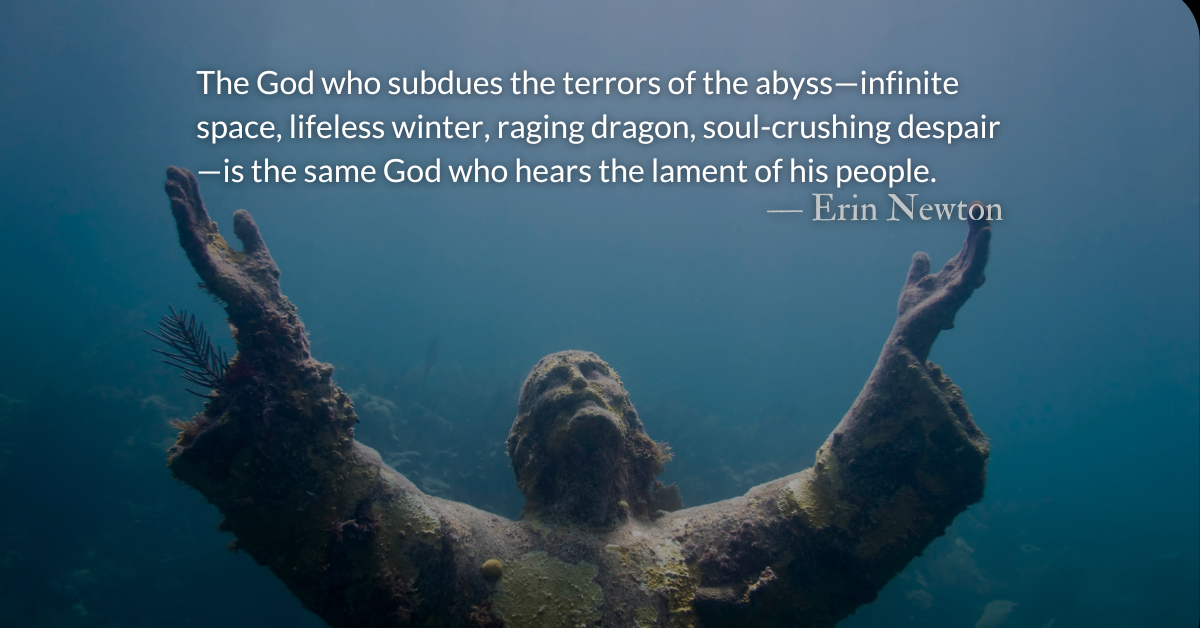
The God who subdues the terrors of the abyss—infinite space, lifeless winter, raging dragon, soul-crushing despair—is the same God who hears the lament of his people.

Let us call upon the God who closes the mouth of the abyss and ask him to remember the vulnerable and the abused. May no person take an ax to the place where God meets with his creation.


Divine Hours Prayer: The Refrain for the Morning Lessons
Send forth your strength, O God; establish, O God, what you have wrought for us. — Psalm 68.28


– From The Divine Hours: Prayers for Summertime by Phyllis Tickle.


Today’s Readings
2 Kings 21 (Listen 4:06
Psalms 74 (Listen 2:34)

Read more about The Struggle against Chaos
One of the thoughts we struggle with is the idea that all the events of life are haphazardly occurring, without meaning, spinning out of control.

Read more about Anxious Nights Between Destruction and Chaos
From the chaos of the sea and the wilderness wind, God brings order and a highway to salvation.
A Sin We Are Proud Of

Scripture Focus: 2 Kings 20.16-19
16 Then Isaiah said to Hezekiah, “Hear the word of the Lord: 17 The time will surely come when everything in your palace, and all that your predecessors have stored up until this day, will be carried off to Babylon. Nothing will be left, says the Lord. 18 And some of your descendants, your own flesh and blood who will be born to you, will be taken away, and they will become eunuchs in the palace of the king of Babylon.”

19 “The word of the Lord you have spoken is good,” Hezekiah replied. For he thought, “Will there not be peace and security in my lifetime?” 

Reflection: A Sin We Are Proud Of
By John Tillman

Hezekiah is one of the greatest kings among the great kings of Judah. The writer of 2 Kings says of him, “Hezekiah trusted in the Lord, the God of Israel. There was no one like him among all the kings of Judah, either before him or after him.”

Hezekiah drove out idolatry and reestablished true worship. In Hezekiah’s day, the Temple of the Lord had actually been closed up, like a shop with no customers. The lights were out. The doors were barred. 

Hezekiah not only opened them, he covered the doors and other items in the Temple in gold and silver, reopening and restoring the Temple and the priesthood to shimmering glory

Hezekiah is, however, as deeply flawed as his father David before him. Even in our “anything goes” culture, David’s sin is abhorred, but Hezekiah’s sin is one our culture is proud of—pride. 

Other passages about Hezekiah make it clear that God was concerned about Hezekiah’s pride. God tested Hezekiah by sending Babylonians to inquire about Hezekiah’s miraculous healing. Instead, Hezekiah showed off his accomplishments and wealth to them, prompting Isaiah’s prophecy that everything that had been shown to them would be carried off to Babylon. 

At least David repented of his lust and murder, giving us the beauty of Psalm 51. All we get from Hezekiah when he is confronted with the results of his sin is a shrugging, selfish, justification. Hezekiah says that at least there will be “peace and security in my lifetime.“ 

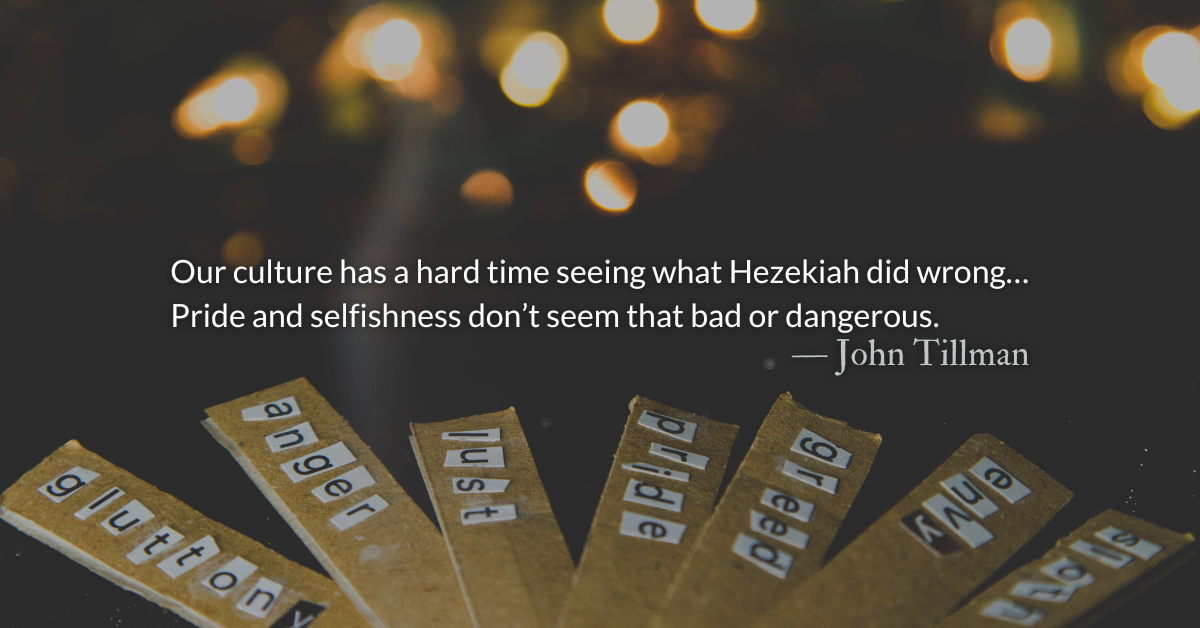
Our culture has a hard time seeing what Hezekiah did wrong. We hesitate to equate Hezekiah’s sin to David’s. Pride and selfishness don’t seem that bad or dangerous. Storing up for ourselves is prudence. Seeking our own peace and prosperity is honorable. God thinks otherwise. Jesus spoke to his time, Hezekiah’s time, and ours when he said, “You fool! This very night your life will be demanded from you. Then, who will get what you have prepared for yourself?” 

We do not know where Christ was standing when he told the parable of the rich fool, but I like to imagine that he might have been standing next to some of the rubble from the buildings Hezekiah built to hold his treasures of gold and silver, food and grain. Christ’s audience would have understood the significance.

Obtaining “peace and security” in our lifetimes is not a gospel-centered way of living. We are expected to think beyond ourselves. May we humbly repent.

Pride, greed, and love of wealth are sins equally heinous in God’s eyes as lust, rape, and murder. May we humbly repent.


Divine Hours Prayer: The Greeting

Out of Zion, perfect in its beauty, God reveals himself in glory.
Let the heavens declare the rightness of his cause; for God himself is judge. — Psalm 50.2, 6

– From The Divine Hours: Prayers for Summertime by Phyllis Tickle.


Today’s Readings

2 Kings 20 (Listen 3:39
Psalms 73 (Listen 2:56)

Read more about The Identical Nature of Greed and Lust
When the prophet Nathan needed an analogy for lust, he chose a parable about a rich man stealing material goods from the poor.

Read more about Pride and Short-sightedness :: Throwback Thursday
The remarkable life of Hezekiah ends in pride and short-sightedness.

We, Your People

Scripture Focus: Psalm 72.12-14
12 For he will deliver the needy who cry out,
the afflicted who have no one to help.
13 He will take pity on the weak and the needy
and save the needy from death.
14 He will rescue them from oppression and violence,
for precious is their blood in his sight. 

Reflection: We, Your People
By John Tillman

The true king that the psalmist references is not Solomon or any political realm to follow. Jesus is the true king who liberates and brings justice.

The golden age Solomon ushered in rode on the back of immense taxes and slave labor. Solomon’s political alliances were sealed with unholy marriages and consecrated by temples built to idols. What looked like paradise was paid for by hellish means.

Jesus, by contrast, took the weight of hell on his back and set us free from its burden. Now, Jesus calls us to be part of the glorious kingdom he’s building. The true son makes us true heirs. Only through him can we establish justice, make peace, defend the weak, seek the welfare of the poor, and liberate prisoners. It is not “we, the people,” but “He, the savior.”

Let this prayer, based on Psalm 72, constitute a confession and request that Christ will make us true heirs and ambassadors of his righteousness.

Prayer of We, Your People
We, your people, Lord, acknowledge that justice deserving the name does not come from us. Our best work will be partial and incomplete…

Endow us with your justice, O God… (v 1)
Help us defend the afflicted, save the children of the needy, and crush oppression in all its forms. (v 4)

We claim your promise to us through Eve that her seed would crush evil. (Genesis 3:15)
We give our lives and bodies as Mary did. Use us to bring down wicked rulers, lift the humble, and fill the needs of the hungry. (Luke 1.52-53)

We confess we have been deaf. Give us ears to hear the needy.
We confess we have been cowardly. Give us strength to help the afflicted.
We confess we have been hard-hearted. Give us compassion for the weak and empathy with those under oppression and violence, for precious is their blood in your sight. (v 12-14)

May we work in the name of Christ our King. Anoint us with your Spirit to proclaim good news to the poor, to bind up the brokenhearted, to proclaim freedom for the captives, and to release prisoners from darkness. (Isaiah 61.1-2)

Where earthly governments join these tasks, may we walk with them. But never let us rely on earthly kings to carry out the tasks of the heavenly kingdom.

Praise be to his glorious name forever;
may the whole earth be filled with his glory.
Amen and Amen. (v 19)

Divine Hours Prayer: The Refrain for the Morning Lessons
“Because the needy are oppressed, and the poor cry out in misery, I will rise up,” says the Lord, “ And give them the help they long for.” — Psalm 12.5

– From The Divine Hours: Prayers for Summertime by Phyllis Tickle.

Today’s Readings
2 Kings 19 (Listen 6:11
Psalms 72 (Listen 2:21)

Read more about Calling the Kettle
David knew better than most that human leaders, especially himself, were incapable of bringing the kind of justice he wrote of.

Read more about Supporting Our Work
Please consider becoming a donor. Support ad-free content that brings biblical devotionals to inboxes across the world.

In Great Company

Scripture Focus: Psalm 68.11
11 The Lord announces the word,
    and the women who proclaim it are a mighty throng:

Reflection: In Great Company
By John Tillman

For a decade of ministry, I quoted this verse from the NKJV: “…Great was the company of those who proclaimed it.” (Psalm 68.11) Our traveling ministry group was called “The Company.” When we introduced ourselves, we leaned into the pun but emphasized that “great” did not refer to the quality of our group but to the great number of God’s people charged to proclaim the good news.

Some commentators describe Psalm 68 as a liturgical script for a procession. It may have been a song to accompany a reenactment of the Ark of the Covenant arriving at the Temple. As an artist and actor, this possibility is intriguing. It does seem that parts of the psalm reenact the past, and parts predict the future.

In context, the “word” proclaimed in this psalm is good news of a battle won. Powerful and wicked kings and armies are overthrown as if they are nothing. The psalmist compares them to smoke scattered with a breath or wax melting away before the flames even touch it.

It is news of a victor who is mighty to save. The vulnerable are protected. The lonely are gathered into families. The prisoners are liberated. The poor are bountifully supplied.

This word of good news is true in several ways. It is historically and literally true. God gave Israel many military victories. It is prophetically and metaphysically true. God promises to crush the serpent’s head and destroy evil throughout all time and creation.

Most of all, it is finally, physically and spiritually true in Jesus. He shed his blood for us, his enemies, and was crushed for our misdeeds. Yet, he is the victor who wins the battle. He has overthrown sin and death as if they were nothing. He is the liberator who breaks captives’ chains. He is the provider who bountifully gives to the poor.

We don’t do many celebratory liturgical reenactments in the modern church. One that we do often, however, is communion. When partaking of the cup and the bread, you are also proclaiming its message. Communion proclaims Jesus’ death, his victory, his gifts, and his glory. 

We are part of a great company charged with proclaiming the good news. Let our reenactment spill out of the sanctuary. May we reenact and proclaim the life of Jesus, not merely in art or liturgy but in action and love.

Divine Hours Prayer: The Call to Prayer
Bless our God, you peoples; make the voice of his praise to be heard;
Who holds our souls in life, and will not allow our feet to slip. — Psalm 66.7-8

– From The Divine Hours: Prayers for Summertime by Phyllis Tickle.

Today’s Readings
2 Kings 16 (Listen 3:46)
Psalms 68 (Listen 4:26)

This Weekend’s Readings
2 Kings 17 (Listen 7:19Psalms 69 (Listen 4:04)
2 Kings 18 (Listen 6:72Psalms 70-71 (Listen 3:29)

Read more about The Facade of Worship
What platforms are we willing to sacrifice for that compete with the sole worship of God? Some things must be secondary in life; God must be primary.

Read more about Platforming Idols
Sometimes, not always, the burden in our lives is the false god we’ve decided to carry…

Unhealthy Patterns of Insurrection

Scripture Focus: 2 Kings 15.8-12
8 In the thirty-eighth year of Azariah king of Judah, Zechariah son of Jeroboam became king of Israel in Samaria, and he reigned six months. 9 He did evil in the eyes of the Lord, as his predecessors had done. He did not turn away from the sins of Jeroboam son of Nebat, which he had caused Israel to commit. 
10 Shallum son of Jabesh conspired against Zechariah. He attacked him in front of the people, assassinated him and succeeded him as king. 11 The other events of Zechariah’s reign are written in the book of the annals of the kings of Israel. 12 So the word of the Lord spoken to Jehu was fulfilled: “Your descendants will sit on the throne of Israel to the fourth generation.” 

From John
: We return to this devotional from 2021 that may be more needed today. It is concerning that since 2021, even more Americans from every religious, political, and racial demographic have said our country is in such bad shape that we need authoritarian leaders who will “break some rules,” or we may need to resort to violence, including civil war.

“Over three in ten white evangelical Protestants (31%), along with 25% of white mainline/non-evangelical Protestants, 24% of Black Protestants, 23% of non-Christians, 23% of religiously unaffiliated Americans, 21% of Hispanic Catholics, and 20% of white Catholics agree that true American patriots may have to resort to violence…” Source: 2023 American Values Survey

Reflection: Unhealthy Patterns of Insurrection
By John Tillman

As promised, Jehu’s dynasty was the longest in Israel’s history but Zechariah, the fifth in the line, only lasted six months. Stability was not the norm in Israel. Previously, the dynasty of Omri (Ahab’s father) was the longest, lasting three generations. (There were four kings in Omri’s line but the last two were both sons of Ahab.)

Zechariah’s death kicked off a period of political instability and growing threats both inside and outside Israel. Six different kings ruled Israel during this time. Four of them were assassinated by their successors. Only one passed the throne on to his son.

Israel repeatedly resorted to rebellion—perhaps rebellion against David’s sons set a pattern. Insurrection was normalized. Assassination, rather than inauguration, was common.

Recently, speaking at Hutchmoot Homebound on “Faith, Fiction, and Christian Nationalism,” Dr. Russell Moore quoted Wendell Berry’s essay “Discipline and Hope,” published in 1972. Berry said, “The most destructive of ideas is that extraordinary times justify extraordinary measures.”

Many rebels think themselves just and their targets wicked. Many in power think themselves righteous and any resistance or critique is equivalent to wickedness. Such moral relativism is not new to politics. What is new is how completely it has overtaken some Christians.

Many people today have come to believe that the times are extraordinary enough that any measures are justified, even civil war. When convinced that situations are dire enough, any measure, any abuse, any violence, any tactic seems justified. 

For Christians, it is always right to defend the weak. It is always right to rescue those crushed by the powerful. However, there is never a time when a just end justifies a sinful means to attain it. If the means are unjust, the ends are tainted.

God redeems evil acts after the fact, but he doesn’t preemptively give “hall passes” for evil as long as something good happens. Christians shouldn’t either. Good intentions don’t lead to hell, but good intentions pursued by wicked means do.

God’s purposes for our lives do not require a “Christian” government. In fact, arguably, greater kingdom work is more often done by global majority Christians living outside the cushy environment and soft-bodied sloth of the Western church.

May we pray and pursue peace. May we reject the justifications of violence by kings and those who would topple them. Our king was assassinated, yet still reigns. May he be the only king to whom we give allegiance.


Divine Hours Prayer: A Reading
Jesus went on to say, “What is the kingdom of God like? What shall I compare it with? It is like a mustard seed which a man took and threw into his garden: it grew and became a tree, and the birds of the air sheltered in its branches.” — Luke 13.18-19

– From The Divine Hours: Prayers for Summertime by Phyllis Tickle.

Today’s Readings
2 Kings 15 (Listen 6:21)
Psalms 66-67 (Listen 3:32)

Read more about The Hero We Need Isn’t Jehu
Jehu was an incomplete savior who delivered an incomplete and unsatisfying justice.

Read more about Tribalism and Insurrection
It is difficult to make peace with insurrectionists. They aren’t interested. In a world fluent in violence, when we speak of peace, it is “an unknown tongue.”