Two Lamechs, One Jesus

Scripture Focus: Genesis 5.28-29
28 When Lamech had lived 182 years, he had a son. 29 He named him Noah and said, “He will comfort us in the labor and painful toil of our hands caused by the ground the Lord has cursed.” 

Matthew 5.43-48
43 “You have heard that it was said, ‘Love your neighbor and hate your enemy.’ 44 But I tell you, love your enemies and pray for those who persecute you, 45 that you may be children of your Father in heaven. He causes his sun to rise on the evil and the good, and sends rain on the righteous and the unrighteous. 46 If you love those who love you, what reward will you get? Are not even the tax collectors doing that? 47 And if you greet only your own people, what are you doing more than others? Do not even pagans do that? 48 Be perfect, therefore, as your heavenly Father is perfect.  

Reflection: Two Lamechs, One Jesus
By John Tillman 

Noah’s world was cursed by anger, hatred, division, and sin. Sound familiar? 

Lamech, the father of Noah, is a descendant of Adam’s son, Seth. Lamech the father of Jabal and Jubal is a descendant of Cain. The two Lamechs have their hopes in and represent very different things.  

Cain’s Lamech is his sixth descendant, a number often associated with humanity and with the days of creation. Lamech multiplies all of Cain’s sins. (Genesis 4.19-24) His hope is in violence and oppression. He violates God’s establishment of marriage by “marrying” two wives. (The Hebrew is not the same word as “marry” or  “wed” but means “take” as in carry away or seize. This implies violence in the taking of these women.)   

Cain’s Lamech multiplies violence. He is proud of being more violent than any other man. He escalates violence and rejects peace. He seeks to weaponize God’s curse on Cain for his violent advantage. 

Seth’s Lamech is his eighth descendent, a number associated with the “eighth day” or rebirth of creation. To Eve, Seth is God’s replacement for Abel, who Cain killed. Seth’s line represents hope in God and rebirth. This is the hope in which Lamech names his son, Noah. Through Noah, Lamech prophesied that the curse of the garden would be lifted and God would comfort his people. (Genesis 3.17; Romans 8.20

The peace, comfort, and the breaking of Eden’s curse did indeed come through Lamech and his son, Noah. They are both included in the genealogy of Jesus, who gives us peace and comfort in a world flooded by darkness. 

Noah was placed on a wooden ark to save himself and his family from evil, violent people who filled the earth with bloodshed. Jesus placed himself on a wooden cross and drowned himself in the flood of our sins. Jesus brought us up from the watery grave of our sin, to deliver us from destruction. Through Noah and Christ, we have a new covenant. We are to love, not hate, our enemy. We are to not be self-serving but bless all around us. 

The literal sons of Cain’s Lamech died in the flood. But his ideological descendants abound. There are two lines of mankind. 

There are those who multiply and escalate violence, trusting in and glorying in their strength.
There are those who work to reverse the curse, flooding the earth with hope, peace, and rebirth. 

Which line of Lamech will you follow? 

Divine Hours Prayer: The Call to Prayer
Love the Lord, all you who worship him; the Lord protects the faithful, but repays to the full those who act haughtily. — Psalm 31.23

– Divine Hours prayers from The Divine Hours: Prayers for Autumn and Wintertime by Phyllis Tickle

Today’s Readings
Genesis 5 (Listen – 3:18) 
Matthew 5 (Listen – 6:03)

Read more about Responding to Political Violence
Despite our sense of moral superiority, we have not advanced beyond violence for political ends.

Read more about Choosing Gentleness Over Violence
We cannot continue posting and liking things that are resentful, quarrelsome, and the opposite of gentle, yet expect to represent Christ.

Who Needs Anger?

Thank you, 2020 donors! 
Over 90 donors supported us this year with donations of all sizes! Our 2021 ministry could not continue without you!

Follow this link to write a thank you note to our donors who make it possible for us to continue this ministry. We’d love to have your help in thanking them throughout this year. You can also still become a donor with a one-time or monthly donation in 2021. For more information, visit the link to our support page

Peace,
John

Scripture Focus: Genesis 4.6-7
6 Then the Lord said to Cain, “Why are you angry? Why is your face downcast? 7 If you do what is right, will you not be accepted? But if you do not do what is right, sin is crouching at your door; it desires to have you, but you must rule over it.”

Matthew 4.8-11
8 Again, the devil took him to a very high mountain and showed him all the kingdoms of the world and their splendor. 9 “All this I will give you,” he said, “if you will bow down and worship me.” 

10 Jesus said to him, “Away from me, Satan! For it is written: ‘Worship the Lord your God, and serve him only.’” 

11 Then the devil left him, and angels came and attended him. 

Reflection: Who Needs Anger?
By John Tillman

Anger is just one of the devil’s tools that he uses as he “crouches at the door,” ready to master us as he did Cain, longing to sift us as he did Peter. (Luke 22.31-32) When Jesus condemned being angry at one’s brother as being comparable to murder, (Matthew 5.21-22) it is likely that he had Cain’s anger, and its result, in mind.

Anger is out of control in our society. Two of the main reasons why are that anger feels good and anger is profitable

Anger feels good? Yes. We get a rush of self-righteousness from anger. Anger gives us a false feeling of control. We feel as if by our anger we are doing something about a problem.

Anger is also profitable. How? Because it is a reliable trigger for manipulation. Satan knew this in the garden and used anger to manipulate Cain. Article writers know this. Politicians know this. Advertisers know this. Angry readers click and share without verifying facts. Angry voters vote rashly. Angry consumers are suggestible and susceptible. Angry citizens tolerate and ignore the abuses of leaders who stoke their anger.

The sin of anger hides in other things. Anger hides in misguided love. (Abusive husbands and parents “love” their wives and children. Abusive leaders “love” their country.) Anger hides in our desires for justice. Anger tempts us to seize control. Jesus was tempted to seize the kingdoms of the world in the wilderness. Peter attempted to seize control with a sword in the garden.

In an age of anger, God’s question to Cain is more relevant to us than ever. God asks, “Why are you angry?” 

Are you being manipulated by anger? What is motivating your anger? What is your anger prompting you to do? Will you do it? Who will profit when you do?

How we respond to anger will determine how easily we will be manipulated. The anger that so easily trips us up reveals our need for Jesus. Peter thought Jesus needed him in the garden. Many today think that Jesus needs the angry swings of our social media swords or other dangerous weapons. Jesus doesn’t need our anger. We need his peace. 

Satan may sift us like wheat, but after we have turned back, may we, like Peter, strengthen our brothers with love and not anger. May we lay down our angry swords and take up feeding his lambs and carrying our cross.

Divine Hours Prayer: The Call to Prayer
Open my eyes, that I may see the wonders of your low. — Psalm 34.3

– Divine Hours prayers from The Divine Hours: Prayers for Autumn and Wintertime by Phyllis Tickle

Today’s Readings
Genesis 4 (Listen – 3:54) 
Matthew 4 (Listen – 3:09)

Read more about The Focus of Christ’s Anger
In our culture of outrage, we can’t get enough of anger.

Read more about God’s Regret and Samuel’s Anger
Samuel’s mourning for Saul and angry night of prayer helped him share God’s regret and rejection of the man he formerly supported.

I Heard The Bells On Christmas Day — Carols of Advent Peace

Scripture Focus: John 14.27
27 Peace I leave with you; my peace I give you. I do not give to you as the world gives. Do not let your hearts be troubled and do not be afraid.

Matthew 1.20-23
20 But after he had considered this, an angel of the Lord appeared to him in a dream and said, “Joseph son of David, do not be afraid to take Mary home as your wife, because what is conceived in her is from the Holy Spirit. 21 She will give birth to a son, and you are to give him the name Jesus, because he will save his people from their sins.”
22 All this took place to fulfill what the Lord had said through the prophet: 23 “The virgin will conceive and give birth to a son, and they will call him Immanuel” (which means “God with us”).

Isaiah 9.6-7a
6 For to us a child is born,
    to us a son is given,
    and the government will be on his shoulders.
And he will be called
    Wonderful Counselor, Mighty God,
    Everlasting Father, Prince of Peace.
7 Of the greatness of his government and peace
    there will be no end.

Reflection: I Heard The Bells On Christmas Day — Carols of Advent Peace
By Jon Polk

“I Heard the Bells on Christmas Day” was written during the American Civil War by the poet Henry Wadsworth Longfellow.

Longfellow’s wife had died in an accidental fire and his oldest son had been severely wounded in the war, so it is no surprise that when he penned the lyrics on Christmas Day 1863, he included somber words:

And in despair I bowed my head
There is no peace on earth I said
For hate is strong and mocks the song
Of peace on earth, good will to men

Fifty years later, a war broke out across the world so terrible that it was called the War to End All Wars.

Germans invaded France and Belgium and some front-line trenches were only fifty yards apart. At the end of 1914, initiatives for peace were rejected, including a request by Pope Benedict for a truce on Christmas Day.

A miracle took place on Christmas Eve. Roughly 100,000 British and German troops were involved in an unofficial Christmas Truce.

Private Frank Sumter of the London Rifle Brigade journaled,

We heard the Germans singing “Silent night, Holy night”… and we joined in… One German took a chance and jumped up and shouted, “Happy Christmas!” Our boys said, “If he can do it, we can do it,” and we all jumped up. A Sergeant Major shouted, “Get down!” But we said, “Shut up Sergeant, it’s Christmas time!”

Troops from both sides climbed out of their trenches, wished each other “Merry Christmas,” played games, and shared gifts. For a few hours, the peace of Christmas prevailed on the fields of battle.

This is what Christmas does. Jesus radically breaks into our cold, dark, and hostile world. 

The world says, “Get down. Don’t try to make peace. Don’t cross enemy lines. Don’t befriend people whose race, politics, culture or nationality are different from you.”

Jesus says, Shut up world, it’s Christmas time!”

The world says, “In despair I bowed my head, there is no peace on earth, I said.” 

Jesus says, “Then pealed the bells more loud and deep, God is not dead, nor does He sleep.”

The world says, “For hate is strong, and mocks the song of peace on earth, good will to men!” 

Jesus says, “The wrong shall fail, the right prevail, with peace on earth, good will to men.”

History reminds us the War to End All Wars did not do so. Physical wars continue but so do wars of words, ideologies, and cultures. Strife and discord still exist in our world. 

Jesus brings a new kind of peace, not only absence of war, but a new way of living. It is a peace that allows us to take risks by loving both our neighbor and our enemy, by being a voice of hope and the hands and feet of God in the world. 

Each and every year, this peace is available to all who find rest in the Savior, Christ the Lord.

Listen: I Heard the Bells on Christmas Day by Bryan Duncan
Read: Lyrics at Hymnary.org
Bonus View: Sainsbury’s 2014 Christmas Advert on the 100th Anniversary of the 1914 Christmas Truces

Divine Hours Prayer: The Refrain for the Morning Lessons
Be strong and let your heart take courage, all you who wait for the Lord. — Psalm 31.24

– Divine Hours prayers from The Divine Hours: Prayers for Autumn and Wintertime by Phyllis Tickle

Today’s Readings
Zechariah 11 (Listen – 2:40)
John 14 (Listen – 4:13)

Christmas Day Readings
Zechariah 12.1-13.1 (Listen – 2:30)
John 15 (Listen – 3:20)

This Weekend’s Readings
Zechariah 13.2-9 (Listen – 1:40) John 16 (Listen – 4:14)
Zechariah 14 (Listen – 3:52) John 17 (Listen – 3:40)

Read more about End of Year Giving and Supporting our work
We rely on gifts of all sizes, including mustard-seed-sized gifts from many people, that can enable us to move mountains.

Read more about The Peace of Christ :: Peace of Advent
How many Christ-Followers have come to fully understand the divine reality that peace is our inheritance?

The Coventry Carol — Carols of Advent Peace

Scripture Focus: John 11.32-35
32 When Mary reached the place where Jesus was and saw him, she fell at his feet and said, “Lord, if you had been here, my brother would not have died.”
33 When Jesus saw her weeping, and the Jews who had come along with her also weeping, he was deeply moved in spirit and troubled. 34 “Where have you laid him?” he asked.
“Come and see, Lord,” they replied.
35 Jesus wept.

Matthew 2.16-18
16 When Herod realized that he had been outwitted by the Magi, he was furious, and he gave orders to kill all the boys in Bethlehem and its vicinity who were two years old and under, in accordance with the time he had learned from the Magi. 17 Then what was said through the prophet Jeremiah was fulfilled:

18 “A voice is heard in Ramah,
    weeping and great mourning,
Rachel weeping for her children
    and refusing to be comforted,
    because they are no more.”

Reflection: The Coventry Carol — Carols of Advent Peace
By Jon Polk

The peaceful sounding hymn, “The Coventry Carol,” with its calming chorus of “lully, lullay” (an onomatopoeia also found in the word lullaby), could be a perfect song for singing a sweet baby to sleep.

O sisters too, how may we do
For to preserve this day
This poor youngling for whom we sing,
“Bye bye, lully, lullay”?

The carol takes a decidedly dark turn in the second verse.

Herod the king, in his raging,
Charged he hath this day
His men of might in his own sight
All young children to slay.

Not what we might expect from a lullaby, these are the words of Bethlehem mothers grieving over their doomed sons. Yes, this carol depicts the often-overlooked postscript to the nativity story, the grim ‘Massacre of the Innocents.’ 

The mothers’ despair results from Herod’s order to kill all the male infants in Bethlehem under the age of two, his reaction to the inquiry of the Magi about the baby born to be king.

Certainly not a scene one typically finds in a modern Christmas pageant.

“The Coventry Carol” originates from 16th century Coventry, England, where it was performed, in fact, in a play called, The Pageant of the Shearmen and Tailors, a medieval performance depicting the complete nativity story from chapter two of Matthew, including the death of the young boys.

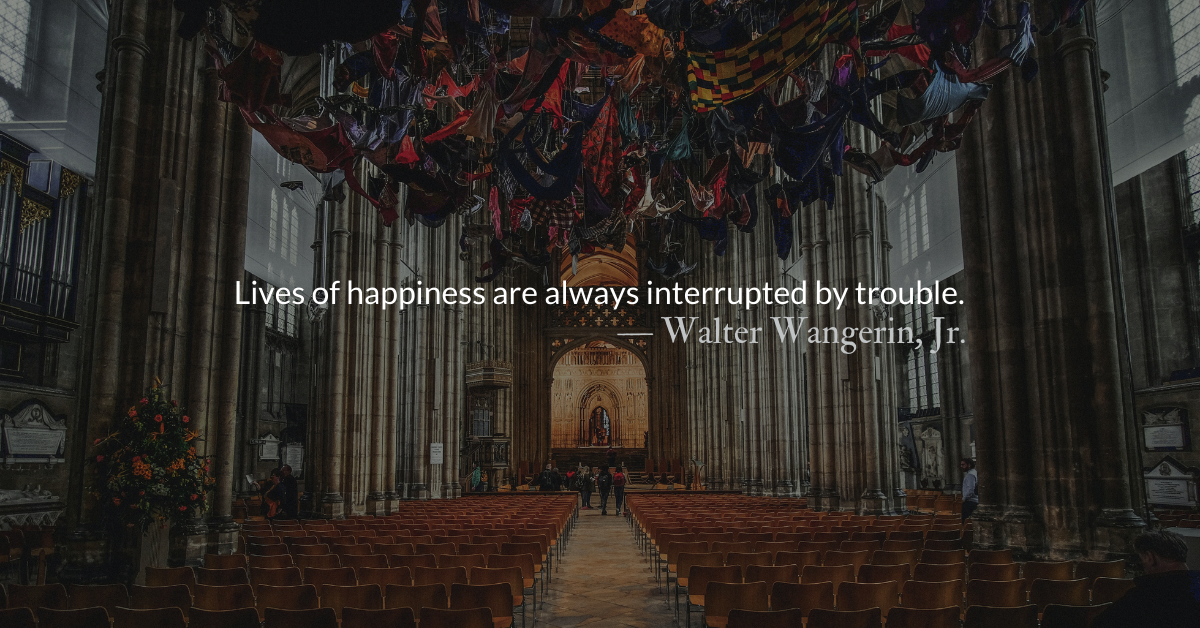
Of this horrific incident, Walter Wangerin writes, “It’s a hard thing to think about that event—especially now when it interrupts our Christmas joy. Yet it must be remembered, because lives of happiness are always interrupted by trouble.”

This haunting song reminds us that even the birth of our Savior is accompanied by grief and tragedy. For many, Christmas may not be ‘the most wonderful time of the year,’ but instead, a time when painful memories of missing loved ones or difficult days past overshadow our experience of the season.

Something lovely happens in the final verse, however. 

That woe is me, poor child, for thee
And ever mourn and may
For thy parting neither say nor sing,
“Bye bye, lully, lullay.”

The lamenting mothers recognize “thy parting,” that Mary and Joseph are able to flee to Egypt with the baby. Solace can be taken in the knowledge that Jesus has escaped the wrath of Herod. Christ’s final ‘parting’ will come with his own brutal death, which will serve to bring ultimate peace to humanity.

If you are grieving over loss this Christmas time, know that is okay.

If you are lamenting the past this Christmas, know that is okay.

If you are struggling to feel “Christmas-y” this year, know that is okay.

Take heart. Christ is coming. Peace will prevail. The empty manger ultimately leads to an empty tomb.

Listen: The Coventry Carol by Alison Moyet
Read: Lyrics from Hymnary.org

Image Note: The picture used in our image is from an artistic display at the Canterbury Cathedral by the British artist Arabella Dorman. It is made up of hundreds of items of refugee clothing, found largely on the beaches of the Greek island of Lesbos. It is a reminder to us of the violence and darkness refugees flee from, as did the holy family, and the light of Christ that promises to overturn that darkness. The unedited image can be viewed here

Divine Hours Prayer: The Refrain for the Morning Lessons
Be strong and let your heart take courage, all you who wait for the Lord. — Psalm 31.24

– Divine Hours prayers from The Divine Hours: Prayers for Autumn and Wintertime by Phyllis Tickle

Today’s Readings
Zechariah 8 (Listen – 3:33)
John 11 (Listen – 4:44)

Read more about End of Year Giving and Supporting our work
If you have not donated this year (or ever), please prayerfully consider joining our donors, with either a one-time or monthly donation.

Read more about Joy Despite Everything :: Joy of Advent
Martha greets us at the darkest point of her life. When faith has failed. When her wick smolders. Martha shows us how to wait.

Of Pride and The Sword

Scripture Focus: Ezekiel 32.9-10, 19-21
9 I will trouble the hearts of many peoples 
when I bring about your destruction among the nations, 
among lands you have not known. 
10 I will cause many peoples to be appalled at you, 
and their kings will shudder with horror because of you 
when I brandish my sword before them. 
On the day of your downfall 
each of them will tremble 
every moment for his life. 

19 Say to them, ‘Are you more favored than others? Go down and be laid among the uncircumcised.’ 20 They will fall among those killed by the sword. The sword is drawn; let her be dragged off with all her hordes. 21 From within the realm of the dead the mighty leaders will say of Egypt and her allies, ‘They have come down and they lie with the uncircumcised, with those killed by the sword.’ 

Matthew 26.52
“…all who draw the sword will die by the sword.”  

Reflection: Of Pride and The Sword
By John Tillman

Jesus does not simply make up this proverb (Matthew 26.52) about the sword out of thin air. 

Jesus was pointedly referencing the recurrent theme of the sword in scripture. He did so both as a warning to Peter and the disciples and a condemnation of the religious leaders and the empire with which they were partnering in his unjust murder.

The English phrase “the sword” is mentioned over 1,400 times in the New International Version of the Bible. Its usage is sometimes literal, but the word is often used as a metaphor for violence. It is sometimes the violence of war between nations, sometimes the violence of nations against their own poor, orphans, widows, and foreigners, and sometimes the violence between people.

In scripture the sword is not inanimate. The sword is hungry, with an appetite to devour individuals, races, nations, kings, and empires. (2 Samuel 11.25; Jeremiah 46.14) The sword is wielded by kings and empires and then cuts them down. Even David, the human archetype of the messiah to come, wielded the sword selfishly and was told “the sword will never depart from your house,” as a result. (2 Samuel 12.10)

God’s question to Egypt, (Ezekiel 32.19) “Are you more favored than others?,” could be phrased, “Are you the exception?” This question implies a belief in Egyptian exceptionalism. Many nations think so. “Other nations have fallen, but we can not. Other nations were foolish, but we are wise. Other nations are evil, but we are worthy of praise.”

God had emphasized to Egypt that greater nations than she had fallen due to pride and abuse of authority. Despite how Egypt, or any nation, postures itself, those who live by the sword will fall by it. Those who profit by violence will face justice.

God does not rejoice in the death of any person, much less any nation (Ezekiel 33.11; 2 Peter 3.9), but he rejoices to see justice done to oppressors and the proud humbled. 

As individuals and nations, may we learn this in humility. May we not puff ourselves up with pride. May we not deny our sins but confess and repent. Then, rather than shake with fear, (Ezekiel 32.10) we may rejoice on the day oppressors fall, unjust governments are unseated, and Jesus, with the sword of his mouth (Revelation 19.11-16) cuts down wielders of the sword who oppose justice.

Divine Hours Prayer: The Refrain for the Morning Lessons
The fool has said in his heart, “There is no God.” — Psalm 14.1

– Divine Hours prayers from The Divine Hours: Prayers for Summertime by Phyllis Tickle

Today’s Readings
Ezekiel 32  (Listen – 5:30) 
Psalm 80 (Listen – 1:58)

Read more about Hearing the Groans of the Prisoner
He hears the cries of all those oppressed by their rulers. He judges all rulers and leaders who conduct themselves with pride and irresponsibility.

https://theparkforum.org/843-acres/hearing-the-groans-of-the-prisoners/

Read more about Prepare for the End
Christians are sometimes guilty of looking forward to the apocalypse like a private revenge fantasy.