One Thing Needed

Luke 10.42
Few things are needed—or indeed only one.

Everybody I know says they need just one thing. Really what they mean is they need just one thing more. — Rich Mullins

Reflection: One Thing Needed
By John Tillman

The Church’s anticipatory season of Advent doesn’t officially begin until December 2nd this year, but our cultural and commercial anticipation of Christmas is in full swing. Parties are being planned. Trees are going up. Lights are being strung.

Christmas is coming.

For some, Christmas seems more ominous than celebratory—like a massive to-do list with an inflexible deadline. With all of the cultural expectations of Christmas, it’s no wonder people push “starting Christmas” earlier and earlier in the year.

If Christmas is about having the perfect meal, with the perfect side-dishes, the perfect guests, the perfect gifts, the perfect decor, the perfect tree, and the perfect decorations, increasing the production timeline makes a lot of sense. But even starting in October, as some do, that’s a lot of perfection for imperfect people to manage in a broken world. It’s a perfect mix for holiday depression and anxiety rather than the peace, comfort, and joy that should be experienced at Christmas.

Martha, the detail oriented disciple, often gets a hard time from preachers who focus on jokes about how uptight she is. We often preach on Martha’s scolding of Jesus about her sister and too rarely preach about Martha’s open declaration that Jesus was the Messiah.

If Martha, in today’s passage is scattered and distracted, the Martha who greets Jesus after her brother’s death is focused with clarity on the “one thing” needed. Martha’s declaration was no trivial thing. Nearby were those who were already plotting Christ’s death and would next be plotting the death of her soon-to-be resurrected brother. Her confession was at the risk of her life.

The one thing that is needed, the better portion that Mary chose and Martha learned to choose under pain of death, is to place ourselves at all costs in the presence of Jesus, our Lord.

Mary and Martha aren’t stereotypes for us to sort ourselves into and excuse our tendencies. We can’t say, “Well, I’m a Mary,” and ignore details. We can’t say, “Well, I’m a Martha,” and ignore relationships. To do so is to dehumanize these women into parables to make us feel better about ourselves.

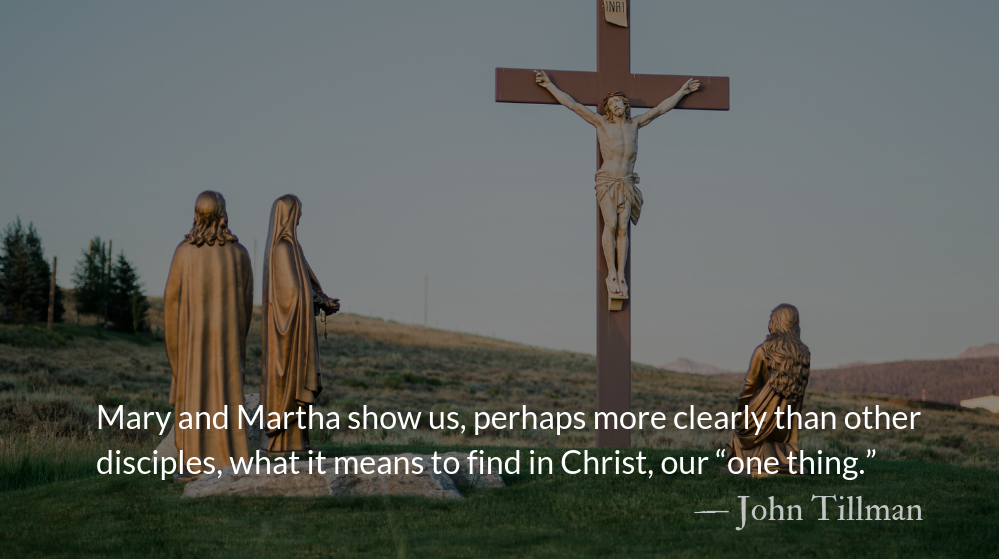
These female disciples each are immature in their own way when we first meet them. But in their final appearances in scripture, they abandon all for Christ, risking financial security, risking reputation, risking their lives to honor him. They show us, perhaps more clearly than other disciples, what it means to find in Christ, our “one thing.”

Prayer: Request for Presence
Protect me, O God for I take refuge in you. I have said to the Lord, “You are my Lord, my good above all other,”  — Psalm 16:1

– Prayer from The Divine Hours: Prayers for Autumn and Wintertime by Phyllis Tickle.

Prayers from The Divine Hours available online and in print.

Today’s Readings
Micah 1 (Listen – 2:46)
Luke 10 (Listen – 8:05)

Additional Reading
Read More about Confessing Christ, Full Grown
It is more difficult to stand before a man who, by inaction, allowed your brother to die and call that man the Messiah, as Martha did.

Read More about The Fragrance of Faith :: Readers’ Choice
Mary of Bethany’s anointing of Christ on his last trip to Jerusalem is intimately connected to the gospel—Christ said that it would be.

Support our Work
Each month over 22,000 Park Forum email devotionals are read around the world. Support our readers with a monthly or a one time donation.

Prayer from the Belly of the Beast

Jonah 2.7-9
“When my life was ebbing away,
I remembered you, Lord,
and my prayer rose to you,
to your holy temple.
“Those who cling to worthless idols
turn away from God’s love for them.
But I, with shouts of grateful praise,
will sacrifice to you.
What I have vowed I will make good.
I will say, ‘Salvation comes from the Lord.

Reflection: Prayer from the Belly of the Beast
By John Tillman

Prayer and thankfulness seem natural around a table of friends and family. But prayer can be even more powerful in the dark places of our lives.

Origen, writing of prayer, speaks of Jonah’s faith that, even though swallowed, as it were, by death, he could be heard by God:

Jonah, because he did not despair of being heard from the belly of the monster that had swallowed him, was able to quit the monster’s belly and complete his interrupted prophet’s mission to the Ninevites. How many things could each of us recount should he choose to recall with gratitude the benefits conferred upon him and to offer praise to God for them!

Let him, moreover, who has learned by experience what manner of monster that which swallowed Jonah typified, if he should ever come to be in the belly of the monster, pray in penitence.

Analogies to the prophet aside, we may not be in the beast’s belly because of wrongdoing, but because our world is filled with beasts. But regardless of how we came to be there, our prayer may be sharpened, amplified, and have greater effect on our hearts. Origen continues:

We know that often fugitives from God’s commands who have been swallowed by death, which at the first prevailed against them, have been saved by reason of repentance from so great an evil, because they did not despair of being able to be saved though already overpowered in the belly of death: for death prevailed and swallowed, and again God took away every tear from every face.

If you have not been there yet, sooner or later we all experience the belly of the beast—sinking in the darkest hole of our lives, in deepest, grave-like depression. In the belly of the beast and in the grip of death, we can, as Jonah did, find in prayer what we could not find with our feet on solid ground.

As Origen says, “Souls that have long been barren but have become conscious of their intellects’ sterility and the barrenness of their mind, through persevering prayer have conceived of the Holy Spirit and given birth to thoughts and words of salvation full of contemplated truth.”

May we find God’s love. May we find courage. May we find purpose. May we find God, waiting there for us. Ready to wipe our tears and carry us onward.

Prayer: Request for Presence
I have said to the Lord, “You are my God;” listen, O Lord, to my supplication  — Psalm 97:9

– Prayer from The Divine Hours: Prayers for Autumn and Wintertime by Phyllis Tickle.

Prayers from The Divine Hours available online and in print.

Today’s Readings
Jonah 2 (Listen – 1:20)
Luke 7 (Listen – 7:14)

This Weekend’s Readings
Jonah 3 (Listen – 1:31) Luke 8 (Listen – 8:09)
Jonah 4 (Listen – 1:56) Luke 9 (Listen – 8:05)

Additional Reading
Read More about Praise in the Midst of Trouble :: A Guided Prayer
A common note ringing from scripture is praise—most particularly praise from those in the midst of, and not yet rescued from trouble.

Read More about about Prayer for Those who Suffer
Bonhoeffer, who suffered for years in Nazi prisons, is both comforted and sobered by this reality: “Only God can help. But then, all our questions must also again and again storm directly against God.”

Support our Work
Each month over 22,000 Park Forum email devotionals are read around the world. Support our readers with a monthly or a one time donation.
Beyond Selfish Thankfulness

Jonah 1.1-3
The word of the Lord came to Jonah son of Amittai: “Go to the great city of Nineveh and preach against it, because its wickedness has come up before me.”

Reflection: Beyond Selfish Thankfulness
By John Tillman

On a day of Thanksgiving we take a brief look at a selfish prophet—Jonah.

Jonah was a prophet of national status. Second Kings tells us that Jonah prophesied that God would restore Israel’s borders through Jeroboam II, Israel’s longest reigning and most outwardly successful king. However, Jeroboam II was an evil king who maintained the evil practices of the kings before him, and the Bible is clear that God saved Israel at this time for the sake of his name and because of the suffering of the people, and not due to Jeroboam’s repentance, leadership, or greatness.

Jonah was likely thankful for God’s mercy on his own country and people, despite their evil leadership. But then, Jonah is called to prophesy to another evil nation. Nineveh was the capital of the Assyrian empire that had been threatening and oppressing the northern kingdom of Israel for years.

And Jonah ran. He ran not to avoid God’s punishment for his sins, but to avoid being the instrument of God’s mercy for others’ sins. Jonah thought he could selfishly carry God’s mercy away.

A God who does not treat us as we deserve is also a God who often does not treat our enemies as we might feel they deserve. It is hard to be thankful for God’s mercy to others. We’d more often, like Jonah, set up a watch party to view their destruction.

Jonah’s only moment of thankfulness is one of selfishness. He is thankful for the plant that shades him from the burning sun. But he is scornful of God’s mercy that shaded Nineveh from God’s burning anger.

We too often, like Jonah, feel responsible that those who have wronged us should not “get away with it.” But in God’s timing, nothing goes unpunished. Assyria eventually suffered all the destruction and punishment their evil practices deserved. But in this moment, mercy was offered, and mercy was accepted. And Jonah had to learn to be thankful for it.

It is wonderful to have a national holiday focused on thankfulness. But we need to go a step further than our culture, a step further than Jonah, to go beyond being selfishly thankful.

May we be selflessly thankful for the mercy that God may choose to display even to those who we deem unworthy.
May we be thankful to be agents of forgiveness to those who do not know their right hand from their left.

Prayer: The Call to Prayer
Come, let us bow down, and bend the knee, and kneel before the Lord our Maker. For he is our God, and we are the people of his pasture and the sheep of his hand.  — Psalm 95:6-7

– Prayer from The Divine Hours: Prayers for Autumn and Wintertime by Phyllis Tickle.

Prayers from The Divine Hours available online and in print.

Today’s Readings
Jonah 1 (Listen – 2:29)
Luke 6 (Listen – 6:46)

Additional Reading
Read More about Resisting in Faith
Daniel embraces civility and service to his enemies. Daniel embraced civility even when he was under the direct threat of death.

Read More about Face Like Flint :: A Guided Prayer
In what ways are we willing to accept victory with Christ but not suffering? Where do we reach for our swords, when Christ calls out, “No more of this!”…and heals the one we would attack? Are we willing to heal our enemies?

Support our Work
Each month over 22,000 Park Forum email devotionals are read around the world. Support our readers with a monthly or a one time donation.
Thanksgiving Stirs God’s Heart

Luke 5.8
When Simon Peter saw this, he fell at Jesus’ knees and said, “Go away from me, Lord; I am a sinful man!”

Reflection: Thanksgiving Stirs God’s Heart
By John Tillman

When Simon (not yet called Peter) saw what Christ had done for him and his partners, he skipped right over being thankful to being fearful. “Go away from me! I’m not worthy. I don’t understand! You don’t know how sinful I am!”

Simon didn’t yet understand the heart of Jesus. He didn’t understand that he came for the sinful, that he was seeking that which was lost, and that Simon himself would be changed and would become, Peter, the rock.

But whatever happened in this moment, he was changed enough at heart to follow when Jesus asked. This passage from Luke resounds with thankfulness from those touched by Christ.

Richard Foster writes in his book Prayer, that seeing the heart of God is the key that opens the door to thankfulness in our hearts.

If we could only see the heart of the Father, we would be drawn into praise and thanksgiving more often. It is easy for us to think that God is so majestic and so highly exalted that our adoration makes no difference to him. To be sure, the self-sufficiency of God is a precious doctrine, but we should always remember that words of Saint Augustine: “God thirsts to be thirsted after.”

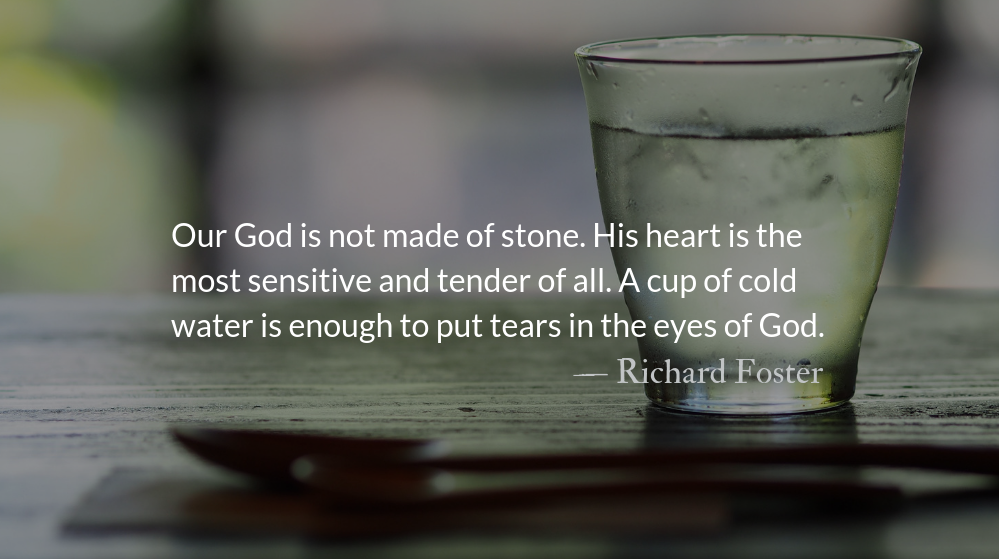
Our God is not made of stone. His heart is the most sensitive and tender of all. No act goes unnoticed, no matter how insignificant or small. A cup of cold water is enough to put tears in the eyes of God.

Foster goes on to list many who, with simple acts of thanksgiving, touched the heart of Christ. When we act in thanksgiving, acknowledging the gifts of God’s Spirit to us, it connects us to Christ and marks us as his children carrying on his work in this world. Foster continues:

And what about us? Dare we hold back? It brings joy to the heart of God when we grip that pierced hand and say simply and profoundly, “Thank you, bless you, praise you.!”

And if we cannot grasp his hand in thankfulness, we can grasp the hand of our enemies in love.
And if we cannot provide him a place to lay his head, we can work that others might have one.
And if we cannot anoint his head and feet, we can anoint those who suffer in this world.
And if we cannot weep on his feet, we can weep with those who weep.

For what we do to the least of these, we do unto Him.
And what we would do for One, by His power, we may do for all.

Prayer: The Small Verse
The people that walked in darkness have seen a great light; on those who live in a land of deep shadow a light has shone.  — Isaiah 9.1

– Prayer from The Divine Hours: Prayers for Autumn and Wintertime by Phyllis Tickle.

Prayers from The Divine Hours available online and in print.

Today’s Readings
Obadiah 1 (Listen – 3:28)
Luke 5 (Listen – 5:04)

Additional Reading
Read More about Thankful Workers for Peace :: Worldwide Prayer
May we be as miraculously transformed as the Gerasene man, and as thankful as he, running to the cities with the life-changing message of the gospel.

Read More about Thanksgiving in Times of Trial
The first Christians were thankful in suffering because their focus rested not on the storm around them, but on the solid rock of Christ.

Support our Work
Each month over 22,000 Park Forum email devotionals are read around the world. Support our readers with a monthly or a one time donation.

Confessing Christ, Full Grown

Luke 4.41
Moreover, demons came out of many people, shouting, “You are the Son of God!” But he rebuked them and would not allow them to speak, because they knew he was the Messiah.

Reflection: Confessing Christ, Full Grown
By John Tillman

Very few individuals, before the resurrection, stated out loud their belief in who Jesus truly was. And most of them were women.

Simeon, and Anna are the first. But it is somewhat easier to proclaim a baby the Messiah. Baby Jesus as Messiah isn’t making any demands. This is why Baby Jesus is widely culturally acceptable. It is only once he opens his mouth to speak that people reject him.

It is more difficult to stand before a man who, by inaction, allowed your brother to die and call that man the Messiah, as Martha did.

It is more difficult to admit that the man who confronted you with your sexual sin is the Messiah, as the Samaritan woman did.

It is more difficult to speak what has been revealed to you by God when you don’t fully understand it yet, as Peter did when he confessed, “You are the Messiah.” Peter showed that he didn’t fully understand, only a verse or two later when he rebuked Jesus for talking about his upcoming crucifixion.

Like Peter, we have a tendency to want to tell Jesus what to do instead of doing what he tells us. Jesus corrected Peter for not being concerned about what God, what Jesus, was concerned about, and he would say the same to us today.

Peter, and the rest of the disciples, despite being exposed to so much otherworldly power, were concerned about earthly kingdoms and power. Even after the resurrection, moments before his ascension, they asked him, “Lord, are you at this time going to restore the kingdom to Israel?”

We must stand and confess, not just the Christ Child and the childish, temporal hopes we may have for this world, but confess Christ the Crucified King. We must stand before the man who says, “In this world you will have trouble,” and accept it as he did, “for the joy set before him.” We must stand before the man who said, “take up your cross,” we must, like him set our face, “like a flint,” toward our sacrifice.

When we pray “your kingdom come”, the kingdom must come in our hearts before it can be realized into the world.
The kingdom among us, is realized in our work together.
The kingdom among us is realized as we sharpen each other.
The kingdom among us is realized when each part of Christs’ body does its work.

Prayer: The Call to Prayer
Love the Lord, all your who worship him; the Lord protects the faithful, but repays to the full those who act haughtily. Be strong and let your heart take courage, all you who wait for the Lord.  — Psalm 31.23-24

– Prayer from The Divine Hours: Prayers for Autumn and Wintertime by Phyllis Tickle.

Prayers from The Divine Hours available online and in print.

Today’s Readings
Amos 9 (Listen – 3:08)
Luke 4 (Listen – 5:27)

Additional Reading
Read More about Beyond Admiration
The difference between an admirer and a follower still remains. The admirer never makes any true sacrifices. He always plays it safe…he renounces nothing, gives up nothing, will not reconstruct his life, will not be what he admires, and will not let his life express what it is he supposedly admires.

Read More about Doing All Things Well :: Readers’ Choice
As we follow Christ, we are meant to take on this mantle of confidence and comfort. This is not a confidence in our ability or a comfort in our own power, but an indwelling, filling, and freeing expression of the Holy Spirit with us.

Support our Work
Each month over 22,000 Park Forum email devotionals are read around the world. Support our readers with a monthly or a one time donation.