God is Faithful, not Indebted

Scripture Focus: Job 20.2-3
      My troubled thoughts prompt me to answer 
         because I am greatly disturbed. 
      I hear a rebuke that dishonors me, 
         and my understanding inspires me to reply. 

Job 21.4-6
      “Is my complaint directed to a human being? 
         Why should I not be impatient? 

Reflection: God is Faithful, not Indebted
By John Tillman

Chapter 20 begins with Zophar speaking up because he is offended: “I hear a rebuke that dishonors me…” Then as now, when making arguments, people get emotional, tend toward exaggeration and aggression, and take personal offense at the other person’s comments. It is notable that in chapter 19, Job was not responding to Zophar, but to Bildad. The last we heard from Zophar was in chapter 11. 

How often have we (have I) taken offense at an argument or comment not directed at me on Facebook and lashed out? Probably more often than it is comfortable to admit.

Zophar spends this speech defending the idea that the wicked succeed only momentarily before being destroyed. Something Job easily demonstrates as false in the next chapter. Most of Zophar’s speech is gleeful descriptions of what he believes will happen to the wicked. It reads a bit like revenge fantasy.

Zophar and the rest of Job’s friends have a deep, fear-based need to show that Job’s sin caused his suffering. If they can convince Job and themselves that Job messed up and brought this on himself, then they are safe because God owes them protection.

Prior to these events, Job and his friends believed in an indebted God who owed good to the righteous, owed suffering to the wicked, and never made late payments. 

The God Job begs audience with, whom he desires to stand before, is a different God.
He is an un-indebted God. It is we who are the debtors. 
If God does owe us anything, it is wrath—wrath which he is forestalling payment of, holding that debt in arrears until such time as Christ would pay it.  

God proves more faithful than Job’s friends, and as he came to Job, he also comes to us. God comes to sit in the dust with us when we suffer. God does not attempt to make himself look good in comparison to us, as Job’s friends did, instead he comes to trade places with us, taking our suffering, experiencing it as his own.

Rather than an indebted God, we serve a faithful God. He does not treat us as we deserve. He has laid on Christ the iniquity and punishment owed to us. He has imputed to us the righteousness won and proved by Christ. By his poverty we are enriched. By his stripes, we are healed.

Divine Hours Prayer: The Request for Presence
Turn to me and have mercy upon me; …and save the child of your handmaid. — Psalm 86.16

– Divine Hours prayers from The Divine Hours: Prayers for Springtime by Phyllis Tickle.

Today’s Readings
Job 20 (Listen -2:52)
1 Corinthians 7 (Listen -6:09)

Read more about Christ, Our Undeserved Friend :: A Guided Prayer
That I might swap with him my place,
That I might be changed by his grace,
That I might be healed through his wounds,
That I might live, he be entombed.

Read more about Calloused Hands and Softened Hearts
In suffering for the gospel, Paul carried with him a joy and purpose that he worked to pass on to Timothy and to us.


Well Equipped for Good or Bad

Scripture Focus: Job 19.25
I know that my redeemer lives…

Hebrews 13:20-21
Now may the God of peace…equip you with everything good for doing his will, and may he work in us what is pleasing to him, through Jesus Christ, to whom be glory for ever and ever.

Reflection: Well Equipped for Good or Bad
By John Tillman

Whether it is students going to school, business professionals walking in to a presentation, or tourists going on vacation, no one willingly goes ill-equipped. 

A student may be ill-equipped due to economic disadvantagement. A business professional may be ill-equipped due to faulty research or poor preparation. A vacationer may be ill-equipped due to negligence or ignorance. But they aren’t ill-equipped on purpose and each of them would admit embarrassment at the outcomes of their situations that resulted from being poorly equipped.

We typically put a lot of thought and emotional and financial investment into equipment we rely on. This is true of our mobile devices—the most ubiquitous equipment that modern urbanites carry—but it is also true of any item we use frequently. However, being spiritually ill-equipped is common and our investment in our spiritual equipment—prayer and other spiritual disciplines—is often lacking. 

When a disaster hits our lives, it is often a wakeup call to our spiritual life. We pray when we’ve never prayed before. We read the Bible when we’ve never read it before. We seek godly counsel through the community of the church when we had been going it alone.

Job shows us that spiritual practice does not prevent tragedies of any kind, but we can see that his spiritual practice prepared him to experience tragedy differently than his wife or his friends. Even in his most bitter and painful moments, Job sees the truth of his situation and his desperate cries give us some of the greatest insights and prophecies of Christ’s role as our mediator.

“I know that my redeemer lives,
and that in the end he will stand on the earth.
And after my skin has been destroyed,
yet in my flesh I will see God;
I myself will see him
with my own eyes—I, and not another.
How my heart yearns within me!” Job 19.25-27

Spiritual disciplines allow the Holy Spirit to equip us for good and prepare us for bad. He prepares our hearts for the joys, the trials, the successes, and the failures that are and will be a part of our walk with Christ. He gracefully walks with us and will supply our needs when we call on him.

Don’t wait for tragedy to seek God or to serve humanity in his name. Engage in spiritual disciplines today that will empower you to do good now and strengthen you for evil days to come.

Divine Hours Prayer: The Refrain for the Morning Lessons
Send forth your strength, O God; establish, O God, what you have wrought for us. — Psalm 68.28

– Divine Hours prayers from The Divine Hours: Prayers for Springtime by Phyllis Tickle.

Today’s Readings
Job 19 (Listen -2:48)
1 Corinthians 6 (Listen -3:03)

Read more from Meditation in Spiritual Rhythm
Meditation is a breathing apparatus to help us survive in a poisonous atmosphere polluted by anxiety and fear.

Read more about Cultivating Daily Bread
Daily bread refers to a daily need for God and purposely highlights the need for spiritual disciplines that are required for us to grow in faith.

Incest, Greed, and Idolatry

Scripture Focus: 1 Corinthians 5.9-10
I wrote to you in my letter not to associate with sexually immoral people—not at all meaning the people of this world who are immoral, or the greedy and swindlers, or idolaters. In that case you would have to leave this world.

Reflection: Incest, Greed, and Idolatry
By John Tillman

Pause for a moment and summon up your feelings about the sexual sin of incest. 

Think about how destructive it is, about how often it is rooted in or leads to abuse, and about how, even in our sexually freewheeling culture, it is considered repulsive….

In this letter to Corinth, sexual sins take the forefront because Paul is addressing a case of incest, a specific kind of sexual sin. But Paul hardly ever mentions sexual sins without also mentioning sins involving power, idolatry, and wealth. The most skipped-over words in the fifth chapter of 1 Corinthians may be “or the greedy and swindlers, or idolaters.” This shows that Paul, in comparison to incest, considers greed and idolatry to be equally repulsive, equally abusive, equally destructive, equally sinful, and therefore an equal reason to be subject to church discipline.

It’s uncomfortable to think about sins that we are prone to being the spiritual equivalent of incest. Although most Christians understand the belief that “sin is sin” and all sins are the same before God, in reality we all see the sins of others as having great and terrible import, while we minimize, excuse, and normalize our own sins. 

Paul would have us as uncomfortable with greed and idolatry as we are with incest and other sexual sins. But are we? When was the last time someone was disfellowshipped from a church for greed? When was the last time Christians boycotted something due to greed? Are you greedy and a Christian? Paul advises other Christians not to eat with you.

Paul does not encourage boycotts or avoiding non-Christians who are active in sin. It is only believers who are continuing, unrepentantly in sin who are subject to this kind of treatment. Christians with a subculture mentality, who isolate themselves from interactions with non-believing “sinners,” are doing exactly what Paul says not to do.

We should also remember that Paul’s instructions about removing fellowship are intended to be an effort to warn and correct others so that they may be won back through repentance. 

May we never expect non-Christians to live differently before we show them love.
May we be gracious to one another as we face the conviction of the Holy Spirit in areas of serious sins, such as sexual sin, greed, and idolatry.
May we stand for the Christian sexual ethic without abandoning other ethical stances that scripture holds as equally important. 

Divine Hours Prayer: The Refrain for the Morning Lessons
I hate those who have a divided heart, but your law do I love. — Psalm 119.113

– Divine Hours prayers from The Divine Hours: Prayers for Springtime by Phyllis Tickle.

Today’s Readings
Job 18 (Listen -1:54)
1 Corinthians 5 (Listen -1:58)

Read more about In Denial about Greed and Power
If there is anything that can still be shocking in today’s world, it is that we still don’t fully admit or understand the destructive nature of the sins of greed and power.

Read more about In Denial about Injustice
The sins that brought God’s judgment and caused the exile of Israel were multi-faceted. But there is a common thread—injustice.

Christ, Our Undeserved Friend :: A Guided Prayer

Scripture Focus: Job 16.19-21
Even now my witness is in heaven;
    my advocate is on high.
My intercessor is my friend
    as my eyes pour out tears to God;
on behalf of a man he pleads with God
    as one pleads for a friend.

Reflection: Christ, Our Undeserved Friend :: A Guided Prayer
By John Tillman

The earliest dates for Job’s writing are around 2,000 years before Christ, and the antiquity of the events may be far earlier than that date. Both Ezekiel and James discuss Job among lists of historical persons, implying that they believe him to be more than merely a story or parable. So, Job’s words give us the earliest written prophetic vision of Christ. In Job, Christ is our un-named and undeserved heavenly representative, who takes our case and acts as a true friend, even as Job’s earthly friends berate and badger him.

This week, pray this poetic prayer of thanks to Christ, our advocate, redeemer, and friend. This poem incorporates prayers of Job and other scriptures.

Christ, Our Undeserved Friend:
In this life,
When gripped by strife,
I know above
Of one who loves.

When I’m amidst a storm that swirls
Hiding from accusations hurled,
Immobilized in sin and guilt,
Collapsing consequence I built,

Rotten inward and outward too,
My sins are yeast worked through and through.
Condemned, inner and outer self
Have no appeal, no chance of health.

I cannot speak, for if I do
My words turn each fault into two.
My speech reflects my inward sin.
My thoughts bring outward sins within.

I hope in nothing I can reach
But he who in this darkness seeks.
The darkness is not dark to him.
He sees me clearly, sees my sin.

Though my sins and weakness he sees,
My case before the Father, pleads.
He knows my state and yet he bends
God’s ear to me, for me contends:

That I might swap with him my place,
That I might be changed by his grace,
That I might be healed through his wounds,
That I might live, he be entombed.

The Father consented.
The son he descended.
He purloined my guilt.
His dear blood was spilt.

My sin he grasped with nail-pierced grip
Dragged sin to hell, and there left it.
My sorrow sees his body riven.
My joy to know his body risen.

With death defeated, he grasped me,
That I should live eternally.
His work in me, begins to show,
As obeying his Word, I go.

Serving my world in thanks to Him,
Shunning pride, a humble pilgrim
To read, ponder, walk in, live in
The Word, and Holy Spirit given.

I walk with my redeemer, friend,
Holding my hand, until the end.
In this world there will sufferings be,
Tolerable only when with thee.

Give my mouth a tongue which will speak
Of your love and, though I am weak,
Unfailing faith to stand in grace
And steps to finish out this race.

Christ, he our undeserved friend,
Is with me yet, until the end.

Divine Hours Prayer: The Call to Prayer
Be strong and let your heart take courage, all you who wait for the Lord. — Psalm 31.24

– Divine Hours prayers from The Divine Hours: Prayers for Springtime by Phyllis Tickle.

Today’s Readings
Job 16=17 (Listen -3:40)
1 Corinthians 4 (Listen -3:15)

Read more about Lamenting With Job :: Guided Prayer
Lament is frequent and important in the Bible and should be in our lives as well.

Read more about Greater Footstool, Greater God, Greater Redeemer
Before Job ends, he declares the promise that the Redeemer will stand upon the Earth to reclaim it.


Not in the Brochure

Scripture Focus: 1 Corinthians 1:21-22, 25
For since in the wisdom of God the world through its wisdom did not know him, God was pleased through the foolishness of what was preached to save those who believe. Jews demand signs and Greeks look for wisdom… For the foolishness of God is wiser than human wisdom, and the weakness of God is stronger than human strength.

Reflection: Not in the Brochure
By Jon Polk

Expectations. We all have them. When fulfilled they can be a powerful source of excitement. When dashed, they can lead to tremendous disappointment.

Time for that family holiday to visit the amazing national park which you’ve heard so much about. You’ve studied the brochures, plotted your route and set out with great anticipation. You arrive to discover that the cabins aren’t as clean as they looked in the photos, the mosquitos are large and hungry, and you have to pay extra for firewood! This was not in the brochure!

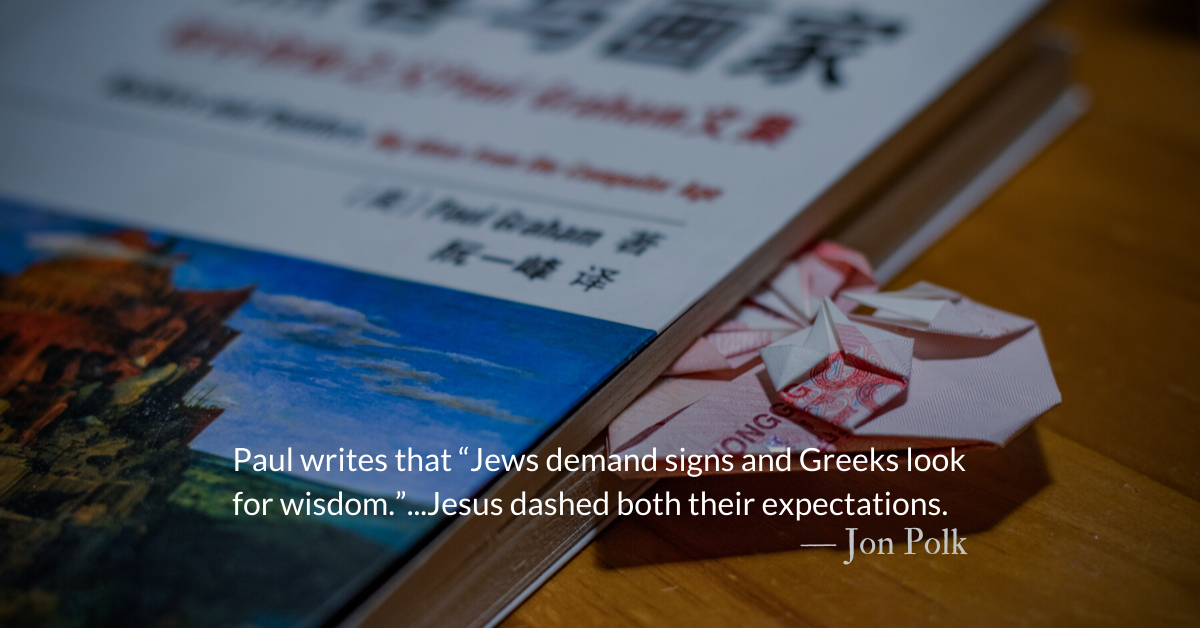
Jews in Jesus’ day had read the prophets, their brochures describing the coming of the Messiah. Paul writes that “Jews demand signs and Greeks look for wisdom.” Jews expected a victorious Messiah, signs and wonders accompanying a conquering King with power, majesty and glory. The Greeks were sophisticated; they were concerned with the pursuit of wisdom and knowledge for its own sake.

Jesus dashed both their expectations. He did not come as a conqueror to please the Jews, nor as a philosopher to please the Gentiles. Instead, Jesus was a King who demonstrated his power through the sacrifice of his own life and his wisdom by preaching a message of selflessness and humility.

Imagine what even Jesus’ own followers might have felt seeing their beloved master, teacher and friend taken down from the cross and carried off for burial. “What just happened? Wait a minute, Jesus, this is not what we followed you for! This was not in the brochure!”

How would our life brochure read if we wrote it? It probably wouldn’t be much different than the expectations the Jews had for the Messiah. Jesus will solve all your problems. Jesus will make you happy. Jesus will defeat your enemies and those who have done you wrong. Jesus will bring roses and ponies and rainbows.

Now to be fair, Jesus does provide peace, comfort, joy and satisfaction in life, but not always in the way we might expect. Come to Jesus and sacrifice yourself? Follow Jesus and give your life away? That’s not in our brochure.

The Christian life has a way of not turning out the way we expect. We make our plans, we have our ideas about what God should do for us, we have our own self-focused motivations, but the foolishness of God is wiser than human wisdom. We strive to provide for our own security and comfort in this life, but the weakness of God is stronger than human strength. 

Thankfully, through that foolishness and weakness, we are saved from our own expectations to discover God’s higher wisdom and humble strength and we learn to live a new life, one that we may not have expected.

*This devotional was written from a devotional Jon gave for the staff at International Christian School in Hong Kong. To see the video version of this devotional, follow this link.

Divine Hours Prayer: The Refrain for the Morning Lessons
Help me, O Lord my God; same me for your mercy’s sake. — Psalm 109.25

– Divine Hours prayers from The Divine Hours: Prayers for Springtime by Phyllis Tickle.

Today’s Readings
Job 13 (Listen -2:27)
1 Corinthians 1 (Listen -4:03)

This Weekend’s Readings
Job 14 (Listen -2:23), 1 Corinthians 2 (Listen -2:26)
Job 15 (Listen -3:23), 1 Corinthians 3 (Listen -3:05)

Read more about Crucified, By Nature
It is hard for us to grasp how foolish, offensive and shameful crucifixion was in the ancient world.

Read more about The Sign of Jonah and The Cross
If Jesus had a website “Can you show us a sign from Heaven?” would be listed in his FAQs.

Show Buttons
Hide Buttons
Spur a spiritual rhythm of refreshment right in your inbox
By joining this email list you are giving us permission to send you devotional emails each weekday and to communicate occasionally regarding other aspects of the ministry.
100% Privacy. We don't spam.