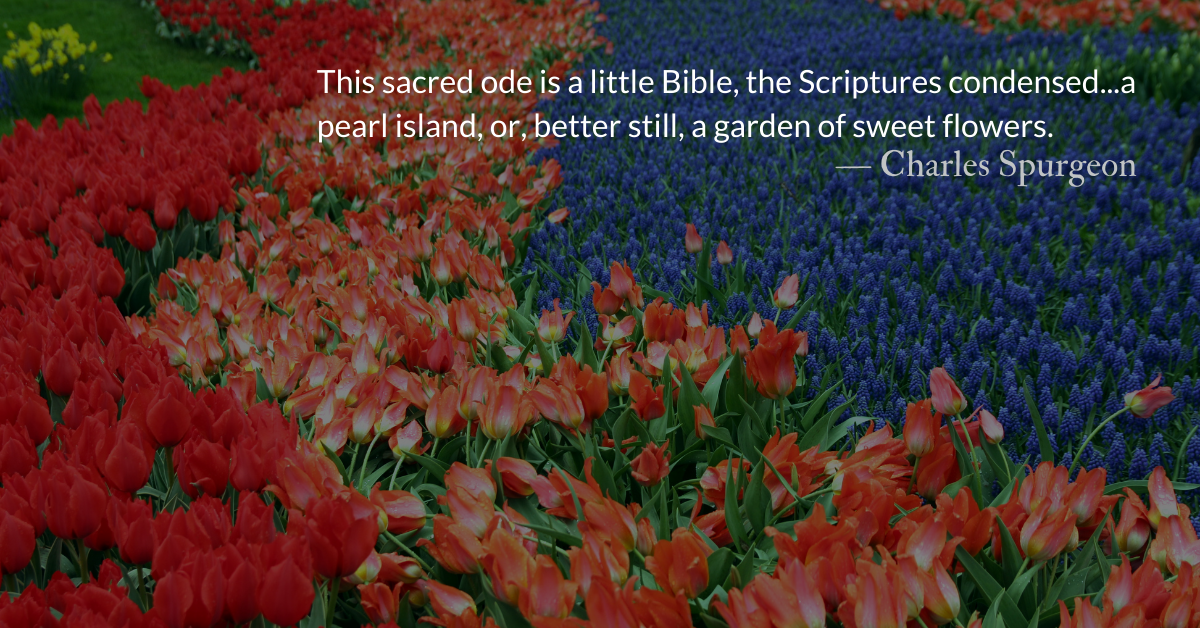
The Garden of Psalm 119

Scripture Focus: Psalm 119.169-176
169 May my cry come before you, Lord; 
give me understanding according to your word. 
170 May my supplication come before you; 
deliver me according to your promise. 
171 May my lips overflow with praise, 
for you teach me your decrees. 
172 May my tongue sing of your word, 
for all your commands are righteous. 
173 May your hand be ready to help me, 
for I have chosen your precepts. 
174 I long for your salvation, Lord, 
and your law gives me delight. 
175 Let me live that I may praise you, 
and may your laws sustain me. 
176 I have strayed like a lost sheep. 
Seek your servant, 
for I have not forgotten your commands. 

From John: As we wrap up Psalm 119 this week, we look back again at our reflection on Charles Spurgeon’s words about the great psalm. We are also eagerly anticipating the beginning of Student Writers Month in July followed by your Readers’ Choice selections in August. To submit your selections for Readers’ Choice, follow this link.

Reflection: The Garden of Psalm 119
By John Tillman

We finish Psalm 119 today and reflect on it with some words from Charles Spurgeon: 

“Those who have studied this divine hymn, and carefully noted each line of it, are amazed at the variety and profundity of the thought…The more you look into this mirror of a gracious heart the more you will see in it.”

Spurgeon is convinced that David wrote the Psalm and if not he, then some other writer who spent long years in its work and created it not over a short span, but through a lifetime of faithfulness.

“There is evident growth in the subject matter. The earlier verses are of such a character as to lend themselves to the hypothesis that the author was a young man, while many of the later passages could only have suggested themselves to age and wisdom.”

In the end, rather than rising in acclaim or celebration, the aged wisdom of the psalmist leads him to a humble and prostrate stance.

“The psalmist is approaching the end of the Psalm…he seems to break into the inner circle of divine fellowship, and to come even to the feet of the great God whose help he is imploring. This nearness creates the most lowly view of himself, and leads him to close the Psalm upon his face in deepest self-humiliation, begging to be sought out like a lost sheep…It is a very sweet thing to a suppliant when he knows of a surety that his prayer has obtained audience. It is to Jehovah that this prayer is expressed with trembling earnestness…we crave audience of none else, for we have confidence in none beside.”

Meditating on Psalm 119 daily has been a common spiritual practice for centuries with many reporting a wealth of spiritual benefit.

“This sacred ode is a little Bible, the Scriptures condensed, a mass of Bibline, holy writ rewritten in holy emotions and actions. This Psalm, like the whole Scripture which it praises, is a pearl island, or, better still, a garden of sweet flowers.”

It is our hope that each cycle of our two-year-long tread through the garden of scripture produces not pride, but humility. Not judgmental attitudes, but merciful gratitude. Not clamoring commands for others, but tender notes of correction in our own hearts.

*Quotations abridged from A Treasury of David, Charles Haddon Spurgeon.

Divine Hours Prayer: The Call to Prayer
Hallelujah! Give praise, you servants of the Lord; praise the Name of the Lord. — Psalm 113.1

– Divine Hours prayers from The Divine Hours: Prayers for Springtime by Phyllis Tickle

Today’s Readings
Deuteronomy 33-34 (Listen – 4:43)
Psalm 119:145-176 (Listen – 15:14)

Read more about Readers’ Choice 2021
It is time for us to hear from you about the posts from the past eleven months (September 2020 through July 2021) that have challenged and comforted you and helped you find new meaning in the scriptures.

https://forms.gle/ozM13qvW9ouSWhJS7

Read more about Setting Aside the Scriptures
Considering all of Scripture together without breaking it apart requires patience and a deep familiarity with Scripture.
The Stretching Arm of Salvation — A Guided Prayer

Scripture Focus: Deuteronomy 30.11-14
11 Now what I am commanding you today is not too difficult for you or beyond your reach. 12 It is not up in heaven, so that you have to ask, “Who will ascend into heaven to get it and proclaim it to us so we may obey it?” 13 Nor is it beyond the sea, so that you have to ask, “Who will cross the sea to get it and proclaim it to us so we may obey it?” 14 No, the word is very near you; it is in your mouth and in your heart so you may obey it.

Psalm 119.81
81 My soul faints with longing for your salvation, 
but I have put my hope in your word. 

Reflection: The Stretching Arm of Salvation — A Guided Prayer
By John Tillman

The gospel is not a lifehack. Salvation is not a touch-up job on a fender bender. Sanctification is not akin to the marginal improvements available by the effort of will and self-determination. Jesus is not a self-help guru.

Self-help righteousness has been tried. It failed. Despite the fact that Moses tells the people that it, “is not too difficult for you or beyond your reach,” the rest of Israel’s history proved otherwise. Israel lived by sight yet could not avoid idolatry and judgment. We live by faith and our failures, in many ways, are more spectacularly evil than theirs. 

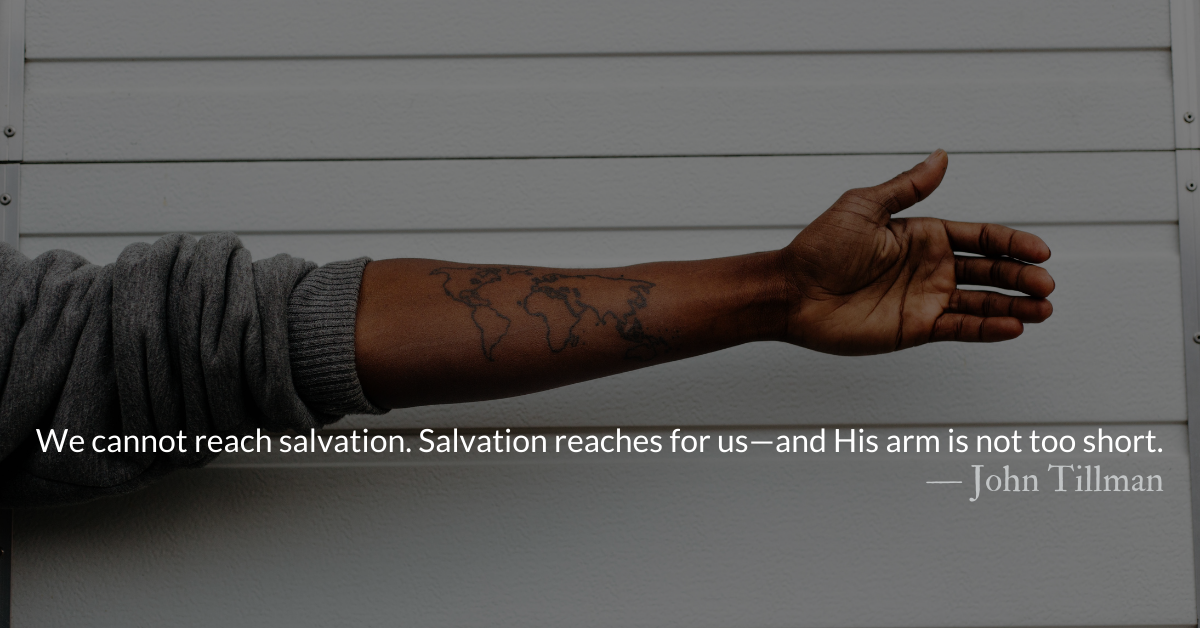
We cannot reach salvation. Salvation reaches for us—and His arm is not too short.

We pray, today, along with a section of Psalm 119, a prayer for those in need of salvation. It is a prayer for those suffering oppression, injustice, and persecution. We pray on behalf of those inside or outside our borders who suffer the sting of unjust treatment and the careless disregard of the powerful. May God move on their behalf and may he do it through us. 

For Salvation
My soul faints with longing for your salvation,
    but I have put my hope in your word.


Extend to us the stretching arm of salvation, promised in your holy word and fulfilled in The Word who became flesh for us.

My eyes fail, looking for your promise;
    I say, “When will you comfort me?”


We seek not the comforts of this world but those of the next, “on earth as it is in heaven.

Though I am like a wineskin in the smoke,
    I do not forget your decrees.


May suffering burn up our pride and vanity and fill us with your Word.

How long must your servant wait?
    When will you punish my persecutors?
The arrogant dig pits to trap me,
    contrary to your law.


Your law is abused, Lord. 
Twisted to harm rather than protect.
Used to excuse abuse rather than to empower love and mercy.

All your commands are trustworthy;
    help me, for I am being persecuted without cause.
They almost wiped me from the earth,
    but I have not forsaken your precepts.
In your unfailing love preserve my life,
    that I may obey the statutes of your mouth.


We can obey your commands with joy, for they are good.
Your love will not fail us.
Amen.

Divine Hours Prayer: The Call to Prayer
Sing to the Lord a new song, for he has done marvelous things.
With his right hand and his holy arm has he won for himself the victory. — Psalm 98.1-2

– Divine Hours prayers from The Divine Hours: Prayers for Springtime by Phyllis Tickle

Today’s Readings
Deuteronomy 30 (Listen – 3:12)
Psalm 119:73:96 (Listen – 15:14)

This Weekend’s Readings
Deuteronomy 31 (Listen – 4:57), Psalm 119:97-120 (Listen – 15:14)
Deuteronomy 32 (Listen – 7:10), Psalm 119:121-144 (Listen – 15:14)

Read more about Ways of Canaan, Ways of Christ
Seek God’s face and ask him to reveal and remove “ways of Canaan” within you, replacing them with the ways of Christ.

Read more about The Antivenom for Sin
We cannot save ourselves from the venom of sin. It inevitably will cause our death and many other harms in our lives.

Make God’s Love Evident

Scripture Focus: Psalm 119.50-53, 61-64
50 My comfort in my suffering is this: 
Your promise preserves my life. 
51 The arrogant mock me unmercifully, 
but I do not turn from your law. 
52 I remember, Lord, your ancient laws, 
and I find comfort in them. 
53 Indignation grips me because of the wicked, 
who have forsaken your law. 

61 Though the wicked bind me with ropes, 
I will not forget your law. 
62 At midnight I rise to give you thanks 
for your righteous laws. 
63 I am a friend to all who fear you, 
to all who follow your precepts. 
64 The earth is filled with your love, Lord; 
teach me your decrees. 

Reflection: Make God’s Love Evident
By John Tillman

There is great wickedness in the world. Yet, in such a world, the psalmist proclaims God’s love, the power of God’s laws, and the strength of his desire to know God more deeply.

Even in a world in which a person may be bound with ropes, or separated from their family, or denied justice, or put into a cage, or killed for the convenience of others, or hung from a tree, or gunned down in a church… Even in such a world, the psalmist tells us, “God’s love is evident.”

Wickedness is evident but God’s love is also evident.

God’s love is evident in the many Christian and secular organizations that move, at times into dangerous circumstances, to help the downtrodden, the poor, and those purposely excluded from justice. Our God sends help to the helpless, no matter the owner of the goods, the ship, the truck, or the organization.

God’s love is evident in his promises to bring disaster upon nations that ignore their responsibilities to the poor and to the foreigner. An endlessly repeating biblical theme, especially in the Old Testament, is that God’s people are to be kind and compassionate to foreigners and the marginalized. Our God humbles nations addicted to greed—including His own

God’s love is evident in God’s help and justice, but also in his presence. Our God is with those who suffer.

Only the suffering God can help. — Dietrich Bonhoeffer

Our God lies on concrete floors under aluminum blankets with abandoned children and ethnic minorities. He bleeds on the floor of a sanctuary with victimized worshipers. His body bears the wounds and scars of unjust captivity that are familiar to those brutalized by government forces.

God’s love is, of course, most fully evident in the gospel. However, passively chattering about “the gospel” in the face of evil, with no action, makes us smiling signposts on the road to Hell rather than under-shepherds of Christ, pulling sheep from the mouths of wolves.

The gospel is Christ’s frontal assault on wickedness. He storms Hell to set free its captives. We are Christ’s body in this world to carry out his righteousness. 

Make God’s love evident. Reach out in God’s love in any way that is available to you, whether through financial means or political. Even giving a cup of water in the name of Christ to the least of these will be remembered.

Divine Hours Prayer: The Morning Psalm
But let the righteous be glad and rejoice before God; let them be merry and joyful.
Sing to God, sing praises to his Name; exalt him who rides upon the heavens; Yahweh is his Name, rejoice before him!
Father of orphans, defender of widows, God in his holy habitation! — Psalm 68.3-5

– Divine Hours prayers from The Divine Hours: Prayers for Springtime by Phyllis Tickle

Today’s Readings
Deuteronomy 29 (Listen – 4:14)
Psalm 119:49-72 (Listen – 15:14)

Read more about Spiritual Indicators
God holds his people responsible for the welfare of the poor, the foreigners, the widows, and the orphans.

Read more about The Sojourn of Sanctification
Those who had been exploited as foreigners were commanded to become a nation that blessed foreigners.

Reversible Blessings and Curses

Scripture Focus: Deuteronomy 28.15-19
15 However, if you do not obey the Lord your God and do not carefully follow all his commands and decrees I am giving you today, all these curses will come on you and overtake you: 
16 You will be cursed in the city and cursed in the country. 
17 Your basket and your kneading trough will be cursed. 
18 The fruit of your womb will be cursed, and the crops of your land, and the calves of your herds and the lambs of your flocks. 
19 You will be cursed when you come in and cursed when you go out. 

“You wish to have the curse reversed? I’ll need a certain potion first…” — The Witch, Into the Woods, Steven Sondheim

Reflection: Reversible Blessings and Curses
By John Tillman

Curses in fairy tales are written to be reversed. The musical, Into the Woods, uses this storytelling trope as its primary plot device. Reversing the curse involves multiple characters from familiar storylines interacting and confronting each other with lies, betrayals, and, at times, the truth.

The opening sections of Deuteronomy 28 promise a blessing to God’s people that will be a pervasive good, touching their lives in every way. They will be “blessed in the city and blessed in the country…blessed when you come in and blessed when you go out.”

However, God’s blessing can be reversed into an all-encompassing curse. They will be “cursed in the city and cursed in the country…cursed when you come in and cursed when you go out.” God says this curse will “come on you and overtake you.” At times Israel would run an impressive race as God’s people, eventually this curse would overtake them.

Anyone steeped in the magic stew of fairy tales tends to see salvation through the lens of a heroic quest. Heroes in fairy tales, often through a combination of cooperation, wit, and luck, typically reverse their own curses. Divine assistance, from fairy godmothers or otherwise, is elusive and typically not determinative of the outcome. Humans, not the gods, exert heroic effort to break fairy tale curses.

Yet, we are not plucky heroes who can, with just a bit of luck, turn the tables on our enemy and reverse our own curse. We can’t make the potion. We can’t kill the dragon. We can’t climb the tower. And our kiss is the kiss of death, not a kiss of life.

Like many other curses of God, the curse of Mount Ebal is a reflection and reenactment of the curse of Eden. It overtook Israel, and it overtakes us. Peter describes our adversary as a roaring lion seeking to devour us. Paul describes an inner curse of sinfulness that even he, the great “Hebrew of Hebrews,” cannot escape.

Yet, the curse of Eden is written to be reversed. Within its words, a hero is promised who will break it. Jesus is that hero. The gospel message we carry is that, in Christ our curse is broken and all people can join him to be blessed in the city, in the country, when we come in, and when we go out.

Divine Hours Prayer: The Call to Prayer
Love the Lord, all you who worship him; the Lord protects the faithful, but repays to the full those who act haughtily. — Psalm 31.23


– Divine Hours prayers from The Divine Hours: Prayers for Springtime by Phyllis Tickle

Today’s Readings
Deuteronomy 28:-20-68 (Listen – 10:11)
Psalm 119:25-48 (Listen – 15:14)

Read more about Two Lamechs, One Jesus
There are those who work to reverse the curse, flooding the earth with hope, peace, and rebirth. 
Which line of Lamech will you follow?

Read more about Accepting Jesus
May we, poor family that we are, join the holy family in redemptively reversing the curse.

The Sojourn of Sanctification

Scripture Focus: Deuteronomy 27.9-10
9 Then Moses and the Levitical priests said to all Israel, “Be silent, Israel, and listen! You have now become the people of the Lord your God. 10 Obey the Lord your God and follow his commands and decrees that I give you today.” 

Reflection: The Sojourn of Sanctification
By John Tillman

The desert sojourn is a transforming experience for Israel and this process of sanctification can be mirrored in the lives of modern believers.

When Israel entered Egypt, they were small, humble, and in need but carried with them God’s blessing. Egypt, so long as she remembered Joseph, enjoyed these blessings and was transformed into a nation that blessed other nations. Soon, however, nationalism took hold in Egypt. Joseph was forgotten. Foreigners were to be feared and exploited. Generations of Israilites were oppressed in slavery. They became a people unfamiliar with freedom and separated from the pleasures of life. They were disconnected from their calling to bless others.

The Exodus is about more than freedom. The desert transforms Israel. They are reintroduced to their purpose, calling, and empowerment. Those who had been exploited as foreigners were commanded to become a nation that blessed foreigners. Those who had been held in slavery, were commanded to become a nation marked by releasing slaves from bondage. Those who had been indoctrinated in the false gods of Egypt would become the teacher of all nations, showing them what the one, true God is like. 

God’s people are always in a process of becoming. Moses says, “Be silent…you have now become the people of the Lord, your God.” (Deuteronomy 27.9) When we come to Christ, we are freed from sin as the Israelites were freed from Egyptian slavery. Sin’s chains are struck from our hands in an instant, but it takes time in the desert with God’s word for the chains of an enslaved mindset to be melted from our hearts.

Jesus says, “For them I sanctify myself, that they too may be truly sanctified.” (John 17.19) Jesus is our model, our pattern, our leader to follow through the desert as we are changed from one kind of people to another.

Paul says, “We…are being transformed into his image, with ever-increasing glory.” (2 Corinthians 3.18) God is glorified with every step we take in becoming more like Christ.

We are like the people of Israel in many ways. We are not just freed from sin, but called for a purpose. The desert of sanctification is transformational so let us hold nothing back from its influence. May we become the people of the Lord our God.

Divine Hours Prayer: A Reading
Jesus taught us, saying: “It is not anyone who says to me, ‘Lord, Lord,’ who will enter the kingdom of heaven, but the person who does the will of my Father in heaven. When the day comes many will say to me, ‘Lord, Lord, did we not prophesy in your name?’ Then I shall tell them to their faces: ‘I have never known you; away from me all evildoers!’” — Matthew 7.21-23


– Divine Hours prayers from The Divine Hours: Prayers for Springtime by Phyllis Tickle

Today’s Readings
Deuteronomy 27-28:19 (Listen – 13:27)
Psalm 119:1-24 (Listen – 15:14)

Read more about Attending God’s Lessons
Through their liberation from Egypt and their time in the desert, God became Israel’s teacher.

Read more about Ready to Exit the Desert
Their faith wasn’t ready to exit the desert and enter the promised land. Desert months turned into desert decades.

Show Buttons
Hide Buttons
Spur a spiritual rhythm of refreshment right in your inbox
By joining this email list you are giving us permission to send you devotional emails each weekday and to communicate occasionally regarding other aspects of the ministry.
100% Privacy. We don't spam.