Cringing at Culture or at Christ?

Scripture: Esther 8.3
Esther again pleaded with the king, falling at his feet and weeping. She begged him to put an end to the evil plan of Haman the Agagite, which he had devised against the Jews.

Reflection: Cringing at Culture or at Christ?
By John Tillman

You’d be hard pressed to find a Christian or Jew who would express dislike for Esther. However, depending on your political/philosophical bent there are aspects of her story that make one cringe.

Some cringe when Esther is supplicative and submissive—submitting to being one of a harem of wives, throwing herself into servile hospitality and beauty as strategy, and finally, pleading and begging, apologetically before the king, her husband. We want her, instead, to be a modern, powerful, assertive woman.

Some cringe when Esther is powerful and assertive—she is unashamed of her sexuality and uses the power of beauty and seduction, she writes law for a nation, she orders the death of her enemies, she tells the king what to do. We want her, instead, to be a demure princess so we can dress up our daughters like her.

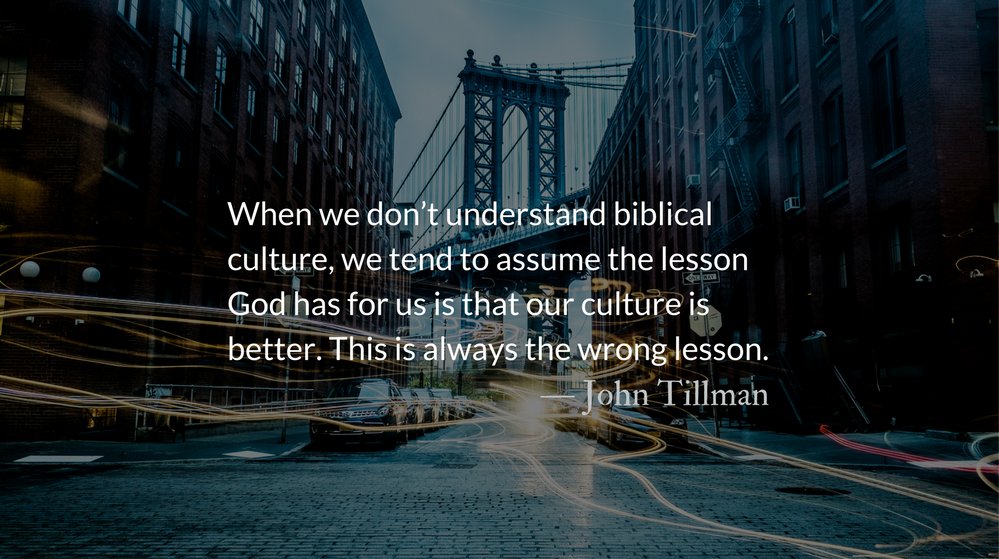
Esther’s culture specifically and biblical culture in general is so foreign to us that we often fail to understand it. Even with years of study and knowledge of cultural facts, we can’t fully understand what living in that culture was like. When we don’t understand biblical culture, we tend to assume the lesson God has for us is that our culture is better. This is always the wrong lesson. Always.

But it is more than just Esther’s brokenness, or that of her culture, that makes us uncomfortable. It is the image of God in her. Esther, like any of us, does not carry the image of God perfectly. But the image of God does make us uncomfortable—even in Christ, the one perfect image of God.

We, like Peter, are uncomfortable with the kneeling, submissive Christ who serves us. We also, like the Pharisees, are uncomfortable with the powerful Christ of Heaven, as described by Stephen before his martyrdom.

Yet Christ is both. And we must accept him completely. And Esther is both. And she deserves to be seen fully. And as we attempt to manifest Christ in our world and to our culture, we must allow the Holy Spirit to bring out in us the fullest picture of who God is.

It is healthy for us to remember that what we admire in biblical heroes and heroines came to them from God. We need not emulate the heroes so much as we need to allow the Holy Spirit to work in us, drawing out of us the shining vestiges of God’s image that are needed.

The Request for Presence
Let my cry come before you, O Lord; give me understanding, according to your word. — Psalm 119.169

– From The Divine Hours: Prayers for Autumn and Wintertime by Phyllis Tickle.

Full prayer available online and in print.

Today’s Readings
Esther 8 (Listen – 3:41)
Romans 3 (Listen – 4:30)

Racism Wears a Mask

Scripture: Esther 7.5-6
King Xerxes asked Queen Esther, “Who is he? Where is he—the man who has dared to do such a thing?” Esther said, “An adversary and enemy! This vile Haman!”

Reflection: Racism Wears a Mask
By John Tillman

When Xerxes asks “Who is he?” we sit in a satisfying dramatic tension. We can’t wait for the villain to be revealed. But the answer is not quite as clear cut as it may seem.

Esther wisely responded to the king’s question by pointing at Haman as the man responsible. But as John Wesley points out in his notes on Esther, the queen could easily have answered the question of Xerxes by saying, “It was you, King! You signed the law to eradicate my people! You accepted payment for our murder! You not only allowed this to happen, but profited from it!”

We like to put Haman on a shelf with Hitler as punching bags from a bygone era. By their example we smugly speak of how far we have come. But our racism, just like Haman’s and the king’s, always claims to be about something else.

It is rare that a person will admit, even to themselves, that they act out of racism directly. Racism always wears a mask. Prejudice always pleads statistics. Segregation always pleads danger. Oppression always pleads economics. Eugenics always pleads scientific data.

Even if we are not like Haman, many of us are like Xerxes and like the government officials. We have allowed racism to rise wearing a mask decorated with other concerns. In our government. In our businesses. Even in our churches. Even if we have not acted directly against minorities, we have passively benefited from the actions of others who have.

Putting ourselves in the shoes of King Xerxes, the best thing we can plead is ignorance and incompetence. And the best thing we can do is use our enormous power and privilege to aid those we previously ignored and to save those whose oppression we profit from.

Racism is not just an individual crime or action, it is an unseen burden we are forced to carry by our culture and our history. The church was the first entity in history to directly attack racism and the Holy Spirit is the only way its burden can truly be put down.

May we abandon our protestations of being innocent of racism. May we instead cling to Christ, whose Holy Spirit is the only hope and source of unity.

The Request for Presence
Open my eyes, that I may see the wonders of your law. — Psalm 119.18

– From The Divine Hours: Prayers for Autumn and Wintertime by Phyllis Tickle.

Full prayer available online and in print.

Today’s Readings
Esther 7 (Listen – 2:08)
Romans 2 (Listen – 4:13)

Degrading Each Other

Scripture: Romans 1.24
Therefore God gave them over in the sinful desires of their hearts to sexual impurity for the degrading of their bodies with one another.

Everybody’s got a hungry heart. — Bruce Springsteen

Reflection: Degrading Each Other
By John Tillman

God’s wrath is often framed as a response to offenses committed by men and women against God. In this framing, God is the one harmed and the one seeking vengeance. Moderns contemplating this view have a hard time reconciling it. God seems selfish, vindictive, petty, and small.

It’s not that this framing of God’s wrath is inaccurate as much as it is woefully incomplete. The missing component is that God is wrathful not for what we have done to him directly, but for what we have done to each other.

We can’t reach God to harm him and sin against him, so instead we attack God through harming and degrading others made in his image. God’s wrath is seated not in selfish vengeance against his enemies but in justice for those he loves.

You have done it unto me.

Whether we help or harm others, Jesus steps into the interaction. He places himself into the bodies and the pain and the suffering of the people we harm every day—whether directly, indirectly, by our actions, or by our inactions. It is a shocking claim.

As the #MeToo movement sweeps around the world, Jesus stands with the victims, claiming their pain as his own, identifying with their feelings of powerlessness, of isolation, and of being silenced for so long.

Christianity teaches that no matter what our lusts are, they are not outside of our control. Sexual behavior is under the control of our will and, therefore, regardless of state of mind, location, previous behavior, the influence of alcohol or drugs, or even the state of dress of another person, we are responsible that we not “wrong or take advantage of a brother or sister” in this matter.

No environment, from Hollywood offices to the sanctuaries of our churches is untouched by the culture of degrading sexual manipulation and abuse. Christians have an opportunity to drop partisan loyalty, abandon “what-aboutism,” and step into this cultural problem with the perspective of the Gospel.

Christians can uniquely offer condemnation for abusive actions and the systems which allowed them, while offering compassion and protection for victims, and even forgiveness and redemption (though not necessarily reinstatement) for perpetrators.

The Morning Psalm
May god be merciful to us and bless us, show us the light of his countenance and come to us. — Psalm 67.1

– From The Divine Hours: Prayers for Autumn and Wintertime by Phyllis Tickle.

Full prayer available online and in print.

Today’s Readings
Esther 6 (Listen – 2:40)
Romans 1 (Listen – 5:02)

Tempting God

Scripture: 1 Corinthians 1.28
God chose the lowly things of this world and the despised things—and the things that are not—to nullify the things that are, so that no one may boast before him.

Reflection: Tempting God
The Park Forum

If morality was all that Christ desired for the lives of his followers, the cross would be superfluous. Christ’s response, when tempted in the wilderness, wasn’t “that would be immoral,” but, “You shall not put the Lord your God to the test.”

Theologian J.P. Lange explains; “To tempt God is to involve oneself in four contradictions: (1) faith without obedience, (2) prayer without self-surrender, (3) action without warrant from on high, and (4) success without comfort or assurance.”

To tempt God is to give the appearance of spiritual vitality, as Lange points out, but still live unfaithfully. Jesus’ success in temptation shows how broken we are. The Christian experience isn’t just about doing the right things—if we cultivate righteousness under our own power, we still miss relationship with God.

“If the truth of being justified by Christ alone—not by our works—is lost, then all Christian truths are lost,” Martin Luther cautioned. The great reformer believed one of the keys to faithfulness was renewing the gospel—the good news of Christ’s work—in our hearts daily. Luther continues:

Now both these things continue while we live here. We are accused, exercised with temptations, oppressed with heaviness and sorrow, and bruised by the law with its demands of active righteousness. These attacks fall upon our flesh—the part of our heart that still seeks to earn our salvation.

There is no middle ground between Christian righteousness and works-righteousness. There is no other alternative to Christian righteousness but works-righteousness; if you do not build your confidence on the work of Christ you must build your confidence on your own work. On this truth and only on this truth the church is built and has its being.

This distinction is easy to utter in words, but in use and experience it is very hard. For in times of struggle, the devil will seek to terrify us by using against us our past record, the wrath, and law of God. So learn to speak to one’s heart and to the Law. When the law creeps into your conscience, learn to be a cunning logician—learn to use arguments of the gospel against it.

The Greeting
I put my trust in your mercy; my heart is joyful because of your saving help. — Psalm 13.5

– From 
The Divine Hours: Prayers for Summertime by Phyllis Tickle.

Full prayer available online and in print.

Today’s Readings
1 Samuel 17 (Listen – 8:59)
Romans 15 (Listen – 4:32)

This Weekend’s Readings
1 Samuel 18 (Listen – 4:30) Romans 16 (Listen – 3:30)
1 Samuel 19 (Listen – 3:43) 1 Corinthians 1 (Listen – 4:03)

Commenting in Community

Scripture: Romans 14.7
For none of us lives for ourselves alone, and none of us dies for ourselves alone.

It is certain that nothing is more threatening, nor more often fatal, to Christian societies, than the contentions and divisions of their members. By these wounds the life and soul of religion expire. — Matthew Henry (1672-1714)

Never read the comments. — Internet Proverb, Anonymous (of course…)

Reflection: Commenting in Community
By John Tillman

When Paul wrote, “Accept the one whose faith is weak, without quarreling over disputable matters,” one might imagine that he had a vision of modern Facebook comment squabbles. But in truth, the Holy Spirit was revealing not the future, but a current and eternal, deeply ingrained, sinful, broken need that we have to dominate and control others.

Writing for The New Yorker in 2013, Maria Konnikova discussed Popular Science’s justification for discontinuing comments on its site: “Internet comments…lead to a culture of aggression and mockery that hinders substantive discourse.” Popular Science eliminated comments completely and many sites disabled anonymous comments.

The consensus seemed to be that commenters using their real identities and names would be more civil, less brutal, less confrontational. Boy, were we wrong.

One of Facebook’s uniquenesses from its inception was that you were never anonymous—you used your real name. But Facebook comments through recent elections and conflicts have revealed that we don’t need to be anonymous to be as nasty as we want to be to each other. It seems many people don’t mind attaching their identities to noxious ideas, lies, exaggerations, hurtful and mean-spirited memes, name-calling, and desperate pandering to the powerful.

Whether online or in person, Christians have a greater identity than our own to represent and a greater power to be accountable to than a forum or group moderator. It doesn’t matter how many upvotes or likes we get from comments if we misrepresent the Spirit of Christ.

What is missing in online commenting is precisely what commenting attempts to recreate—community. In community, we have relational equity to push for change without being pushy. Our comments in community may be corrective while still being loving, and supportive without giving license to sin.

We can work together to sort out what we hold as sacred, as long as we remember that our fellow believers are held sacred by Christ through his sacrifice.

The Call to Prayer
Open my lips, O Lord, and my mouth shall proclaim your praise — Psalm 51.16

– From 
The Divine Hours: Prayers for Summertime by Phyllis Tickle.

Full prayer available online and in print.

Today’s Readings
1 Samuel 16 (Listen – 3:45)
Romans 14 (Listen – 3:28)