Prophets We Want, Prophets We Need

Scripture Focus: Micah 2.6, 11
6 “Do not prophesy,” their prophets say. 
“Do not prophesy about these things; 
disgrace will not overtake us.” 

11 If a liar and deceiver comes and says, 
‘I will prophesy for you plenty of wine and beer,’ 
that would be just the prophet for this people! 

Luke 11.29-32
29 As the crowds increased, Jesus said, “This is a wicked generation. It asks for a sign, but none will be given it except the sign of Jonah. 30 For as Jonah was a sign to the Ninevites, so also will the Son of Man be to this generation. 31 The Queen of the South will rise at the judgment with the people of this generation and condemn them, for she came from the ends of the earth to listen to Solomon’s wisdom; and now something greater than Solomon is here. 32 The men of Nineveh will stand up at the judgment with this generation and condemn it, for they repented at the preaching of Jonah; and now something greater than Jonah is here.

Reflection: Prophets We Want, Prophets We Need
By John Tillman

In his commentary on Micah, James Limburg described the people’s objections to Micah as grounded in “a theology which assured them of the Lord’s perpetual blessing, of his long-suffering and patience, and of his mighty acts on behalf of his people.”

Micah’s opponents had a theological concept that God’s nature and promises trapped him into perpetually improving their circumstances. In other words, God loved them too much for anything bad to happen. This misreading of the scriptures provided them a bulletproof feeling of invulnerability. To them, it was scandalous and inappropriate to proclaim guilt or catastrophic consequences. 

Certainly, the Lord’s nature is long-suffering and patient. God’s first description of himself in the Bible is that he is compassionate, gracious, slow to anger, abounding in love and faithfulness. (Exodus 33.19-23, 34.5-7) But God will also have justice. In this same passage, he declares that he will not leave the guilty unpunished. 

Certainly, the Lord made promises regarding Abraham’s descendants. But as John the Baptist later warned, “out of these stones God can raise up children for Abraham.” (Luke 3.7-9) Any person or group thinking God’s plans would be thwarted if they experienced suffering, defeat, imprisonment, or even death is foolish and prideful.

Modern Christians, welcome messages of blessing or victory or power, but, like Micah’s objectors, reject convicting messages. We are sometimes guilty of falsely claiming biblical promises (such as the Abrahamic promises or promises regarding our righteousness in Christ) as a cloak of invulnerability against suffering or guilt. Some today are scandalized by “prophets” who speak like Micah and Amos, especially if they speak on similar topics. 

“Don’t say such things!” 
“Don’t talk about justice.” 
“Don’t hold us responsible for prior generations.” (God regularly holds entire nations responsible for the deeds of prior generations. — Amos 1; Joel 3.19; Ezekiel 25, 35)

Pointing out unrighteousness or the need for justice should not be scandalous.

We wrongly interpret God’s promises to us through Christ if we only see them as guarantees of blessings in this life. We are ignoring Christ’s lived example if we do not think it likely that suffering, mistreatment, or even death might be part of God’s plan or purpose for our lives.

If the only prophets we listen to promise “plenty of wine and beer,” and the “signs” we want from God are all blessings for ourselves, we may be in the same boat as Micah’s hearers.

Divine Hours Prayer: The Greeting
O God, you know my foolishness, and my faults are not hidden from you. — Psalm 69.6– Divine Hours prayers from The Divine Hours: Prayers for Autumn and Wintertime by Phyllis Tickle

Today’s Readings
Micah 2 (Listen – 2:11)
Luke 11 (Listen – 7:33)

This Weekend’s Readings
Micah 3 (Listen – 1:51) Luke 12 (Listen – 7:42)
Micah 4 (Listen – 2:33) Luke 13 (Listen – 5:02)

Read more about God is Faithful, not Indebted
Rather than an indebted God, we serve a faithful God. He does not treat us as we deserve.

Read more about Jesus with Axe and Fire
John the Baptist describes a Christ who stands ready with both axe and fire.

Admit the Dark — Hope of Advent

Scripture Focus: Micah 7.7-9
7 But as for me, I watch in hope for the Lord, 
I wait for God my Savior; 
my God will hear me. 
Israel Will Rise
8 Do not gloat over me, my enemy! 
Though I have fallen, I will rise. 
Though I sit in darkness, 
the Lord will be my light. 
9 Because I have sinned against him, 
I will bear the Lord’s wrath, 
until he pleads my case 
and upholds my cause. 
He will bring me out into the light; 
I will see his righteousness. 

Reflection: Admit the Dark — Hope of Advent
By John Tillman

In order to hope in the light, we first have to notice and confess that we live in the dark.

Micah, like his contemporary, Isaiah, acknowledges his own part of his country’s sin. (Isaiah 6.5) In our day, too many people are concerned about denying their part in group or national sins. 

“Well, I didn’t do that.” 
“That’s not my sin.” 
“I’m innocent of that.”

These types of protestations are rarely found in the mouths of God’s faithful prophets. Micah and Isaiah speak to condemn their culture, but they do not separate themselves from it by claiming innocence. In contrast, they dive in, confessing their complicity in the corruption that surrounded them.

After all, when the farmer selling grain is cheated by the baker who uses false weights, (Micah 6.10-11) does not the one who buys bread benefit? Doesn’t the one who buys a sandwich made from that bread benefit?

We cannot divorce ourselves from societal and cultural sins. When we live in systems connected to victimization of the poor, or in countries built by oppression, we have our part to confess in those sins. God promises to punish “unto the fourth generation” those who do evil in the land. (Deuteronomy 5.9-10; Numbers 14.18; Exodus 34.7; Psalm 79.8; 109.14) If you do the math in your own country’s history, there’s a lot of sin that we, rather than denying our guilt, should be confessing and seeking repentance from.

May we pray instead as Micah and Isaiah did, confessing our sins and the sins of our fathers and mothers. Instead of distancing ourselves from the guilt of these events, let us confess them to God and men and move toward repentance and reconciliation.

Let us admit that we have fallen, so that we may rise.
Let us confess that we sit in darkness, so that we may hope in the light.
Let us wait on Christ our Savior, watching in hope for him.
He will hear us. He will save us.
It is he who will plead our case.
It is he who will bear the Lord’s wrath.
It is he who will lead us out into the light of his righteousness.

Divine Hours Prayer: The Refrain for the Morning Lessons
With my whole heart I seek you; let me not stray from your commandments. — Psalm 119.10

– Divine Hours prayers from The Divine Hours: Prayers for Autumn and Wintertime by Phyllis Tickle

Today’s Readings

Micah 7 (Listen – 3:36)
Luke 16 (Listen – 4:27)

Read more about End of Year Giving and Supporting our work
We produce over 100,000 words a year to:
Encourage believers to engage the culture with the love of God.

Read more about Abandoning Sinful Hopes :: Hope of Advent
Aren’t we in many ways waiting for the things they were waiting for? Revenge? Power? Worldly success?

The Losers Who Write History

Jeremiah 26.16-19 (quoting Micah 3.12)
Then the officials and all the people said to the priests and the prophets, “This man should not be sentenced to death! He has spoken to us in the name of the Lord our God.”

Some of the elders of the land stepped forward and said to the entire assembly of people, “Micah of Moresheth prophesied in the days of Hezekiah king of Judah. He told all the people of Judah, ‘This is what the Lord Almighty says:

“‘Zion will be plowed like a field,
Jerusalem will become a heap of rubble,
the temple hill a mound overgrown with thickets.’

“Did Hezekiah king of Judah or anyone else in Judah put him to death? Did not Hezekiah fear the Lord and seek his favor? And did not the Lord relent, so that he did not bring the disaster he pronounced against them? We are about to bring a terrible disaster on ourselves!”

Reflection: The Losers Who Write History
By John Tillman

In our passage today we read a prophecy from Micah that was quoted as precedent in defense of the prophet Jeremiah at least 80 years later.

Micah prophesied during the time of Hezekiah, one of the few kings of Judah who obeyed God and lived righteously. Yet even under a “good” king Micah spoke of the leaders of Judah when he said, “Therefore because of you, Zion will be plowed like a field, Jerusalem will become a heap of rubble, the temple hill a mound overgrown with thickets.”

Micah, it seems, lived in a time when dissent was not considered unpatriotic disloyalty. Hezekiah, listened, repented, and the prophesied disaster was, seemingly, averted. In reality it was only delayed, like Hezekiah’s prophesied death.

Jeremiah, by contrast, lived during the last gasps of a failing kingdom, amidst an evil generation and a corrupt government. There were still some who stood up to prevent the silencing of dissenting voices. But eventually, Jeremiah was killed in exile for his continued “unpatriotic” messages.

It has been said that winners write history books, but in the case of the Bible, that is decidedly not true. Scripture, especially when it comes to the prophets, passes the microphone to the losers of history.

There were prophets other than the ones in the canon of scripture. Micah mentions them in his writing. They sided with powerful kings, predicted good things to get a financial benefit, and spread the king’s vision of the country’s future instead of God’s.

From the standpoint of the time, these powerful, wealthy prophets were the winners. Yet, not one of those glowingly positive, king-praising prophets’ writings are in our Bible. Instead we have the writings of the losers. The cries of the oppressed. The letters from those imprisoned in the Concord jails, and Birmingham jails of Judah and Israel and often letters from those killed.

The same Jesus who wept over “Jerusalem, who kills the prophets” was also not afraid to utilize biting sarcasm on the topic, saying, “surely no prophet can die outside Jerusalem!”

Jesus also condemned the religious leaders who decorated the prophet’s tombs. He recognized that when we venerate prophets, we are often just venerating ourselves by proxy—envisioning ourselves in their role.

May we learn to listen to “losers” and learn what God may say through them.
May we learn to recognize ourselves as the audience of the prophets, not the prophets themselves.
May we learn from dissenting voices, testing every “prophecy” against scripture

Prayer: The Refrain for the Morning Lessons
I will bear witness that the Lord is righteous; I will praise the Name of the Lord Most High  — Psalm 7:18

– Prayer from The Divine Hours: Prayers for Autumn and Wintertime by Phyllis Tickle.

Prayers from The Divine Hours available online and in print.

Today’s Readings
Micah 3 (Listen – 1:51)
Luke 12 (Listen – 7:42)

Additional Reading
Read More about How to Read Prophetic Judgment :: Readers’ Choice
The best way to read prophecy is to imagine yourself not as the speaker, but as the spoken to.

Read More about Decorating the Tombs of the Prophets
The most difficult thing about following a risen and reigning prophet, priest, and king, is that he will not leave us alone. He will keep bugging us.

Support our Work
Each month over 22,000 Park Forum email devotionals are read around the world. Support our readers with a monthly or a one time donation. 

The Gospel is an Uprising

Micah 2.13
The One who breaks open the way will go up before them;
they will break through the gate and go out.
Their King will pass through before them,
the Lord at their head.”

Luke 11.20-22
But if I drive out demons by the finger of God, then the kingdom of God has come upon you. “When a strong man, fully armed, guards his own house, his possessions are safe. But when someone stronger attacks and overpowers him, he takes away the armor in which the man trusted and divides up his plunder.

Reflection: The Gospel is an Uprising
By John Tillman

The word translated “resurrection” is anastasis. It is a common term. It is used for individual resurrection events, such as the resurrections of Jairus’s daughter, of Lazarus, and of Jesus himself. It also refers to the ultimate resurrection event to come at the end of time.

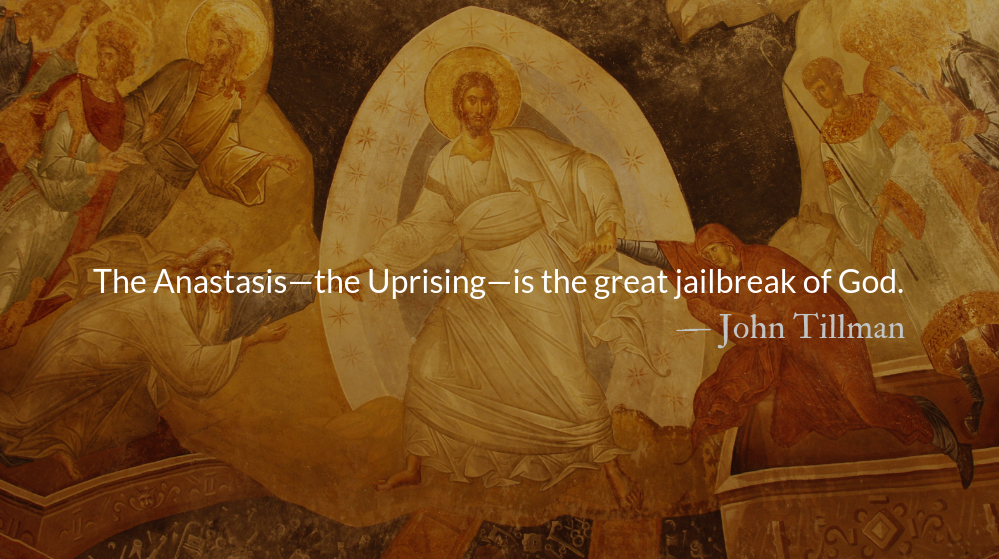
The depictions of Christ in today’s readings relate strongly to a traditionally Eastern Christian visualization of this ultimate resurrection that translates anastasis more literally as “Uprising.”

These artworks depicting Christ’s resurrection step outside of time and geography to show Christ exiting the doors of Hell itself, literally breaking open the gates. He is often depicted stepping upon Death, as he leads by the hand Adam, Eve, and others of the faithful dead.

The Anastasis—the Uprising—is the great jailbreak of God.

The Uprising is a visualization of Christ’s resurrection gleaned less from gospel accounts than from multiple sources throughout scripture, including our passage today in Micah, where Christ is “the One who breaks open the way,” gathering captives together and smashing through the gates holding them back, and our passage from Luke, where Christ portrays himself as a violent thief, breaking in to the house of the strong man, Satan, destroying his defenses, and plundering his possessions.

The Anastasis can be interpreted as an Eighth Day occurrence, an event occurring outside of time. But it can also be understood as “already and not yet.” It is both completed in the past, coming in the future, and happening now, in our midst.

Our ultimate freedom may be in the future, but Christ is still the strong man, standing ready to liberate us today as he did the many demoniacs in scripture. We may not suffer in the same way they did but aren’t we still impaired as many of them were?

Aren’t we at times mute when we should speak truth into the lives around us?
Don’t we at times throw ourselves into the fires of judgment rather than accept Christ’s grace?
Don’t we at times harm others and ourselves in our rage?

What sins are you blind to? What cries for help are you deaf to? What injustice leaves you mute, unwilling to speak?

May Jesus, the strong man, the liberator, free us to see, to hear, and to speak.
May he kick open the gates of what paralyzes us and lead us out to do his work in the world.

May we join the Uprising.

Prayer: The Call to Prayer
God has gone up with a shout, the Lord with the sound of the ram’s horn.  — Psalm 47:5

– Prayer from The Divine Hours: Prayers for Autumn and Wintertime by Phyllis Tickle.

Prayers from The Divine Hours available online and in print.

Today’s Readings
Micah 2 (Listen – 2:11)
Luke 11 (Listen – 7:33)

Additional Reading
Read More about The Eighth Day
Peter encourages his readers about Christ’s second coming with thoughts that closely relate to the Jewish concept of the eighth day that was influential on early Christian belief and practice.

Read More about Freedom for Prisoners :: Epiphany
The Gospel is a jailbreak. Jesus is a thief in the night, robbing the possessions of the strong man, Satan—stealing away with captives who foolishly, yet willingly sold themselves to the debtor’s prison of sin.

Support our Work
Each month over 22,000 Park Forum email devotionals are read around the world. Support our readers with a monthly or a one time donation.

*Image By © José Luiz Bernardes Ribeiro /, CC BY-SA 3.0

Vibrant Faith :: Weekend Reading List

Our mission at The Park Forum is to cultivate vibrant faith and sharpen cultural insight through curated devotionals and scripture readings. Each day over 4,000 of us read, pray, and expand our faith through this community.

Over the last year we’ve sought to grow not only our knowledge of Scripture, but our understanding of the culture we live in. We believe that fostering an informed faith is one of the first steps in making the grace and peace of Christ known in our communities.

Today, for the final Weekend Reading List of the year, we want to take a look back at some of our favorites.


Restorative Silence

Once a spiritual discipline, silence is now more likely to be viewed as the uncomfortable penalty for those who do not have enough to do. But how can we hear the whispers of the Spirit without the cloister of silence?


David Brooks on Simplicity and Morality

Life seems to become perpetually more overwhelming, despite the time and money we spend simplifying—most of us feel underwater when it comes to work, family, and personal life.


The Bible’s Future

More versions of Scripture are available, while less people are reading and legally able to spread the word of God than ever before. It is time for Scripture’s seventh major transition.


Christian Civility

Civility falters when people live in fear—fear that their views may be wrong; fear that their power is limited; fear that there is no sovereign who cares for their interests.


Confronting Sin

Today’s calls for racial justice, if anything, understate the problem—white America, however well meaning, is astonishingly oblivious to pervasive inequity.


Today’s Reading
Jonah 4 (Listen – 1:56)
Luke 9 (Listen – 8:05)

This Weekend’s Readings
Micah 1 (Listen – 2:46) Luke 10 (Listen – 5:40)
Micah 2 (Listen – 2:11) Luke 11 (Listen – 7:33)


Show Buttons
Hide Buttons
Spur a spiritual rhythm of refreshment right in your inbox
By joining this email list you are giving us permission to send you devotional emails each weekday and to communicate occasionally regarding other aspects of the ministry.
100% Privacy. We don't spam.