The Depths of Suffering

And Jesus said to them, “Why are you afraid, O you of little faith?” Then he rose and rebuked the winds and the sea, and there was a great calm. — Matthew 8.26

In some ways, the prosperity gospel’s value proposition is appealing: faithfully obey God and he will keep your life privileged and comfortable. It’s a quid pro quo—if you can muster up faith, then he will respond to your strength. But this is not the way it worked for the saints’ lives recorded in Scripture.

God chose not to save Israel from slavery, but to rescue them in it. “Ah!”—the prosperity delusion says—they were sinful; they had a lesson to learn before the Exodus. It’s clear disobedience is an element of their story, but obedience and faithfulness aren’t demonstrated anymore after the Exodus than they are before or during it.

Consider Shadrach, Meshach, and Abednego. They were faithful, but God didn’t save them from the fire—he saved them in it. “There are four men walking around!” the king exclaimed. Daniel wasn’t spared from receiving the death penalty, but he was rescued in the depths of the pit.

Had Daniel expected God to protect him from the embarrassment of arrest, the anguish of being sentenced to death, or even the fall down onto the sandy blood-stained floor, the great man of prayer would have missed what was happening. Where was God when Daniel was falling into the pit? At the bottom, we learn, waiting in the depths of suffering.

Jesus’ disciples falsely believed that their faith in Christ would exempt them from experiencing the storms of life. When the tempest lashed against them they cried out, “Save us!” It is no different from us.

Like with Israel, God redeems us from the slavery of sin and brokenness. Like with Shadrach, Meshach, and Abednego, Gods meets us in the fiery struggles of our world. Like with Daniel, God is the only thing sufficient to spare us from death’s sting. Yet this is not all he does.

Limiting the story of the gospel to individual salvation focuses our faith on ourselves. If our lives are the focus of Christ’s work, then going through a storm is a sign God has lost control. Yet if the gospel is about a greater work of renewing and restoring a lost and broken world, then we can trust God to be Emmanuel—God with us—in the storm.

Today’s Reading
Isaiah 60 (Listen – 3:55)
Matthew 8 (Listen – 4:09)
Roads and Stars

[Jesus said,] “Enter through the narrow gate. For wide is the gate and broad is the road that leads to destruction, and many enter through it.” — Matthew 7.13

The Romans were the first culture in history to prioritize roads. The Law of Twelve Tables, one of Rome’s founding legal documents from around 450 B.C.E., required roads to be no less than eight feet wide with 16 foot widths in turns—far wider than the single-path trails which were the then-historical standard for human travel.

Rome’s cultural expansion, economy, and military scaled rapidly as their citizens traversed the 250,000-mile network of cobblestone.

Jesus’ message not to trust the pathways of the empire is less counter-cultural in modern time. Gallop has published a deluge of research revealing Americans’ rapidly-eroding trust in institutions. While most people in Rome’s day looked toward their government to deliver happiness, success, and meaning, most people in our day do not.

The institution of government does not represent all Americans well, but other cultural institutions—like the movie industry—may better reveal our loyalties. Even the title of the award-winning film The Fault in Our Stars suggests what many believe: we are fine; but there are problems (and people) outside of ourselves that keep us from the life we really want.

Though we don’t look to our empire in the same ways, we still live on Roman Roads—pursuing the interests of our personal kingdoms through a vast network of personal expression, commerce, and self-protection.

“The fault, dear Brutus, is not in our stars, but in us,” laments Cassius in Julius Caesar. Perhaps Shakespeare is confessing what we are slow to admit: the problem really isn’t just in our stars, it’s in our relentless pursuit of self.

This idea may be what Viktor Frankl was reflecting on when he wrote:

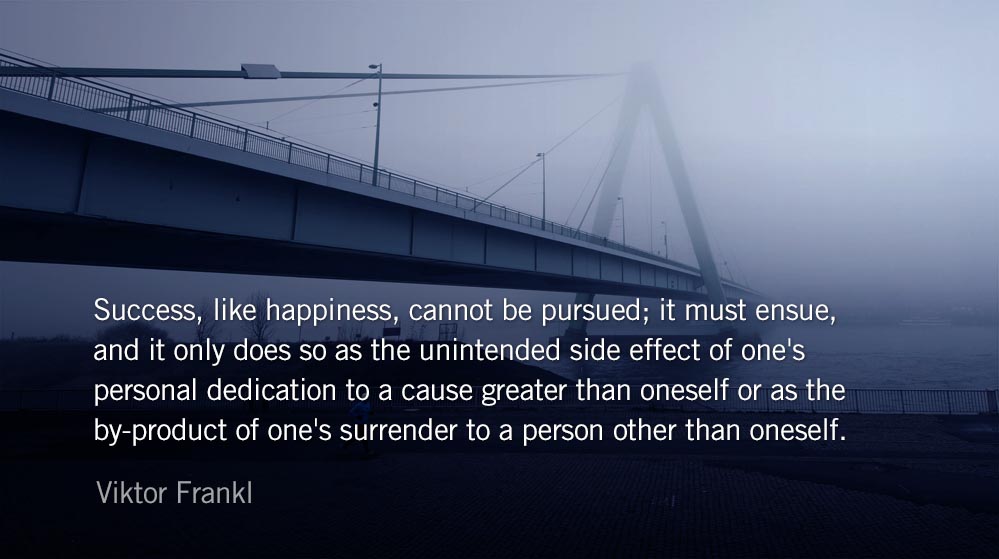
Don’t aim at success. The more you aim at it and make it a target, the more you are going to miss it. For success, like happiness, cannot be pursued; it must ensue, and it only does so as the unintended side effect of one’s personal dedication to a cause greater than oneself or as the by-product of one’s surrender to a person other than oneself.

The wide path nearly guarantees comfort and luxury, but is insufficient for meaning and fulfillment. Jesus’ invitation requires we exit the roads on which we pursue ourselves—for, in his words, “Whoever finds their life will lose it, and whoever loses their life for my sake will find it.”

Today’s Reading
Isaiah 59 (Listen – 3:54)
Matthew 7 (Listen – 3:31)

When the World Needs Us to Look :: Weekend Reading List

I spent the first five years of my professional life as a paramedic in the critical care, neonatal transport, and 911 systems of Dallas and Fort Worth, TX. I’ve been around gunfire three times; once my partner and I were shot at, the other two times we were simply far too close when shots were fired on others. Although both warrant immediate action, if I’m honest I’ll admit I generally prefer shot-near to shot-at.

I’ll never forget the first time my tactical boot stepped in a deep enough puddle of blood that it rippled as I walked toward my patient. I’ll never forget carrying the lifeless bodies of children toward the ambulance while their parents chased after us, praying and hoping we could help.

Our culture is designed to insulate us from the realities medical professionals face each day—even more from the stories of those who give their lives to serve the marginalized through organizations like Doctors Without Borders.

The barrier was broken this past week by Ben Taub’s haunting New Yorker article, The Shadow Doctors. As I read Taub’s account of the small group of doctors serving and suffering in Syria, I found myself wanting to look away. Then I realized this impulse—to return to my comfortable life—is among the greatest tragedies of the modern world: instead of facing reality, we have the option to turn away. Taub writes:

For almost a year, Syrian government helicopters had been lobbing barrels filled with shrapnel and TNT onto markets, apartment blocks, schools, and hospitals.

In the aftermath of a barrel-bomb attack, [Dr. David Nott] said, “as you walked down the stairs to the emergency department, you just heard screams.” Barrel bombs blow up entire buildings, filling the air with concrete dust; many people who survive the initial explosion die of suffocation minutes later. Every day, patients arrived at the hospital so mangled and coated in debris that “you wouldn’t know whether you were looking at the front or the back, whether they were alive or dead,”

When barrel bombs fall on homes, they often send entire families to the ward. One day, five siblings arrived. Unable to treat any of them, Nott started filming the scene, so that he would have proof, he said, of “how terrible it was.” A baby with no feet let out a stifled cry, then died. An older brother lay silently nearby, his guts coming out. In the next room, a toddler with blood on his face shouted the name of his dying brother.

Two medical workers carried in the fourth brother, who was about three years old. His pelvis was missing, and his face and chest were gray with concrete dust. He opened his eyes and looked around the room, blinking, without making a noise.

The boy was dying. There was no treatment; he had lost too much blood, and his lungs had filled with concrete particles. Nott held his hand for four agonizing minutes. “All you can do is just comfort them,” he told me. I asked him what that entailed, since [the hospital] had exhausted its supply of morphine. He began to cry, and said, “All you can hope is that they die quickly.”

Dr. Nott has trained a team of medical professionals to serve in a network of underground hospitals. They are so effective the Syrian government has started to target them for assassination.

Shots have been fired at our global brothers and sisters, and their lives are near enough to ours that it should move us to action. The global refugee crisis is a massive problem—yet it is not beyond the sufficiency of Christ’s work of restoration in and through his Church.

Refugees and immigrants need our prayers and action on their behalf. Organizations serving in this crisis need our support. Government officials working toward justice need to hear our voices speaking out for the fatherless and the marginalized. The blood of innocent children will ripple as we move toward those that need our help the most—but we cannot look away.

Weekend Reading List

Today’s Reading
Isaiah 56 (Listen – 2:11)
Matthew 4 (Listen – 3:09)

This Weekend’s Readings
Isaiah 57 (Listen – 3:37) Matthew 5 (Listen – 6:03)
Isaiah 58 (Listen – 3:09) Matthew 6 (Listen – 4:35)

Sorrow and Hatred :: Throwback Thursday

By Thomas Watson (c. 1620 – 1686)

“Repent, for the kingdom of heaven is at hand.” — Matthew 3.2

It is one thing to be a terrified sinner and another to be a repenting sinner. Sense of guilt is enough to breed terror. Infusion of grace breeds repentance. If pain and trouble were sufficient to repentance, then the damned in hell should be most penitent, for they are most in anguish. Repentance depends upon a change of heart.

Repentance is a grace of God’s Spirit whereby a sinner is inwardly humbled and visibly reformed. For a further amplification, know that repentance is a spiritual medicine made up of six special ingredients:

  1. Sight of Sin
  2. Sorrow for Sin
  3. Confession of Sin
  4. Shame for Sin
  5. Hatred for Sin
  6. Turning from Sin

If any one is left out it loses its virtue.

Sorrow for Sin

Godly sorrow is fiducial. It is intermixed with faith: “the father of the child cried out, and said with tears, Lord, I believe” (Mark 9.24). Here was sorrow for sin checkered with faith, as we have seen a bright rainbow appear in a watery cloud.

Spiritual sorrow will sink the heart if the pulley of faith does not raise it. As our sin is ever before us, so God’s promise must be ever before us. As we much feel our sting, so we must look up to Christ our brazen serpent.

Some have faces so swollen with worldly grief that they can hardly look out of their eyes. That weeping is not good which blinds the eye of faith. The Christian has arrived at a sufficient measure of sorrow when the love of sin is purged out.

Confession of sin makes way for pardon. No sooner did the prodigal come with a confession in his mouth, “I have sinned against heaven,” than his father’s heart did melt towards him, and he kissed him

Hatred for Sin

A holy heart detests sin for its intrinsic pollution. Sin leaves a stain upon the soul. A regenerate person abhors sin not only for the curse but for the contagion. He hates this serpent not only for its sting but for its poison. He hates sin not only for hell, but as hell.

True hatred is implacable; it will never be reconciled to sin any more. Anger may be reconciled, but hatred cannot.

Let it not be said that repentance is difficult. Things that are excellent deserve labor.

*Excerpted and languages updated from The Doctrine of Repentance by Thomas Watson.

Today’s Reading
Isaiah 55 (Listen – 2:11)
Matthew 3 (Listen – 2:17)

Jesus, the Refugee

“Rise, take the child and his mother, and flee to Egypt, and remain there until I tell you.” — Matthew 2.13

If Christ were born today he wouldn’t be the scion of an affluent mega-church pastor; his mother wouldn’t have access to social media to share her delight; his skin wouldn’t fit in the majority of any dominant industrialized nation.

Instead he would be another child cradled in the arms of one of millions of nameless refugees risking their lives to flee a murderous dictator.

His parents’ faces would reveal the extraordinary stress of a journey where the natural elements daily threaten their child. They would live under constant pressure from wicked traffickers and the callous governments whose international apathy is matched only by their desire to reroute the vulnerable.

Statistically speaking, if the the Son of God were born today, it would be highly likely that his young corpse would wash up on a shore somewhere.

These are not political statements—it’s tragic that mentioning refugees hurls our discourse into partisanship—as much as observations of the depths that a member of the Godhead was willing to venture in order to enter our suffering and pour out his love to the world.

In another way, possibly the way Scripture intends, these statements are a rebuke to those of us who would likely miss such a man.

He had no form or majesty that we should look at him, and no beauty that we should desire him. He was despised and rejected by men; a man of sorrows, and acquainted with grief; and as one from whom men hide their faces he was despised, and we esteemed him not. — Isaiah 53.2-3

We don’t praise Jesus today because he was the refugee who went from rags to riches. It’s actually the exact opposite. This is the gospel: the Son of the King willingly cast off every comfort, privilege, and glory—laying down his very life—so that we might inherit the righteousness of God.

Christ is near to us today; the only question is whether we’re willing to share our abundance with the world he loves. Jesus says that, when given the option, many still esteem him not:

For I was hungry and you gave me no food, I was thirsty and you gave me no drink, I was a foreigner and you did not welcome me.

Today’s Reading
Isaiah 54 (Listen – 3:14)
Matthew 2 (Listen – 3:18)

Show Buttons
Hide Buttons
Spur a spiritual rhythm of refreshment right in your inbox
By joining this email list you are giving us permission to send you devotional emails each weekday and to communicate occasionally regarding other aspects of the ministry.
100% Privacy. We don't spam.