
Eating With Enemies

Scripture Focus: 2 Kings 6.17-18, 20-23
16 “Don’t be afraid,” the prophet answered. “Those who are with us are more than those who are with them.” 
17 And Elisha prayed, “Open his eyes, Lord, so that he may see.” Then the Lord opened the servant’s eyes, and he looked and saw the hills full of horses and chariots of fire all around Elisha. 
18 As the enemy came down toward him, Elisha prayed to the Lord, “Strike this army with blindness.” So he struck them with blindness, as Elisha had asked. 

20 After they entered the city, Elisha said, “Lord, open the eyes of these men so they can see.” Then the Lord opened their eyes and they looked, and there they were, inside Samaria. 
21 When the king of Israel saw them, he asked Elisha, “Shall I kill them, my father? Shall I kill them?” 
22 “Do not kill them,” he answered. “Would you kill those you have captured with your own sword or bow? Set food and water before them so that they may eat and drink and then go back to their master.” 23 So he prepared a great feast for them, and after they had finished eating and drinking, he sent them away, and they returned to their master. So the bands from Aram stopped raiding Israel’s territory. 

Matthew 26.52-54
52 “Put your sword back in its place,” Jesus said to him, “for all who draw the sword will die by the sword. 53 Do you think I cannot call on my Father, and he will at once put at my disposal more than twelve legions of angels? 54 But how then would the Scriptures be fulfilled that say it must happen in this way?” 

Psalm 23.5
5 You prepare a table before me
    in the presence of my enemies.
You anoint my head with oil;
   my cup overflows.

Reflection: Eating With Enemies
By John Tillman

Elisha was, perhaps, never more Christ-like than when he led an army of his political enemies into the citadel of his spiritual enemies and then directed everyone to sit and eat a meal together.

This wasn’t a kumbaya moment where everyone held hands and decided to get along. It was a power play. Elisha demonstrated that God alone was king—not Joram, not the king of Aram, Yahweh. Elisha, through God’s power, prepared a table in the presence of his enemies and made them eat together. (Psalm 23.5)

However, no demonstration of God’s power is sufficient to prevent human rebellion. After a short peace in which Aram avoided Israel’s territory, hostilities resumed. After calling Elisha, “Father,” and being obedient during a crisis, Joram and Israel’s kings returned to their idolatry.

No miracle or display of power can sustain faith. The Bible proves over and over that miraculous signs and wonders will not convince us to abandon our idols for long.

Sin is too ingrained in us to be sanded off, like a minor imperfection. Sin is too bold to be frightened away. It crouches at our door. It seeks to master us. It asks to sift us. It hovers over us like a mighty predator. It surrounds us like an army.

Yet, we are not without hope. Like Elisha’s servant, we need our eyes opened to realize those with us are greater than those with them. He that is within us is greater than he that is in the world. (1 John 4.4) The sin that stalks us, has been defeated by the one who walks with us. (Psalm 23.4) The sin that crouches at our door has been nailed to Christ’s cross. (Genesis 4.7) Sin intends to sift us, but Christ has prayed for us. (Luke 22.32)

Like Peter, we will deny Christ, draw our swords, and sin. But we can turn back and strengthen others. Walking with Christ, we will be led to eat with our enemies rather than destroy them.

When Christ leads us into the heavenly city, we will find ourselves dining and worshiping with people we harmed or who harmed us. Christ’s love will cover all, Christ’s justice will restore our hurts and harms, and we will feast together.

However, we shouldn’t wait for eternity. Let us call on God’s power for peace, not destruction. Let us love our enemies today. Through Christ, enemies can eat together in peace.

Divine Hours Prayer: The Call to Prayer
Be strong and let your heart take courage, all you who wait for the Lord. — Psalm 31.24

– From The Divine Hours: Prayers for Summertime by Phyllis Tickle.

Today’s Readings
2 Kings 6 (Listen – 5:05)
1 Timothy 3 (Listen – 2:10)

Read more about Christless Forgiveness is the Absence of Justice
Forgiveness is unjust if forgiveness is simply letting evil succeed…if victims are never heard and no one ever answers for their pain.

Read more about The Undeserved Banquet of the Gospel
God sets his table for scoundrels, shaking hands with undeserved trust.

Misleading the Least — Readers’ Choice

Readers’ Choice Month:
In August, The Park Forum looks back on our readers’ selections of our most meaningful and helpful devotionals from the past 12 months. Thank you for your readership. This month is all about hearing from you. Submit a Readers’ Choice post today.

Today’s post was originally published, January 18, 2021, based on readings from Matthew 18.
It was selected by reader, Brian Miller from Florence MT
Thank you for this devotional.  This is very pertinent today.  May our words or actions never hinder someone’s journey with Jesus. Someone is always watching us. May our actions always reflect Christ.

Scripture Focus: Matthew 18:6–9
6 “If anyone causes one of these little ones—those who believe in me—to stumble, it would be better for them to have a large millstone hung around their neck and to be drowned in the depths of the sea. 7 Woe to the world because of the things that cause people to stumble! Such things must come, but woe to the person through whom they come! 8 If your hand or your foot causes you to stumble, cut it off and throw it away. It is better for you to enter life maimed or crippled than to have two hands or two feet and be thrown into eternal fire. 9 And if your eye causes you to stumble, gouge it out and throw it away. It is better for you to enter life with one eye than to have two eyes and be thrown into the fire of hell.

Reflection: Misleading the Least — Readers’ Choice
By John Tillman

The gospels record many times that people asked Jesus about “the greatest.”

There are religious debates about the greatest commandments, and multiple times, in many different settings, the disciples approach Jesus about, or are caught by Jesus arguing about, “the greatest.” (Matthew 18.1-3; 23.11; Luke 9.46; Mark 9.34)

Who is the greatest in the kingdom of heaven…
Can my two sons sit in the greatest seats…
Which of us is the greatest…
We want to know, don’t we?

Jesus definitively stated that the greatest in the kingdom are the least, the lowest, the small, the “little ones.” Jesus used a child in this example, but there is a different Greek word that refers to age. The word Jesus chooses, translated little, implies low status or being unimportant. 

The unimportant, Jesus says, are of the greatest importance, but we, like the disciples, don’t quite believe it. We want to be important, big, mature, strong, dominant. We want to win. In pursuit of importance and status, we grasp at power. We grasp at fame. We grasp at wealth. All the grasping we engage in to be the greatest, is meaningless—chasing after wind.

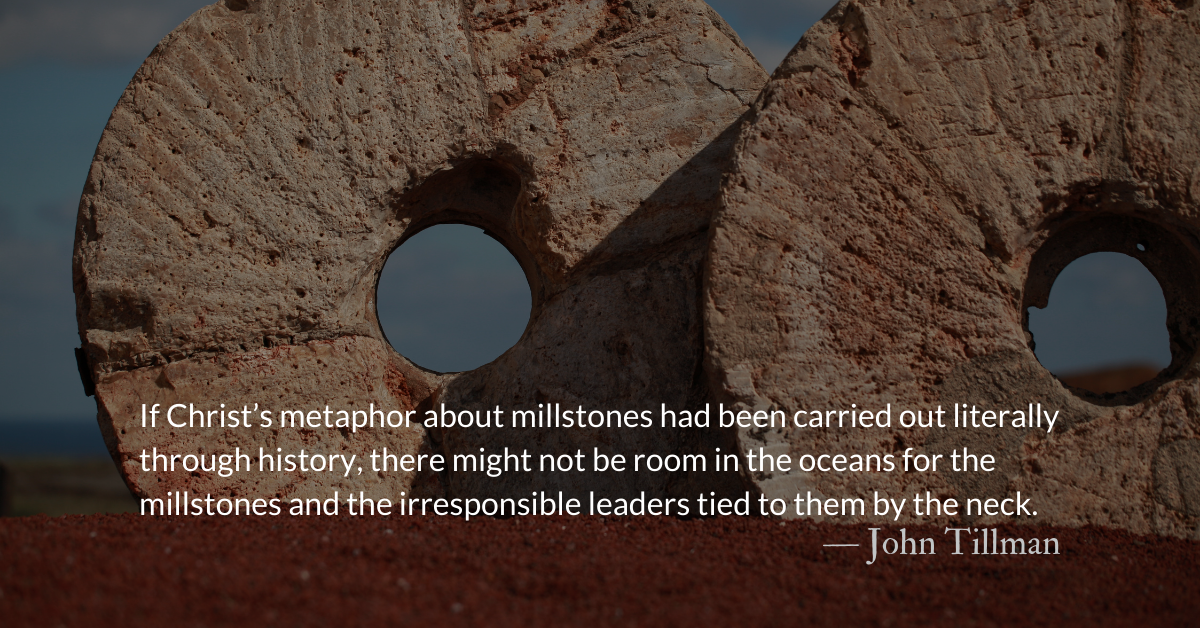
This is challenging enough to our sinful nature, but what comes next is more chilling, Jesus has a stark warning for the leaders of the little. To those leaders and influencers who through actions or words may cause “little ones” to stumble, comes one of the most graphic pictures of punishment to cross the lips of Jesus. If Christ’s metaphor about millstones had been carried out literally through history, there might not be room in the oceans for the millstones and the irresponsible leaders tied to them by the neck.

Woe to leaders who mislead. Woe to influencers who cause others to stumble. Woe when we manipulate rather than educate. Woe when we foment sin rather than form spiritual morality. Woe when we lie and deceive rather than unfailingly cling to the truth.

Have we caused others to stumble? If so, how?

By being an example of greed or any other sin? By spreading a lie? By keeping silent in the face of injustice? By sharing an inflammatory post? By provoking others? By being purposely insensitive? By manipulating people?

May we repent of any of our actions or words that may have caused others to stumble. It is better for us to cut those actions out of our lives than to cause harm to others.

Divine Hours Prayer: The Greeting
The words of the Lord are pure words, like silver refined from ore and purified seven times in fire. — Psalm 12.6

– Divine Hours prayers from The Divine Hours: Prayers for Springtime by Phyllis Tickle

Today’s Readings
1 Samuel 1 (Listen – 4:13)
Romans 1 (Listen – 5:02)

Read More about Readers’ Choice 2021
Have we heard from you yet? Tell us about posts from the past year (September 2020 – July 2021) that have helped you in your faith.

https://forms.gle/ozM13qvW9ouSWhJS7

Read more about Abimelek, Caesar, and Jesus
Believers today who feel a religious compunction to political violence are serving an idolatrous, man-made religion, not Jesus.

Who Needs Anger? — Readers’ Choice

Readers’ Choice Month:
In August, The Park Forum looks back on our readers’ selections of our most meaningful and helpful devotionals from the past 12 months. Thank you for your readership. This month is all about hearing from you. Submit a Readers’ Choice post today.

Today’s post was originally published, January 4, 2021, based on readings from Genesis 4 and Matthew 4.
It was selected by reader, Jennifer K. from Brooklyn, NY
“Why are you angry?” is a great question I need to remind myself of often, especially in this particular season where there is so much anger being spewed in the news and within my personal and professional life. The truth in “Jesus doesn’t need our anger. We need his peace” is powerful because we are powerless in anger. Wow, now I need to repeat that over and over in my daily meditations. This post struck a deep chord in my heart – my broken, sinful, hopeful, yearning for God’s love heart. My heart is only one in a world full of hearts crying out for peace yet are overwhelmed by anger, hurt and pain. Thank you, The Park Forum, for speaking truth to inspire us all to live life in love, peace and truth through our relationship with Jesus. 

Scripture Focus: Genesis 4.6-7

6 Then the Lord said to Cain, “Why are you angry? Why is your face downcast? 7 If you do what is right, will you not be accepted? But if you do not do what is right, sin is crouching at your door; it desires to have you, but you must rule over it.”

Matthew 4.8-11

8 Again, the devil took him to a very high mountain and showed him all the kingdoms of the world and their splendor. 9 “All this I will give you,” he said, “if you will bow down and worship me.” 
10 Jesus said to him, “Away from me, Satan! For it is written: ‘Worship the Lord your God, and serve him only.’” 
11 Then the devil left him, and angels came and attended him. 

Reflection: Who Needs Anger? — Readers’ Choice

By John Tillman

Anger is just one of the devil’s tools that he uses as he “crouches at the door,” ready to master us as he did Cain, longing to sift us as he did Peter. (Luke 22.31-32) When Jesus condemned being angry at one’s brother as being comparable to murder, (Matthew 5.21-22) it is likely that he had Cain’s anger, and its result, in mind.

Anger is out of control in our society. Two of the main reasons why are that anger feels good and anger is profitable. 

Anger feels good? Yes. We get a rush of self-righteousness from anger. Anger gives us a false feeling of control. We feel as if by our anger we are doing something about a problem.

Anger is also profitable. How? Because it is a reliable trigger for manipulation. Satan knew this in the garden and used anger to manipulate Cain. Article writers know this. Politicians know this. Advertisers know this. Angry readers click and share without verifying facts. Angry voters vote rashly. Angry consumers are suggestible and susceptible. Angry citizens tolerate and ignore the abuses of leaders who stoke their anger.

The sin of anger hides in other things. Anger hides in misguided love. (Abusive husbands and parents “love” their wives and children. Abusive leaders “love” their country.) Anger hides in our desires for justice. Anger tempts us to seize control. Jesus was tempted to seize the kingdoms of the world in the wilderness. Peter attempted to seize control with a sword in the garden.

In an age of anger, God’s question to Cain is more relevant to us than ever. God asks, “Why are you angry?” 

Are you being manipulated by anger? What is motivating your anger? What is your anger prompting you to do? Will you do it? Who will profit when you do?

How we respond to anger will determine how easily we will be manipulated. The anger that so easily trips us up reveals our need for Jesus. Peter thought Jesus needed him in the garden. Many today think that Jesus needs the angry swings of our social media swords or other dangerous weapons. Jesus doesn’t need our anger. We need his peace. 

Satan may sift us like wheat, but after we have turned back, may we, like Peter, strengthen our brothers with love and not anger. May we lay down our angry swords and take up feeding his lambs and carrying our cross.

Divine Hours Prayer: The Call to Prayer
Let the righteous be glad and rejoice before God; let them be merry and joyful. — Psalm 68.3

– Divine Hours prayers from The Divine Hours: Prayers for Springtime by Phyllis Tickle

Today’s Readings
Judges 19 (Listen – 4:52)
Acts 23 (Listen – 5:15)

Read More about Readers’ Choice 2021
It is time to hear from you about the posts from the past eleven months (September 2020 – July 2021) that have challenged, comforted, and helped you find new meaning in the scriptures.

https://forms.gle/ozM13qvW9ouSWhJS7

Read more about The Focus of Christ’s Anger
In our culture of outrage, we can’t get enough of anger.

Deuteronomy’s Dream for the Poor

Scripture Focus: Deuteronomy 15.4-5, 7-11
4 …there need be no poor people among you, for in the land the Lord your God is giving you to possess as your inheritance, he will richly bless you, 5 if only you fully obey the Lord your God …

7 If anyone is poor among your fellow Israelites in any of the towns of the land the Lord your God is giving you, do not be hardhearted or tightfisted toward them. 8 Rather, be openhanded and freely lend them whatever they need. 9 Be careful not to harbor this wicked thought: “The seventh year, the year for canceling debts, is near,” so that you do not show ill will toward the needy among your fellow Israelites and give them nothing. They may then appeal to the Lord against you, and you will be found guilty of sin. 10 Give generously to them and do so without a grudging heart; then because of this the Lord your God will bless you in all your work and in everything you put your hand to. 11 There will always be poor people in the land. Therefore I command you to be openhanded toward your fellow Israelites who are poor and needy in your land. 

Matthew 26.11
11 The poor you will always have with you, but you will not always have me.

Reflection: Deuteronomy’s Dream for the Poor
By John Tillman

Matthew 26.11 is just one phrase of many words of Jesus that have been misquoted, taken out of context, or abused in history. People have used this to imply that poverty is intractable and action against it is ineffectual at best and against God’s will at worst. This false teaching is one of the more damaging ones to spread in the history of the church.

Jesus never implied opposing poverty means opposing God’s sovereignty. Instead, Jesus directly referenced Deuteronomy 15.11, including its command to be openhanded toward the poor.

Deuteronomy makes an extraordinary promise that “there need be no poor people among you” (Deuteronomy 15.4) but follows it up with realism, saying, “There will always be poor people…” (Deuteronomy 15.11)

God proclaims the possibilities of generosity while acknowledging the grim reality of greed. Through following God, we can open our hearts and hands, maintaining idealistic visions and actions without losing sight of ugly realities. Christians can look the darkest realities of poverty in the face and confidently say, “It doesn’t have to be this way.” 

“If only you fully obey the Lord your God.” (Deuteronomy 15.4)

The dream of Deuteronomy 15.4 was fulfilled (for a short time) in the early church. It was said of them, “God’s grace was so powerfully at work in them all that there were no needy persons among them.” (Acts 4.33-34) These Spirit-filled believers fulfilled Deuteronomy’s proclaimed possibility about the poor.

All systems controlled by humans eventually become corrupted and the Acts 4 church is no exception. Racism slips into the distribution of food and the highest levels of the church leadership must get involved (and get honest) to solve it. Corruption in systems run by humans is inevitable. If the church’s own system faced accusations of inequity, how much more can we expect inequity to be a concern in secular systems? However, these concerns are not a reason that we should abandon our calling in this area. 

At the heart level of each individual and at the highest levels of our churches, denominations, and governments, Christians must acknowledge that the poor are our responsibility and are one way that God will judge how well we are helping his will to be done “on Earth as it is in Heaven.” (Matthew 6.9-10)

Divine Hours Prayer: The Refrain for the Morning Lessons
Let not those who hope in you be put to shame through me, Lord God of hosts; let not those who seek you be disgraced because of me. — Psalm 69.6

 – Divine Hours prayers from The Divine Hours: Prayers for Springtime by Phyllis Tickle

Today’s Readings
Deuteronomy 15 (Listen – 3:20)
Psalm 102 (Listen – 2:45)

Read more about Spiritual Indicators
God holds his people responsible for the welfare of the poor, the foreigners, the widows, and the orphans.

https://theparkforum.org/843-acres/spiritual-indicators

Read more about He Became Poor
The reasons God gives for his just acts of judgment against Israel and Judah…always include offenses related to oppression of the poor.

The Shema and The Lord’s Prayer

Scripture Focus: Deuteronomy 6.3-9
3 Hear, Israel, and be careful to obey so that it may go well with you and that you may increase greatly in a land flowing with milk and honey, just as the Lord, the God of your ancestors, promised you. 

4 Hear, O Israel: The Lord our God, the Lord is one. 5 Love the Lord your God with all your heart and with all your soul and with all your strength. 6 These commandments that I give you today are to be on your hearts. 7 Impress them on your children. Talk about them when you sit at home and when you walk along the road, when you lie down and when you get up. 8 Tie them as symbols on your hands and bind them on your foreheads. 9 Write them on the doorframes of your houses and on your gates.

Matthew 6.9-13
9 “This, then, is how you should pray: 
“ ‘Our Father in heaven, 
hallowed be your name, 
10 your kingdom come, 
your will be done, 
on earth as it is in heaven. 
11 Give us today our daily bread. 
12 And forgive us our debts, 
as we also have forgiven our debtors. 
13 And lead us not into temptation, 
but deliver us from the evil one.’

Reflection: The Shema and The Lord’s Prayer
By John Tillman

Many people today pray daily using The Lord’s Prayer which Jesus taught his disciples in the New Testament. Jesus and his disciples however, already grew up saying a daily prayer. It was a prayer taken from Moses’ speech to the people about to enter the land and was, in Jesus’ day, said twice daily. Jesus answered using this prayer when he was asked what the greatest commandment in the law was. (Mark 12:28-34; Matthew 22.36-40)

This prayer is called, “the Shema.” The Shema takes its name from the first word of the prayer. The Hebrew word shema is sometimes translated to listen or hear. In this prayer, and elsewhere in scripture, hearing and obeying are intrinsically linked in the Hebrew language. Shema implies not just hearing words but carrying them out. 

In The Lord’s Prayer, action is also implied. Praying “your will be done on Earth as it is in heaven,” is not intended to be a passive wish with no participation on our part. In both the Shema and The Lord’s Prayer, we are expected to engage in concrete actions once we stop praying.

We will pray today, combining these two prayers from scripture. Before you rise from prayer, ask God to guide your feet and hands to enact his word.

Hear, Listen, Obey
We ask you to hear us, God, but we need to hear you.
You alone are God, our only Father in Heaven
Your name is holy as we are to be holy.
Father, Son, and Spirit are one, as we are to be one.

You alone are the provider of our bread.
You alone are the forgiver of our debts.

In return, Lord, we love you with all our heart, showing your love to others in forgiveness
In return, Lord, we love you with all our soul, opening our inner being to your indwelling
In return, Lord, we love you with all our strength. The strength of our body and mind, we give to you for your service and will.

Tie your Word to us that…
In your strength, may we resist temptation.
In your love, may we rescue the falling.
In your Spirit, may we speak the gospel with our words, carry the gospel with our feet, and enact the gospel with our hands.

Video: (Shema — The Bible Project)

Divine Hours Prayer: A Reading
Jesus taught us, saying: “Whoever holds to my commandments and keeps them is the one who loves me; and whoever loves me will be loved by my Father, and I shall love him and reveal myself to him.” —- John 14.21– Divine Hours prayers from The Divine Hours: Prayers for Springtime by Phyllis Tickle

Today’s Readings
Deuteronomy 6 (Listen – 3:13)
Psalm 89 (Listen – 5:29)

Read more about Lewis on Prayer Without Words
For many years after my conversion I never used any ready-made forms except the Lord’s Prayer… — C.S. Lewis

Read more about Public, Prayerful, Persistent Protest
Daniel prayed in defiance of an unjust law. He was guilty before the law of the land, but blameless before God.