Better Things to Do

Amos 8.5-6, 11
When will..the Sabbath be ended
that we may market wheat?
…buying the poor with silver
and the needy for a pair of sandals…

“The days are coming,” declares the Sovereign Lord,
“when I will send a famine through the land—
not a famine of food or a thirst for water,
but a famine of hearing the words of the Lord.

Reflection: Better Things to Do
By John Tillman

At this time of year a basket of ripe fruit brings connotations of joy and celebration, but as God explained to Amos, the ripeness of the fruit was not the ripeness of joy, but of inward sin.

The people of Israel only seem religiously observant. Inwardly, they are wishing that the bothersome business of worshiping God could be over with so they could get back to making money.

In a day when only openly religious businesses dare to be closed on Sunday, we may not comprehend a time when no business in the nation-state of Israel would dare to be open on a religious holiday.

In our culture, extended holiday hours are expected. They are a fact of life and many work additional jobs during the holidays to get by.

Although I’ve never rushed out of church to open a grain market, at times I have needed to get to the mall and open a Santa set. In my own life and the lives of many others, additional holiday employment doesn’t supply luxuries or money for presents, it is needed to get by. The additional work I get around the holidays has at times provided nearly a third of our yearly income. The gig economy is not always pretty.

The poor indeed are bought with silver.

We see repeated in Amos the theme of economic sins being prioritized by the Lord’s prophets in his messages. The uncaring attitude that the wealthy market owner has starts with a greedy lie that he has better things to do than worship God—namely, to wring out profit from every minute, every worker, and every square foot of land.

As we move into a cultural season in which we will all interact with many seasonal workers—often undertrained and often sleep-deprived—may we at a minimum interact with them with mercy and grace. And, for those who are supervisors and managers, may we work to humanize our treatment of our employees and better their lives encouraging as much rest as is possible in this season of economic frenzy.

And in moments of worship, whether private or corporate, may we remember there is nothing more profitable that we could be doing than worshiping God.

Amos is clear that if we don’t value worshiping God, the punishment is a famine. Not a famine of profit, or water, or food. A famine of the Word of God.

Prayer: The Call to Prayer
Come now and see the works of God, how wonderful he is in his doing toward all people.  — Psalm 25.1-2

– Prayer from The Divine Hours: Prayers for Autumn and Wintertime by Phyllis Tickle.

Prayers from The Divine Hours available online and in print.

Today’s Readings
Amos 8 (Listen – 2:16)
Luke 3 (Listen – 5:24)

Additional Reading
Read More about Inattentiveness in Worship :: Readers’ Choice
We must cultivate in worship a certain kind of inattentiveness toward other worshipers and even toward the leaders—maintaining our attention on God as the focus of all our joined efforts.

Read More about Prayers God Hates
Jesus, like Jeremiah, was concerned about oppression. We see this not only by who is driven out, but by who Christ calls in their place. The blind. The lame. The children. Christ makes room for the marginalized and the oppressed, and in they come.

Support our Work
Each month over 22,000 Park Forum email devotionals are read around the world. Support our readers with a monthly or a one time donation.
Under His Covering

Luke 1.49-51
The Mighty One has done great things for me—
holy is his name.
His mercy extends to those who fear him,
from generation to generation.
He has performed mighty deeds with his arm;
he has scattered those who are proud in their inmost thoughts.

Amos 5.24
But let justice roll on like a river,
righteousness like a never-failing stream!

From John:
There are echoes of Amos (and other prophets) in Mary’s song, especially in relation to God’s compassion for and provision for the outcasts, the poor, and the oppressed. As you read both scriptures this weekend, may we join in Mary’s song, and let our voices sing out for the oppressed.

But I’m really writing to introduce the first contribution by a new guest writer, Dena Dyer. Dena sent me this contribution months ago and I knew it would line up perfectly on this day, so I’ve been impatiently waiting for the chance to share it with you.

Dena is a friend from seminary days and has a wonderful voice, both as a writer and a singer. You can follow her and find out about her other writings at her Facebook page. I look forward to sharing more from Dena in the future.

Reflection: Under His Covering
By Dena Dyer

When my friend Renae invited me to her country home for coffee and conversation, I eagerly accepted. After a long, refreshing talk, we toured the land around her house. Her husband, a teacher and part-time landscaper, had created several lovely sitting areas and interesting out-buildings around the property.

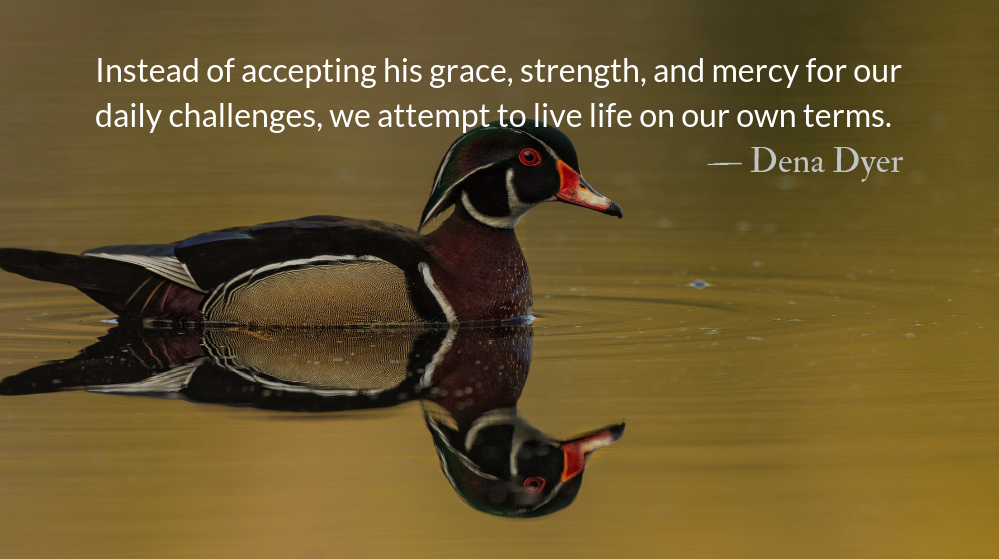
Not far from the house, Renae pointed out a small pond. “We built the duck pen first, but later decided to build homes for the birds. We wanted to keep them safe when they enjoyed the water,” she said.

I exclaimed over the craftsmanship of the two small abodes. The first was built to look like a Japanese pagoda. A foundation had been laid on four stilts, which secured the building to the pond floor. Tiny wooden steps led from the base of the duck house to the upper level, which was covered by a large peaked roof. It was beautiful, well-built, and practical.

“The ducks are dumb. They don’t use them,” Renae explained. “They sit on the pond, out in the open, and sometimes get killed and eaten by falcons.”

“What? Are you serious?” I asked. She nodded.

It struck me later that God is like Renae’s husband—a master craftsman who has given us everything we need. His gifts are beautiful, well-built, and practical.

However, we are like the ducks. Instead of accepting his grace, strength, and mercy for our daily challenges, we attempt to live life on our own terms. Then, when Satan throws hardship, temptation, or other spiritual arrows at us, we are vulnerable. Often, we get eaten alive.

I want to be more like Mary and less like a stubborn, silly duck. When God sent an angel to the young Jewish girl, Gabriel told her that he had chosen her to be the womb for the Messiah. In faith, she accepted that her heavenly Father had favored her above every other human being. She trusted him to provide for her in a myriad ways and leaned on him to give her strength throughout Jesus’ birth and life. She lifted the name of God high, instead of lifting up thousands of questions, as I would have been tempted to.

The wise men gave three presents to the baby Jesus, but God also gave three presents to Mary. He gave her the Messiah, but he also granted her joy and peace. I’m so thankful she opened all three gifts.

Has God granted you a spiritual gift that you haven’t opened out of rebellion or apathy? Confess that to the Lord, and make things right with him.
Has there ever been a time when God protected you from something because you trusted in him and followed his commands?
How can you encourage those in your community to seek shelter with God this week?

*This devotional was originally posted as a part of The High Calling devotional series.

Prayer: The Greeting
To you, O Lord, I lift up my soul; my God, I put my trust in you; let me not be humiliated, nor let my enemies triumph over me.
Let none who look to you be put to shame.  — Psalm 25.1-2

– Prayer from The Divine Hours: Prayers for Autumn and Wintertime by Phyllis Tickle.

Prayers from The Divine Hours available online and in print.

Today’s Readings
Amos 5 (Listen – 3:44)
Luke 1:1-38 (Listen – 9:26)

This Weekend’s Readings
Amos 6 (Listen – 2:13) Luke 1:39-80 (Listen – 9:26)
Amos 7 (Listen – 2:45) Luke 2 (Listen – 6:11)

Additional Reading
Read More about The Spirit of the Lord :: Epiphany
The growth of Jesus in Mary’s womb symbolizes his growth and gradual manifestation in our lives. Mary lent Jesus DNA, and cells, and tissue—her body knit him together and delivered him into our world. Mary lent his Spirit flesh. Jesus gives our flesh Spirit.

Read More about Dream Like Joseph :: Readers’ Choice
Mary, and Joseph after her, answered, “yes.” They accepted the danger. They accepted the unknown. They accepted the world-flipping power shift that would start with Mary and be concluded by her first-born son.

Support our Work
Each month over 22,000 Park Forum email devotionals are read around the world. Support our readers with a monthly or a one time donation.

Fasting as a Feast

Scripture: Luke 15.23
Bring the fattened calf and kill it. Let’s have a feast and celebrate.

Reflection: Fasting as a Feast
By John Tillman

While fasting is practically a Western spiritualized industry, and industry elites use it as a body-hack to eke out more labor and profit, feasting is viewed with shame. Our cultural concept of spirituality is bent toward asceticism so much that we have a hard time accepting anything resembling a “feast” as spiritual.

Christians have a conflicted relationship with feasting, though we seem fine with most other extravagances.

Celebrating with food is almost always discussed online and in social media as either something to be guilty about or something earned through hard work in the gym or previous fasting or cleansing. In the moralist, ascetic West, we don’t have feasts. We have “cheat days.”

Feasts are prescribed as spiritual practice right alongside descriptions of fasting in the scripture. When the Israelites left Egypt, God established a yearly liturgy of feasts and fasts—times of abstinence and times of indulgence. Feasts were times of celebration and teaching, and were intended as times of thankfulness and mindfulness toward the work of God.

Even the regular sacrifices in the Tabernacle and the Temple were times of feasting. Specific offerings for sin were burned up entirely, and some offerings could only be eaten by the priests, but, after a representative sample was burned and the priest removed his portion, many offerings were eaten by the family offering them. Regulations required these sacrifices to be eaten on the day it was sacrificed. Leftovers could be eaten the next day, but anything still leftover was to be burned. Even for a large family, eating an entire bull makes for quite a feast.

No matter what level of fasting we are pursuing, a natural part of fasting should be a spiritual feast of worship.

In experiences of fasting we are not so much abstaining from food as we are feasting on the word of God. Fasting is feasting! — Richard Foster

As we observe Lent by abstaining, may we maintain a more constant connection and relationship to God through Scripture, prayer and meditation. May more frequent times of worship be feasts for our mind, our heart, and our souls.

Prayer: The Call to Prayer
Bless our God, you peoples; make the voice of his praise to be heard; Who holds our souls in life, and will not allow our feet to slip. — Psalm 66.7-8

– Prayer from The Divine Hours: Prayers for Springtime by Phyllis Tickle.

Full prayer available online and in print.

Today’s Readings
Proverbs 1 (Listen – 3:12)
2 Corinthians 13 (Listen – 2:19)

Beethoven’s Anguish

Prayer—though it is often draining, even an agony—is in the long term the greatest source of power that is possible.

―Timothy Keller

Lenten Reflection: Beethoven’s Anguish
The Park Forum

Ludwig Van Beethoven began going deaf at age of 28. For the next decade and a half the master would suffer from excruciating ringing and pain as his auditory register eroded.

In a letter to his brothers Carl and Johann, Beethoven lamented not simply his loss in hearing, but what it meant socially, “No longer can I enjoy recreation, refined conversation, or mutual outpourings of thought. Completely isolated, I only enter society when compelled to do so.”

Early on, Beethoven’s physician sent him to a small town outside of Vienna to rest his hearing. It was during this respite the young maestro came to terms with his hearing loss—and almost committed suicide. He wrote of the experience in the Heiligenstadt Testament, named for the village in which he stayed:

What humiliation when any one beside me heard a flute in the far distance, while I heard nothing, or when others heard a shepherd singing, and I still heard nothing! Such things brought me to the verge of desperation, and well-near caused me to put an end to my life.

Art! Art alone deterred me. Ah! How could I possibly quit the world before bringing forth all that I felt it was my vocation to produce? And thus I spared this miserable life—so utterly miserable that any sudden change may reduce me at any moment from my best condition into the worst.

The letter seems to be a record of Beethoven working through his suffering in real time—finding new meaning and depth in life. In the Testament he instructs his brother to:

Recommend Virtue to your children; that alone, and not wealth, can ensure happiness. I speak from experience. It was Virtue alone which sustained me in my misery; I have to thank her and Art for not having ended my life by suicide.

In addition to the Heiligenstadt Testament, Beethoven would pen Symphony No. 3—the profound turning point in his career. The depth and vitality of the third symphony parallel the note Beethoven scribed on the outside of his Testament:

Almost as I came, I depart. Even the lofty courage that so often animated me in the lovely days of summer is gone forever. O Providence! Vouchsafe me one day of pure felicity! How long have I been estranged from the glad echo of true joy! When! O my God! When shall I again feel it in the temple of Nature and of man? — Never? Ah! that would be too hard!

Prayer: The Small Verse

Let me seek the Lord while he may still be found. I will call upon his name; while he is near.

– From The Divine Hours: Prayers for Springtime by Phyllis Tickle.

Full prayer available online and in print.

Today’s Reading
Exodus 21 (Listen – 4:44)
Luke 24 (Listen – 6:16)

This Weekend’s Readings
Exodus 22 (Listen – 4:23) John 1 (Listen – 6:18)
Exodus 23 (Listen – 4:44) John 2 (Listen – 3:02)

Contemplating the Cross

The road is narrow. He who wishes to travel it more easily must cast off all things and use the cross as his cane. In other words, he must be truly resolved to suffer willingly for the love of God in all things.

— St. John of the Cross

Lenten Reflection: Contemplating the Cross
The Park Forum

Rejection of God is not limited to irreligion; it is possible to refuse the grace of Christ through religion. Because the heart of Christianity isn’t morality, the nature of temptation isn’t a draw toward immorality.

The irreligious version of this is obvious: the systematic or categorical rejection of God. Life apart from God through religion is more difficult to see. The religious atheist is observant—even outwardly impressive in his adherence. The religious atheist sees his efforts of living like Jesus as sufficient and acceptable to God.

The cross is perplexing to someone earning acceptance through works. It seems cruel and vulgar—pointless in affecting daily life and practice. To the faithful—who place their trust in the life, death, and resurrection of Christ—the cross, while no less cruel, is also beautiful because on it we see the depth of God’s love.

In the late 19th century Edward Monro composed a five-part hymn, The Story of the Cross. In the fifth to eighth stanzas Monro writes:

Follow to Calvary;
Tread where He trod,
He Who forever was
Son of God.

You who would love Him stand
Gaze at His face:
Tarry awhile on your
Earthly race.

As the swift moments fly
Through the blest week,
Read the great story the
Cross will teach.

Is there no beauty to
You who pass by,
In that lone figure which
Marks that sky?

Monro wrestles with the weight of the cross, “For us Thy blood is shed, us alone.” Yet he is overwhelmed by the grace of God in this sacrifice. The cross is transformative in daily life because on it we see that God’s acceptance is not based on our work, but on his own—that God’s grace has no limits—that God’s love is sufficient where every earthly affection has failed.

In the final three stanzas Monro reflects on the daily impact of Christ’s sacrifice on our behalf:

Yea, let Thy cross be borne
Each day be me;
Mind not how heavy, if
But with Thee.

Lord, if Thou only wilt,
Make us Thine own,
Give no companion, save
Thee alone.

Grant through each day of life
To stand by Thee;
With Thee, when morning breaks
Ever to be.

Prayer: The Refrain

Send forth your strength, O God;* establish, O God, what you have wrought for us. — Psalm 68:28

– From The Divine Hours: Prayers for Springtime by Phyllis Tickle.

Full prayer available online and in print.

Today’s Reading
Exodus 20 (Listen – 3:21)
Luke 23 (Listen – 6:39)