Rulers with Borrowed Scepters

Scripture Focus: Genesis 49.10
10 The scepter will not depart from Judah, 
nor the ruler’s staff from between his feet, 
until he to whom it belongs shall come 
and the obedience of the nations shall be his. 

Luke 2.30-32
30 For my eyes have seen your salvation, 
31 which you have prepared in the sight of all nations: 
32 a light for revelation to the Gentiles, 
and the glory of your people Israel.”

Reflection: Rulers with Borrowed Scepters
By John Tillman

Most of what Israel says to Judah has little to do with the son in front of him, but the Son who was to come through him.

The ruler prophesied would eventually come to Judah. The staff of rulership that Israel saw, resting between the feet of Judah’s descendants, would one day be claimed and taken up. 

Ten tribes broke away from the Davidic kings’ after Solomon’s death. The Northern secessionists kept the name, Israel, and the Southern kingdom, composed of Judah and Benjamin, was called Judah after the tribe of its rulers.

Judah and Benjamin managed to preserve their identities and heritage through Babylonian captivity and, eventually, were returned to their capital of Jerusalem to rebuild. The northern tribes were less successful, if at all, in holding on to their unique identity. This is perhaps due to how muddled and corrupted their identity was even before captivity. 

The Northern kingdom never had a ruler who could be classified as “good.” In fact, King Ahab, whose name is synonymous with poor leadership and corruption, might be considered one of the better kings Israel ever had. He set quite a low bar, but most who came after him were even worse. Almost half of the kings of Israel took the throne by insurrection or assassination.

The rulers of Judah fared better but still suffered political swings from evil and idolatrous rulers to pious and faithful reformers. However, none of them were the one foreseen. That is Jesus alone.

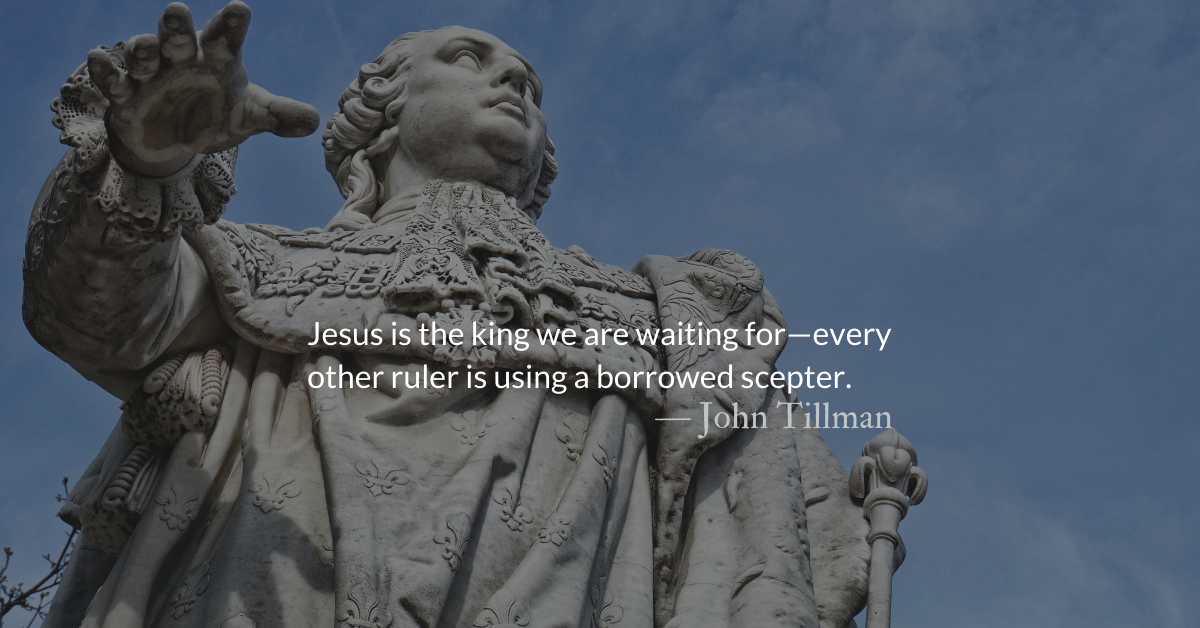
Jesus is the king we are waiting for—every other ruler is using a borrowed scepter. 

From Joseph’s beneficent Pharaoh to Moses’s genocidal Pharaoh, rulers are highly variable. But no ruler, not the best of Pharaohs or of Judah’s kings, not any emperor or empire past, present, or future, is worthy of our unswerving loyalty. Any of them will betray our hopes. None of them can be trusted to deliver us. The best human rulers are but poor stand-ins for Christ and the worst of them are anti-Christs.

No matter if we live under Pharaohs or Sauls, under Davids or under Ahabs, under Hezekiah’s or under Nebuchadnezzars, they are only shadows that will pass and grass that will dry up and blow away. 

We, like Simeon, (Luke 2.25) are waiting for our true king, Jesus, the root of Jesse, the “glory of Israel.” (Luke 2.29-32) Our king and kingdom are from another place. (John 18.36

Divine Hours Prayer: The Greeting
Out of Zion, perfect in its beauty, God reveals himself in glory.
Let the heavens declare the rightness of his cause; for God himself is judge. — Psalm 108.2

– Divine Hours prayers from The Divine Hours: Prayers for Springtime by Phyllis Tickle

Today’s Readings
Genesis 49 (Listen – 4:54) 
Luke 2 (Listen – 6:11)

Read more about To Wicked Kings, Foreign and Domestic
Jonah took God’s messages to wicked kings, foreign and domestic.

Read more about The Thriving Tree
Zedekiah didn’t make his bad decisions alone. A host of religious leaders and yes-men helped.

Becoming a Blessing

Scripture Focus: Genesis 48.14, 17-20
14 But Israel reached out his right hand and put it on Ephraim’s head, though he was the younger, and crossing his arms, he put his left hand on Manasseh’s head, even though Manasseh was the firstborn…

17 When Joseph saw his father placing his right hand on Ephraim’s head he was displeased; so he took hold of his father’s hand to move it from Ephraim’s head to Manasseh’s head. 18 Joseph said to him, “No, my father, this one is the firstborn; put your right hand on his head.” 

19 But his father refused and said, “I know, my son, I know. He too will become a people, and he too will become great. Nevertheless, his younger brother will be greater than he, and his descendants will become a group of nations.” 20 He blessed them that day…

Luke 1.46-47
46 My soul glorifies the Lord 47 and my spirit rejoices in God my Savior.

Reflection: Becoming a Blessing
By John Tillman

It took generations for the blessing God promised to grow and come to pass but we see glimpses of it in the process, such as the way, through Joseph, Egypt and the surrounding countries were blessed.

God’s blessing that he promised would come through Abram continued to grow more detailed and more defined as time went on. He changed his people as he went.

In Israel’s crossed arms, we see God subtly pushing to overturn unfair practices. Even though Israel sets Ephraim first, he provides an equivalent blessing to them both rather than a blessing similar to the one Jacob had stolen from Esau.

Eventually, a young girl descended from Judah would pronounce the fulfillment of and growth of the promise of blessing. The good news Mary proclaimed was also an overturning of blessings. The poor would be filled. The rich would go away empty. (In The Face of Wonder)

Today we will pray a prayer based on the blessing spoken to Abram, the blessing spoken over Ephraim and Manassah, and the blessing spoken by Mary to all people.

Becoming a Blessing
From Abram, you made a great nation
Through Abram, you promised to bless the nations
Make us, O Lord, a blessing in our nations

You blessed Jacob, renaming him Israel
Israel gave the blessing of being called by his name
To his children and his children’s children
Rename us, O Lord
Remake us, O Lord, worthy to be called by your name

May our pursuit of holiness increase in your name
May our ways of righteousness increase in your name
May our working of justice increase in your name

Through Mary, you helped your servant, Israel
You remembered to be merciful
You did great things for the small
Your powerful arm worked mightily for the weak
Your rich blessings poured out to satisfy the hungry
Yet, those who considered themselves full and rich went away empty

Our broken world seeks righteousness.
Bring it through us.
Our lost world seeks truth.
Speak it through us.
Our hurting world seeks justice.
Work it through us.
Our sickened world seeks healing.
Heal it through us.

May no king gain our fealty.
May no prince dominate our praise.
May our soul glorify only you, our Savior.
May our spirit rejoice only in the true and only God.

Make and remake us, Lord, into a blessing.

Divine Hours Prayer: The Call to Prayer
The Lord is King; let the earth rejoice; let the multitude of the isles be glad. — Psalm 97.1

– Divine Hours prayers from The Divine Hours: Prayers for Springtime by Phyllis Tickle

Today’s Readings
Genesis 48 (Listen – 3:43) 
Luke 1.39-80 (Listen – 5:16)

Read more about In The Face of Wonder
Your glory, Lord, overcoming and transforming our weaknesses is cause for our souls to sing.

Read more about Identity Lost, Identity Gained
God, our father, longs to bless us with every spiritual blessing. No one who comes to him will need cry, “Do you have only one blessing, my father?”

Waking Up With Pigs

Scripture Focus: Matthew 19.7-10
7 “Why then,” they asked, “did Moses command that a man give his wife a certificate of divorce and send her away?” 
8 Jesus replied, “Moses permitted you to divorce your wives because your hearts were hard. But it was not this way from the beginning. 9 I tell you that anyone who divorces his wife, except for sexual immorality, and marries another woman commits adultery.” 
10 The disciples said to him, “If this is the situation between a husband and wife, it is better not to marry.” 

Genesis 21.13
13 I will make the son of the slave into a nation also, because he is your offspring.” 

Luke 15.16-17
16 He longed to fill his stomach with the pods that the pigs were eating, but no one gave him anything.17 “When he came to his senses, he said, ‘How many of my father’s hired servants have food to spare, and here I am starving to death!

Reflection: Waking Up With Pigs
By John Tillman

Moses (not God) “permitted” divorce and Abraham sent his “slave wife” away (in tomorrow’s reading) for the same reason. This reason was explained by Jesus generations later:

“Because your hearts were hard…”

God offers grace even for our worst, hard-hearted mistakes in which we misunderstand or disobey him. Abraham and Sarah sought solutions from their own culture instead of relying on God’s promise. They twisted God’s plan to justify sexual exploitation and their sin produced a “slave wife” and a “son of a slave.” 

Their hearts were hard. They did not believe God fully and they rationalized that the ends justify the means. Then their hearts became harder. When they realized their error, they rejected the evidence of their sin by sending Hagar and the child away. Though they hardened their hearts, God did not. God saved Hagar from her situation and blessed the child produced from her victimization.

Each time a person rejects God’s heartfelt invitation, their heart grows a little harder. Each time they look away from his outstretched arms, their sight dims. Each time they tune out his calls and cries to repent, their sense of hearing diminishes.

Even Christ’s disciples missed the point of his message. They thought the solution to the question about divorce was not to marry. 

“If we don’t marry, we don’t have to be soft-hearted.” 

How foolish. The solution is, instead, to become soft-hearted children like our soft-hearted God.

God deals with hard-hearted people throughout the Bible. God is consistently calling, pleading with the hard-hearted to return to him. He holds out love and kindness to coax them. He grants them mercy and grace if only they will return. 

Our hard-hearted errors can be redeemed by our loving God, but the better lesson to remember is that our hard hearts can be softened again. In humbling, shocking moments the hard-hearted can come to our senses like the prodigal among the pigs.

Have Christians awakened to find ourselves among a trampling herd of violent pigs? Are we shocked awake to the shame of our state? Have we recognized our hunger for the pods the pigs are eating? Perhaps, having a taste of the pods can finally turn our stomach and wake revulsion for our wrongdoing.

Let us return to our loving father, quitting the pig-sty, abandoning our stubbornness. Let us humble ourselves, soften our hearts, and return home.

Divine Hours Prayer: The Call to Prayer
Love the Lord, all you who worship him; the Lord protects the faithful, but repays to the full those who act haughtily. — Psalm 31.23

– Divine Hours prayers from The Divine Hours: Prayers for Autumn and Wintertime by Phyllis Tickle

Today’s Readings
Genesis 20 (Listen – 2:39) 
Matthew 19 (Listen – 4:04)

Read more about Seeking Righteousness
There should be a clear and recognizable difference in the way that Christians interact with social and political unrest because we are not a people of unrest.

Read more about Leaders Against Oppression
May we work to ensure that the powerful are warned not to be abusive. May we live in such a way that others will not be dispossessed.

It Came Upon The Midnight Clear — Carols of Advent Peace

Scripture Focus: John 13.13-15
13 “You call me ‘Teacher’ and ‘Lord,’ and rightly so, for that is what I am. 14 Now that I, your Lord and Teacher, have washed your feet, you also should wash one another’s feet. 15 I have set you an example that you should do as I have done for you.

Luke 2.13-14
13 Suddenly a great company of the heavenly host appeared with the angel, praising God and saying,
14 “Glory to God in the highest heaven,
    and on earth peace to those on whom his favor rests.”

Reflection: It Came Upon The Midnight Clear — Carols of Advent Peace
By Jon Polk

After graduating in 1837 from the Theological School in Cambridge, Massachusetts, Edmund Hamilton Sears settled in as pastor in the country town of Wayland. The church was impressed with his character and preaching and Sears, who never had ambitions for a prominent city congregation, was enamored by the quiet beauty of the little parish.

One can sense parochial tranquility in his most famous hymn.

It came upon the midnight clear,
That glorious song of old…

The world in solemn stillness lay,
To hear the angels sing.

Sears’ family would quickly grow to four children, compelling him to seek out a larger church which could support them. In 1840, he accepted the pastorate of a church in Lancaster, where he would serve for seven years.

The work in Lancaster was difficult and Sears suffered from illness, depression, and an eventual breakdown. Ultimately, his condition deteriorated to the point where he was unable to project his preaching voice loud enough for the congregation to hear.

To facilitate recovery, he returned to Wayland for a year of rest. When healthy, he was invited to return to the Wayland church part-time, which freed him to use his gifts in writing.

In the aftermath of his personal struggles, he wrote “It Came Upon the Midnight Clear,” in 1849. At the time, the U.S. was reeling from the Mexican War and struggling with slavery as the Civil War drew near.

His sadness is palpable in the lyrics.

Yet with the woes of sin and strife
The world has suffered long…

And man, at war with man, hears not
The love-song which they bring…

Sears’ theology was passionately focused on Christ; he preached “The word ‘Jesus’ opens the heart and touches the place of tears.” He maintained that Christ alone had bridged the great divide between God and humanity.

As a result, he believed that we are responsible for implementing God’s peace in the world, consequently he preached for equality of women and men, opposing killing even in war, and against the evils of slavery.

This work towards peace is reflected in the carol’s hopeful ending.

When peace shall over all the earth
Its ancient splendors fling,
And the whole world give back the song
Which now the angels sing.

Following his life struggles, Sears managed to find his own peace and eventually a new purpose as a full-time writer. In his most read work, The Fourth Gospel: The Heart of Christ, he writes,

My consciousness at one time may give me an inward sense of moral ruin and disorder. I may see a creation rise out of this chaos… a peace more sweet than the tranquility of the morning… It comes not from inward beholdings of the Deity, but of what He does…

Listen: It Came Upon A Midnight Clear by Over the Rhine
Read: Lyrics at Hymnary.org

Divine Hours Prayer: The Request for Presence
Send our your light and your truth, that they may lead me, and bring me to your holy hill and to your dwelling;

That I may go to the altar of God, to the God of my joy and gladness; and on the harp I will give thanks to you, O God my God. — Psalm 43.3-4

– Divine Hours prayers from The Divine Hours: Prayers for Autumn and Wintertime by Phyllis Tickle

Today’s Readings
Zechariah 10 (Listen – 2:11)
John 13 (Listen – 5:06)

Read more about End of Year Giving and Supporting our work
It is only through the support of our donors that we are able to continue this work. Consider joining them today.

Read more about From Silence, Peace :: Peace of Advent
The God who turned his back, came back. He came to speak peace to the people who had chosen death instead of life.

God Rest Ye Merry, Gentlemen — Carols of Advent Peace

Scripture Focus: John 12.14-15
14 Jesus found a young donkey and sat on it, as it is written:
15 “Do not be afraid, Daughter Zion;
    see, your king is coming,
    seated on a donkey’s colt.”

Zechariah 9.9
9 Rejoice greatly, Daughter Zion!
    Shout, Daughter Jerusalem!
See, your king comes to you,
    righteous and victorious,
lowly and riding on a donkey,
    on a colt, the foal of a donkey.

Luke 2.10-12
10 But the angel said to them, “Do not be afraid. I bring you good news that will cause great joy for all the people. 11 Today in the town of David a Savior has been born to you; he is the Messiah, the Lord. 12 This will be a sign to you: You will find a baby wrapped in cloths and lying in a manger.”

Reflection: God Rest Ye Merry, Gentlemen — Carols of Advent Peace
By Jon Polk

“The owner of one scant young nose, gnawed and mumbled by the hungry cold as bones are gnawed by dogs, stooped down at Scrooge’s keyhole to regale him with a Christmas carol: but at the first sound of

‘God bless you, merry gentleman!
May nothing you dismay!’

Scrooge seized the ruler with such energy of action, that the singer fled in terror, leaving the keyhole to the fog and even more congenial frost.”

“God Rest Ye Merry, Gentlemen” is among the oldest existing Christmas carols, dating back to the 16th century. It is so iconic that Charles Dickens used it in his classic tale from 1843, A Christmas Carol, as the carol sung by a young caroler attempting to bring joy to the hardened Ebenezer Scrooge.

Changes in language and word usage over time have led to an unfortunate misinterpretation of the opening line and confusion over punctuation. Even Dickens, in his quotation of the lyric, got it wrong.

Contrary to common perception, the song is not an instruction to relax, directed to a group of cheerful men.

In old English, the word rest means “to keep, remain.” The adjective merry had a broader meaning which included “prosperity” and “peace” in addition to “joy.” The comma should properly be placed between merry and gentlemen.

“God rest ye merry” could more accurately be phrased as, “May God grant you peace and joy.”

A great contrast is depicted in Dickens’ scene: the young caroler braving the blistering winter cold to spread tidings of comfort and joy and the elder Scrooge, safe and warm inside, yet with a cold, hard heart, devoid of peace and joy.

The antidote to Scrooge’s downcast spirit would have been found in a later verse, had he let the poor young singer continue.

“Fear not, then,” said the angel,
“Let nothing you affright;
This day is born a Savior
Of a pure virgin bright,
To free all those who trust in him
From Satan’s power and might.”

The comforting message from the angel to the shepherds was, “Don’t be afraid! I’ve got good news of peace and joy!” (Luke 2:10).

Scrooge was visited, not by angels, but by spirits, and his heart began to soften. When later questioned by the Ghost of Christmas Past, Scrooge remembered his error, “There was a boy singing a Christmas Carol at my door last night. I should like to have given him something: that’s all.”

Let us, like Scrooge, allow our hearts to soften as we set aside our fears this Christmas. Let us actively embrace God’s peace promised to us by the angel on that first Christmas morn.

God rest ye merry, gentle reader, and fear not, for the Prince of Peace has been born.

Listen: God Rest Ye Merry, Gentlemen by Jars of Clay
Read: Lyrics from Hymnary.org
Bonus Read: A Christmas Carol by Charles Dickens


From John: Just interjecting here to say that as a writer, I was thrilled and nerding out a bit that part of Jon’s analysis of this carol involved understanding the change in meaning that can be made by the placement of a comma. I’ve been so thankful for Jon’s careful and excellent work on these pieces. Readers, God rest ye merry!

Divine Hours Prayer: The Request for Presence
May God be merciful to us and bless us, show us the light of his countenance and come to us.
Let your ways be known upon earth, your saving health among all nations. — Psalm 67.1-2

– Divine Hours prayers from The Divine Hours: Prayers for Autumn and Wintertime by Phyllis Tickle

Today’s Readings
Zechariah 9 (Listen – 3:01)
John 12 (Listen – 6:26)

Read more about End of Year Giving and Supporting our work
Many of you have already responded this past week with end-of-year donations and we are so thankful! No donation is too large or too small.

Read more about Transcendent Peace and Rest
We can experience God’s peace in every day and any moment. Hebrews tells us that “we who have believed enter that rest.”