Cosmic and Earthy Creations

Links for today’s readings:

Read: Genesis 2 Listen: (3:42), Read: John 2 Listen: (3:02)

Scripture Focus: Genesis 2.7-8

7 Then the Lord God formed a man from the dust of the ground and breathed into his nostrils the breath of life, and the man became a living being.
8 Now the Lord God had planted a garden in the east, in Eden; and there he put the man he had formed.

Reflection: Cosmic and Earthy Creations

By John Tillman

The creation accounts in Genesis 1 and 2 sound different.

Genesis 1 is cosmic, ordered, rhythmic poetry. The Spirit hovers. The Word speaks. Photons, matter, and life forms burst into being ex nihilo, “out of nothing.” Day and night separate each act from the next in a chain of images, like framed paintings on a museum gallery’s wall, or colored panes in a stained glass window.

Genesis 2 is earthy, messy, intimate prose. The actions of creation are less ordered and formal. The Creator kneels in a grassless, soggy plain forming a human from the wet earth. He puts his mouth on the muddy shape and breathes into it, then wipes mud from his lips as Adam takes his first breath. God, the gardener, keeps digging in the dirt. He plants and cultivates trees that provide beauty and health, cuts rivers that supply water to distant lands, forms other living creatures out of the ground, and a co-laborer for Adam from his own flesh.

These two versions aren’t arguing with each other. The writers of scripture weren’t confused or ignorant. They didn’t forget what they just wrote. When you lay these two stories over each other, they fill in each other’s gaps.

Whether you need to be reminded of how grand, glorious, and powerful God is or how near, intimate, and tender he is, Genesis has you covered.

Our creator is both cosmic and earthy. He blows galaxies across the universe and he breathes into our lungs. He speaks to photons and whispers in our ears. He scatters stars in the sky and sows seeds in the dirt—and seeds in our hearts.

From its first pages, the Bible reminds us that the glorious God of Heaven muddied his knees and hands at our making. The God who created calculus and physics also created our emotions and feelings. We are also both cosmic and earthy creations. We need his cultivation.

In this new year, how is your garden? Do you need irrigation for dry soil? Do you need to diagnose diseased plants? Do you need to stop pests from nibbling your fruit? Or do you need to plow it all under and start ex nihilo? Let our garden-planting God guide you.

As we walk through the scripture with him, God will never stop cultivating our muddy, messy lives into the garden he always designed us to live in.


Image Note: The image used in today’s post is of the Butterfly Nebulae, located in the constellation of Scorpius.

Divine Hours Prayer: The Request for Presence

Save me, O God, for the waters have risen up to my neck. — Psalm 69.1

– From The Divine Hours: Prayers for Autumn and Wintertime by Phyllis Tickle.

Read The Bible With Us

The best time to join our two-year Bible reading plan is now. What will you hear from God this year?

https://mailchi.mp/theparkforum/m-f-daily-email-devotional

Read more: God In the Dark

God still says “let there be light” and causes the Morningstar to rise in our hearts.

A City to Live In — Readers’ Choice

Scripture Focus: Psalm 87
1 He has founded his city on the holy mountain. 
2 The Lord loves the gates of Zion 
more than all the other dwellings of Jacob. 
3 Glorious things are said of you, 
city of God: 
4 “I will record Rahab and Babylon 
among those who acknowledge me— 
Philistia too, and Tyre, along with Cush— 
and will say, ‘This one was born in Zion.’ ”
5 Indeed, of Zion it will be said, 
“This one and that one were born in her, 
and the Most High himself will establish her.” 
6 The Lord will write in the register of the peoples: 
“This one was born in Zion.” 
7 As they make music they will sing, 
“All my fountains are in you.”

Genesis 4.16-17
16 So Cain went out from the Lord’s presence and lived in the land of Nod, east of Eden.

17 Cain made love to his wife, and she became pregnant and gave birth to Enoch. Cain was then building a city, and he named it after his son Enoch.

“I’ll find a city. Find myself a city to live in. Help me. Find a city. Find myself a city to live in.” — David Byrne, Talking Heads, “Cities”

Originally published on May 6, 2024, based on readings from Psalm 87 and Genesis 4.16-17.

Readers’ Choice is here: There’s still time to tell us about your favorite, most meaningful posts of the year. If you shared it with someone, or it helped you, let us know via email, direct message, or filling out the linked form.

Music Week: Many choices from readers were ones having to do with music. Some were inspired by a song or hymn, some simply included music as part of the reflection experience. This week, we pray the Holy Spirit’s tune echoes in your heart and that he guides you into Truth as you listen again to these earthly tunes.

Readers’ Choice posts are selected by our readers:
Brian, DC — Thanks for this reflection.

Barbara, TN — Thank you.

Reflection: A City to Live In — Readers’ Choice
By John Tillman

In the Talking Heads song “Cities,” David Byrne sings of searching for a place to live. He weighs good points and bad points and longs for “home cooking” and a place where the river doesn’t stink. He’s checking them out and trying to figure them out, but this elusive city cannot be found.

Cities have good points. Cities have bad points. Anyone considering a move knows it is difficult to “figure it out.” Anyone who has left a familiar city knows the isolation of feeling like a wanderer.

The condemned, restless wanderer Cain named the first city after his son, Enoch. (Genesis 4.11-17) Cain was cursed and prevented from cultivating the ground, but in Enoch City, other skills were cultivated. From this city came arts and technology. (Genesis 4.21-22)

Cast out of Eden’s garden, humans planted cities to protect and provide for themselves, but like other things humans planted, cities were subject to the curse. The cursed ground produced thorns and thistles, and soon, cities bore the fruits of violence, oppression, and evil rather than peace, advancement, or justice.

Most cities in the Bible are mentioned because of evil, not good. From the front pages to the last, the Bible uses the city of Babylon as a symbol of human wickedness. Other cities and empires such as Egypt, Tyre, the cities of the Philistines, and more represent rampant violence and evil.

These cities are covered in darkness. Their rivers stink of death. But there is another city for us.

Psalm 87 names Zion as a city God loves. Zion is another name for Jerusalem, but the city God loves goes beyond a physical location. This city is God’s city. It is founded on holiness rather than sinfulness. It hints at Heaven, described by biblical writers as a city of healing, peace, justice, and mercy, from which the river of life flows.

God loves cities. If they acknowledge God, even wicked cities are spiritually connected to Zion. God writes down Babylon, Rahab (here a nickname for Egypt), and Tyre as “born in Zion.” 

Cities have good points. Cities have bad points. But God loves cities and sends us to them. Small ones. Big ones. What are you doing to bring the freshness of the river of life and the aroma of the home-cooked banquet of the gospel to your city?

Video: “The City,” by The Bible Project

From John: The Divine Hours prayers will return in October. This month we will pray one scripture passage or verse each week.

Prayer:
Come, let us sing for joy to the Lord; let us shout aloud to the Rock of our salvation.
Let us come before him with thanksgiving and extol him with music and song.
For the Lord is the great God, the great King above all gods.
 — Psalm 95.1-3


​Today’s Readings
Jeremiah 36 (Listen 5:54)
1 Corinthians 12 (Listen 4:25)

Read more about Moving Into the City
May we make our light shine through good deeds, showing God’s mercy and his grace to us, and turning slums and suburbs into cities on a hill.

Readers’ Choice is here!
This month, we are thankful to share your favorite posts from the past year. There’s still time to tell us your faves via email, direct message, or the linked form, so we can repost them.

https://forms.gle/9vyYwVxa1kZZn7AKA

A City to Live In

Scripture Focus: Psalm 87
1 He has founded his city on the holy mountain. 
2 The Lord loves the gates of Zion 
more than all the other dwellings of Jacob. 
3 Glorious things are said of you, 
city of God: 
4 “I will record Rahab and Babylon 
among those who acknowledge me— 
Philistia too, and Tyre, along with Cush— 
and will say, ‘This one was born in Zion.’ ”
5 Indeed, of Zion it will be said, 
“This one and that one were born in her, 
and the Most High himself will establish her.” 
6 The Lord will write in the register of the peoples: 
“This one was born in Zion.” 
7 As they make music they will sing, 
“All my fountains are in you.”

Genesis 4.16-17
16 So Cain went out from the Lord’s presence and lived in the land of Nod, east of Eden.

17 Cain made love to his wife, and she became pregnant and gave birth to Enoch. Cain was then building a city, and he named it after his son Enoch.

“I’ll find a city. Find myself a city to live in. Help me. Find a city. Find myself a city to live in.” — David Byrne, Talking Heads, “Cities

Reflection: A City to Live In
By John Tillman

In the Talking Heads song “Cities,” David Byrne sings of searching for a place to live. He weighs good points and bad points and longs for “home cooking” and a place where the river doesn’t stink. He’s checking them out and trying to figure them out, but this elusive city cannot be found.

Cities have good points. Cities have bad points. Anyone considering a move knows it is difficult to “figure it out.” Anyone who has left a familiar city knows the isolation of feeling like a wanderer.

The condemned, restless wanderer Cain named the first city after his son, Enoch. (Genesis 4.11-17) Cain was cursed and prevented from cultivating the ground, but in Enoch City, other skills were cultivated. From this city came arts and technology. (Genesis 4.21-22) Cast out of Eden’s garden, humans planted cities to protect and provide for themselves, but like other things humans planted, cities were subject to the curse. The cursed ground produced thorns and thistles, and soon, cities bore the fruits of violence, oppression, and evil rather than peace, advancement, or justice.

Most cities in the Bible are mentioned because of evil, not good. From the front pages to the last, the Bible uses the city of Babylon as a symbol of human wickedness. Other cities and empires such as Egypt, Tyre, the cities of the Philistines, and more represent rampant violence and evil.

These cities are covered in darkness. Their rivers stink of death. But there is another city for us.

Psalm 87 names Zion as a city God loves. Zion is another name for Jerusalem, but the city God loves goes beyond a physical location. This city is God’s city. It is founded on holiness rather than sinfulness. It hints at Heaven, described by biblical writers as a city of healing, peace, justice, and mercy, from which the river of life flows.

God loves cities. If they acknowledge God, even wicked cities are spiritually connected to Zion. God writes down Babylon, Rahab (here a nickname for Egypt), and Tyre as “born in Zion.” 

Cities have good points. Cities have bad points. But God loves cities and sends us to them. Small ones. Big ones. What are you doing to bring the freshness of the river of life and the aroma of the home-cooked banquet of the gospel to your city?

Video:The City,” by The Bible Project

Divine Hours Prayer: The Refrain for the Morning Lessons
This is the Lord’s doing, and it is marvelous in our eyes. — Psalm 118.23

– From The Divine Hours: Prayers for Summertime by Phyllis Tickle.

​Today’s Readings
Micah 6 (Listen 2:28)
Psalm 86-87 (Listen 2:26)

Read more about The Urban Sprawl of the City of God
Jesus calls us to live within the borderless, wall-less, ever-sprawling city of New Jerusalem.

Read more about Supporting Our Work
May we make our light shine through good deeds, showing God’s mercy and his grace to us, and turning slums and suburbs into cities on a hill.

Tamar’s Story — Love of Advent

Scripture Focus: Matthew 1.1, 3
1 This is the genealogy of Jesus the Messiah the son of David, the son of Abraham:

3 Judah the father of Perez and Zerah, whose mother was Tamar…

Genesis 38.26
26 Judah recognized them and said, “She is more righteous than I, since I wouldn’t give her to my son Shelah.” And he did not sleep with her again.

Reflection: Tamar’s Story — Love of Advent
By Erin Newton

These are the matriarchs of Jesus: Tamar, Rahab, Ruth, Bathsheba, and Mary. This is Tamar’s story.

Born among the Canaanites, Tamar was not one of Abraham’s kin. She married Er, the son of Judah and Shua, his Canaanite wife, and so became (for a short time) part of Abraham’s lineage.

Marital bliss was not to be found, for Er was evil. I imagine a loveless marriage filled with emotional or physical abuse. Perhaps a husband prone to angry outbursts and critical remarks. Perhaps a husband who sought other women or beat his workers. We are left only to wonder. The wickedness of Er, however, exceeded the tolerance of even God, and God ended his days.

Marital bliss certainly vanished. Tamar was a young widow. Among a people heralded for their covenantal righteousness—bound to be blessings among the nations—Tamar would find another form of abuse.

Judah’s second son, Onan, purposely thwarted his cultural duty to provide an heir for Tamar, though not hesitating to take pleasure in sleeping with her. She is used for her body but denied a child. Such selfishness of Onan exceeded the patience of God, and so God ended his days as well.

The final son, Shelah, is given to Tamar as a vague promise. A long time passes. I imagine Tamar living in her father’s house without a husband or child. Two men had abused her and now she must wait for the third. I imagine she worried he would be as terrible as his brothers.

Judah—a man of the covenant of Abraham, the namesake for the nation of God’s people, the patriarch in charge of Tamar’s honor—seeks out a shrine prostitute without hesitation just as the promises to Tamar have been delayed without hesitation. She takes matters into her own hands, maneuvering the situation so that Judah confuses her with a prostitute. She bears twin boys by Judah and reveals his failure of duty.  

The men tasked to care for Tamar placed their pleasures and priorities over her dignity and honor.

This was no story of godly love. 

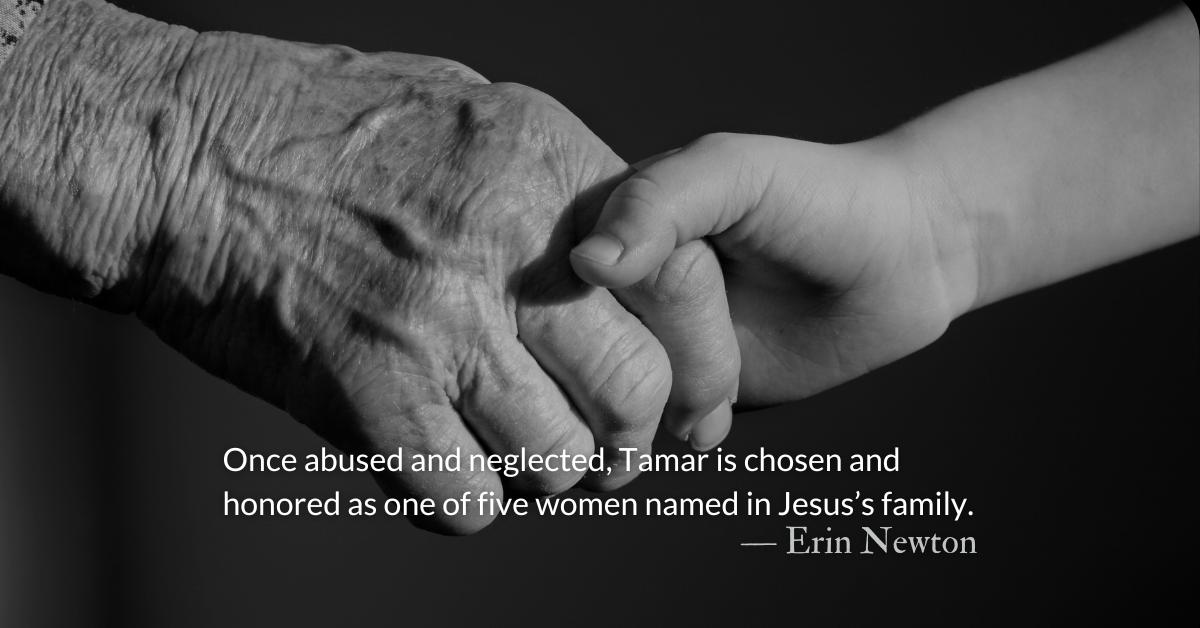
But she is not defined by the abuse she suffered at the hands of men or by her assertive (and albeit, morally questionable) actions. Once abused and neglected, Tamar is chosen and honored as one of five women named in Jesus’s family. She is a matriarch of Jesus.

In the love of Jesus belong the abused. 


Divine Hours Prayer: The Greeting
I will thank you, O Lord my God, with all my heart, and glorify your Name forevermore. — Psalm 86.12

– From The Divine Hours: Prayers for Summertime by Phyllis Tickle.


Today’s Readings
2 Chronicles 11-12  (Listen 6:00)
Psalms 119-25-48 (Listen 15:14)

Read more about The Wrong People
Many of us have felt like we’re the wrong people to build up God’s kingdom…God uses the Tamars…Rahabs…And the Pauls. 

Read more about Supporting Our Work
Donate today to support ad-free content that brings biblical devotionals to inboxes across the world.

Mistakes for Good? — Readers’ Choice

Scripture Focus: Genesis 48:17-19
17 When Joseph saw his father placing his right hand on Ephraim’s head he was displeased; so he took hold of his father’s hand to move it from Ephraim’s head to Manasseh’s head. 18 Joseph said to him, “No, my father, this one is the firstborn; put your right hand on his head.”
19 But his father refused and said, “I know, my son, I know. He too will become a people, and he too will become great. Nevertheless, his younger brother will be greater than he, and his descendants will become a group of nations.”

Originally published on February 15, 2023, based on readings from Genesis 48.

Readers’ Choice posts are selected by our readers:
Brian, Washington D.C. — Thanks for this reflection and your beautiful perspective. After years of thinking about what happened to the church where I worked…I have come to these conclusions: The Lord used the destruction of this congregation to scatter anointed lay people to other churches that needed fresh ideas and new gifts…And I learned about the grace of our Lord who loved the man who brought the damage. The Lord allowed him to learn and now he is a humble servant…And I learned about the grace of God for me, as I was filled with anger and judgment…God allowed me to see what He was doing so that I could gain wisdom and patience. God is good.

Reflection: Mistakes for Good? — Readers’ Choice
By Erin Newton

God can take something meant for evil and make it work for good. But what about mistakes? Can God take a human mistake and use it for good?

As Jacob lays on his deathbed, Joseph brings his two sons to see their dying grandfather. Jacob blesses the boys with promises given to his own sons. But the grandsons are blessed out of order! Ephraim, the younger, is given the elevated blessing, a firstborn’s portion. Manasseh, the oldest, is blessed as a second-born.

Jacob is blind, and Joseph assumes his crossed arms were an accident. Jacob continues by granting Ephraim the greater blessing.

Joseph only sees a mistake being made. (He even tries to jump in to correct his father.) He bases his assumptions on how things ought to be. He has done everything right, reconciled with his brothers, and visited his ailing father. This should be a straightforward situation; nothing can go wrong.

Like the story of Joseph’s enslavement and deportation to Egypt, God worked through situations that looked hopeless or bound for misery. We are accustomed to looking at tragedies and preaching to our hearts that God can work something good out of them. But what about things that look haphazard? What about the events that look like someone messed up? 

The text never really indicates if God divinely inspired Jacob to switch the blessing order or if a mistake was made that Jacob accepted. The blessing was done, and the results could not be changed.

How many times do we look at a situation and assume that someone has made a mistake? If it’s a small thing, we don’t give it a second thought. But what about the big mistakes—the doctor who missed a diagnosis, the airline that lost your luggage, the distracted driver that hit your car, or the cashier who overcharged you?

When these things happen, we fault the person for making a mistake. We think, “If only they had done it right, I wouldn’t be suffering right now!” We cling to an “if-only” faith.
Jesus was blamed for an “if-only” scenario. “If only you had been here, Lazarus would not have died” (John 11.32).

It is easier to blame someone for making a mistake rather than trusting God to work among errors. God works through perceived irregularities. Think of the “if-only” times in your life. Hear God say, “I know, son, I know.”


Divine Hours Prayer: The Call to Prayer
Come and listen, all you who fear God, and I will tell you what he has done for me. — Psalm 66.14


– From The Divine Hours: Prayers for Summertime by Phyllis Tickle.

Today’s Readings
1 Samuel 21-22 (Listen 6:35)
Revelation 2 (Listen 4:59)

Read more about Supporting Our Work
Our donors support ad-free content that brings biblical devotionals to inboxes across the world. Please consider joining them.

Read more about Becoming a Blessing
Our broken world seeks righteousness.
Bring it through us.
Our lost world seeks truth.
Speak it through us.