Exiles Near God’s Heart

Scripture Focus: Ezekiel 5.1, 3
1 “Now, son of man, take a sharp sword and use it as a barber’s razor to shave your head and your beard.

3 But take a few hairs and tuck them away in the folds of your garment.

Reflection: Exiles Near God’s Heart
By John Tillman

Though at times Ezekiel prophesies the future, at other times, he seems to be demonstrating and explaining what God’s current judgment means.

One of Ezekiel’s lived-out object lessons involves shaving off all of the hair from his head and beard. This enacted parable teaches us about God’s judgment and his love.

God embodies himself in our shame.
When God instructed Ezekiel to shave off his hair and beard, Ezekiel played the role of God and the hair shaved off represented the people being separated from God because of their sins. The shaving of the head was a common form of humiliation when done to an enemy or of mourning when done to oneself. Ezekiel shows us a shaved and mourning God who takes on himself the humiliation and shame of our sins. 

God’s vow of Salvation will not fail
Shaving the head was also a well-known way of marking the completion of an oath or a vow (Acts 18.18). This aspect of Ezekiel’s demonstration hints at the covenantal vow broken by the people—a vow that God alone can complete. God will uphold his vow to bring salvation. The promise made to Eve in Eden, to Abram in Ur, and to David in Bethel, would be fulfilled by Christ on Golgotha. God symbolically shaves his head ahead of time, knowing his faithful servant would complete the vow.

God holds the faithful exiles close to his heart.
Most of the hair cut off is burned, scattered, or cut up by a sword. But Ezekiel is instructed to save out a few hairs. He protects these, tucking them into his garment for safe keeping. These few hairs represent the faithful remnant, held close to God’s heart. They may even represent individuals such as Ezekiel, Jeremiah, and Daniel, prophets of the day who were faithful to God. Some of the hairs are burned, showing that even the faithful may still suffer during times of judgment. (Just as Daniel and Ezekiel live, but Jeremiah is eventually stoned.)

In Ezekiel’s depiction only a few will be saved and tucked close to God’s heart in his garment. In the course of history, however, the number of those saved, drawn back to his heart, and carried into new life will be an unnumbered multitude. (Revelation 7.9)

We praise God that he bore our shame, his vow of salvation is sure, and he tucks us close to his heart! Amen.

Divine Hours Prayer: The Request for Presence
O Lamb of God, that takes away the sins of the world, have mercy on me, O Lamb of God, that takes away the sins of the world, have mercy on me, O Lamb of God, that takes away the sins of the world, grant me your peace. — Agnus Dei– Divine Hours prayers from The Divine Hours: Prayers for Summertime by Phyllis Tickle

Today’s Readings
Ezekiel 5  (Listen – 3:28)
Psalm 42-43 (Listen – 2:32)

Read more about Different Kind of Exile
Living as outcasts in society has nearly always brought healing to the church through suffering.

Read more about The Mingled Prayers of Exiles
Pray today as the exiles prayed, with mingled sorrow and joy.
We weep for losses, sins, error, and struggle. 
We shout for mercy, comfort, redemption, and aid.
Model of an Exile

Scripture Focus: Ezekiel 4.1-4
“Now, son of man, take a block of clay, put it in front of you and draw the city of Jerusalem on it. 2 Then lay siege to it: Erect siege works against it, build a ramp up to it, set up camps against it and put battering rams around it. 3 Then take an iron pan, place it as an iron wall between you and the city and turn your face toward it. It will be under siege, and you shall besiege it. This will be a sign to the people of Israel. 
4 “Then lie on your left side and put the sin of the people of Israel upon yourself.

Reflection: Model of an Exile
By John Tillman

Ezekiel didn’t preach attempting to prevent the judgment of God—he already lived under it. Ezekiel is an exile. We have this in common with him.

Ezekiel served those who had already suffered exile. They had experienced sieges and been defeated in battle. They had been stripped of their property, family members, and clothing and marched ignominiously into slavery and servitude in Babylon.

In his acting out of the final siege of Jerusalem, however, Ezekiel introduces something other than the starvation, the deprivation of freedom, or the destruction these people had already experienced. He demonstrated the role of someone who would bear the sins of the city. 

The word translated “bear” can mean to lift or carry away. The people Ezekiel was serving had already been “carried away” into captivity. But part of Ezekiel’s message was that their sin would one day be carried away by another. The Messiah to come would bear their burdens, sorrows, and sins. 

Ezekiel did not just build a model of a battle, he gave us a model of how to minister to our fellow exiles and to the land in which we are foreigners. He cares for the exiles, cautioning them to not forget their God in this new land. He confronts them, refusing to avoid the hard truth that their sins brought destruction to the city, the country, and the people they loved. He also comforts them, teaching that there will be a time of restoration, healing, and peace.

As we worship God in this world, we may feel under siege. This should remind us that we are in a state of exile. No matter how comfortable we allow ourselves to become in our countries, our cities, or our cultures, we are from another place and represent another kingdom.

We must not avoid the difficult truths of our sins and the consequences that affect us in this falling empire of Babylon in which we live. We also must speak of the healing and comfort available in the Messiah, Jesus Christ, who bears our sins.

May we confront and be humbled by difficult truths about our sins.
May we be comforted by Christ who bears our sins.
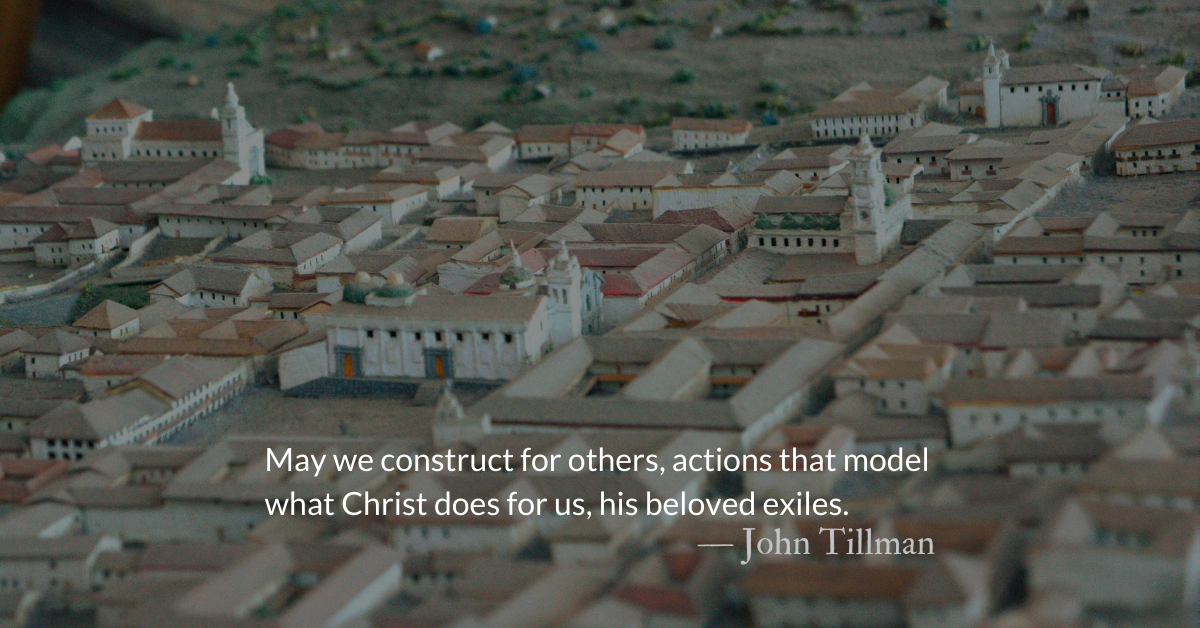
May we construct for others actions that model what Christ does for us, his beloved exiles.

Divine Hours Prayer: The Greeting
Your statutes have been like songs to me wherever I have lived as a stranger. — Psalm 119.54
– Divine Hours prayers from The Divine Hours: Prayers for Summertime by Phyllis Tickle

Today’s Readings
Ezekiel 4  (Listen – 2:56)
Psalm 40-41 (Listen – 3:57)

Read more about Captivity, Exile, and Exodus
The return from exile narrative is a mirror-version of the Exodus from Egypt narrative.

Read more about Faithful Through Exile
How can God promise salvation when he also promises exile? Does he truly care about his people?

Christ: Temple, River, and City

Ezekiel 48.35
“And the name of the city from that time on will be: the Lord is there.”

Reflection: Christ: Temple, River, and City
By John Tillman

Ezekiel spends a huge amount of his text describing the terrors, the corruption, and injustice of the city of Jerusalem and its Temple. Then, in his final chapters, he gives us a vision of a new temple, a river, and a city to come.

This temple and city Ezekiel describes bear little resemblance to the temple he knew or the temples to come in the future. In just one example, in chapter 47, Ezekiel describes a river that flows from the restored Temple. The river grows deeper and wider, until it can no longer be crossed. When this river meets the Salt Sea, the Dead Sea, it makes it alive again, bringing back to life not only the aquatic life, but the entire ecological system.

If Ezekiel’s visions sound familiar, it may be because, in Revelation, John’s visions of God’s city and the river flowing from it are remarkably similar.

Just because God’s city and temple have only been seen by visionaries and prophets, doesn’t mean they aren’t real or accessible to us today. John and Ezekiel may not intend to show us a physical temple or city that we will ever see on earth, but rather something else entirely.

Perhaps the temple of Ezekiel has never been seen on Earth because it is not a temple built by human hands. Perhaps the temple Ezekiel sees is the same one Christ told the Pharisees could be destroyed and rebuilt in three days.

Christ himself is our temple. He is the gate, the doorway, through which we enter to worship. He is our priest, he is the offerer of the only sacrifice capable of covering our sin and our only mediator before God.

Christ is our river, flowing as the Holy Spirit into our lives, into our cities, into our dead, dry, and poisoned environments. His river-like spirit brings life to what is dead and healing to what is sickened by the waste products of our sins’ industrious and destructive revolution.

Christ is our city. He is our refuge and rest—our strong tower and protected place—our park of peace in the midst of a frantic and fracturing world.

We say, “amen” to these visions.
May we regularly enter the peace of this city, be nourished by this river, and be made righteous in this temple.
May the temple, the city, and the river of these visions come.
May we dwell in the city called, “The Lord is there.”

Prayer: The Request for Presence
Let those who seek you rejoice and be glad in you; let those who love your salvation say forever, “Great is the Lord!” — Psalm 70.4

– Prayer from The Divine Hours: Prayers for Autumn and Wintertime by Phyllis Tickle.

Prayers from The Divine Hours available online and in print.

Today’s Readings
Ezekiel 48 (Listen – 6:15)
Psalm 104 (Listen – 3:37)

Additional Reading
Read More about Last Priest Standing
We can rest in the security of knowing that our eternal priest ,Jesus the Christ, is forever working for the salvation of those who seek him and he is alive to intercede before God on our behalf.

Read More about A High Priest Like No Other
Our great high priest Jesus has provided each of us with access to God’s throne of grace in any time of need. May we live our lives in faithfulness and gratitude for the great high priest who redeems.

Support our Work
Each month over 22,000 Park Forum email devotionals are read around the world. Support our readers with a monthly or a one time donation.

Forgiveness to Soften the Hardened :: Worldwide Prayer

Psalm 89.15-16
Blessed are those who have learned to acclaim you,
who walk in the light of your presence, Lord.
They rejoice in your name all day long;
they celebrate your righteousness.

From John:
There is no level of spiritual achievement or growth at which one is not susceptible to hardening of the heart and the spirit.

Christ’s call echoes again. Calling us deeper into every discipline we pursue. Whether into deeper love for others, or into deeper relationships with our community, or into deeper generosity toward all, or into deeper, more truthful and loving communication, there is always more to learn in Christ.

He accepts us just as we are. But he doesn’t settle. As C.S. Lewis says about Christ’s love for us, “It is not wearied by our sins, or our indifference; and, therefore, it is quite relentless in its determination that we shall be cured of those sins, at whatever cost to us, at whatever cost to Him.”

Reflection: Forgiveness to Soften the Hardened :: Worldwide Prayer
A Prayer of confession from Great Britain

Dear Lord, forgive us.

Forgive our hard hearts—so rarely showing
real love to you and our neighbors.

Forgive our week heads—so rarely thinking
for you with depth, imagination, daring, and trust.

Forgive our closed ears—so rarely listening
to your still voice and the needs of those
close around us.

Forgive our clenched hands—so rarely open
to give generously to you and others
and to reach out in friendship.

Forgive our willful tongues—so rarely stopping
before uttering words to cause hurt and trouble.

Lord, help us now. We want to be better people by your Holy Spirit. Please forgive us through Jesus Christ.

*Prayer from Hallowed be Your Name: A collection of prayers from around the world, Dr. Tony Cupit, Editor.

Prayer: The Refrain for the Morning Lessons
For God, who commanded the light to shine out of darkness, hath shined in our hearts, to give the light of the knowledge of the glory of God in the face of Jesus Christ. — 2 Corinthians 4.6

– Prayer from The Divine Hours: Prayers for Summertime by Phyllis Tickle.

Prayers from The Divine Hours available online and in print.

Today’s Readings
Ezekiel 38 (Listen – 4:23)
Psalm 89 (Listen – 5:29)

This Weekend’s Readings
Ezekiel 39 (Listen – 4:51) Psalm 90 (Listen – 2:03)
Ezekiel 40 (Listen – 8:21) Psalm 91 (Listen – 1:39)

Additional Reading
Read More from Risks of Faith :: Advent’s Love
Do not sit trying to manufacture feelings. Ask yourself, ‘If I were sure that I loved God, what would I do?’ When you have found the answer, go and do it. — C.S. Lewis

Read More about how Confession Destroys Denial
We confess we have been deaf to cries of the needy, cries for help, and cries of injustice. Give us your hearing and heart as we work in the name of Christ our king to proclaim good news to the poor and set the oppressed free.

Support our Work
Each month over 22,000 Park Forum email devotionals are read around the world. Support our readers with a monthly or a one time donation.

Meditation in Spiritual Rhythm :: Throwback Thursday

Psalm 88.1-2
Lord, you are the God who saves me;
day and night I cry out to you.
May my prayer come before you;
turn your ear to my cry.

Reflection: Meditation in Spiritual Rhythm :: Throwback Thursday
By John Tillman

As Thomas Merton poetically wrote about humanity, “He is the saddest animal. He drives a big red car called anxiety.”

Meditation is a breathing apparatus to help us survive in a poisonous atmosphere polluted by anxiety and fear.

Meditation is not new age, but old. However, in the modern age, it has often been forgotten on the shelf as many Christians and Christian leaders followed our culture into frenetic clamor instead of leading our culture from a place of peace and rest.

Today we look back a few hundred years or so, to a collection of thoughts on meditation that were not considered radical or strange in their time, but simply a prudent, practical, and effective Christian discipline.

George Müller (1805-1898)
Now what is food for the inner man? Not prayer, but the Word of God; and here again, not the simple reading of the Word of God, so that it only passes through our minds, just as water passes through a pipe, but considering what we read, pondering over it and applying it to our hearts.

This exercise of the soul can be most effectively performed after the inner man has been nourished by meditation on the Word of God, where we find our Father speaking to us, to encourage us, to comfort us, to instruct us, to humble us, to reprove us. We may therefore profitably meditate with God’s blessing though we are ever so weak spiritually; nay, the weaker we are the more we need meditation for the strengthening of our inner man.

Richard Baxter (1615-1691)
Nor should we imagine it will be as well to take up with prayer alone, and lay aside meditation; for they are distinct duties, and must both of them be performed. We need the one as well as the other, and therefore we shall wrong ourselves by neglecting either. Besides, the mixture of them, like music, will be more engaging; as the one serves to put life into the other. And our speaking to ourselves in meditation, should go before our speaking to God in prayer.

William Bridge (1600-1670)
Begin with reading or hearing. Go on with meditation; end in prayer…Reading without meditation is unfruitful; meditation without reading is hurtful; to meditate and to read without prayer upon both, is without blessing.

From these writings and ones like them, we draw a pattern, a spiritual rhythm, that we want to promote for all our readers: Read, reflect, pray…repeat.

Prayer: The Refrain for the Morning Lessons
Blessed are they which do hunger and thirst after righteousness: for they shall be filled. — Matthew 5.6

– Prayer from The Divine Hours: Prayers for Summertime by Phyllis Tickle.

Prayers from The Divine Hours available online and in print.

Today’s Readings
Ezekiel 37 (Listen – 5:07)
Psalm 87-88 (Listen – 2:45)

Additional Reading
Read More about A Discipline for the Anxious
A recent Harvard study found that church attendance paired with spiritual disciplines such as meditation and prayer have a beneficial effect on mental health.

Read More about The Practice of Meditation :: Running
Meditative prayer is exercise to expand your spiritual lung capacity, allowing you to breathe in God’s spirit more naturally at any time—including during a crisis.

Support our Work
Each month over 22,000 Park Forum email devotionals are read around the world. Support our readers with a monthly or a one time donation.