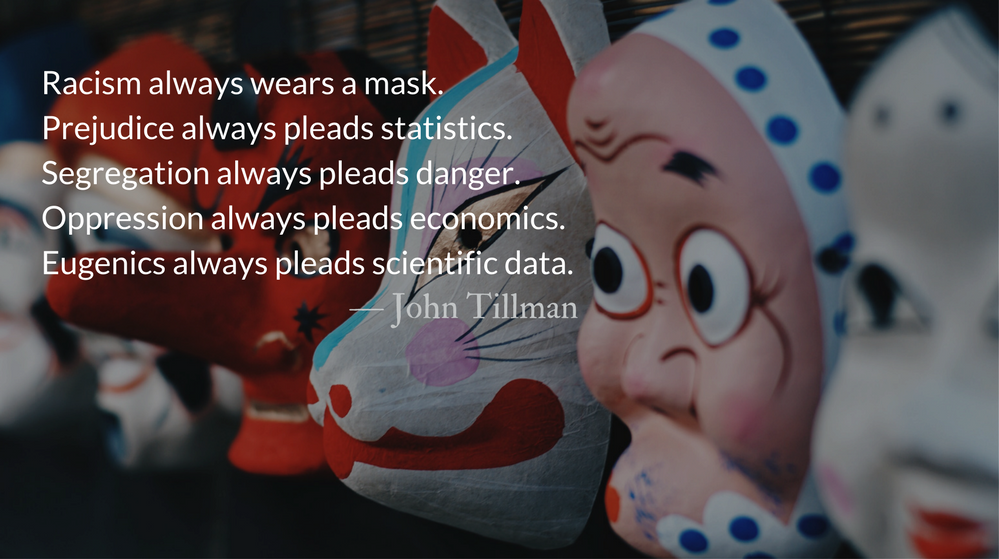
Racism Wears a Mask

Scripture: Esther 7.5-6
King Xerxes asked Queen Esther, “Who is he? Where is he—the man who has dared to do such a thing?” Esther said, “An adversary and enemy! This vile Haman!”

Reflection: Racism Wears a Mask
By John Tillman

When Xerxes asks “Who is he?” we sit in a satisfying dramatic tension. We can’t wait for the villain to be revealed. But the answer is not quite as clear cut as it may seem.

Esther wisely responded to the king’s question by pointing at Haman as the man responsible. But as John Wesley points out in his notes on Esther, the queen could easily have answered the question of Xerxes by saying, “It was you, King! You signed the law to eradicate my people! You accepted payment for our murder! You not only allowed this to happen, but profited from it!”

We like to put Haman on a shelf with Hitler as punching bags from a bygone era. By their example we smugly speak of how far we have come. But our racism, just like Haman’s and the king’s, always claims to be about something else.

It is rare that a person will admit, even to themselves, that they act out of racism directly. Racism always wears a mask. Prejudice always pleads statistics. Segregation always pleads danger. Oppression always pleads economics. Eugenics always pleads scientific data.

Even if we are not like Haman, many of us are like Xerxes and like the government officials. We have allowed racism to rise wearing a mask decorated with other concerns. In our government. In our businesses. Even in our churches. Even if we have not acted directly against minorities, we have passively benefited from the actions of others who have.

Putting ourselves in the shoes of King Xerxes, the best thing we can plead is ignorance and incompetence. And the best thing we can do is use our enormous power and privilege to aid those we previously ignored and to save those whose oppression we profit from.

Racism is not just an individual crime or action, it is an unseen burden we are forced to carry by our culture and our history. The church was the first entity in history to directly attack racism and the Holy Spirit is the only way its burden can truly be put down.

May we abandon our protestations of being innocent of racism. May we instead cling to Christ, whose Holy Spirit is the only hope and source of unity.

The Request for Presence
Open my eyes, that I may see the wonders of your law. — Psalm 119.18

– From The Divine Hours: Prayers for Autumn and Wintertime by Phyllis Tickle.

Full prayer available online and in print.

Today’s Readings
Esther 7 (Listen – 2:08)
Romans 2 (Listen – 4:13)

For Such a Time

Scripture: Esther 4:12-14
When Hathach told Mordecai what Esther had said, Mordecai sent her this message: “Don’t think that just because you live in the king’s house you’re the one Jew who will get out of this alive. If you persist in staying silent at a time like this, help and deliverance will arrive for the Jews from someplace else; but you and your family will be wiped out. Who knows? Maybe you were made queen for just such a time as this.” (The Message)

Reflection: For Such a Time
By Jada Swanson

There are times in one’s life when following God’s plan for our lives does not really make sense to those closest to us and, perhaps, not even to us. Even still, God calls us to obedience during the dark and the daring moments of our lives. In his word, he has promised never to leave us or forsake us (Hebrews 13:5).

In this passage, Esther finds herself facing a most important crossroads, which necessitates a response of faith, even at great personal risk. In each of our lives, there are times when God Almighty calls us to boldly speak out for and act on behalf of those who are marginalized and disenfranchised, the voiceless, and the invisible. Embracing his promptings as an act of obedience, even when it comes at great personal cost. This is leadership.

John Wesley states, “We should every one of us consider, for what end God has put in the place where we are? And when an opportunity offers of serving God and our generation, we must take care not to let it slip” (Notes, 4:14).

Leadership comes in many ways and takes on many forms. At its very core, leadership is influence. Although we may not hold positional roles of leadership, we all have very specific influential roles of leadership in our everyday lives. Have you taken notice of where they are? And with whom? Pray for God to reveal these opportunities to you. Pray for boldness and courage to step forward and speak out, to be of service to the Lord and His people.

God has a plan and purpose for each of our lives. And in God’s view of time, there are no coincidences. As such, it was no coincidence that Esther, a Jew, was selected as queen. Neither is it a coincidence where we find ourselves at this very moment and on this very day. Be observant of those around you, of situations and circumstances. Take notice of how you may be the one appointed to take action, in seemingly small or significant ways. As God’s children, we know that he will accomplish his purposes and plans for this world. The beauty is that he invites us to take part…for such a time as this!

Song: Born for This by Mandisa

The Request for Presence
I call with my whole heart; answer me, O Lord, that I may keep your statues. — Psalm 119.145

– From The Divine Hours: Prayers for Autumn and Wintertime by Phyllis Tickle.

Full prayer available online and in print.

Today’s Readings
Esther 3 (Listen – 3:12)
Acts 26 (Listen – 5:17)

This Weekend’s Readings
Esther 4 (Listen – 2:53) Acts 27 (Listen – 6:09)
Esther 5 (Listen – 2:42) Acts 28 (Listen – 4:56)

Every Man a King?

Scripture: Esther 1:22
He sent dispatches to all parts of the kingdom, to each province in its own script and to each people in their own language, proclaiming that every man should be ruler over his own household

Reflection: Every Man a King?
By John Tillman

It is perhaps most fitting that a book titled for it’s heroine, Esther, begins with a tale of fragile male ego. In what amounts to not answering her husband’s Facebook event invite, Vashti commits what, to the assembled, powerful men of the land was a grievous wrong.

What follows is what typically follows after a bruised male ego—overreaction leading eventually to violence. In any era, including our own, powerful men being snubbed at a party can set off a chain of events that threatens an entire population, but in the ancient world of monarchs it was inevitable.

Xerxes, who on the outside seems the most powerful person in the story, is shown in many ways to be the weakest. He is ruler of half the known land mass of the world, but spends the entire narrative beset by and tied up in, reactionary (and irreversible) laws. Some of them of his own making.

Xerxes is obsessed with what happens to himself. His ego can’t tolerate being disobeyed in even the slightest way. When snubbed, he looks to legislation rather than to relationships as both punishment and final solution.

The idea of “every man a king” does not come exclusively from this verse, but it is an early iteration of the concept and a desperate attempt by men to maintain ungodly power over women who are, together with men, bearers of the image of God.

The legislation that ends Chapter one is the desperate shutting of the door on an already empty barn. It is descriptive—telling us of the foolish actions of men. It is not prescriptive—telling us how men should deal with women. The men who utter it are the bumbling fools of the story, not the heroine.

And the next step taken, to replace Vashti, is the first step in bringing to power a woman who will do something more unusual than refuse the king’s presence. She will command his attention instead. She will condemn to death men close to him. She will issue commands to the leaders of his people and change the course of history.

The Call to Prayer
But I will call upon God, and the Lord will deliver me.
In the evening, in the morning, and at noonday, I will complain and lament,
He will bring me safely back… God, who is enthroned of old, will hear me. — Psalm 55.17ff

– From The Divine Hours: Prayers for Autumn and Wintertime by Phyllis Tickle.

Full prayer available online and in print.

Today’s Readings
Esther 1 (Listen – 4:14)
Acts 23 (Listen – 4:11)

The Theology of Food :: Weekend Reading List

Scripture’s focus on every facet of the tabernacle and temple is remarkable—God’s dwelling place, and the materials used to create it, were selected and prepared with the fastidious care. The New Testament confesses that the bodies of the faithful are the new temple of God’s Spirit.

To build this theology the authors of Scripture first caution against vanity. The care given to the temple was not to make it beautiful for its own sake, but to display the glory of God. At the same time, they challenge the early Christians to see how their decisions in the physical world affect their bodies.

In a recent article Bethany Jenkins, our founder at The Park Forum, asked, Do You Know Where Your Food Comes From? It’s a wonderful question that expands the discussion of faith and food beyond healthy eating to exploring how Christians can cultivate human flourishing through the food we consume.
Where did we get the idea that our food should be as cheap as possible? Do we not know that, when food is cheap to us, it is costly to someone else? Regular baking cocoa is cheaper than its fair trade equivalent, at least in part, because only a tiny portion of its profits goes to its growers.
It was Franklin D. Roosevelt’s administration that, following the Great Depression, worked aggressively to lower the percentage of the average American salary that went to food and rent. In our world today, the loss of this easy-to-access and inexpensive food creates what the U.S. Department of Agriculture calls a “food desert.”

Journalists Phillip Lucas And Mike Schneider explain the ripple effects of a food desert created by the closure of a neighborhood’s Wal-Mart:
In Wichita (Kansas), the Wal-Mart that opened four years ago became a community hub in a shopping plaza that previously had been a haven for prostitution and gang shootings, said Pastor Kevass Harding, whose Dellrose United Methodist Church is right by the store.

“We had a place that used to be an eyesore, but then we had a first-class shopping center in this urban neighborhood,” Harding said. “So last week we get the news, my heart just broke. I was disgusted that it’s about money. It’s not about the people.”
The reality that cheap food has become about profit cannot be understated—just ten companies now manufacture almost everything Americans eat. The public’s awareness of the modern industrial food complex has opened up an opportunity for a host of local, organic, and hand-crafted food start-ups. Yet the price mark up on these foods causes pause. This is where Jenkins asks, “If we commit ourselves to ethical food sourcing, will the higher prices we pay be worth it?”

The answer, at least in part, is found in knowing where our food comes from—and maintaining a healthy skepticism toward the narrative crafted around it. Last year the Mast Brothers, who sell “artisanal chocolate” for $10 a bar, were accused of remelting high-cacao-butter chocolate from the French chocolate manufacturer Valrhona to create what they claimed were their own “bean to bar” chocolates. This unleashed what can only be described as chocolate kerfuffle.

In The Way Forward for Hipster Food Dana Goodyear explains the lesson for those trying to make informed purchasing decisions around food:
Old-fashioned food: let’s examine its appeal for a moment. So much of the artisanal movement is about a return to pre-industrial aesthetics and flavors, a celebration of the home- and handmade… But the Victorian era the movement makes loving reference to was not a wonderful time to be a consumer.

In the moment that the Masts’ aesthetic conjures, food was an anxious proposition, unregulated and rife with chicanery—lead in the red candy, chalk in the milk. Deep in our memories, along with the nostalgia for mustache wax, lies the awareness that stories about food are not always true, and that buying into them can be dangerous.
The main question for people of faith is not about recovering a lost aesthetic, but about the value of spending more money on food that is ethically sourced, humanely raised, and environmentally conscious. “UNICEF estimates that 200,000 children are working in the cocoa fields of the Ivory Coast,” Jenkins writes, “and up to 12,000 of them may be victims of trafficking or slavery.”

It’s up to us as consumers to raise our awareness of laborers in the food industry. As stewards of this world we cannot turn our eyes away from the effects of industrial food production on the environment or the horrific treatment of animals by the poultrybeef, and dairy industries. Our decisions in the physical world affect God’s dwelling place and, through that, our world.

Thoughtfulness around this matters for Christians because, as the leaders of the Lausanne Movement write,
The earth is created, sustained and redeemed by Christ. We cannot claim to love God while abusing what belongs to Christ by right of creation, redemption and inheritance. We care for the earth and responsibly use its abundant resources, not according to the rationale of the secular world, but for the Lord’s sake.

If Jesus is Lord of all the earth, we cannot separate our relationship to Christ from how we act in relation to the earth. For to proclaim the gospel that says ‘Jesus is Lord’ is to proclaim the gospel that includes the earth, since Christ’s Lordship is over all creation. Creation care is thus a gospel issue within the Lordship of Christ.

Today’s Reading
Esther 6 (Listen – 2:40)
Romans 1 (Listen – 5:02)

This Weekend’s Readings
Esther 7 (Listen – 2:08)  Romans 2 (Listen – 4:13)

Esther 8 (Listen – 3:41)  Romans 3 (Listen – 4:30)

Weekend Reading List

The Honor of Faith :: Throwback Thursday

By George Whitefield
Haman recounted to them the splendor of his riches, the number of his sons, all the promotions with which the king had honored him, and how he had advanced him above the officials and the servants of the king. — Esther 5.11

I suppose you would all think it a very high honor to be admitted into an earthly prince’s private council—to be trusted with his secrets, and to have his ear at all times and at all seasons. It seems Haman thought it so when he boasted.

Alas, what is this honor in comparison of that which the meekest of those enjoy: to walk with God! Do you think it a small thing to have the secret of the Lord of lords with you and to be called the friends of God? All God’s saints have this honor!

The secret of the Lord is with them that fear him: “No longer do I call you servants, for the servant does not know what his master is doing; but I have called you friends, for all that I have heard from my Father I have made known to you.” David was so sensitive to the honor of walking with God that he declares, “I would rather be a doorkeeper in the house of my God than dwell in the tents of wickedness.”

As it is an honorable, so it is a pleasing thing, to walk with God. The wisest of men has told us that wisdom’s “ways are ways of pleasantness, and all her paths are peace.”

Has not one day in the Lord’s courts been better to you than a thousand? In keeping God’s commandments, have you not found a present, and very great reward? Has not his word been sweeter to you than the honey or the honeycomb?

What have you felt when, like Jacob, you have been wrestling with your God? Has not Jesus often met you when meditating in the fields, and been made known to you over and over again in breaking of bread? Has not the Holy Ghost frequently shed the divine love abroad in your hearts abundantly and filled you with joy unspeakable, even joy that is full of glory?

I know you will answer all these questions in the affirmative and realize the yoke of Christ is easy and his burden light—His service is perfect freedom. And what need we then any further motive to excite us to walk with God?

*Abridged and language updated from George Whitefield’s sermon, Walking With God.

Today’s Reading
Esther 5 (Listen – 2:42)
Acts 28 (Listen – 4:56)