Come, Thou Long-Expected Jesus — Carols of Advent Hope

Scripture Focus: Hebrews 9:14-15
14 How much more, then, will the blood of Christ, who through the eternal Spirit offered himself unblemished to God, cleanse our consciences from acts that lead to death, so that we may serve the living God!
15 For this reason Christ is the mediator of a new covenant, that those who are called may receive the promised eternal inheritance—now that he has died as a ransom to set them free from the sins committed under the first covenant.

Haggai 2:7
7 “I will shake all nations, and what is desired by all nations will come, and I will fill this house with glory,” says the Lord Almighty.

From John:
Jon Polk is kicking off our Advent devotionals this year with another music-focused week on the Carols of Advent. We are always thankful for Jon’s contributions, especially so in this format. We pray your Advent season is filled with hope, love, joy, and peace as we anticipate the celebration of Christmas.

Reflection: Come, Thou Long-Expected Jesus — Carols of Advent Hope
By Jon Polk

With lyrics expressing profound longing and hope, there are few hymns more suited for the season of Advent than Charles Wesley’s “Come, Thou Long-Expected Jesus.”

Come, thou long expected Jesus,
born to set thy people free;
from our fears and sins release us,
let us find our rest in thee.

Charles Wesley, younger brother of prominent English preacher John Wesley, was a theologian in his own right and a remarkably prolific hymn writer, credited with the authorship of over 6000 songs. In 1744, “Come, Thou Long-Expected Jesus,” one of Wesley’s most enduring Christmas hymns, was first published in his Hymns for the Nativity of Our Lord, a small collection of only eighteen hymns that proved to be so popular, it was reprinted over twenty times in his lifetime.

Partially based on a previously written prayer, the lyrics were also inspired by Haggai 2:7, “what is desired by all nations will come.” Wesley was troubled by the poor living conditions of orphans in the city around him and the obvious class divisions in Great Britain at the time. The lyrics express a palpable sense of longing for deliverance, both physically and spiritually, for the oppressed. The long-awaited King of Israel would, in fact, be the hope of all the world.

Israel’s strength and consolation,
hope of all the earth thou art;
dear desire of every nation,
joy of every longing heart.

Wesley effectively utilizes the literary device of repetition to emphasize the aspects of Jesus’ mission as God’s Savior for a broken world. Each use of the word “born” adds layers to the hope we have in Jesus as our redeemer: born to set us free, born to deliver us, born as a King, and born to reign eternally.

Born thy people to deliver,
born a child and yet a King,
born to reign in us forever,
now thy gracious kingdom bring.

Absent from the hymn are references to any details of the Christ-child’s birth. No manger, angels, shepherds, or magi. Instead, the focus is on the mystery of the Incarnation, with lyrics suited for both reflecting back upon the birth of Jesus and looking ahead with hope towards his Second Coming.

By thine own eternal spirit
rule in all our hearts alone;
by thine all sufficient merit,
raise us to thy glorious throne.

Certainly, the season of Advent is a time of preparing our hearts and minds for celebrating the birth of Christ on Christmas day. More importantly, however, Advent is a time set aside on the Church calendar when we are reminded of our great hope that the child who was born a King will one day return to bring us into his gracious eternal Kingdom.

Listen:
Come Thou Long Expected Jesus by Sara Groves
Read: Lyrics from Hymnary.org

Divine Hours Prayer: The Cry of the Church
Even so, come, Lord Jesus!

Today’s Readings
Daniel 11(Listen 8:13)
Hebrews 9(Listen 4:40)

Read more about Deuteronomy’s Dream for the Poor“…there need be no poor people among you…he will richly bless you if only you fully obey the Lord your God”

Read more about Supporting Our Work
We believe Christians, changed by the Bible, will change the world. Help us provide free biblical content with no ads and no agendas.

Paul’s Example of Thankfulness

Scripture Focus: Philippians 1:3-5, 9-10
I thank my God every time I remember you. In all my prayers for all of you, I always pray with joy because of your partnership in the gospel from the first day until now…And this is my prayer: that your love may abound more and more in knowledge and depth of insight, so that you may be able to discern what is best and may be pure and blameless for the day of Christ…

From John: I am so thankful for those who assist me in this ministry. I refer not only to Jon and Erin who regularly contribute writings to lighten my load. But others of you readers who lighten our load by your financial donations, by your prayers, and by your regularly emailed encouragements. This support is deeply felt, and I thank you all. This repost from 2019 by Jon Polk says it well. I hope you will turn to those who encourage you and express your thankfulness for them. 

Reflection: Paul’s Example of Thankfulness
By Jon Polk

Who has been used by God to help you in your walk with Christ? Who has come alongside you during difficult times? Who has helped shape you into the follower of Christ that you are today?

In his letters, Paul frequently gives thanks for other Christians that have been important in his life and he has good reasons to have fond feelings for the church in Philippi.

There, Paul met Lydia and a group of “God-fearing” women praying down by a river. Lydia and her household responded immediately to the Gospel message and she invited Paul to stay in her home. The fledgling Philippian church started by meeting in her house.

There, Paul was imprisoned after incurring the wrath of a slave owner. While he was praying and singing hymns, an earthquake broke open the prison doors! Because Paul chose not to escape, the jailer and his household came to faith.

There, Paul would return to minister at least three times following his initial visit. The church in Philippi began to financially support his traveling ministry. Their support was so significant that Paul would brag about them in a letter to another church.

So it is no surprise that Paul writes about them, “I thank my God every time I remember you.” How many people in your life can you say that about, that you thank God for them every time you think of them? Not only does Paul thank God for them, he also prays for them on a regular and frequent basis.

What exactly does Paul pray for them? He prays that their love increases and grows to overflowing. He prays that as their love grows, so does their relationship with God. He prays that their actions and motives would be pure, driven by this profound love.

When you think about those who have been influential in your life, is this the way you pray for them? Do you pray that they might have so much love that they can’t expend it all? Do you pray that their relationship with God grows and deepens? Do you pray as frequently for your friends as Paul says he does for the Philippians?

Perhaps we should.

So why don’t you take a moment now to thank God for significant people in your life. But don’t stop there. Like Paul did, send them a note letting them know how much you appreciate them. Surprise someone with encouragement today. You’ll be glad you did. And so will they.

Divine Hours Prayer: The Call to Prayer
Taste and see that the Lord is good; happy are those who trust in him! — Psalm 34.8

– From The Divine Hours: Prayers for Summertime by Phyllis Tickle.

Today’s Readings
Ezekiel 14(Listen 4:09)
Philippians 1(Listen 4:03)

This Weekend’s Readings
Ezekiel 15(Listen 1:09)Philippians 2(Listen 4:352)
Ezekiel 16(Listen 10:36)Philippians 3(Listen 3:21)

Read more about Praising Christ’s Righteousness
How pitiful a situation we would be in if our salvation relied on human institutions.

Read more about Transformed by Koinonia
Within us are exalted idols and habits that must be torn down. Within us are fruits of the spirit that we have trampled under selfish feet.

Be Good Figs

Scripture Focus: Jeremiah 24:1-3
1 After Jehoiachin son of Jehoiakim king of Judah and the officials, the skilled workers and the artisans of Judah were carried into exile from Jerusalem to Babylon by Nebuchadnezzar king of Babylon, the Lord showed me two baskets of figs placed in front of the temple of the Lord. 2 One basket had very good figs, like those that ripen early; the other basket had very bad figs, so bad they could not be eaten.
3 Then the Lord asked me, “What do you see, Jeremiah?”
“Figs,” I answered. “The good ones are very good, but the bad ones are so bad they cannot be eaten.”

Reflection: Be Good Figs
By Jon Polk

Figs could certainly use a brand image makeover. I doubt that any other fruit’s favorability polls are as low as the fig’s.

The familiar Fig Newton cookie was invented in 1891 by a Philadelphia baker. Fig Newtons were one of the first mass-produced baked goods by the newly formed Nabisco cookie company.

The cookies were exclusively filled with fig filling until the 1980s when Nabisco started replacing the fig jam with raspberry, strawberry, blueberry, and apple flavors. In 2012, after over a century known as Fig Newtons, “Fig” was dropped, and the cookies became known simply as Newtons.

According to the company
, “It was going to be hard for us to advance the Newtons brand with the baggage of the fig.” Ouch.

Figs are, however, a superfood with incredible nutritional value and the highest fiber and mineral content of the most common fruits and vegetables.

Figs are mentioned throughout the Bible in mostly positive contexts. Figs were one of the fruits mentioned when describing the fertility of the Promised Land. Fig trees symbolize the prosperity of the Jewish nation. Fig cakes were presented as gifts to King David. Hezekiah’s illness was cured by a poultice of figs. A superfood, indeed.

Occasionally in scripture, figs have a negative connotation. Adam and Eve sewed together fig leaves when they realized their nakedness. Isaiah, Jeremiah, Hosea, and Joel used the image of ruined figs as a representation of God’s judgment. And of course, Jesus himself notably cursed a fig tree at Passover.

In Jeremiah 24, we find both good and bad figs. God shows Jeremiah a vision of two baskets of figs at the temple; one basket had good, ripe figs and the other basket had figs that had turned so bad they couldn’t even be consumed.

The good figs are the Jewish exiles in Babylon. As noted in the previous chapter, God had a plan to protect them, rescue them, and restore God’s relationship with them. God says the good figs will return to God with all their heart.

The bad figs are King Zedekiah and his officials. Also noted in the previous chapter, God had a plan to bring them to ruin for their selfishness and poor shepherding of God’s people.

“Two ways” metaphors are common in scripture: wisdom vs. folly, light vs. darkness, narrow vs. wide gate, etc.

How to interpret Jeremiah’s vision? Simple. Be good figs.


Divine Hours Prayer: The Refrain for the Morning Lessons
Purge me from my sin, and I shall b pure; wash me, and I shall be clean indeed. — Psalm 51.8

– From The Divine Hours: Prayers for Summertime by Phyllis Tickle.

Today’s Readings
Jeremiah 24(Listen -1:54)
1 Corinthians 1 (Listen – 4:03)

Read more about Unexpected Contents of God’s Cup of Wrath
May we soften our hearts…so that we, like the “good figs”…will be carried through the judgment rather than destroyed in it.

Readers’ Choice is Coming!
Tell us about meaningful posts from the past 12 months. Let us know about them and we will share them with others.

The Righteous Branch

Scripture Focus: Jeremiah 23:5-6
5 “The days are coming,” declares the Lord,
    “when I will raise up for David a righteous Branch,
a King who will reign wisely
    and do what is just and right in the land.
6 In his days Judah will be saved
    and Israel will live in safety.
This is the name by which he will be called:
    The Lord Our Righteous Savior.

Reflection: The Righteous Branch
By Jon Polk

That’s it. I’ve had enough.

“Woe to the shepherds who are destroying and scattering the sheep of my pasture!” declares the Lord. (Jer. 23:1)

God laments how poorly the kings of Judah have shepherded God’s people. Jeremiah had warned them previously to get their act together, to do what is right by the people, and bring justice to the poor and oppressed (Jer. 22:3-4) because he knew the consequences were dire:

“But if you do not obey these commands, declares the Lord, I swear by myself that this palace will become a ruin.” (Jer. 22:5)

Alas, the string of terrible, self-serving Jewish kings was too much.

Zedekiah ruled over Judah at this particular time. He ascended to the throne when King Nebuchadnezzar of Babylon besieged Jerusalem, capturing King Jehoiachin and naming Zedekiah as regent. Thus began an epic conflict between Judah and Babylon which lasted the eleven years of Zedekiah’s reign and – spoiler alert – ended with the destruction of Jerusalem and the exile of most of the Jews to Babylon.

All is not lost, however, for in one of Jeremiah’s few direct messianic prophecies, there is profound hope! A new King is coming! This King’s name will be The Lord Our Righteous Savior (ironically, Zedekiah’s name means “The Lord is my righteousness”). This King will do what the other kings could not.

This King will reign with wisdom, lead with justice, and rescue his people from captivity. This rescue will be so great that the exodus from Egypt, the pinnacle event in the Old Testament, will pale in comparison. (Jer. 23:7-8)

This King will be a Righteous Branch, an ancient term for the rightful heir of an established dynasty.

Who can forget the infamous Christmas Branch from A Charlie Brown Christmas? Selected by Charlie Brown to be the centerpiece for the annual Christmas Play, his scrawny pine branch “tree” is the laughingstock of the whole Peanuts gang. Dejected, Charlie Brown leaves the production all alone. Led by Linus, the gang eventually follows and, using ornaments and lights from Snoopy’s doghouse, transforms the branch into a wondrous tree.

The branch that had been rejected ultimately brought them all together in unity

The Righteous Branch was also despised and rejected and held in low esteem. (Isaiah 53:3)

This Righteous Messianic Branch, the rightful heir of David’s line, sacrificed his life so that we might be reunited with God, a relational rescue so great that, indeed, the exodus out of Egypt, pales by comparison.


Divine Hours Prayer: The Refrain for the Morning Lessons
This is the Lord’s doing, and it is marvelous in our eyes. — Psalm 118.23

– From The Divine Hours: Prayers for Summertime by Phyllis Tickle.

Today’s Readings
Jeremiah 23(Listen -7:13)
2 Thessalonians 3(Listen – 2:16)

Read more about Hope Amidst Destruction
Even among the destruction of what is coming to Judah in Isaiah’s prophecies, there is hope.

Readers’ Choice is Coming!
We want to hear about your favorite posts from the past 12 months. Even if all you have to say is, “It blessed me,” let us know about it.

We Three Kings — Carols of Epiphany

Scripture Focus: Psalm 10.16
The Lord is King forever and ever;
    the nations will perish from his land.

Matthew 2.1-2, 11
1 After Jesus was born in Bethlehem in Judea, during the time of King Herod, Magi from the east came to Jerusalem 2 and asked, “Where is the one who has been born king of the Jews? We saw his star when it rose and have come to worship him.”

11 On coming to the house, they saw the child with his mother Mary, and they bowed down and worshiped him. Then they opened their treasures and presented him with gifts of gold, frankincense and myrrh.

From John: We are thrilled to have a “bonus” carol from Jon Polk today, on Epiphany, sometimes called, “Three Kings Day” or the twelfth day of Christmas. Epiphany is the true conclusion of the season of Christmas, called Christmastide, and the true purpose of the incarnation is revealed to us in it. Christ is a gift to all people but today, he receives gifts fit for worship.

Reflection: We Three Kings — Carols of Epiphany
By Jon Polk

Have you ever been to a birthday party where guests received gifts but not the one having the birthday?

January 6 on the Christian calendar is known as Epiphany, the celebration of the gifts and journey of the Magi.

“We Three Kings” was the first widely popular carol written in America. Composed in 1857 by Episcopal minister and church music instructor at General Theological Seminary in New York, John Henry Hopkins, Jr., the song was created for a Nativity pageant at the seminary. 

We three kings of Orient are;
Bearing gifts we traverse afar,
Field and fountain, moor and mountain,
Following yonder star.

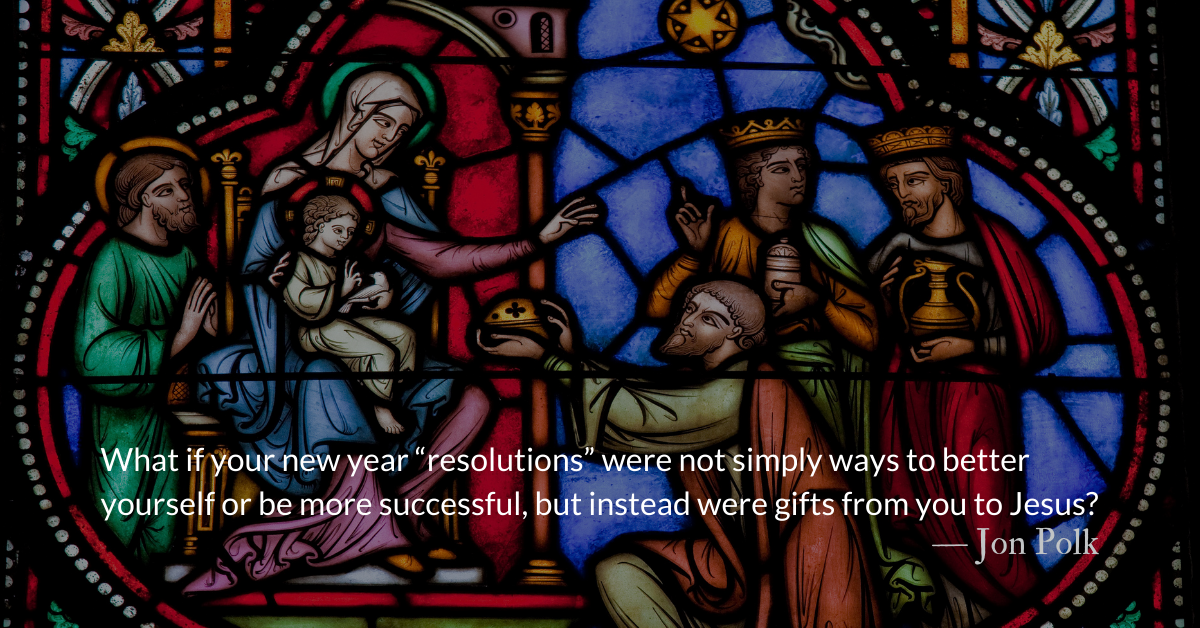
For dramatic purposes, Hopkins assigned a gift and a verse to three Magi, traditionally named Caspar, Melchior and Balthazar. Note that Matthew’s account mentions three gifts, not three men. In some Christian traditions, they are twelve in number.

Furthermore, there is no indication in Matthew that they were kings. The word magi refers to astrologers, thus their interest in following a star. Not royalty, but most certainly foreigners, these Magi were likely familiar with Hebrew prophecies.

Despite these slight missteps the carol makes, Hopkins does a fine job describing the symbolism of the gifts.

Born a King on Bethlehem’s plain,
gold I bring to crown him again

Gold is the most frequently mentioned valuable metal in scripture, used as currency but also for making jewelry, ornaments, and utensils for royalty. This gift is fit for a king.

Frankincense to offer have I
Incense owns a Deity nigh

Frankincense, derived from Boswellia tree resin, produces a sweet odor when burned and was part of the incense allowed on the altar. This gift is fit for worship.

Myrrh is mine; its bitter perfume
Breathes a life of gathering gloom

Myrrh, sap from a small tree in Arabia, was used as a perfume and to stifle the smell of a dead body before burial. This gift is fit for death.

As astrologers, not royalty, the gifts came at a significant financial cost to the Magi. Traveling from as far away as Persia, a two-year journey, required time and energy. These gifts were sacrificial, intended for worship.

However, what do we do at Christmas time? We give gifts to everyone but the guest of honor himself.

What if this year you begin a new tradition? What if your new year “resolutions” were not simply ways to better yourself or be more successful, but instead were gifts from you to Jesus?

What present would you give Jesus? More time in prayer or Bible study? Kicking a habit that is holding back your spiritual growth? Focusing attention less on yourself and more on those around you?

If you give Jesus a gift this year, what will it be? Following the example of the Magi, let it be sacrificial and intended for worship.

Listen: We Three Kings by Tenth Avenue North and Britt Nicole
Read: Lyrics from Hymnary.org

Divine Hours Prayer: The Call to Prayer
Sing to the Lord and bless his Name; proclaim the good news of his salvation from day to day.
Declare his glory among the nations and his wonders among all peoples.
For great is the Lord and greatly to be praised; his is more to be feared than all gods. — Psalm 96.2-4

– From The Divine Hours: Prayers for Autumn and Wintertime by Phyllis Tickle.

Today’s Readings
Job 6 (Listen – 2:56) 
Psalm 10 (Listen – 2:13)

Join us! Walk through the Bible with us…
Walk with friends through God’s Word this year… Read, Reflect, Pray… Repeat.
https://mailchi.mp/theparkforum/m-f-daily-email-devotional

Read more about Unwrapping Christ’s Gifts :: Epiphany
May we wear Christ’s gifts prominently, like new…clothing. Through the wearing, may we allow them to transform us into the manifestation of the giver.