Tribe Over Truth

Links for today’s readings:

Read: Judges 20 Listen: (7:13) Read: Hebrews 7 Listen: (4:01)

Scripture Focus: Judges 20: 12-13, 35-36

12 The tribes of Israel sent messengers throughout the tribe of Benjamin, saying, “What about this awful crime that was committed among you? 13 Now turn those wicked men of Gibeah over to us so that we may put them to death and purge the evil from Israel.”

But the Benjamites would not listen to their fellow Israelites.

35 The Lord defeated Benjamin before Israel, and on that day the Israelites struck down 25,100 Benjamites, all armed with swords. 36 Then the Benjamites saw that they were beaten.

Reflection: Tribe Over Truth

By Erin Newton

I have stood in that precarious place, watching and waiting to see how people—people I trusted with my story—would respond. Would they believe me? What about the perpetrator’s friends? Whose side would they pick?

The burden of proof for a victim of abuse is almost unbearable. Not only has one endured abuse, but it often falls on the victim to convince others that a wrong has been committed. Sadly, some people choose friendships over accepting the grim reality that a person in their circle has harmed another human being.

When those who should purge such wickedness instead grant it safe harbor, they too become complicit.

After the heinous acts were committed against the woman in Judges 19, a glimmer of hope arises as Israel responds. Envoys were sent to Benjamin to make them aware of what happened “and give them the opportunity to acknowledge the crime, to distance themselves from Gibeah and to ensure that justice was done” (Mary Evans, Tyndale Old Testament Commentary: Judges and Ruth). Now was the community’s chance to stand for what was right, but they chose their tribe over the truth.

War ensued after Benjamin defiantly refused to support the victim. (Some see the Levite’s description of the event as an attempt to cover his own complicit nature and an attempt to make himself the victim of “lost/damaged property.” The woman was clearly the victim here and Israel was right to respond in outrage.)

Let us not forget: The Levite sent proof! Even in this scenario, it is not a question of evidence, but of morality. It is a battle between allegiance to other humans and the justice God demands.  

Through Benjamin’s refusal to listen to the envoys and to react in a way that enacted justice, they were choosing either their own collective self-image or choosing to ignore faults for the sake of some past glory they had as a tribe. The motive in Judges 20 is not stated.

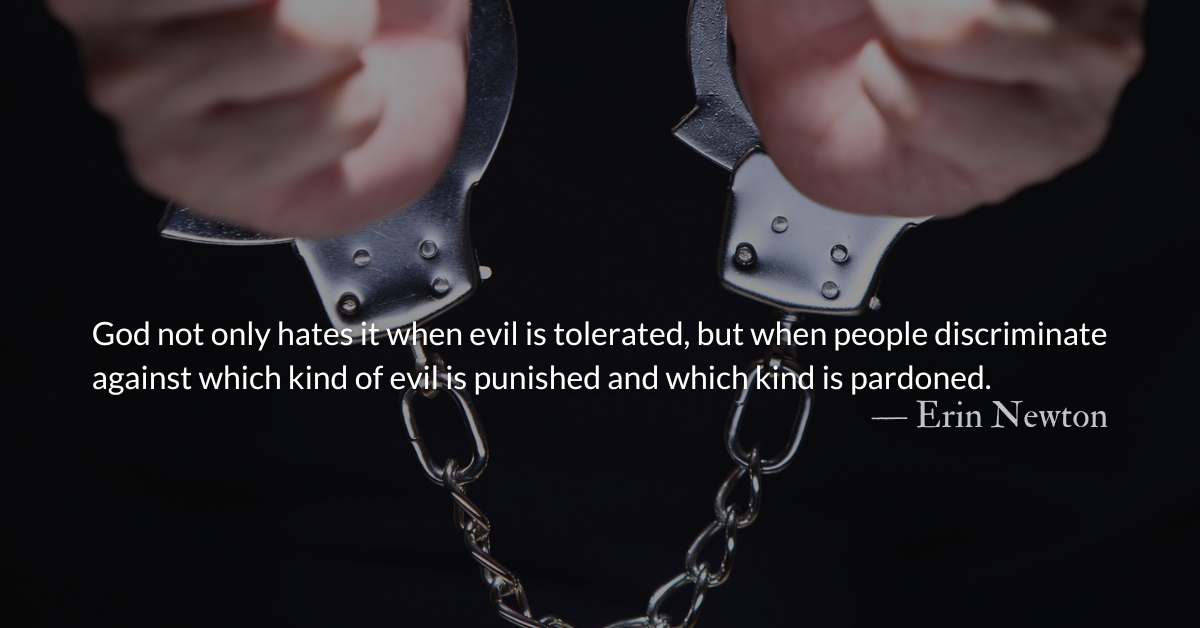
What is clear in this story is this: Evil should never be allowed a foothold within the community. This goes beyond abuse. Evil of all kinds cannot be tolerated; God hates unjust scales. This means that God not only hates it when evil is tolerated, but when people discriminate against which kind of evil is punished and which kind is pardoned.

We are called to be a voice for the voiceless. Don’t choose tribe over truth.

Divine Hours Prayer: The Request for Presence

Show your goodness, O Lord, to those who are good and to those who are true of heart. — Psalm 125.4

– Divine Hours prayers from The Divine Hours: Prayers for Summer
by Phyllis Tickle

Read more: Facing Ugly Truths

When ugly truths that should shock us come to light today, how do we face them?

https://theparkforum.org/843-acres/facing-ugly-truths

Read more: Allowing Injustice to Save Face

Jephthah’s vow was to his pride, not God. He saved face rather than his daughter.

The Hero’s Parents

Links for today’s readings:

Read: Judges 13 Listen: (3:44) Read: 1 Peter 5 Listen: (2:11)

Scripture Focus: Judges 13:21-24

21 When the angel of the Lord did not show himself again to Manoah and his wife, Manoah realized that it was the angel of the Lord.
22 “We are doomed to die!” he said to his wife. “We have seen God!”
23 But his wife answered, “If the Lord had meant to kill us, he would not have accepted a burnt offering and grain offering from our hands, nor shown us all these things or now told us this.”
24 The woman gave birth to a boy and named him Samson.

Reflection: The Hero’s Parents

By Erin Newton

Samson is the Rapunzel of the Old Testament—at least relating to his luscious locks of hair. No one really thinks about his parents, perhaps we are all accustomed to granting his success as a gift from God (and his failure to the hands of his lover).

In the Bible, miraculous children are destined by God for specific purposes. The purpose of Abraham’s promised child (Isaac) was tied to the covenant already given by God. “To your offspring I will give this land” (Genesis 12). Zechariah’s promised child (John) would “bring back many of the people of Israel to the Lord their God” (Luke 2). Manoah’s promised child (Samson) is to “take the lead in delivering Israel from the hands of the Philistines.”

We often look at the joy that erupts at the news of a barren womb made fruitful. It is miraculous. But when Manoah prays to God, I can only imagine the element of shock—not because he was now going to be a father but that he was going to be tasked with raising a divinely appointed child. That would terrify me.

I’m glad Samson had both his father and his mother and that we get to see how both react. Manoah needs a little more reassurance. He tries to get the angel’s name as if that would grant him some sort of power or good luck. He delays the angel, trying to win favor by making an impromptu offering. And he is shocked when the offering billows up to heaven revealing their guest was divine.

Samson’s mother, though nameless here, has the steady demeanor of not freaking out. She meets the angel, receives the miraculous promise, and then rushes home admitting that she might have forgotten to get all the details. And when they realize the guest that was in their presence was the angel of the Lord, she has the logic and wisdom to reassure her husband that God does not promise blessing and then haphazardly kill you when he meets with you.

Once again, Judges gives us a glimpse of people having typical reactions to a very supernatural event. They are also imperfect in their faith and perhaps in their ability to raise this son (see chapter 14). But God knows this will happen. He calls them, meets with them, and continues to uphold his promises—even when they freak out.

Divine Hours Prayer: The Refrain for the Morning Lessons

For as the heavens are high above the earth, so is his mercy great upon those who fear him. — Psalm 103.11

– Divine Hours prayers from The Divine Hours: Prayers for Summer
by Phyllis Tickle

Read more: It’s in the Bible

“Well, it’s right there in the Bible, so it must not be a sin. But it sure does seem like an awful dirty trick…” — Rich Mullins

Consider Supporting Our Work

For the monthly cost of a streaming service, you can help us bring “streams of water” from scripture to the desert of people’s busy lives. Please consider becoming a donor.
Embracing Uncertainty

Links for today’s readings:

Read: Judges 6 Listen: (6:15) Read: Titus 1 Listen: (2:24)

Scripture Focus: Judges 6:39-40

39 Then Gideon said to God, “Do not be angry with me. Let me make just one more request. Allow me one more test with the fleece, but this time make the fleece dry and let the ground be covered with dew.” 40 That night God did so. Only the fleece was dry; all the ground was covered with dew.

John 14:8

8 Philip said, “Lord, show us the Father and that will be enough for us.”

Reflection: Embracing Uncertainty

By Erin Newton

Anxiety was always part of my life, so adding it to my faith was natural.

If your early days in the faith look like mine, you repeatedly prayed for supernatural signs. I always needed God to prove my salvation was secure. Did that prayer “stick”? Maybe I should do it again.

When I read Scripture that spoke of “ye of little faith,” I was the “ye.” Paired with comments that doubting was a lack of faith, I assumed my doubt meant my faith was in jeopardy.

Unfortunately, this mindset about faith caused me to read the story of Gideon in a condescending way. Gideon, he of little faith. An Old Testament Doubting Thomas.

Susan Niditch calls Gideon our most “pleasingly insecure” hero. Yet God loves this insecure hero. He doesn’t back away from using him.

Gideon is called to save Israel from the hands of the Midianites. Despite the God-given instructions, he’s not free from his own insecurity. Has his faith faltered? Have the previous days or years following God suddenly become nullified because he asks God for a sign? And one more sign? No. Gideon the hero struggles with anxiety just like any one of us.

Philip, one of the apostles, repeats this same scenario in John 14. Jesus tells his disciples that he is about to leave them. Things are about to get a lot worse. Philip, looking for some place to alleviate his insecure feelings, says: “Show us the Father and that will be enough.” One more sign. Then I can keep going.

God didn’t hesitate to answer Gideon. Insecurity does not offend God. Jesus answers Philip by pointing out the answer has always been his presence. He was answering his insecurity before Philip realized his own anxiety.

Gideon cannot escape his insecurity. Philip is not immune to doubts. Our repetitive pleas to God to help our uncertainty is not a sign of diminishing faith. Asking for a sign is met with God’s own reassuring words, “I’ve been with you all this time.”

The indwelling of the Spirit will not erase our anxieties. (Oh, how I wish he would remove this thorn in the flesh!) Embracing uncertainty is a part of faith. But like our own fears—our best method is to embrace the overwhelming uncertainty, learning to live in the tension between the surety of our faith in Christ and the common human reaction to ask for one more reassurance.

Divine Hours Prayer: The Request for Presence

You are my helper and my deliverer; O Lord, do not tarry. — Psalm 70.6

– Divine Hours prayers from The Divine Hours: Prayers for Summer
by Phyllis Tickle

Read more: Count Your Hardships

Balanced with the various ways God provided, the anxiety-inducing “what-if” turns into the hope-filled “even-if.”

Read The Bible With Us

Who could you invite to read the Bible with you to find joy in God’s word? Read together at a sustainable, two-year pace.

https://mailchi.mp/theparkforum/m-f-daily-email-devotional

The Legacy of Growing Old

Links for today’s readings:

Read: Joshua 23 Listen: (2:31) Read: Philippians 4 Listen: (3:20)

Scripture Focus: Joshua 23:1-2

1 After a long time had passed and the Lord had given Israel rest from all their enemies around them, Joshua, by then a very old man, 2 summoned all Israel—their elders, leaders, judges and officials—and said to them: “I am very old.”

Reflection: The Legacy of Growing Old

By Erin Newton

According to developmental psychology, after six or seven decades of living, a person’s priority often turns to “leaving a legacy.” The human mind begins to reflect on life, what has happened and what they want to be remembered for. Joshua seems no different.

At the end of his life, Joshua looked out across the land now inhabited by God’s people. He stopped to give them his final words: “You yourselves have seen everything the Lord your God has done… But you are to hold fast to the Lord your God, as you have until now” (Josh 23:3, 8).

The same sentiments we see echoed in Ecclesiastes: “Remember your Creator in the days of your youth, … before the silver cord is severed, … and the dust returns to the ground it came from, and the spirit returns to the God who gave it” (Eccl 12:1, 6-7).

Much like the aging teacher in Ecclesiastes, it is Joshua who feels the grip of old age closing tighter. He is the strong man who stoops. The almond tree blossoms as his hair fades to silvery gray. He echoes the same messages as the wise man did centuries later: Everything is meaningless apart from the memory of God’s faithfulness.

The legacy Joshua hopes to impart is one that memorializes the uniqueness of God. The people are commissioned to remember his faithfulness. Joshua has seen it over and over, in all his long years. They are to remember that it was God who did the work—not them, not another deity.

So much of the Old Testament is a call to remember. One of the greatest gifts of aging is the lengthy history one has with God. Those who grow in years have had more opportunities to see divine providence in action. And each year that passes is another step closer to hearing the answer to one’s prayers.

But our world is obsessed with anti-aging. Even if we can prevent wrinkles or color our graying hair, aging is an honorable gift to be received. Aging is the continued mercy from God. Aging gives us more opportunity to remember him.

It should not burden us to see another gray hair or watch our skin fold into new creases by our eyes. Like Joshua, we should fix our minds on what message we will leave for our community. Like Joshua, may our legacy be a testimony about the faithfulness of God.

Divine Hours Prayer: The Request for Presence

O God of hosts, show us the light of your countaenance, and we shall be saved. — Psalm 80.7

– Divine Hours prayers from The Divine Hours: Prayers for Summer
by Phyllis Tickle

Read more: Minority Report Vindicated

The fearful majority of Caleb’s generation overwhelmingly forgot God, yet God remembered the faithful.

Read more: Josiahs Need Zephaniahs

The next generation needs us to model condemning our past sins, confessing them, and being free. Josiahs need Zephaniahs.

Hamstrung Power

Links for today’s readings:

Read: Joshua 11 Listen: (3:52) Read: Ephesians 3 Listen: (2:41)

Scripture Focus: Joshua 11:7-9

7 So Joshua and his whole army came against them suddenly at the Waters of Merom and attacked them, 8 and the Lord gave them into the hand of Israel. … 9 Joshua did to them as the Lord had directed: He hamstrung their horses and burned their chariots.

Reflection: Hamstrung Power

By Erin Newton

When we read stories of warfare and violence in the Bible, especially in narratives that depict the events as God-ordained, we should not take the stories too lightly. In fact, I suggest we not read them while gloating or with a sense of prowess. They are troubling; they jolt our senses.

The narratives in Joshua describe the journey of God’s people into an occupied land by means of war. The text says that God commanded them to kill everyone. Scholars have long felt the uneasiness of such a brutal request. Some have downplayed the language as hyperbole.

Others say the conquered locations are military outposts rather than civilized towns. Others focus on the details and compare Israel’s God with the foreign gods.

In a pursuit to understand why the violent texts are preserved as God’s word, William Webb and Gordon Oeste looked at various texts and discovered not a God who delights in death but “a highly reluctant war God who is not exactly eager to participate with Israel in its wars” (Bloody, Brutal, and Barbaric? Wrestling with Troubling War Texts).

In Joshua 11, God tells Joshua to hamstring the horses and burn the chariots. Webb and Oeste point out, “We might immediately cringe at the maiming of these animals.” I do. My love of nature includes my compassion on all created beings—from the beetles who burrow in my yard to the elusive tigers of Malaysia. Why would God call for harming his creatures?

Ancient Near Eastern cultures increased power and pride through the accumulation of chariots. With these new victories, Israel might try to increase its weaponry. Therefore, the horses are reduced to domestic labor.

Webb and Oeste see a God who “wanted his people to be owners of cattle in a land flowing with milk and honey, not a people whose land was full of war horses and chariots—the instruments of human oppression and domination.” It is God who hamstrings his people’s pride by asking them to debilitate the enemy’s horses and burn their chariots.

Webb and Oeste’s perspective offers another way of balancing the “leave-none-alive” Old Testament texts with the “turn-the-other-cheek” character of God.

We still wrestle with these violent texts and not all questions may ever be answered. But we see a God who disarms his people, stunts their might, and hinders their pride.

Because in our weakness, he is made strong.

Divine Hours Prayer: The Small Verse

The Lord is my shepherd and nothing is wanting to me. In green pastures he has settled me. — The Short Breviary

– Divine Hours prayers from The Divine Hours: Prayers for Summer
by Phyllis Tickle

Read more: Horses of Flesh or Spirit

Crises expose what we truly rely on. Comfort dulls our hold on principles and the strength of our convictions.

Read The Bible With Us

What meaning will you find by reading the Bible with us at a sustainable, two-year pace?

https://mailchi.mp/theparkforum/m-f-daily-email-devotional