The Branch and the Branches

Scripture Focus: Zechariah 6.12-13
12 Tell him this is what the Lord Almighty says: ‘Here is the man whose name is the Branch, and he will branch out from his place and build the temple of the Lord. 13 It is he who will build the temple of the Lord, and he will be clothed with majesty and will sit and rule on his throne. And he will be a priest on his throne. And there will be harmony between the two.’

Zechariah 3.1-2; 7-8; 10
1 Then he showed me Joshua the high priest standing before the angel of the Lord, and Satan standing at his right side to accuse him. 2 The Lord said to Satan, “The Lord rebuke you, Satan! The Lord, who has chosen Jerusalem, rebuke you! Is not this man a burning stick snatched from the fire?” 

7 “This is what the Lord Almighty says: ‘If you will walk in obedience to me and keep my requirements, then you will govern my house and have charge of my courts, and I will give you a place among these standing here. 
8 “ ‘Listen, High Priest Joshua, you and your associates seated before you, who are men symbolic of things to come: I am going to bring my servant, the Branch.
10 “‘In that day each of you will invite your neighbor to sit under your vine and fig tree,’ declares the LORD Almighty.”

Reflection: The Branch and the Branches
By John Tillman

Joshua, the high priest during the rebuilding of the Temple, is a unique one.

There are multiple restarts and reboots of the priesthood. Joshua is just one of them. In chapter 3, Zechariah has a vision of Joshua in priestly garments that are filthy, covered with excrement.

Satan stands to accuse him, pointing out the filth of his sin. The Lord rebukes Satan and describes Joshua as a “burning stick snatched from the fire.” The filthy clothes representing sin are removed, and just as he tenderly dressed Adam and Eve’s nakedness, The Lord dresses Joshua in fine, clean garments.

Joshua, the stick saved from the fire, is more than just a smoke-smelling testament of grace. He is a symbol, scripture tells us, of one to come. The burnt stick represents “the Branch.” The Branch will “branch out” and build a new temple as well as be a priest and a king. (Isaiah 4.2; Ezekiel 17.22; John 15.1-8) The crown made for Joshua points to this promise. The crown is not meant for Joshua. He is only holding it until the one worthy of it appears.

One of the unique characteristics here is that God is not only rebooting the priesthood but the entire culture and country. Joshua, the other priests, and everything given to them represent something in the future. Joshua represents Jesus and the priests and people represent us. We are an extension of and connected to this reboot.

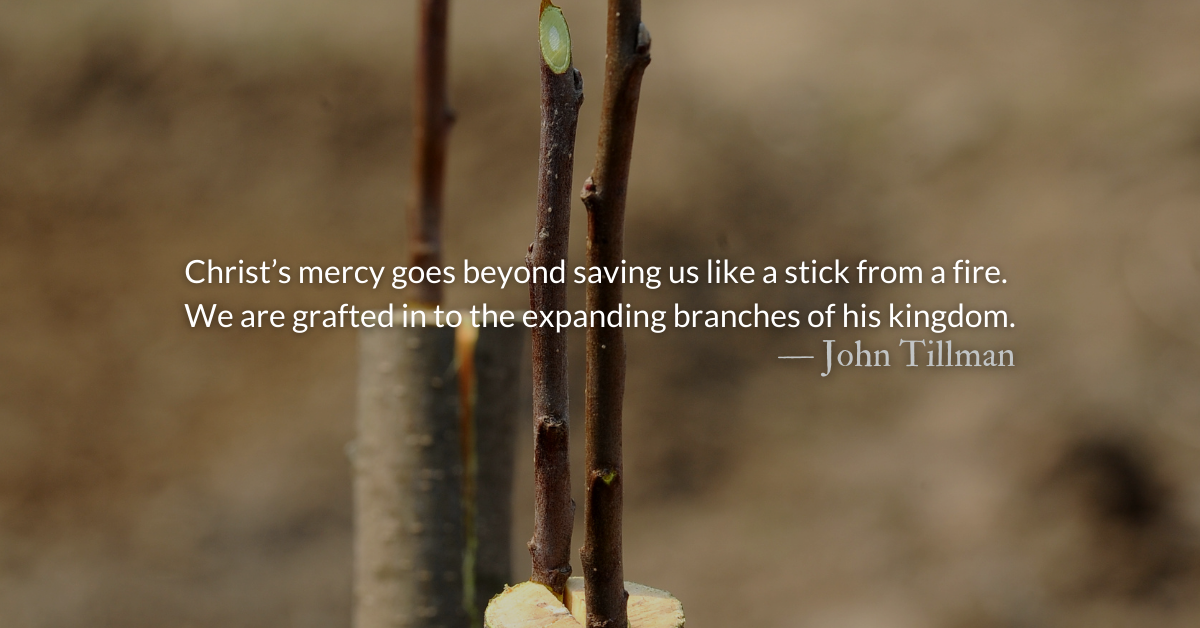
Christ’s mercy goes beyond saving us like a stick from a fire. We are grafted in to the expanding branches of his kingdom. Our high priest, Jesus, is “The Branch” and we are grafted into him. (Romans 11.17-23) Christ is the new Temple of God and, like a tree of life, reaches out to offer healing and a home under his branches. His righteousness flows into us and we are able to create holy space, shade under the limbs of God’s tree.

We are the branches off of which the fruit of the gospel should bloom. May we be found to be not just leafy but fruitful. (Matthew 21.19) May we, filled with the Holy Spirit, create a cooling, welcoming shade for all who have spent time wandering the deserts of sin. (Zechariah 3.10)

Divine Hours Prayer: The Greeting
I will thank you, O Lord my God, with all my heart, and glorify your Name forevermore. — Psalm 86.12

Today’s Readings

Zechariah 6 (Listen – 2:08)
Matthew 3 (Listen – 2:17)

Read more about Family Tree

We can be grafted in to the family tree of Christ and bear the same fruit that he wants to bring about in our lives.

Read more about Cultivation Requires Planning
No park or garden is “natural.” Even the garden of Eden was planted by the Lord after the creation of the plants and animals.
Defilement, Deconstruction, and Reconstruction

Scripture Focus: Zechariah 5.3-4
3 And he said to me, “This is the curse that is going out over the whole land; for according to what it says on one side, every thief will be banished, and according to what it says on the other, everyone who swears falsely will be banished. 4 The Lord Almighty declares, ‘I will send it out, and it will enter the house of the thief and the house of anyone who swears falsely by my name. It will remain in that house and destroy it completely, both its timbers and its stones.’” 

Reflection: Defilement, Deconstruction, and Reconstruction
By John Tillman

Many of Zechariah’s visions are about cleansing and rebuilding afresh. Those returning from exile face a destroyed and defiled landscape.

It isn’t so hard for us to imagine something similar today. Millions of people have fled the Russian invasion of Ukraine and the cities and towns left behind have been bombed to rubble in ways not seen since World War II. Not only bombed buildings but mass graves await those who hope to one day return. Destruction and defilement.

Like post-war Europe, much of Jerusalem in Zechariah’s day would have to be reconstructed from the ground up. However, God isn’t only concerned with physical reconstruction. He wants to reconstruct the people’s faith, starting with their hearts.

God is and always has sought to deal with the corruption and defilement of human hearts. The mental, social, and physical damage we cause one another flows from inner corruption. When our cities are wicked, our hearts are the source. When our countryside is corrupt, our hearts are the cause. When Jerusalem and its walls and Temple were destroyed and burned with fire, it was because of their hearts.

As the new community of Jerusalem rebuilt the Temple, their homes, and eventually the wall, God was concerned that no spiritual defilement would be present. Zechariah sees a vision of a flying scroll that represents a curse. This curse will target those whose hearts seek wicked ways of prospering and will destroy their homes.

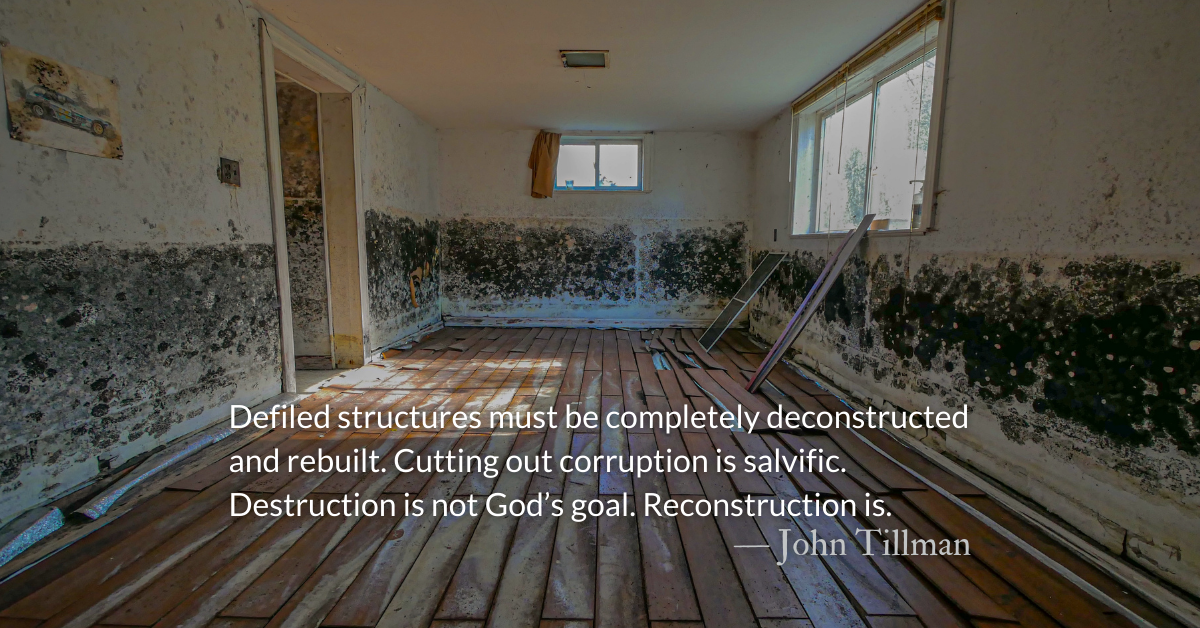
Zechariah’s “timbers and stones” language echoes some passages about physical molds in Leviticus. (Leviticus 14.35-45) Priests inspected homes with mold. If the mold spread, the first step was to remove only the affected stones. But if the mold returned, the entire house had to be deconstructed, “stones, timbers, and all the plaster,” and removed from the community. 

May we never allow ourselves to think we, or our culture, are immune to the rot of sin. In our individual lives, our churches, and the structures of our denominations and nations, we all face defiling influences from our cultures.

Defiling influences have to be fully removed to save existing structures. If small steps do not stop the seeping spread of defilement, more extreme measures are required. Defiled structures must be completely deconstructed and rebuilt.

Cutting out corruption is salvific. Destruction is not God’s goal. Reconstruction is. Take care to deconstruct and destroy only when corruption persists.

Divine Hours Prayer: The Request for Presence
In the morning, Lord, you hear my voice; early in the morning I make my appeal and watch for you. — Psalm 5.3

Today’s Readings
Zechariah 5 (Listen – 1:35)
Matthew 2 (Listen – 3:18)

Read more about Treasuring Our Temples
Through the Babylonian destruction, God did not allow the Temple to be defiled. He took the first step to cleanse it.

Read more about What Time is It?
Our time is not so different…We see around us the elements of the song. Love and hate, war and peace, deconstruction and reconstruction…

The Urban Sprawl of the City of God

Scripture Focus: Zechariah 2.3-11
3 While the angel who was speaking to me was leaving, another angel came to meet him 4 and said to him: “Run, tell that young man, ‘Jerusalem will be a city without walls because of the great number of people and animals in it. 5 And I myself will be a wall of fire around it,’ declares the Lord, ‘and I will be its glory within.’ 
6 “Come! Come! Flee from the land of the north,” declares the Lord, “for I have scattered you to the four winds of heaven,” declares the Lord. 
7 “Come, Zion! Escape, you who live in Daughter Babylon!” 8 For this is what the Lord Almighty says: “After the Glorious One has sent me against the nations that have plundered you—for whoever touches you touches the apple of his eye—9 I will surely raise my hand against them so that their slaves will plunder them. g Then you will know that the Lord Almighty has sent me. 
10 “Shout and be glad, Daughter Zion. For I am coming, and I will live among you,” declares the Lord. 11 “Many nations will be joined with the Lord in that day and will become my people. I will live among you and you will know that the Lord Almighty has sent me to you. 12 

Reflection: The Urban Sprawl of the City of God
By John Tillman

The angel who has been talking to Zechariah leaves him. However, at some distance away, a second angel intercepts the first with an urgent message, sending him back. “Run, tell that young man…” the second angel says.

Zechariah is told that the new Jerusalem will have no walls. This may not seem unusual to us. Most of today’s cities have no walls. The Dallas-Fort Worth metroplex, where I live, covers an area larger than the combined areas of Connecticut, Delaware, and Rhode Island. It is over 9,000 square miles of cities grown right into each other…and sprawling more every month out into the surrounding countryside.

In Zechariah’s day, however, cities without walls were defenseless. However, the angel of the Lord says that he, himself, will be a wall of fire around the city and its glory within. This image links to at least two things. 

On Mount Sinai, God appeared in a fiery cloud of glory. The people were too afraid to go near the mountain, but Moses entered this fire and experienced the glory of God.

In John’s Revelation, the City of God, the New Jerusalem, comes down from Heaven and has no need of sun or lamps because the Lord himself will be its light. His glory will fill the city. (Revelation 22.5; Zechariah 14.7; Isaiah 60.19)

The angel tells Zechariah that God will send him to us in this fire-walled, glorious city. He will come and live among us and many nations will become God’s people.

God has sent Jesus to us in this manner and for this purpose. Jesus is the entrance into all that God has for us. He is the gate and the wall and when we enter, he shows us God’s glory closer than Moses ever got to see. This is an “already and not yet” promise. We can experience it now in part, as through a veil like Moses wore, but then we will experience it more fully.

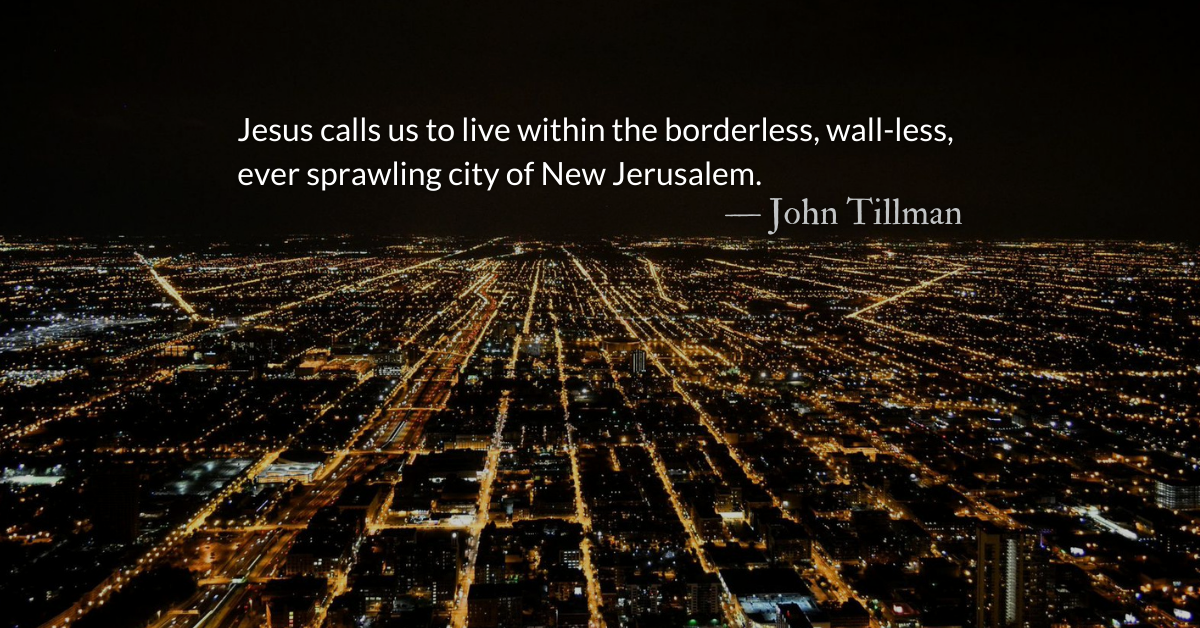
God is writing an Exodus narrative for us today. Jesus calls to us to escape the cities, systems, and empires we now serve. “Escape!”, he cries. “Escape from Babylon!” Jesus calls us to live within the borderless, wall-less, ever sprawling city of New Jerusalem. As we anticipate the ultimate fulfillment of this promise, may we participate in work God calls us to which fulfills it in part.

Divine Hours Prayer: A Reading
Jesus taught us, saying: “The lamp of the body is the eye. It follows that if your eye is clear, your whole body will be filled with light. But if your eye is diseased, your whole body will be darkness. If then, the light inside you is darkened, what darkness that will be! — Matthew 6.22-23

Today’s Readings
Zechariah 2 (Listen – 1:41)
Mark 15 (Listen – 5:16)

This Weekend’s Readings
Zechariah 3 (Listen – 1:48), Mark 16 (Listen – 2:34)
Zechariah 4 (Listen – 1:53), Matthew 1 (Listen – 3:29)

Read more about Christ our Temple, River, and City
Christ is our city. He is our refuge and rest—our strong tower and protected place…

Read more about Hope Among the Traumatized
From our lives may there flow trickles of hope, which combine into a river that brings to life…

Who Stands Among Us?

Scripture Focus: Zechariah 1.12-16
12 Then the angel of the Lord said, “Lord Almighty, how long will you withhold mercy from Jerusalem and from the towns of Judah, which you have been angry with these seventy years?” 13 So the Lord spoke kind and comforting words to the angel who talked with me. 

14 Then the angel who was speaking to me said, “Proclaim this word: This is what the Lord Almighty says: ‘I am very jealous for Jerusalem and Zion, 15 and I am very angry with the nations that feel secure. I was only a little angry, but they went too far with the punishment.’ 

16 “Therefore this is what the Lord says: ‘I will return to Jerusalem with mercy, and there my house will be rebuilt. And the measuring line will be stretched out over Jerusalem,’ declares the Lord Almighty.

Reflection: Who Stands Among Us?
By John Tillman

Zechariah records a strange nighttime vision. A man on a red horse waits among a stand of myrtle trees.

The mysterious figure of the man among the myrtles is also called “the angel of the Lord.” The angel of the Lord is a hard character to pin down in scripture.

Sometimes, as with the man among the myrtles, the angel of the Lord speaks for God, in the third person: “This is what the Lord says…” Is he just one of many angels who speak for God, like Gabriel or others? 

At other times, the angel of the Lord speaks as God, in the first person: “I am the God of your father, the God of Abraham, the God of Isaac and the God of Jacob…” (Exodus 3.6) Is he a Theophany, an embodied presence of God or a Christophany, a pre-incarnate appearance of Christ?

One of the unique characteristics of this particular appearance of the angel of the Lord is that he speaks to God on behalf of humans. “Lord Almighty, how long will you withhold mercy from Jerusalem…?” (Zechariah 1.12) This rarely happens with other angels and is the strongest indicator in the text that the mysterious figure might be Jesus, our mediator, the third person of the Trinity. But it is still inconclusive.

We needn’t be too concerned that we can’t quite identify this Jesus-like figure in the myrtle trees when the disciples couldn’t identify Jesus on the Emmaus road. Just keep walking and listen…

Jesus is the perfect representation of God and the Holy Spirit is among us to show him to us. We have a more complete picture of what God is like than even prophets, like Zechariah, who saw dreams and visions of him.

To Zechariah, the man in the myrtles was a powerful and mysterious presence who announced a time of mercy and rebuilding. We too are connected to a powerful and mysterious presence. Today, mercy and rebuilding are announced not by a mysterious horseman but by the Holy Spirit who stands not among myrtles but among us. The Holy Spirit speaks as God, for God, and to God on our behalf.

Let us proclaim the message the Spirit will pass on through us. When we are in step with the Spirit, we too will announce mercy to those who seek God and rebuilding of all that sin has broken.

Divine Hours Prayer: The Small Verse
My soul thirsts for the strong, living God and all that is within me cries out to him. — Traditional (based partly on Psalm 42.2 and 103.1)

Today’s Readings
Zechariah 1 (Listen – 3:37)
Mark 14 (Listen – 8:37)

Read more about This Present Age
Teach us, Holy Spirit, that in this age and in this space, you have placed us and called us.

Read more about Resurrecting Goodness
We transition from Christ who walked around in a body like ours…to Christ whose Spirit walks around in our bodies prompting us to do good in our world right now.

There is a Fountain Filled with Blood — Lenten Hymns

Scripture Focus: Luke 22:39-44
39 Jesus went out as usual to the Mount of Olives, and his disciples followed him. 40 On reaching the place, he said to them, “Pray that you will not fall into temptation.” 41 He withdrew about a stone’s throw beyond them, knelt down and prayed, 42 “Father, if you are willing, take this cup from me; yet not my will, but yours be done.” 43 An angel from heaven appeared to him and strengthened him. 44 And being in anguish, he prayed more earnestly, and his sweat was like drops of blood falling to the ground.

Zechariah 13:1
On that day a fountain will be opened to the house of David and the inhabitants of Jerusalem, to cleanse them from sin and impurity.

Reflection: There is a Fountain Filled with Blood — Lenten Hymns
By Jon Polk

The hymn, “There is a Fountain Filled with Blood,” can be difficult to sing. Not because of a challenging rhythm or melody, but because of vivid and gratuitous language. This hymn would likely receive a PG-13 rating for violent content.

William Cowper (pronounced “Cooper”), born in England in 1731, wrote “There is a Fountain” after a significant period of depression, something he battled all his life.

Cowper’s mother died in childbirth when he was six. He and his brother were the only two out of seven siblings to survive past infancy. His mother’s death affected him significantly and began his life-long battle with mental illness.

Cowper attended Westminster, where he took an interest in writing poetry. However, after graduation, he became apprenticed to an attorney, but never practiced law.

This led to an offer of a clerkship in the House of Lords, but Cowper suffered a mental breakdown due to the stress of the interview. After attempting to take his own life, he was admitted to St. Alban’s Hospital. He was treated by a Christian therapist who encouraged him to read the Bible. In so doing, Cowper began to find peace of mind and recovered after eighteen months.

There is a fountain filled with blood
Drawn from Immanuel’s veins,
And sinners plunged beneath that flood
Lose all their guilty stains.

The dying thief rejoiced to see
That fountain in his day;
And there may I, though as vile as he,
Wash all my sins away.

Upon release from St. Alban’s, Cowper moved in with a retired clergyman who introduced him to minister and hymn writer, John Newton. Newton invited Cowper to assist with pastoral duties and encouraged him to contribute to a hymnbook. Cowper wrote sixty-eight hymns for the collection, including “There is a Fountain” and he flourished under Newton’s care.

The season of Lent reminds us that when we are at our lowest of lows, Jesus extends his hand to rescue us. He has been there. He has sweat blood in a moment of distress and agony. He has shed blood in the ultimate sacrifice for our rescue and redemption.

William Cowper became a successful hymn writer and renowned secular poet. However, he was a troubled soul most of his life. The death of his brother and several close friends agitated his depression. Cowper claimed God protected him from taking his own life on several occasions.

While the hymn’s imagery may be violent and difficult, so too are the pressures and tragedies we face in life. Our faith in the Fountain redeems even our most tragic wounds.

E’er since by faith I saw the stream
Thy flowing wounds supply,
Redeeming love has been my theme
And shall be till I die.

Music: There is a Fountain by Russ Taff
Lyrics: “Praise for the Fountain Opened” (original title) – from Hymnary.org 

From John: Mental illness should be taken to God in prayer just like cancer, heart disease, Covid-19, or any other illness. Also, just like those other illnesses, one should seek professional help for mental illness. If you struggle with mental illness, especially if you have thoughts of harming yourself, seek help immediately. Contact one of the organizations listed below or local organizations in your community.

Mental Health and Suicide Prevention Resources: 
Mental Health Grace Alliance
Not A Day Promised Resource Page
Life Recovered (Resources for Ministers)
Suicide Prevention Lifeline
Action Alliance for Suicide Prevention
Suicide Prevention Resource Center

Divine Hours Prayer: The Refrain for the Morning Lessons
“Because the needy are oppressed, and the poor cry out in misery, I will rise up,” says the Lord, “And give them the help they long for.” — Psalm 12.5

– Divine Hours prayers from The Divine Hours: Prayers for Springtime by Phyllis Tickle

Today’s Readings
Exodus 19 (Listen – 4:04)
Luke 22 (Listen – 7:58)

Read more about Treatment of Mercy
May we seek to treat the mentally ill medically, spiritually, and relationally, as we support them within our communities as treasured ones, loved by Christ.

Read more about Discipline for the Anxious

The psalmist writes of being “too troubled to speak,” yet he cries to God. He writes of insomnia, yet he rests in God.

Show Buttons
Hide Buttons
Spur a spiritual rhythm of refreshment right in your inbox
By joining this email list you are giving us permission to send you devotional emails each weekday and to communicate occasionally regarding other aspects of the ministry.
100% Privacy. We don't spam.