Augustine on Political Leadership

By Augustine of Hippo (354-430 C.E.)

To you I lift up my eyes, O you who are enthroned in the heavens! — Psalm 123.1

We do not attribute the power of kingdoms and empires to anyone except the true God. It is He who gives happiness in the Kingdom of Heaven to the righteous. And it is He who gives kingly power on earth, both to the righteous and the unrighteous, as it pleases Him. His good pleasure is always just.

He is the one true God who never leaves the human race without justice and help. He gave a kingdom to the Romans, as He also did to the Assyrians—and even the Persians, who, as their own books testify, only worshipped two gods—to say nothing of the Hebrew people, who, as long as they were a kingdom, worshipped none save the true God.

The same One who gave to the Persians harvests gave power to Augustus and also to Nero. To avoid the necessity of going over all of those to whom He has enthroned: He who gave power to the Christian Constantine also gave it to the apostate Julian—whose gifted mind was deceived by a sacrilegious and detestable curiosity, stimulated by the love of power.

Are not all things ruled and governed by the one God as He pleases—and if His motives are hidden, are they therefore unjust?

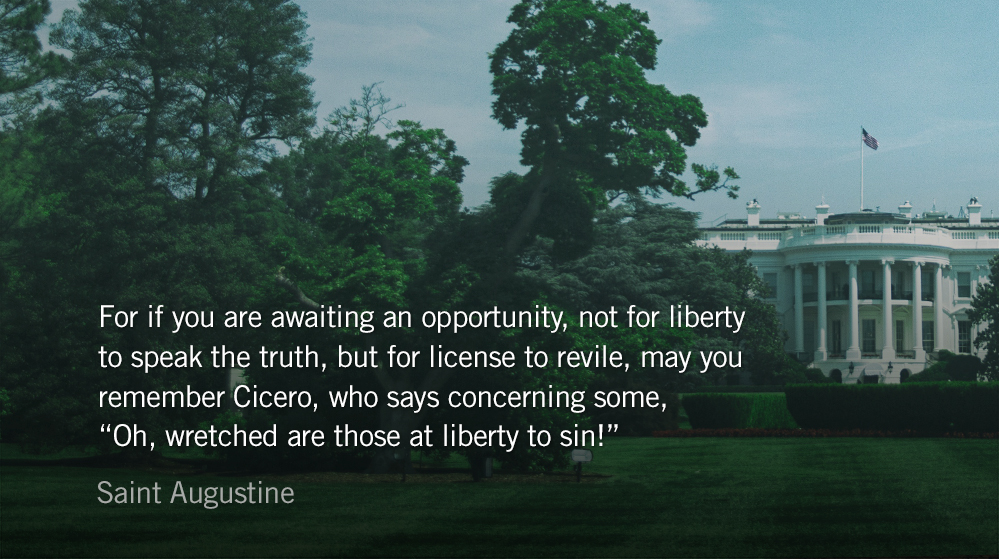
For if you are awaiting an opportunity, not for liberty to speak the truth, but for license to revile, may you remember Cicero, who says concerning some, “Oh, wretched are those at liberty to sin!” Whoever deems himself happy because of license to revile, he would be far happier if that were not allowed at all.

The cause of the greatness of the Roman empire is neither fortuitous nor fatal. (Some call things fortuitous which have either no causes or causes which do not proceed from some intelligible order; others call that which happens independently of the will of God and man fatal.) In a word, human kingdoms are established by divine providence.

Now, against the sacrilegious and impious darings of reason, we assert both that God knows all things before they come to pass, and that we do by our free will whatsoever we know and feel to be done by us only because we will it.

God is supreme and true—He can never be believed to have left the kingdoms of men, their dominations and servitudes, outside of the laws of His providence.

*Abridged and adapted from The City of God.

Today’s Reading
Hosea 8 (Listen – 1:58)
Psalms 123-125 (Listen – 1:52)
Redeeming Speech

Deliver me, O Lord, from lying lips, from a deceitful tongue. What shall be given to you, and what more shall be done to you, you deceitful tongue? — Psalm 120.2-3

In order to understand the true nature of a person’s heart, ancient Jews believed, you looked to his words. “Out of the abundance of the heart his mouth speaks,” Jesus observed. It was a belief widely held in the ancient world; centuries later the Babylonian Talmud imagined a conversation between God and a man’s words:

Said the Holy One, blessed be he, to the tongue, “All the parts of the human body stand upright, but you recline. All the parts of the human body are outside, but you are inside. Not only so, but I have set up as protection for you two walls, one of bone (teeth) and one of flesh (cheeks).”

Though the tongue may recline, it is rarely at rest. ”Lips are soft; but when they are ‘lying’ lips they suck away the life of character and are as murderous as razors,” Charles Haddon Spurgeon remarks:

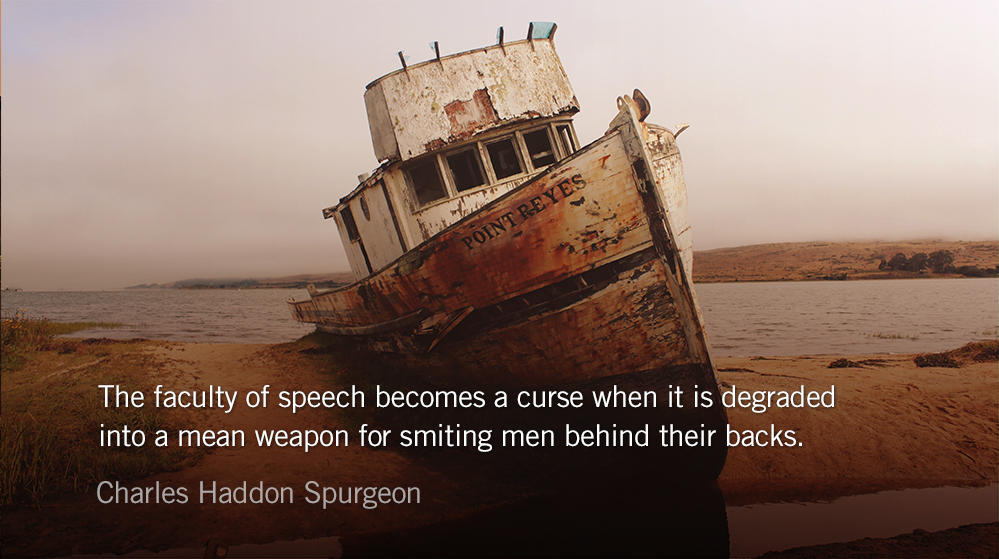
Lips should never be red with the blood of honest men’s reputes, nor salved with malicious falsehoods. The faculty of speech becomes a curse when it is degraded into a mean weapon for smiting men behind their backs. Those who fawn and flatter, too, and all the while have enmity in their hearts, are horrible beings; they are the seed of the devil, and he works in them after his own deceptive nature.

The authors of Scripture react viscerally to malicious and deceptive words, Spurgeon explains, because they are the language of sin:

The Psalmist seems lost to suggest a fitting punishment. It is the worst of offenses—this detraction, calumny, and slander. Judgment sharp and crushing would be measured out to it if men were visited for their transgressions. But what punishment could be heavy enough?

And though Christ absorbed the eternal burden of sin, each broken action has repercussions in our daily lives. The Talmud compares the effects of gossip and hateful speech to one of the most destructive diseases of their day:

The Hebrew for the words “I will destroy” and “in perpetuity” are both derived from one and the same root. Hence… the punishment of destruction will take the form of [leprosy].

Leprosy results in a person’s total disconnection from their community. The outside rots because the inside is incurably ill. Yet the promise of Scripture is that—through Christ—all are healed, all are made new, all are redeemed.

*For Talmud references, see b. Arak. 3:5, II.4.B, D.

Today’s Reading
Hosea 7 (Listen – 2:19)
Psalms 120-122 (Listen – 2:12)


The Beginning of Righteousness

The sum of your word is truth, and every one of your righteous rules endures forever. — Psalm 119.60

It is tempting when we read, in an English Bible, “the sum of your word” to picture a mathematical or financial metaphor. But the Hebrew word for sumrosh—is more often translated with the English word beginning. To be fair, Bible translation is as much art as it is linguistics. Yet the significance of this word was not lost on ancient readers.

The psalmist, who wants his message to culminate with “every one of your righteous rules endures forever,” starts with, “the beginning of your word is truth.” The Babylonian Talmud observes:

The beginning but not the end? But [by] what comes at the end of your word—the truth of the beginning of your word is understood.

Could this be what Jesus was thinking of when Luke records:

[Jesus] said to them, “O foolish ones, and slow of heart to believe all that the prophets have spoken! Was it not necessary that the Christ should suffer these things and enter into his glory?” And beginning with Moses and all the Prophets, he interpreted to them in all the Scriptures the things concerning himself.

The beginning is understood through the end.

If Christianity were merely about the imitation of Christ, the Hebrew Scriptures would have no meaning. Yet the heart of the Christian faith flows from relationship with Christ—and building intimacy begins in the words Jesus say introduce the divine to the world.

Spiritual maturity grows the immature curiosity of, “what would Jesus do?” to, “how will Christ live through what I choose to do?” This question presupposes freedom in Christ and demands intimacy to answer. And so the Psalmist cries:

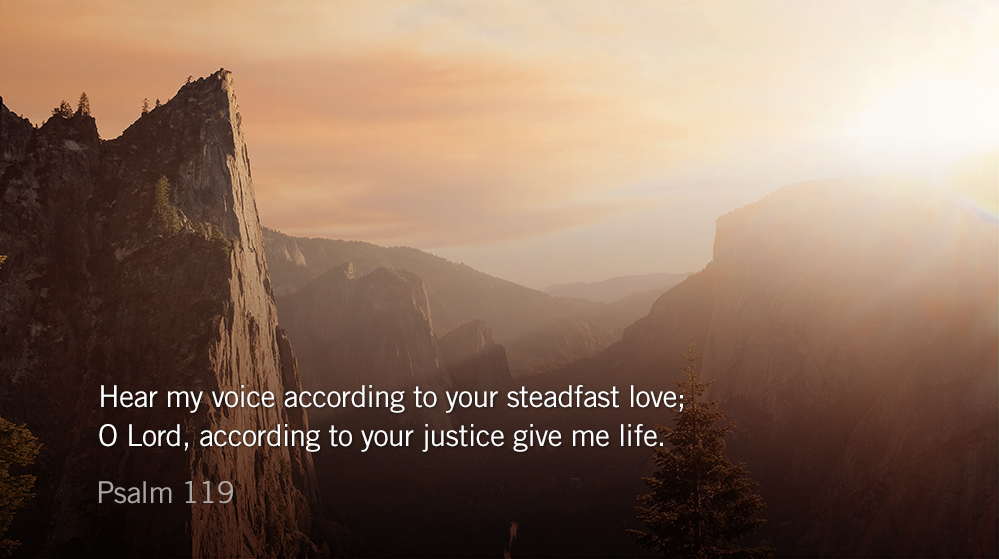
I rise before dawn and cry for help; I hope in your words. My eyes are awake before the watches of the night, that I may meditate on your promise. Hear my voice according to your steadfast love; O Lord, according to your justice give me life.

Here lies the Psalmist’s hope that, “everyone of your righteous rules endures forever.” The Talmud remarks:

Wherever the language, ‘command,’ is used, the sole purpose is to encourage obedience both at that time and for all generations.

The joy for God’s word expressed in Psalm 119 is found in the Psalmist’s faith in God’s goodness as expressed in his word. He is no longer cynical to commands because he has tasted the righteousness of God.

*For Talmud references, see b. Qidd. 1:7, II.9.B and 1:7, I.3.J.

Today’s Reading
Hosea 5-6 (Listen – 3:44)
Psalms 119.145-176 (Listen – 15:14)


The Road to Freedom :: Weekend Reading List

There is a superficial question which asks, “should Christians drive luxury cars?” Then there is a deeper question which examines the way everyday objects metastasize our idols so effectively we no longer notice their presence in our lives. Italian pastor Leonardo de Chirico observes:

Idols like to take form in artifacts. Statues, pictures, images, and buildings are not in themselves idols but are masks for idols, interfaces for idols. Idols like to leave their traces behind them. Idols like to shape the city in a visible way. We have to grasp spiritually the theological skyline of the city.

As individual car ownership begins its decline—replaced by car-sharing and autonomous vehicles—we can pause to reflect on how it has shaped our culture—and how what comes next will reshape the world.

In 1971 science fiction author J.G. Ballard pondered our “strange love affair” with the car. Ballard had just driven a 1904 Renault Park Phaeton across Germany for Drive Magazine and wrote:

If I were asked to condense the whole of the present century into one mental picture, I would pick a familiar everyday sight: a man in a motor car, driving along a concrete highway to some unknown destination. Almost every aspect of modern life is there, both for good and for ill—our sense of speed, drama, and aggression, the worlds of advertising and consumer goods, engineering and mass-manufacture, and the shared experience of moving together through an elaborately signaled landscape.

Ballard’s words are strangely prophetic and his vision of the automobile has come to define western culture. Recently, Robert Moor picked up Ballard’s work and asked the question it begs as we enter this new era of transportation, “Is the Self-Driving Car Un-American?” Autonomous vehicles eliminate many of the aspects of driving that have come, for better or worse, to define our culture. Moor explains:

[Ballard] sensed that the car’s toxic side effects—the traffic, the carnage, the pollution, the suburban sprawl—would soon lead to its demise. At some point in the middle of the 21st century, he wrote, human drivers would be replaced with “direct electronic control,” and it would become illegal to pilot a car.

In Ballard’s grim reckoning, the end of driving would be just one step in our long march toward the “benign dystopia” of rampant consumerism and the surveillance state, in which people willingly give up control of their lives in exchange for technological comforts.

The algorithms behind our favorite technologies have become the most significant higher power in daily life. Our apps and devices speak to us in silent moments, help us navigate the world, and extend our ambitions beyond our wildest dreams.

We give ourselves to them for what is, on the surface, convenience (they are engineered this way) and the allure of what is just beyond our reach—yet they are incapable of delivering more than mere images of our deepest needs.

After arriving in Stuttgart, the home of Mercedes Benz, Ballard reflected on the central promise that drives us back to the car, and perhaps all technology:

The car as we know it now is on the way out. To a large extent I deplore its passing, for as a basically old-fashioned machine it enshrines a basically old-fashioned idea—freedom.

Weekend Reading List

Today’s Reading
Hosea 1 (Listen – 2:08)
Psalms 119.73-96 (Listen – 15:14)

This Weekend’s Readings
Hosea 2 (Listen – 3:48) Psalms 119.97-120 (Listen – 15:14)
Hosea 3-4 (Listen – 3:53)  Psalms 119.121-144 (Listen – 15:14)


Return to God’s Embrace :: Throwback Thursday

By Zachary Crofton (1626-1672)

Your statutes have been my songs in the house of my sojourning. — Psalm 119.54

Repentance is the great work of the word and loud call of the gospel. Sit with care, constancy, and conscience under the word of truth and gospel of grace. Study the nature of God. God must be the object of repentance: we must sorrow toward God and return to God.

The devil labors to keep all light out of man’s soul—so that he might sleep in sin and be locked up in impenitency. When God brings to repentance, he breaks these bars of ignorance, he pulls off these scales of blindness and begins with the understanding.

Sit close to the work of self-examination. No man sits so fast in impiety as the stranger at home. True grace begins always at “the renewing of the mind”—the transforming of the mind to know “the good and acceptable will of God.” And the knowledge of God, being the principle of it, is put for repentance: “They shall know God.”

Thus David professed, “I examined my ways, and turned my feet into thy testimonies.” And when the Prodigal’s wits returned and he considered his wickedness, he would run home to be a servant, where he had been and might have been a son.

You have heard before, that conviction must go before conversion. Man’s conscience is a register which will bring to remembrance, and a judge that will clearly determine of man’s ways. The worst of men, by a short conference with their own soul, would soon see a necessity of repentance. Censure others less and yourselves more: inquire not into other men’s condition so much as your own conversation. Let no day return without accounts. Be serious in self-examination.

Sit loose to the world—the world is the great pull-back to heaven, and hinderance of repentance. You may observe, that the reason of the rebellion and impenitency of Ezekiel’s hearers was, “Their hearts went after their covetousness;” otherwise they took delight to hear.

Seriously apprehend the positive certainty of pardon. The price of man’s sin is paid—the justice of God is satisfied—the pardon is sealed in and by the blood of Christ and proclaimed in the gospel. It is yours with certainty. Nothing needs to deter: God is reconciled—therefore return unto him.

*Abridged and language updated from Zachary Crofton’s “Repentance Not To Be Repented, Plainly Asserted, And Practically Explained.” 

Today’s Reading
Daniel 12 (Listen – 2:40)
Psalms 119.49-72 (Listen – 15:14)