What About Ahaz?

Scripture Focus: Isaiah 1.4
4 Woe to the sinful nation, 
a people whose guilt is great, 
a brood of evildoers, 
children given to corruption! 
They have forsaken the Lord; 
they have spurned the Holy One of Israel 
and turned their backs on him. 

Reflection: What About Ahaz?
By John Tillman

Verse one of Isaiah tells us he served during the reigns of Uzziah, Jotham, Ahaz, and Hezekiah. Jotham was a good king. Under Uzziah and Hezekiah, Judah thrived militarily and spiritually. Ahaz was the only bad seed. Of him, it was said, “he did not do what was right in the eyes of the Lord his God…” (2 Kings 16.2-4

Why does Isaiah open with condemnation of the rebellious nation? Why is Isaiah dragging everyone? What about Ahaz? If we just got rid of Ahaz, wouldn’t everything be okay? Apparently not.

Perhaps when you read about a bad king in the Bible, like Ahaz, you think of a current leader. “If we just got rid of fill-in-the-blank…” I confess that I think of more than one name for that blank, from more than one political party. If I were Isaiah, I’d be tempted to name check people. But Isaiah namechecks the whole nation. “What about you?” he says.

Of course, the removal of wicked leaders is a worthy cause. Prophets, including Isaiah, regularly confronted wicked and errant leaders. (Rabbinic tradition tells us Hezekiah’s son, Manasseh, murdered Isaiah.) But there’s a difference in confronting wicked leaders and pushing off the blame on them. The buck may stop at the president’s desk but sin spends plenty of time on every desk and kitchen table in the country.

The king on the throne of a nation does not determine its righteousness. No matter what king is elevated or deposed, we need to depose sin from the throne of our hearts.

Let us check our own hearts, using Isaiah 1.15-17.

“Your hands are full of blood!”
Are you “clean?”
This blood represents suffering. What suffering have you caused or could have eased?

“…stop doing wrong. Learn to do right…”
Will you repent?
You cannot repent of what you claim is not sin.

“…seek justice.”
Will you seek righteousness?
Righteousness is not forcing others to live in obedience. It is killing your own sinful nature.

“Take up the cause of the fatherless; plead the case of the widow.”
Who will you defend?
Will you take up the cause of the oppressed, even ones who make you uncomfortable?

“Defend the oppressed.”
Who will you correct? 
“Defend the oppressed” can be translated as “correct the oppressor.” Correct those in your circles. Leave others to God.

Before we confront “Ahaz,” be sure we confront ourselves honestly.


Divine Hours Prayer: The Request for Presence
Send out your light and truth, that they may lead me, and bring me to your holy hill and to your dwelling; 
That I may go to the altar of God, to the God of my joy and gladness; and on the harp I will give thanks to you, O God my God. — Psalm 43.3-4


– From The Divine Hours: Prayers for Summertime by Phyllis Tickle.


​Today’s Readings
Isaiah 1 (Listen 4:36)
Psalm 94 (Listen 2:08)

Read more about Wearisome Worship
It is frightening to think that we might trample God’s courts with worship that is annoying to him rather than pleasing.

Read more about Supporting Our Work
Please consider becoming a donor. Support ad-free content that brings biblical devotionals to inboxes across the world.

Prophets in Our Path

Scripture Focus: Isaiah 30.10-11
10 They say to the seers, 
“See no more visions!” 
and to the prophets, 
“Give us no more visions of what is right! 
Tell us pleasant things, 
prophesy illusions. 
11 Leave this way, 
get off this path, 
and stop confronting us 
with the Holy One of Israel!”

Reflection: Prophets in Our Path
By John Tillman

Isaiah describes a caravan in the Negev desert. They carry valuables and gifts of honor through dangerous territory, filled with lions and snakes. They are envoys from Judah sent down to Egypt to seek protection. 

It is an interesting reversal. Israel left Egypt, carrying away Egyptian gold and treasures as they were liberated from slavery. Now, here they are, crawling back through the desert to seek audience with their former abusers.

Why are they returning treasure and pledging fealty to their former captors? Why are they begging for “the shade” of Egypt when God promised they would sit under their own vine and fig tree? Why are they becoming like the grumbling Israelites in the desert who said, “Wouldn’t it be better to go back to Egypt?” (Numbers 14.3-4)

Then, like Balaam on the way to curse Israel, these envoys are confronted and warned. A prophet stands in their path with a message from God. But they brush off the warning and tell the prophet to get out of their way and stop confronting them.

These envoys wanted sweet verses from prophets. But prophecy is often ugly. They longed to hear comforting promises. But prophecy is often disturbing. They sought convenient confirmations of what they already believed. But prophecy often holds inconvenient truths.

How like these envoys are we? How easily do we seek bargains from worldly powers and shelter from our enslavers? How often do we seek prophets to confirm our decisions rather than confront us with truth? 

Let us repent:
When an inconvenient prophecy stops us in our tracks…
When an ugly truth comes to light…
When we are caught holding a check written to evil forces of this world, asking their protection… 

Don’t push past prophets in your path lest this verse be about you: “the Holy One of Israel, says: ‘In repentance and rest is your salvation…but you would have none of it.” (Isaiah 30.15)

Let us have the salvation that God longs to give us. Let us listen to prophets in our path.

“…the Lord longs to be gracious to you; 
therefore he will rise up to show you compassion. 
For the Lord is a God of justice. 
Blessed are all who wait for him! 
People of Zion, who live in Jerusalem, you will weep no more. How gracious he will be when you cry for help! As soon as he hears, he will answer you. — (Isaiah 30.18-19)


Divine Hours Prayer: The Greeting
All your world praise you, O Lord, and your faithful servants bless you.
They make known the glory of your kingdom and speak of your power;
That the peoples may know of your power and the glorious splendor of your kingdom. — Psalm 145.10-12


– From The Divine Hours: Prayers for Summertime by Phyllis Tickle.


​Today’s Readings
Isaiah 30 (Listen 5:52)
Acts 17 (Listen 5:28)

Read more about Today’s Roots, Tomorrow’s Fruit
Prophecies can tell of coming salvation or warn of coming disaster. There’s no question which we prefer to listen to.

Read The Bible With Us
Invite friends to join our Bible reading plan. Read together with us at a sustainable, two-year pace.

https://mailchi.mp/theparkforum/m-f-daily-email-devotional

The Broken Power of Death

Scripture Focus: Hosea 13.14
14 “I will deliver this people from the power of the grave; 
I will redeem them from death. 
Where, O death, are your plagues? 
Where, O grave, is your destruction? 

Psalm 146.3-5
3 Do not put your trust in princes, 
in human beings, who cannot save. 
4 When their spirit departs, they return to the ground; 
on that very day their plans come to nothing. 
5 Blessed are those whose help is the God of Jacob, 
whose hope is in the Lord their God. 

Isaiah 25.8
8 he will swallow up death forever. The Sovereign LORD will wipe away the tears from all faces; he will remove his people’s disgrace from all the earth. The LORD has spoken. 

1 Corinthians 15.54-56
54 When the perishable has been clothed with the imperishable, and the mortal with immortality, then the saying that is written will come true: “Death has been swallowed up in victory.” 

     55 “Where, O death, is your victory?
         Where, O death, is your sting?” 

56 The sting of death is sin, and the power of sin is the law. 57 But thanks be to God! He gives us the victory through our Lord Jesus Christ.


Reflection: The Broken Power of Death
By John Tillman

Hosea and Isaiah’s ministries overlapped and their writing echoes each other. Paul paraphrases their promises of resurrection into one of his brightest, most hopeful refrains. This chorus of hope comes most directly from one of the darkest chapters of Hosea.

Rather than rely upon God, Israel and Judah had turned to political alliances and the gods those allies worshiped. But these “princes” would soon commit atrocities. These sound eerily familiar to ones committed by today’s powerful countries who bomb maternity wards and civilian evacuation corridors.

Death is not only dispensed at the whim of greedy empires but is carried on the wings of disease and aging. What hope can we have against death? This question is common to the people of Israel and Judah in Isaiah and Hosea’s day, to downtrodden outcasts under Rome’s rule, and to those targeted by empires and dictators today.

The poor and the powerless are overrun by death. They have no defenses and little strength to resist or slow its advance. They are helpless.

Wealth and power do much to extend life. The wealthy can easily flee conflict and the powerful are welcomed to new countries rather than crammed into inhumane camps. Experimental and expensive life-saving and life-extending medical treatments are common among the powerful. Absent these extreme examples, even simple, quality of life differences add years to the lives of the wealthy. However, in the end, the rich, the powerful, and the poor all die. The teacher of Ecclesiastes would call these efforts meaningless or absurd. (Ecclesiastes 3:19)

To the unbelieving world, for whom mortal life is all there is, death is ultimate. It is the worst thing that can happen to a person and there is no remedy.

Death is not the worst thing that can happen to us and it does not have the final word in our lives but that does not mean we should not grieve it. Lazarus was only four days in the grave, yet Jesus wept. (John 11.35) We weep and mourn death, but not without hope. (1 Thessalonians 4.13)

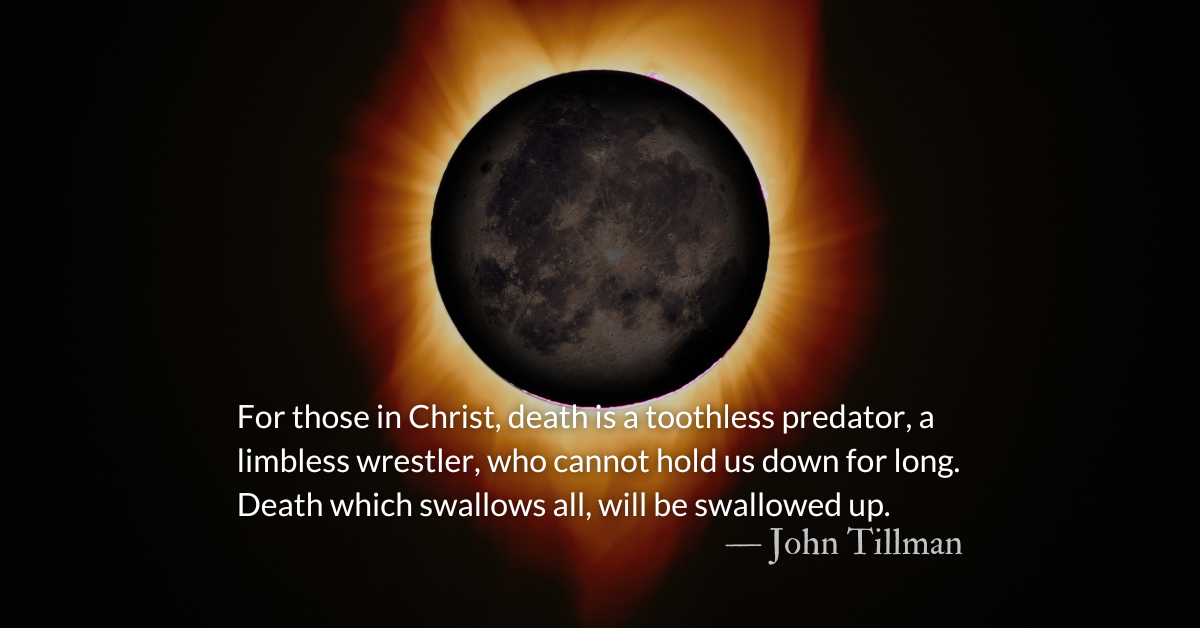
While we flee or delay death, scripture describes death’s defeat. God promises the grave will not be our final destination. We will only pass through and when we leave, we will be led by Christ himself. For those in Christ, death is a toothless predator, a limbless wrestler, who cannot hold us down for long.

Death which swallows all, will be swallowed up.

Divine Hours Prayer: The Greeting
You are the Lord, most high over all the earth; you are exalted far above all gods. — Psalm 97.9

– From The Divine Hours: Prayers for Summertime by Phyllis Tickle.


​Today’s Readings
Hosea 13 (Listen 2:26)
Matthew 16 (Listen 3:43)

This Weekend’s Readings
Hosea 14 (Listen 1:39), Matthew 17 (Listen 3:46)
Joel 1 (Listen 2:59), Matthew 18 (Listen 4:25)

Listen to Too Much to Hold on the Pause to Read podcast
In Christ, we’re made to be like him
Too much for Death to hold

Read more about Stealing Death’s Sting
Untie our grave clothes and strip us of the trappings of this world.
Let us walk into the light and follow your loving voice.

One Who Can Reach

Scripture Focus: Psalm 145.13-14
13 Your kingdom is an everlasting kingdom,
and your dominion endures through all generations.
The Lord is trustworthy in all he promises
and faithful in all he does.
14 The Lord upholds all who fall
and lifts up all who are bowed down.

Isaiah 59.1
1 Surely the arm of the Lord is not too short to save,
    nor his ear too dull to hear.

Reflection: One Who Can Reach
By John Tillman

As the “Arm of the Lord” is superior to the “arm of flesh” (2 Chronicles 32.8), the Kingdom of God is superior to human kingdoms. However, as the arm of flesh is puffed up and proud, the arm of the Lord reaches down to the lowly and lifts them up.

In his commentary on Psalm 145, Federico Villanueva reflects on the difficulty those raised up have in reaching down and lifting up the lowly.

“The common expression in Filipino, hindi na ma-reach (“can no longer be reached”), conveys how the higher one goes, the harder it is to reach those who are down below. But this is not the case for our God, who dwells in the highest place, and yet stoops down to help those who fall.”

Powerful humans lose touch with powerlessness and seem unable to resist abuses of power. Those who rise forget where they came from and despise those of low beginnings. Those on top ignore that others cleared a path for them, and they pull up the ladder behind them, preventing others’ success.

Some descriptions of God sacrifice his love and care for us to emphasize his glory and majesty. Some descriptions of God sacrifice his glory and majesty in an attempt to convey his intimate care for and presence with us. We need to hold these seemingly contradictory qualities of God together in tension.

Our God is not like a powerful human. Our God is never “out of touch.” He longs to welcome us as his children. God is powerful yet cares for the powerless. God does not forget where we come from, yet he does not despise us for our past. God is all-powerful and mighty, yet he uses his power for our good. He is one who can reach.

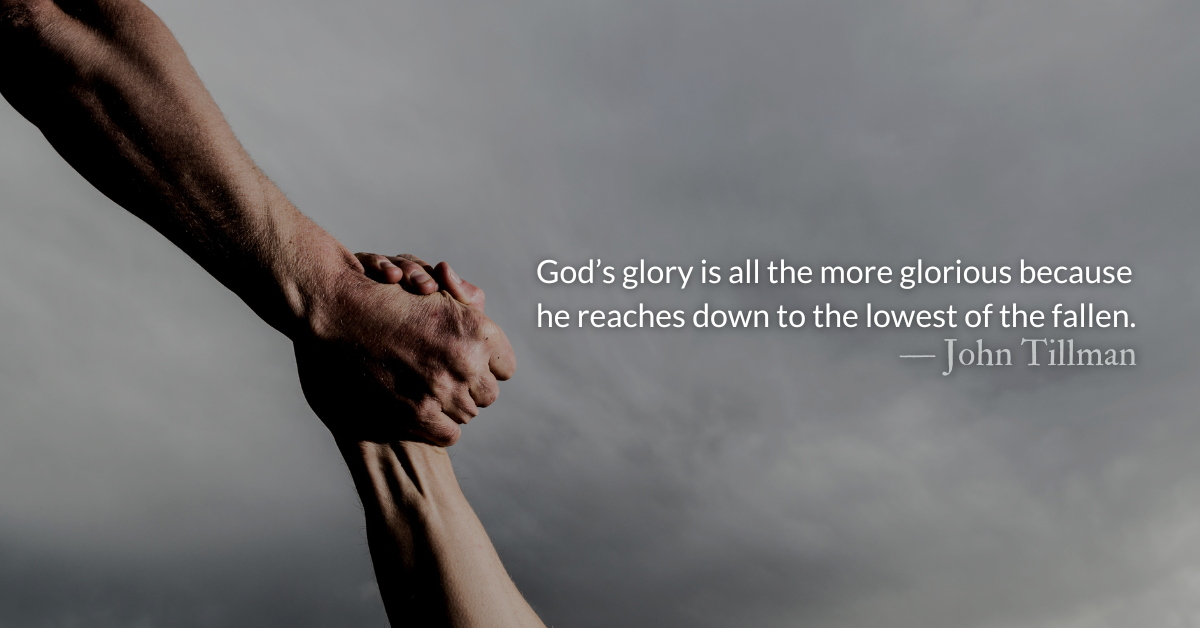
God’s glory is all the more glorious because he reaches down to the lowest of the fallen. The messiness of God’s presence in the incarnation makes his presence before creation and the end of time even more majestic and incomprehensible. God’s goodness and faithfulness to those who are neither faithful nor good is even more praiseworthy than if we were even marginally deserving.

Let us continue to celebrate the Advent of Christ, who is exalted because he made himself nothing and glorious because of the suffering of the cross. (Philippians 2.6-11)

The lower Jesus stoops, the more praiseworthy he is.

Divine Hours Prayer: The Request for Presence
Bow your heavens, O Lord, and come down; touch the mountains, and they shall smoke. — Psalm 144.5

– From The Divine Hours: Prayers for Summertime by Phyllis Tickle.

Today’s Readings
2 Chronicles 33  (Listen 4:01)
Psalms 145 (Listen 2:19)

Read more about He Stoops to Raise
He strips himself.
He lays aside
His Heaven
His throne
His clothes
His life

Read more about Pause To Read
Please keep spreading the word about our new podcast, Pause to Read. Share and rate the episodes to help others find the show.

The Arm of Flesh versus the Prince of Peace

Scripture Focus: 2 Chronicles 32.7-8
7 “Be strong and courageous. Do not be afraid or discouraged because of the king of Assyria and the vast army with him, for there is a greater power with us than with him. 8 With him is only the arm of flesh, but with us is the Lord our God to help us and to fight our battles.” And the people gained confidence from what Hezekiah the king of Judah said.

Isaiah 52.10
10 The Lord will lay bare his holy arm 
in the sight of all the nations, 
and all the ends of the earth will see 
the salvation of our God.

Reflection: The Arm of Flesh versus the Prince of Peace
By John Tillman

A popular Advent verse is Isaiah’s description of the Arm of the Lord being bared, showing the nations God’s salvation. It is a messianic prophecy fulfilled by Christ. The true “Arm of the Lord” is Jesus.

In his encouragement to the people, Hezekiah implies that the arm of the Lord is with them, but with Assyria is “only the arm of flesh.” (2 Chronicles 32.8)

Assyria’s “arm of flesh” went beyond military might. Assyria wielded the weapon of propaganda. Andrew Bowling writes that Sennacherib had “officers in charge of psychological warfare” who reinterpreted Hezekiah’s actions to claim God was on their side, not his. Hezekiah and the people had recently removed not only altars to false gods but altars to Yahweh that were against the regulations of the law. Assyria’s clever propagandists twisted this fact, claiming that Hezekiah had dishonored God and that God sent them to punish him. (Isaiah 36.7, 10

Did Sennacherib truthfully believe this, or was it just a deceptive tactic? His boasts about the supremacy of his own god and military seem to indicate he did not truly follow Yahweh or care about anything he said.

Many say, “God is on our side.” Both spiritual and political leaders claim to be “God’s man” or “God’s woman.” They say, “We are faithful; they are heretics. We follow Jesus; they follow demons.” Like Sennacherib’s propagandists, these leaders often wield scripture. (2 Kings 18.31-32; 1 Kings 4.25; Micah 4.4)

It shouldn’t shock us for scripture to be misused. Satan tempted both Eve and Jesus by misinterpreting God’s word. Peter admitted that Paul’s complex writings were abused and twisted contrary to what Paul intended. (Genesis 3.1; Matthew 4.6; 2 Peter 3.16)

We may often find ourselves opposed by those who use interpretations of scripture against us. Some may truthfully believe what they say. Some are just engaging in psychological manipulation. How can we tell the difference between Sennacherib’s propaganda and Hezekiah’s true faith? 

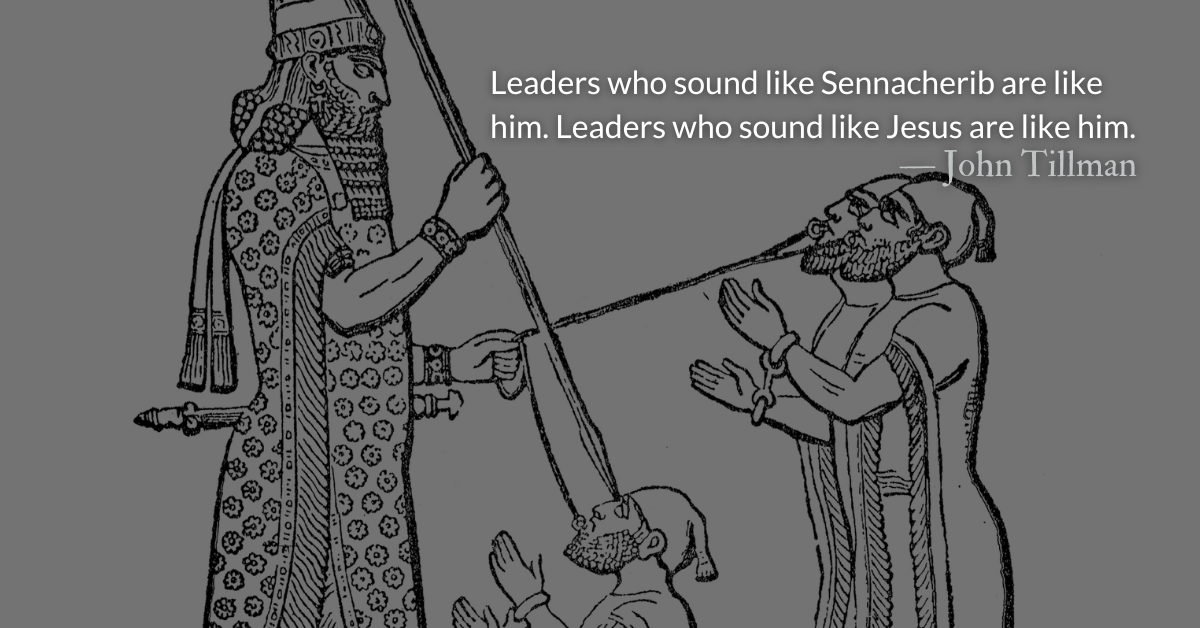
I don’t have a perfect answer. But I do have a guideline. Leaders who sound like Sennacherib are like him. Leaders who sound like Jesus are like him.

The arm of flesh uses the language of would-be emperors. It flexes, insults, boasts, and makes arm-twisting threats. The Arm of the Lord uses the language of the Prince of Peace. It works salvation and preaches repentance, truth, grace, mercy, and love.

May we be encouraged by the presence of the Arm of the Lord and serve the Prince of Peace.

Music: Isaiah 52.10, by Rich Mullins

Divine Hours Prayer: The Refrain for the Morning Lessons
The Lord is my strength and my song, and he has become my salvation. — Psalm 118.14

– From The Divine Hours: Prayers for Summertime by Phyllis Tickle.

Today’s Readings
2 Chronicles 32  (Listen 5:58)
Psalms 144 (Listen 1:56)

Read more about Pause To Read
Have you enjoyed our new podcast, Pause to Read? Subscribe so you don’t miss new episodes coming soon. Share and rate the episodes to help others find the show.

Read more about Supporting Our Work
There’s never a bad time to give. We’ll be as thankful for your donation in January as in December, but time is running out to give in 2023. Please consider giving today.