Organizing Against Corruption

Links for today’s readings:

Read: Leviticus 7 Listen: (5:13) Read: Acts 4 Listen: (5:15)

Links for today’s readings:

Read: Leviticus 8 Listen: (5:06) Read: Acts 5 Listen: (6:49)
Read: Leviticus 9 Listen: (3:18) Read: Acts 6 Listen: (2:35)

Scripture Focus: Leviticus 7.35-36

35 This is the portion of the food offerings presented to the Lord that were allotted to Aaron and his sons on the day they were presented to serve the Lord as priests. 36 On the day they were anointed, the Lord commanded that the Israelites give this to them as their perpetual share for the generations to come.

1 Samuel 2.12-17

12 Eli’s sons were scoundrels; they had no regard for the Lord. 13 Now it was the practice of the priests that, whenever any of the people offered a sacrifice, the priest’s servant would come with a three-pronged fork in his hand while the meat was being boiled 14 and would plunge the fork into the pan or kettle or caldron or pot. Whatever the fork brought up the priest would take for himself. This is how they treated all the Israelites who came to Shiloh. 15 But even before the fat was burned, the priest’s servant would come and say to the person who was sacrificing, “Give the priest some meat to roast; he won’t accept boiled meat from you, but only raw.”

16 If the person said to him, “Let the fat be burned first, and then take whatever you want,” the servant would answer, “No, hand it over now; if you don’t, I’ll take it by force.”

17 This sin of the young men was very great in the Lord’s sight, for they were treating the Lord’s offering with contempt.

Reflection: Organizing Against Corruption

By John Tillman

Leviticus introduces  “organized religion” to God’s people. People introduced corruption.

The Bible’s first “priest” is the mysterious Melchizedek, to whom Abraham gave a tithe of all his plunder after a battle. Other than that one moment, we don’t read of God-followers in the Old Testament seeking God through priests. They went to God directly.

Yet, in Leviticus, God instituted a system of worship managed by a specifically-called group of people. The priests’ first jobs were all physical in nature. They made the sacrifices, divided and placed the animals on the altar, disposed of the waste, and maintained the Tabernacle and its furnishings with the help of their tribe, the Levites.

In return for this service, God gave them a share of the food offerings that were not burned up. Eventually, the priests’ role expanded to teaching and interpreting the law and ministering to spiritual needs through prayer, counsel, and charity.

Centuries later, Eli’s sons, Hophni and Phinehas, broke the regulations in today’s passage by taking more meat than designated and violating the order of the ritual. (1 Samuel 2.12-17). In addition, they violated young women who worked at the Tabernacle. (1 Samuel 2.22-23) God put Hophni and Phinehas to death in a battle in which the Ark of the Covenant was lost. God punished not just the individuals but the entire system of worship.

Any organization is vulnerable to corruption, even ones instituted by God. Priests, prophets, kings—none of them are invulnerable.

Ezekiel prophesied against wicked shepherds, the kings of his day, that abused power, enriched themselves, and increased the poor’s suffering. God stood “against the shepherds” and pledged to be the good shepherd the people needed. (Ezekiel 34.1-4; 10-16)

Corruption is one of the primary reasons “organized religion” has a poor reputation. Wherever there is corruption in the system, God shares the disgust of those who discover corruption and sets himself against those who would deny it or perpetuate it. We shouldn’t be shocked when God punishes not just corrupt individuals, but organizations.

Those in Christ are part of a specifically-called group of people, the Church. We are “organized” into Christ’s body and called to meet spiritual needs through prayer, counsel, and charity.

We cannot ignore or overlook corruption but we also cannot abandon our posts. Despite, and even because of, corruption, we must fulfill our calling faithfully. We must organize against corruption.

We honor Jesus, our high priest, when we oppose corruption and serve honorably.

Divine Hours Prayer: The Call to Prayer

Worship the Lord, O Jerusalem; praise your God, O Zion;

For he has strengthened the bars of your gates; he has blessed your children within you. — Psalm 147.13-14

– Divine Hours prayers from The Divine Hours: Prayers for Springtime by Phyllis Tickle.

Read more: Offal Leaders

Malachi describes a de-commissioning…feces from the animal would be smeared on their faces, representing impurity and death.

Consider Supporting Our Work

Every dollar given goes to the costs required to continue our ad-free content. Please consider becoming a monthly donor, helping us year-round.
The King We Want

Scripture Focus: John 19.15
15 But they shouted, “Take him away! Take him away! Crucify him!” “Shall I crucify your king?” Pilate asked. “We have no king but Caesar,” the chief priests answered.

Zechariah 9.9
9 Rejoice greatly, Daughter Zion! 
Shout, Daughter Jerusalem! 
See, your king comes to you, 
righteous and victorious, 
lowly and riding on a donkey, 
on a colt, the foal of a donkey. 

1 Samuel 8.6-7
6 But when they said, “Give us a king to lead us,” this displeased Samuel; so he prayed to the Lord. 7 And the Lord told him: “Listen to all that the people are saying to you; it is not you they have rejected, but they have rejected me as their king.


Reflection: The King We Want
By John Tillman

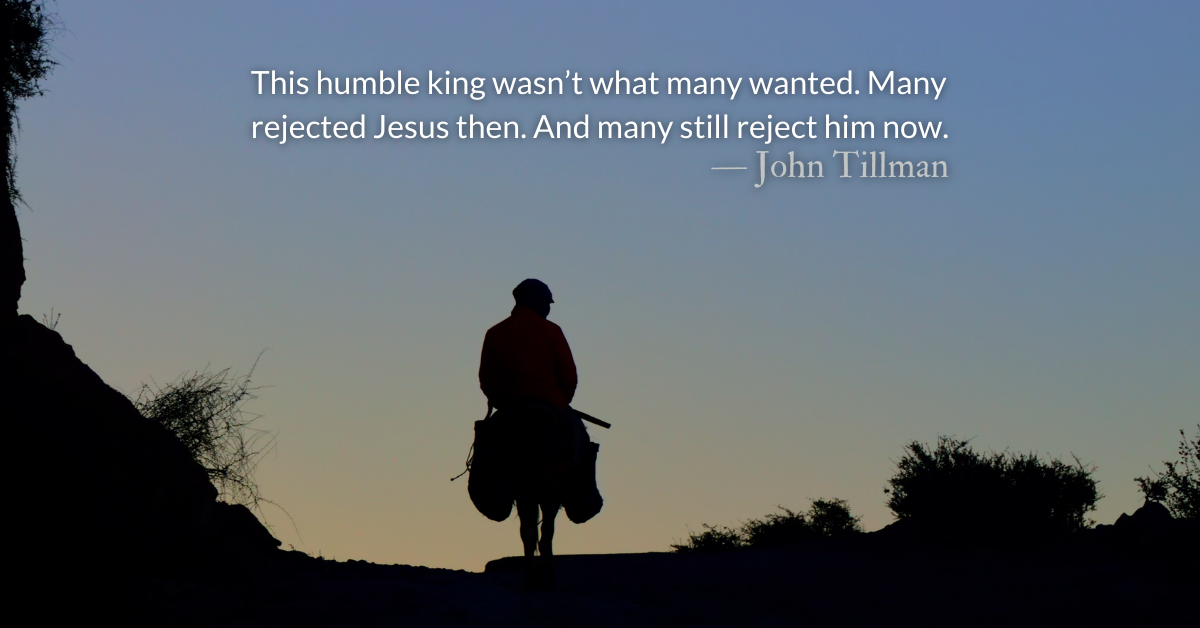
All the gospel writers include the detail from Zechariah’s vision of a coming king riding on a donkey. John and Matthew quote Zechariah 9.9 to point out Jesus’ fulfillment of this prophecy. However, this humble king wasn’t what many wanted. Many rejected Jesus then. And many still reject him now.

The King We Want
We want a king, we say
A king like other nations
With Solomon’s glitz and glamor
With Goliath’s sword and armor

I’ve sent a king, God says
Unlike any you’ve seen
Son of the Giant Killer
Yet, rejected as your ruler

We want a king, we say
Exalted and victorious
We’ll hear his saber rattle
We’ll follow him to battle

I’ve sent a king, God says
A king not of this realm
Your lust for worldly power
Shows you mistake the hour

We want a king, we say
To make our city great
To make for ourselves a name
To not be scattered from this plain

I’ve sent a king, God says
You had no eyes to see him
He wept over your city
That the outcasts gained no pity

We want a king, we say
We’ll even take a bad one
Let him speak like a serpent coiled
Long as we can share the spoils

I’ve sent a king, God says
You had no ears to hear him
Of sin’s sting you must repent
Then my King will crush the serpent

We want a king, we say
A conqueror, triumphant
Crush our enemies who slight us
Crush the governments above us

I’ve sent a king, God says
He rode in on a donkey
My servants prophesied him
You rebels crucified him

We want a king, we say
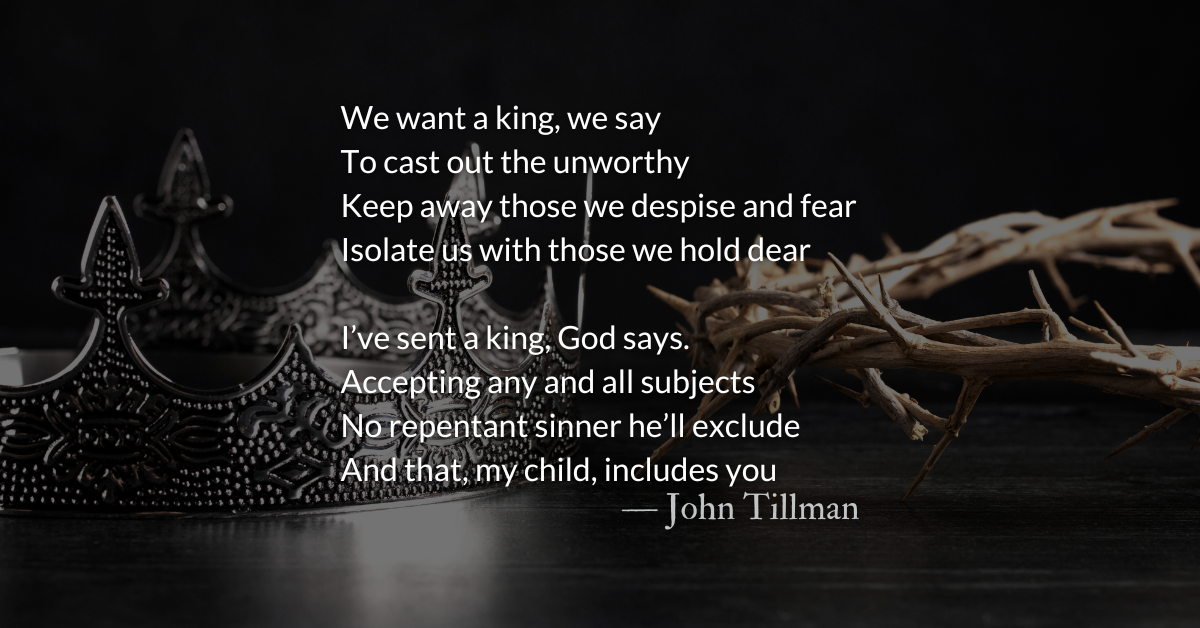
To cast out the unworthy
Keep away those we despise and fear
Isolate us with those we hold dear

I’ve sent a king, God says.
Accepting any and all subjects
No repentant sinner he’ll exclude
And that, my child, includes you


Divine Hours Prayer: The Refrain for the Morning Lessons
Righteousness shall go before him, and peace shall be a pathway for his feet. — Psalm 85.13

– From The Divine Hours: Prayers for Summertime by Phyllis Tickle.


Today’s Readings
Job 20 (Listen 2:52
John 19 (Listen 6:23)

This Weekend’s Readings
Job 21 (Listen 3:05), John 20 (Listen 4:17)
Job 22 (Listen 2:54), John 21 (Listen 3:58)

Read more about Ecce Homo
Pilate presents Jesus as king and he is rejected. Not just by the Jews. By the world. This moment is the essence of all sin.

Read more about Pause To Read
Check out today’s new podcast episode: Defining Moment. How many have you listened to? Let us know what you think. Share and rate the episodes to spread the word.

Diamonds In the Rough

Scripture Focus: 1 Samuel 30.22-25
22 But all the evil men and troublemakers among David’s followers said, “Because they did not go out with us, we will not share with them the plunder we recovered. However, each man may take his wife and children and go.” 

23 David replied, “No, my brothers, you must not do that with what the LORD has given us. He has protected us and delivered into our hands the raiding party that came against us. 24 Who will listen to what you say? The share of the man who stayed with the supplies is to be the same as that of him who went down to the battle. All will share alike.” 25 David made this a statute and ordinance for Israel from that day to this. 

Reflection: Diamonds In the Rough
By John Tillman

During this period of David’s life, he was God’s anointed, the rightful king of Israel, yet Saul was determined to maintain power. David not only had no throne, he was forced into exile.

An outcast, David attracted outcasts. (1 Samuel 22.2) He took in the distressed and the discontented, the poor and the rebellious. It’s easy to lead those of exemplary character and high moral standards. David was leading those so violent they were a danger to even him.

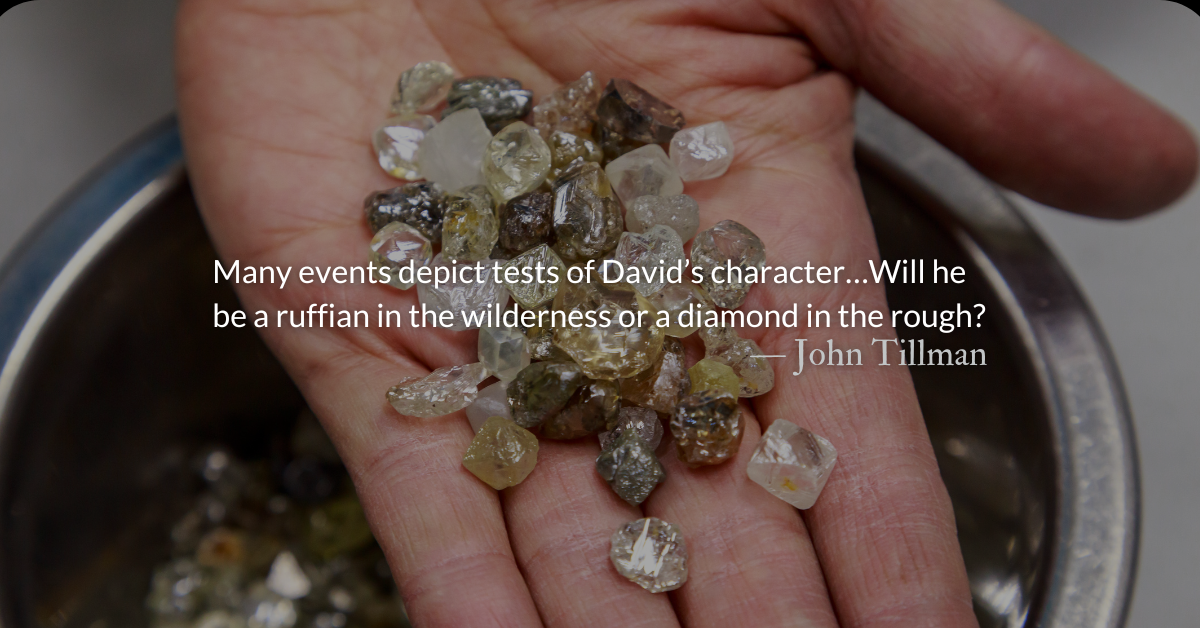
Many events in this section of scripture depict tests of David’s character. Will he murder Nabal? (1 Samuel 25.34) Or Saul? (1 Samuel 24.3-10) Will he take the throne by force? Will he be just? Will he be a ruffian in the wilderness or a diamond in the rough?

David doesn’t pass every test. To survive Saul, he serves the enemy of his enemy, marching under the banner of King Achish and his false god. David is no king yet. At best, during this time we might call David a warlord—a mercenary. At worst, a war criminal. Scripture doesn’t hide these failings but it does highlight moments when David’s roughness is cut away and facets of kingly destiny shine.

In a moment of victory, David’s rough gang of fighters wants to shame the weak, claiming dominance and a greedy share of wealth. The narrator calls them “evil men and troublemakers.” David calls them, “my brothers.”

David does not shy away from pointing out that their arguments are foolish. His rhetorical question, “Who will listen to what you say?” shames them but calling them “brothers” lifts them up. David not only stops the madness of the moment, he establishes a just rule from that moment on. David grows into his calling and at least some of his men follow along.

Like David, we may find ourselves in exile stuck between wicked kings. We feel the tension of being in this world but not of it and being surrounded by the desperate who default to violence and selfishness.

Like David, we’ll stumble, fail, and perhaps compromise when we should stand boldly. But amidst our rough and tumble world, we must remember that in God’s reality, we are children of God and regents of his Kingdom.

We, and those around us, need to be cut, shaped, ground, and polished by the Holy Spirit from diamonds in the rough to shining facets reflecting Christ’s light.

Divine Hours Prayer: The Call to Prayer
Open my lips, O Lord, and my mouth shall proclaim your praise. — Psalm 51.16

– From The Divine Hours: Prayers for Summertime by Phyllis Tickle.

Today’s Readings
1 Samuel 29-30 (Listen 6:33)
Revelation 9 (Listen 3:30)

Read more about Blocking the Way of Wickedness
We don’t always have a choice about working with or living among wicked people, but we can choose how we respond.

Read more about Supporting Our Work
Our donors support ad-free content that brings biblical devotionals to inboxes across the world. Consider becoming one today.

The King We Want

Scripture Focus: Zechariah 9.9-10
9 Rejoice greatly, Daughter Zion! 
Shout, Daughter Jerusalem! 
See, your king comes to you, 
righteous and victorious, 
lowly and riding on a donkey, 
on a colt, the foal of a donkey. 
10 I will take away the chariots from Ephraim 
and the warhorses from Jerusalem, 
and the battle bow will be broken. 
He will proclaim peace to the nations. 
His rule will extend from sea to sea 
and from the River to the ends of the earth. 

1 Samuel 8.6-7
6 But when they said, “Give us a king to lead us,” this displeased Samuel; so he prayed to the Lord. 7 And the Lord told him: “Listen to all that the people are saying to you; it is not you they have rejected, but they have rejected me as their king.

John 19.15
15 But they shouted, “Take him away! Take him away! Crucify him!” “Shall I crucify your king?” Pilate asked. “We have no king but Caesar,” the chief priests answered.

From John: This post and poem were written several days before the shootings at Robb Elementary in Uvalde. We mourn and cry in anger and grief this week. We long ever and ever more for Jesus, the breaker of battle bows, to come. May our bows be broken and our stiff necks be bent. May our hearts of destruction become hearts of cultivation, our swords be melted to plowshares. May his peace come soon. Even now, Lord Jesus. Even now.

Reflection: The King We Want
By John Tillman

Zechariah’s vision of a coming king riding on a donkey is very familiar to New Testament readers. All the gospel writers include this detail. John and Matthew specifically quote Zechariah 9.9 and point out that Jesus fulfills this prophecy. However, this humble king wasn’t what many wanted. Many rejected Jesus then. And many still reject him now.

The King We Want
We want a king, we say
A king like other nations
With Solomon’s glitz and glamor
With Goliath’s sword and armor

I’ve sent a king, God says
Unlike any you’ve seen
Son of the Giant Killer
Yet rejected as your ruler

We want a king, we say
Exalted and victorious
We’ll hear his saber rattle
We’ll follow him to battle

I’ve sent a king, God says
A king not of this realm
Your lust for worldly power
Shows you mistake the hour

We want a king, we say
To make our city great
To make for ourselves a name
To not be scattered from this plain

I’ve sent a king, God says
You had no eyes to see him
He wept over your city
That the outcasts gained no pity

We want a king, we say
We’ll even take a bad one
Let him speak like a serpent coiled
Long as we can share the spoils

I’ve sent a king, God says
You had no ears to hear him
Of sin’s sting you must repent
Then my King will crush the serpent

We want a king, we say
A conqueror, triumphant
Crush our enemies who slight us
Crush the governments above us

I’ve sent a king, God says
He rode in on a donkey
My servants prophesied him
You rebels crucified him

We want a king, we say
To cast out the unworthy
Keep away those we despise and fear
Isolate us with those we hold dear

I’ve sent a king, God says.
Accepting any and all subjects
No repentant sinner he’ll exclude
And that, my child, includes you

Divine Hours Prayer: The Greeting
You are the Lord, most high over all the earth; you are exalted far above all gods. — Psalm 64.9

Today’s Readings
Zechariah 9 (Listen – 3:01)
Matthew 6 (Listen – 4:35)

This Weekend’s Readings
Zechariah 10 (Listen – 2:11Matthew 7 (Listen – 3:31)
Zechariah 11 (Listen – 2:40Matthew 8 (Listen – 4:09)

Read more about The Ram and the Cornerstone
Jesus entered Jerusalem like Isaac’s ram on the mountain top. He rammed his head into the thorns…Jesus knew he would be rejected. His final actions ensured it.

Read more about Truth Unwanted
Jesus, you are the king, the gift, and the truth that the world does not want.

The Best We Can Do

Scripture Focus: 1 Samuel 27.1
But David thought to himself, “One of these days I will be destroyed by the hand of Saul. The best thing I can do is to escape to the land of the Philistines. Then Saul will give up searching for me anywhere in Israel, and I will slip out of his hand.”

Reflection: The Best We Can Do

By John Tillman

We have to always be careful when reading the Bible not to assume that actions described in God’s Word were prescribed by God’s command. 

This is especially difficult with characters such as David. We tend to over-glorify David as a hero archetype who can do no wrong. We misapply the description of David as a “man after God’s own heart” to mean that every decision David made was wholly righteous. This is a terrible way to understand any Bible character, but an especially damaging way to understand David.  

Harold Wilmington, in his commentary on 1 Samuel 27 states that David did not seem to trust Saul, “Nor, apparently did he trust God to protect him.”

This is despite the fact that God has just miraculously assisted David in proving to Saul that David meant him no harm. David suggests that people near Saul must be poisoning him against David, telling David to “go serve other gods.” Saul has confessed that his pursuit of David is sinful, sworn off searching for him, and predicted great things for David.

After this spiritual and political victory, David does exactly what the people poisoning Saul against him suggested. David becomes a servant to king Achish, enemy of Israel, servant of Dagon.

This is a practical political decision (“The enemy of my enemy is my friend.”) but is not depicted as a spiritual decision. Scripture often tells us that David consulted the Lord or prayed, but here it tells us only his human thought process. (Scripture does not tell us that David prayed or consulted the Lord once while in Philistia, except in crisis when their town of Ziklag had been burned and captured.) David’s words are “The best thing I can do…”. 

Rather than the best thing, this decision may have been the worst thing David could have done. Through this decision, David becomes a liar, a war criminal, a slaughterer of women and children, and feigns madness to carry out his desperate plot. Achish, assuming David’s war crimes are against Israel, notes that David is now trapped and will be his servant forever. 

The best we can do—in our strength and wisdom—may not be God’s best for us.

May God deliver us from decisions that are “the best we can do.” 
May we never be enslaved to decisions of political practicality.
May we never compromise our souls to maintain convenient alliances.
May we seek God’s best rather than our human best.

Divine Hours Prayer: The Request for Presence

Be pleased, O God, to deliver me; O Lord, make haste to help me. — Psalm 70.1

– From The Divine Hours: Prayers for Summertime by Phyllis Tickle.

Today’s Readings
1 Samuel 27 (Listen – 1:59) 
1 Corinthians 8 (Listen – 1:54)

This Weekend’s Readings
1 Samuel 28 (Listen – 4:04), 1 Corinthians 9 (Listen – 4:04)
1 Samuel 29-30 (Listen – 6:33), 1 Corinthians 10 (Listen – 4:04)
1 Samuel 31 (Listen – 2:03), 1 Corinthians 11 (Listen – 4:20)

Read more about Christ, the True Hero
We cannot live up to oaths such as Psalm 101. Neither could David. David would eventually bring corruption, rape, murder, and the ravages of civil war to the city which in this Psalm he pledges to protect.

Read more about Prayer From the Cave :: Readers’ Choice
Had David prayed as much in his palace as he did in his cave, he might never have fallen into the act which brought such misery upon his later days.