We Need Renewal — Worldwide Prayer

Links for today’s readings:

Jan 29  Read: Job 31 Listen:(4:16) Read: Psalms 13-14 Listen: (1:43)

Scripture Focus: Psalm 14.2-3

2 The Lord looks down from heaven

    on all mankind

to see if there are any who understand,

    any who seek God.

3 All have turned away, all have become corrupt;

    there is no one who does good,

    not even one.

Reflection: We Need Renewal — Worldwide Prayer

By John Tillman

In Psalm 14 we see a picture of a searching God. He is searching, looking, hoping to see someone, anyone who is searching and looking for him. No one is. All have turned away to something else.

Sometimes when we read in the scriptures that there is no one who does good, we fool ourselves by thinking we are the exception. But God is clear. We are all corrupted and broken.  

The scripture says we do not seek God, but instead have turned away to corruption. That corruption is the reason there is no one who does good—even the good we do is corrupted. 

Each one of us desperately needs the renewal and redemption entreated by both the above Psalm and the prayer below.

A prayer for renewal from the USA:

Father, 

We praise you for your Son who broke into history and through his life, crucifixion, and resurrection enables us to break out of our fallenness. We rejoice in the gift of His Spirit who leads us into abundant and eternal life.

Please forgive our failures in thought, speech, and action, those we omit as well as those we commit. We ask that you bring refreshment, revival, and renewal to your Church. Please visit the world again and again with awakenings by your Spirit that will sweep humanity into your Kingdom and bring greater justice and mercy into our homes, communities, and nations.

May our worship, witness, and work be prompted and empowered by the Spirit of Jesus. Grant that our assemblies and quiet moments be avenues of praise to the Triune God and guidance and power to God’s people in this our day of opportunity. We draw near to you and listen for the words of comfort and challenge that you know we need.

Source: Prayer from Hallowed be Your Name: A collection of prayers from around the world, Dr. Tony Cupit, Editor.

Divine Hours Prayer: The Refrain for the Morning Lessons

Blessed are they which do hunger and thirst after righteousness, for they shall be filled. — Matthew 5.6

– From The Divine Hours: Prayers for Autumn and Wintertime by Phyllis Tickle.

Read more: Ache for Renewal

It is good for us to work…grow…or upgrade…But there is a danger of enacting a secular (and selfish) ritual of self-improvement.

Consider Supporting Our Work

Streaming services serve up entertainment. We provide a stream of living water with our ad-free biblical devotionals. Consider becoming a donor to support our work.
Human Decency

Links for today’s readings:

Jan 28  Read: Job 30 Listen: (3:14)  Read: Psalms 11-12 Listen: (1:59)

Scripture Focus: Job 30:24-26

24 “Surely no one lays a hand on a broken man
    when he cries for help in his distress.
25 Have I not wept for those in trouble?
    Has not my soul grieved for the poor?
26 Yet when I hoped for good, evil came;
    when I looked for light, then came darkness.”

Reflection: Human Decency

By Erin Newton

Human decency is a set of accepted moral standards. There is an expectation that people will act using human decency. We expect strangers to avoid violence, help the weak, and work for the betterment of society.

This is why Job says Surely. The word highlights, emphasizes, and intensifies the concept he’s about to state. Surely people don’t hurt hurting people. Job is relying on the universal concept of human decency.

Even in the ancient world, it was not the accepted standard for people to harm those who were already suffering. They did not assault those asking for help. Human decency isn’t a modern philosophy; Job’s view of the world is grounded in it.

By now, we’ve read through the stories of Job’s suffering and his friends’ poor assessment of his supposed guilt. Over and over Job has pleaded his innocence and questioned his suffering. If humans are expected to treat each other with kindness and respect, shouldn’t God also treat humans in such a way? This is Job’s mindset.

He feels beaten down by the divine hand because his suffering does not fit into their perspective of retribution. But something is not right for Job. He’s innocent and suffering.

This is one of those times that Job is expressing the fullness of his misery. He’s not holding back his words. He’s suffering and bringing it to God demanding that he answer. He brings human morality to the forefront. He knows that there are those who do hurt the helpless, but everyone can see how wrong that is. Is God acting wrong? Job is asking that sort of question.

As we wake up each morning, hesitant to turn on the news fearing another headline that brings heartache, grief, fury, and rage—we are hoping for human decency to prevail. We also are hoping for God to step in—fix our suffering, tell us why this is happening when we are trying so hard to do what is right. Like Job, we must keep asking and bringing into the argument that this is not how people are supposed to act.


We can rest assured that God can handle our doubts about his seeming inaction or his silence. In much the same way we keep calling our representatives, we plead with God. We keep coming to him: “Surely this is not ok. We are asking for light and all we see is darkness.”

Divine Hours Prayer: The Request for Presence

Show us the light of your countenance, O God, and come to us. — Psalm 67.1

– From The Divine Hours: Prayers for Autumn and Wintertime by Phyllis Tickle.

Read more: Prayer When None Are Faithful

We relate to the psalmist’s cries…The costs of lies are all around us. Violence. Confusion. Desperation. Loss of life.

Read more: Help That Brings Hope—Guided Prayer

Let us…be the kind of help that Job hoped for in the lives of those around us.

Break Their Fangs

Links for today’s readings:

Jan 27  Read: Job 29 Listen: (2:26) Read: Psalm 10 Listen: (2:13)

Scripture Focus: Job 29.17

17 I broke the fangs of the wicked

    and snatched the victims from their teeth.

Reflection: Break Their Fangs

By John Tillman

Need to stop a lion, a bear, a wolf, or a viper? Break their fangs.

Broken teeth are bad for any animal but predators are especially reliant on the large teeth that help them capture, hold, and kill prey. No matter how powerful, how large, how fast, or how fierce a predator is, a broken fang means death. Job considered breaking the fangs of the wicked righteousness.

Job often focused on being innocent of wrongdoing. He challenged anyone to point out sin he committed. They couldn’t. He asked God what he had done wrong. God stayed silent. In his final speech, Job focused more on good things he did.

Job’s righteous resume lists actions benefiting the vulnerable. Job was a friend to the poor, the orphan, the widow, and the foreigner. He was eyes for the blind, feet to the lame, a father to those in need, and a legal defender for the immigrant stranger.

As they did then, powerful and wealthy people today take advantage of these and other vulnerable groups. They prey on the weak. Job defined righteousness as not just helping the weak, but incapacitating those preying on them—breaking the predators’ fangs.

Fangs grasp victims, preventing escape, damaging victims, weakening resistance, and sometimes injecting deadly or paralyzing venom. As Christians, breaking the wicked’s fangs does not mean violence but breaking the means used to poison, paralyze, damage, and hold captive the vulnerable.

What might this look like?

Legislation might “break the fangs” of debt, pornography, prejudices, labor abuses, or pollution but political solutions aren’t enough. Churches “break fangs” in their communities in many ways, such as paying off medical debt, supporting pregnant women and mothers, ministering to incarcerated and recently released prisoners, or providing cars, jobs, and safe housing to victims escaping abuse. Individuals “break fangs” by supporting charities that help the fatherless, the immigrant, and other outcasts.

Breaking the fangs of earthly wickedness is about more than saving victims from earthly sufferings. It points to Jesus’ ultimate snake-crushing salvation. John the Baptizer’s doubts about Jesus’ identity were eased by evidence of his earthly actions. Our limited imitations of Christ’s earthly actions ease people’s doubts and reveal Jesus’ true nature as the ultimate savior of all things that will be saved.

Are you on the side of the snake-crusher, the fang-breaker? How are you and your faith community participating in breaking the fangs of the wicked?

Divine Hours Prayer: The Request for Presence

Show us the light of your countenance, O God, and come to us. — Psalm 67.1

– From The Divine Hours: Prayers for Autumn and Wintertime by Phyllis Tickle.

Read more: Righteousness Sets Things Right

Job defines his righteousness by his use of power, wealth, and influence to benefit the weak, the marginalized, and the victimized.

Read more: The Righteous Judge — A Guided Prayer

“Break the arm of the wicked man;

   call the evildoer to account for his wickedness

   that would not otherwise be found out.”

Where is Wisdom — A Guided Prayer

Links for today’s readings:

Jan 26  Read: Job 28 Listen: (2:44)   Read: Psalm 9 Listen: (2:21)

Scripture Focus: Job 28.20-21

Where then does wisdom come from?
Where does understanding dwell?
It is hidden from the eyes of every living thing,
concealed even from the birds in the sky.

Reflection: Where is Wisdom — A Guided Prayer

By John Tillman

As you enter January’s final week and consider the year to come, pause to seek God’s wisdom in a responsive prayer inspired by Job’s words.

Lord, where can we find wisdom?

“There is a mine for silver
and a place where gold is refined…
But where can wisdom be found?
Where does understanding dwell?”

Reflect briefly on some decisions you have made. Move chronologically backward. Spend no more than sixty seconds weighing each one as wise or unwise.

Reflect on one from yesterday.

Then one from the weekend.

Then one from last week.

Then one from two weeks or more.

Now return to the words of Job on wisdom’s value.

“No mortal comprehends its worth;
it cannot be found in the land of the living.
The deep says, ‘It is not in me’;
the sea says, ‘It is not with me.’
It cannot be bought with the finest gold,
nor can its price be weighed out in silver.”

Reflect on some places you have looked for wisdom.

Articles? Advisors? Academic research?

Thank God for human wisdom! We must, however, confess to God that human wisdom can only take us as far as human understanding, which even the greatest of scientists would admit continually finds more questions than it answers.

Ask God to open to us the true and timeless wisdom that comes from one unlimited source.

“God understands the way to it
and he alone knows where it dwells,
…he looked at wisdom and appraised it;
he confirmed it and tested it.
And he said to the human race,
‘The fear of the Lord—that is wisdom.’”

Thank God for his wisdom that is first of all pure, peace-loving, considerate, submissive, full of mercy and good fruit, impartial and sincere (James 3.17).

Ask God for his continual grace to grant you his wisdom in each moment of the remaining week, the remaining month, and the rest of this year.

Divine Hours Prayer: The Greeting

Deliver me, O Lord, by your hand from those whose portion is life in this world. — Psalm 17.14

– From The Divine Hours: Prayers for Autumn and Wintertime by Phyllis Tickle.

Read more: Wisdom—A Spouse, A Path, A Healer

Wisdom is like a healer…gives our bodies nourishment for what needs to grow and medicine for what is sick…Forsaking wisdom is slowly poisoning ourselves.

Read more about Wisdom Versus Obedience

Wisdom is mined from a deep relationship with God. It is refined in the crucible of life.

Vulnerable Quartet

Links for today’s readings:

Jan 23  Read: Job 24 Listen: (2:56) Read: Psalms 3-4 Listen: (1:57)

Links for this weekend’s readings:

Jan 24  Read: Job 25-26 Listen: (1:52) Read: Psalms 5-6 Listen: (2:45)
Jan 25  Read: Job 27 Listen: (2:21) Read: Psalms 7-8 Listen: (2:58)

Scripture Focus: Job 24.1-12

1 Why does the Almighty not set times for judgment? 

Why must those who know him look in vain for such days? 

2 There are those who move boundary stones; 

they pasture flocks they have stolen. 

3 They drive away the orphan’s donkey 

and take the widow’s ox in pledge. 

4 They thrust the needy from the path 

and force all the poor of the land into hiding. 

5 Like wild donkeys in the desert, 

the poor go about their labor of foraging food; 

the wasteland provides food for their children. 

6 They gather fodder in the fields 

and glean in the vineyards of the wicked. 

7 Lacking clothes, they spend the night naked; 

they have nothing to cover themselves in the cold. 

8 They are drenched by mountain rains 

and hug the rocks for lack of shelter. 

9 The fatherless child is snatched from the breast; 

the infant of the poor is seized for a debt. 

10 Lacking clothes, they go about naked; 

they carry the sheaves, but still go hungry. 

11 They crush olives among the terraces; 

they tread the winepresses, yet suffer thirst. 

12 The groans of the dying rise from the city, 

and the souls of the wounded cry out for help. 

But God charges no one with wrongdoing.

“If you aren’t intensely concerned for the quartet of the vulnerable…it’s a sign your heart is not right with God.” — Tim Keller

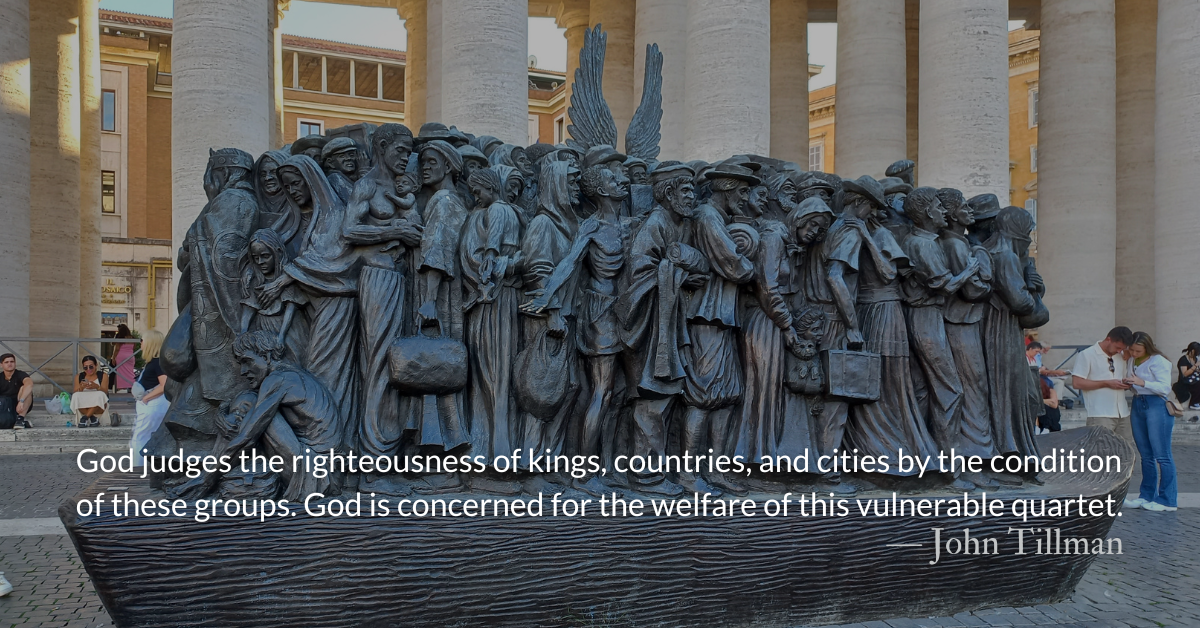
Photo Note: Today’s photo is of the Angels Unawares sculpture by Timothy Schmalz. It was installed in St. Peter’s Square in the Vatican September 29, 2019 for the 105th World Day of Migrants and Refugees.

Reflection: Vulnerable Quartet

By John Tillman

The “quartet of the vulnerable” is a term for those vulnerable to harm, particularly in the Bible: the widow, the orphan, the immigrant, and the poor.

Job sees wrongs in his community, questioning why God has not acted on behalf of three of these four groups. He shines a light on the sufferers and has compassion for them.

Job starts with the subtle crime of moving boundary stones. Doing this made one’s land more profitable and incrementally stole influence and livelihood from neighbors.

An action in Job’s list that particularly infuriates me is driving away the orphan’s donkey. Driving away the donkey is an act of financial sabotage, equivalent to breaking a farmer’s tractor or burning down their barn. It is intended to cause bankruptcy, loan default, and desperation. It cuts their bootstraps to prevent them from pulling themselves up, ensuring that there is no escape from poverty and enslavement. 

Another wrong Job lists is sending “the poor of the land into hiding”, forcing them into deserts where there is no food for their children. (Job 24.4-5) These wrongs make me think of current issues.

When we look honestly at our society as Job did, can we not see those incrementally “moving boundary stones” stealing wealth and influence from their neighbors? Can we not see those financially and educationally sabotaging people working to escape poverty? Can we not see those sweeping the poor out of sight or allowing them to languish and die?

Laws have been opposed and defeated to help the poor or penalize financial crimes. Programs or money that would feed hungry children have been attacked or eliminated. Churches, programs, or pastors who help the poor or migrants have been criticized, intimidated, fined, and prosecuted for doing so.

What kind of society does these things? Not a great one. Not a righteous one. God judges the righteousness of kings, countries, and cities by the condition of these groups. God is concerned for the welfare of this vulnerable quartet. We should share his concern.

Job began this section with despair that these things were happening. We may identify with that despair. Job ends this section with certainty that God will destroy and punish abusers of the vulnerable.

If Job looked past his pain to shine a light on the sufferers, have compassion for them, cry out to God for them, and take action on their behalf, so can we.

Divine Hours Prayer: The Call to Prayer

Come now and see the works of God, how wonderful he is in his doing toward all people.

– From The Divine Hours: Prayers for Autumn and Wintertime by Phyllis Tickle.

Read more: Taking Advantage of the Desperate

Economically disadvantaged neighborhoods often contain payday lenders and abortion clinics, but few doctor’s offices or grocery stores—monetization of desperation.

Read The Bible With Us

It’s not how quickly you read the Bible. It’s how well you live it out. Join our sustainable, two-year Bible reading plan and get more out of each page.

https://mailchi.mp/theparkforum/m-f-daily-email-devotional

Show Buttons
Hide Buttons
Spur a spiritual rhythm of refreshment right in your inbox
By joining this email list you are giving us permission to send you devotional emails each weekday and to communicate occasionally regarding other aspects of the ministry.
100% Privacy. We don't spam.