The Un-Localized God

Links for today’s readings:

Jan 22  Read: Job 23 Listen: (1:43) Read: Psalms 1-2 Listen: (2:05)

Scripture Focus: Job 23.

3 If only I knew where to find him;

    if only I could go to his dwelling!

4 I would state my case before him

    and fill my mouth with arguments.

5 I would find out what he would answer me,

    and consider what he would say to me.

6 Would he vigorously oppose me?

    No, he would not press charges against me.

7 There the upright can establish their innocence before him,

    and there I would be delivered forever from my judge.

8 “But if I go to the east, he is not there;

    if I go to the west, I do not find him.

9 When he is at work in the north, I do not see him;

    when he turns to the south, I catch no glimpse of him.

10 But he knows the way that I take;

    when he has tested me, I will come forth as gold.

11 My feet have closely followed his steps;

    I have kept to his way without turning aside.

12 I have not departed from the commands of his lips;

    I have treasured the words of his mouth more than my daily bread.

Reflection: The Un-Localized God

By John Tillman

Job couldn’t find God but trusted God would find him.

Most ancient peoples worshiped territorially localized gods. Like kings, gods had borders. Your god might be a god of the plains, your ally’s god a god of the seas or rivers, and your enemy’s god a god of the mountains. Yahweh was remarkably un-localized. He claimed sovereignty over earth, heavens, mountains, plains, and seas.

Followers of Yahweh built altars to the Lord wherever they experienced him. You could never tell where Yahweh would show up. Abraham “called on the name of the Lord” from under “the great tree of Moreh” (Genesis 12.6-7), between Bethel and Ai (Genesis 12.8), under a tamarisk tree he planted in Beersheba (Genesis 21.33), and on Mount Moriah (Genesis 22.1-14). Isaac, Jacob, and others did the same.

Like Abraham, Job had no tabernacle or temple at which to seek God. In one way, Job felt God’s presence, like a hand oppressing him. In another way, he longed to appeal to God but could not reach him.

David would have sympathized. At times he fruitlessly sought God (Psalm 13) and at others claimed he could not escape God’s presence (Psalm 139.7-12).

The exiles sympathized. They felt simultaneously punished and abandoned. Without a temple and in a foreign land, Jeremiah reminded them God was not localized and they would find him when they sought him with all their hearts (Jeremiah 29.13).

Do you sympathize with Job? Do you feel exiled? Does God seem everywhere and nowhere at once?

God revealed himself to Abraham on Moriah and to Moses in the burning bush. Today, God reveals himself primarily in scripture. Learning to find God in scripture and prayer helps us to find him in every situation. Scripture shows us Jesus, the perfect image of the Father. And it shows us the Holy Spirit, poured out on all people everywhere.

Under the shade of scripture’s spreading branches, build an altar with habits of reading, study, and worship. Call upon the name of the Lord. With your ears, listen to God’s voice speaking through the Holy Spirit, scripture’s human authors, and your fellow Christians. With your hands do the works and wonders scripture commands (Luke 9.1-6; 10.8-9; Matthew 10.1-8). With your feet, follow the paths scripture describes and shun the ones it condemns. (Matthew 10.16-31)

Our God is not localized. God is present even when we don’t notice and he is seeking worshipers (John 4.21-24). The un-localized God wants to dwell within us. Seek him in Spirit and truth.

Divine Hours Prayer: The Request for Presence

For God alone my soul in silence waits; truly, my hope is in him. — Psalm 62.6

– From The Divine Hours: Prayers for Autumn and Wintertime by Phyllis Tickle.

Read more: Jesus, Our Blessed One — A Guided Prayer

We aspire, Lord,…to delight in your law…to meditate day and night. But we rely, Lord, not on our striving but on Jesus Christ.

Consider Supporting Our Work

If our ad-free devotional content has helped your faith, help us make more and reach more people with it. Become a donor today.


Assumptions

Links for today’s readings:

Jan 21  Read: Job 22 Listen: (2:54) Read: John 21 Listen: (3:58)

Scripture Focus: Job 22:4–5

4 “Is it for your piety that he rebukes you
    and brings charges against you?
5 Is not your wickedness great?

Reflection: Assumptions

By Erin Newton

When headlines break with news of some new atrocity, the details are often vague and incomplete. With the lack of information, assumptions rush to fill the void. Whatever the incident, whoever the person, assumptions are a common exacerbator of suffering.

When Job’s friends arrive on the scene, they give him a week’s silence. Then the verbal (and emotional) onslaught begins. As Francis Andersen notes in the Tyndale commentary on Job, “The idea of a good man suffering never enters their thoughts. It would demolish their theology, or, as Eliphaz has already said, undermine religion.” Eliphaz, just a few chapters earlier is dismayed by Job’s repeated insistence of innocence. “But you even undermine piety and hinder devotion to God” (15:4). The thinking, at that time, was that bad things happen to bad people. He deserved it. And then they probe to find it.

But we keep returning to the fact that we already know the reason for Job’s suffering; his friends, however, do not. Three rounds of debates between Job and his friends ensue. Eight different conversations grow in their intensity. First, they all generally suggest that suffering is caused by a person’s sin. By Job 22, Eliphaz is not mincing his words anymore: “Are not your sins endless?” (v. 5) and “That is why snares are all around you” (v. 10). Job’s friends cast the cause of his misery onto his own head.

When our first instinct is to heap responsibility back onto the person who suffers, we are often acting like Eliphaz himself. We cannot see a world outside of our own assumptions—even more so, our assumptions rooted in preconceived biases.

Andersen reminds us: “The reader … understands that Job is neither stubborn nor arrogant. He is honest and tenacious. From the depths of a sick body and broken mind, his spirit is still thrusting its faith into God, even though his blind cries sound wild to his friends.”

For those who suffer from chronic or life-threatening illness, are we quick to assume they’ve done something wrong? For those who lose a loved one to violence, are we blaming the victim for “being in the wrong place at the wrong time”? For those who have been abused by someone, are we analyzing their outfits, their demeanor, or their gullibility?

To avoid being like Job’s friends, we must be quick to listen, slow to speak—and I’d like to add—slow to assume.

Divine Hours Prayer: The Request for Presence

Let my cry come before you, O Lord; give me understanding, according to your word.

Let my supplication come before you; deliver me, according to your promise. — Psalm 119.169-170

– From The Divine Hours: Prayers for Autumn and Wintertime by Phyllis Tickle.

Read more: Return from Financial Sins

One rarely hears sermons on financial sins that approach the passion and zeal of sermons about sex or drugs or pornography…unless one reads the Bible.

Read The Bible With Us

How’s your Bible reading plan going? Don’t give up. There’s no wrong way to read the Bible and no bad time to start. Join our sustainably-paced plan today.

https://mailchi.mp/theparkforum/m-f-daily-email-devotional

Needing Jesus to Pray

Links for today’s readings:

Jan 20  Read: Job 21 Listen: (3:05) Read: John 20 Listen: (4:17)

Is my complaint directed to a human being?
Why should I not be impatient?

Reflection: Needing Jesus to Pray

By John Tillman

We tell our wants to God (and everyone else) easily enough. If this was all prayer was, it could be said to be natural, but Dietrich Bonhoeffer, the pastor and theologian, disagrees. He said, “This is a dangerous error to imagine that it is natural for the heart to pray.” 

Dietrich Bonhoeffer lost his life in a Nazi concentration camp in 1945 just two weeks shy of the liberation of the camp by American forces. To say he understood the experience of intense prayer, and unanswered prayer, would be an understatement. He wrote:

“It can become a great torment to want to speak with God and not to be able to do it—having to be speechless before God, sensing that every cry remains enclosed within one’s own self, that heart and mouth speak a perverse language which God does not want to hear.”

Bonhoeffer taught ministry students and congregants that it was not possible to pray rightly without the power of God:

“We confuse wishing, hoping, sighing, lamenting, rejoicing—all of which the heart can certainly do on its own—with praying. But in doing so we confuse earth and heaven, human beings and God. Praying certainly does not mean simply pouring out one’s heart. It means, rather, finding the way to and speaking with God, whether the heart is full or empty. No one can do that on one’s own. For that one needs Jesus Christ.”

Bonhoeffer further explained how to pray Scripture, which is the Word of God, through the Holy Spirit, who fills words with the power of God:

“Jesus Christ has brought before God every need, every joy, every thanksgiving, and every hope of humankind. In Jesus’ mouth the human word becomes God’s Word. When we pray along with the prayer of Christ, God’s Word becomes again a human word.

If we want to read and to pray the prayers of the Bible, and especially the Psalms, we must not, therefore, first ask what they have to do with us, but what they have to do with Jesus Christ. We must ask how we can understand the Psalms as God’s Word, and only then can we pray them with Jesus Christ. Thus it does not matter whether the Psalms express exactly what we feel in our heart at the moment we pray.

Perhaps it is precisely the case that we must pray against our own heart in order to pray rightly. It is not just that for which we ourselves want to pray that is important, but that for which God wants us to pray. If we were dependent on ourselves alone, we would probably often pray only the fourth petition of the Lord’s Prayer. But God wants it otherwise. Not the poverty of our heart, but the richness of God’s word, ought to determine our prayer.”

Divine Hours Prayer: The Call to Prayer

Open my lips, O Lord, and my mouth shall proclaim your praise. — Psalm 51.16

Read more: Defining Moment

What adjectives do you carry with you? Doubting? Wounded? Worthless? Unreliable? Delete them and accept the new descriptors that are given to us in Jesus

Read more: Crushing Bruised Reeds

We do not need to abandon essentials to charitably embrace those in distress who struggle to define “essentials.” They need love, not contempt.

Principles Under Pressure

Links for today’s readings:

Jan 19  Read: Job 20 Listen:(2:52) Read: John 19 Listen: (6:23)

Scripture Focus: John 19.4-16

4 Once more Pilate came out and said to the Jews gathered there, “Look, I am bringing him out to you to let you know that I find no basis for a charge against him.” 5 When Jesus came out wearing the crown of thorns and the purple robe, Pilate said to them, “Here is the man!” 6 As soon as the chief priests and their officials saw him, they shouted, “Crucify! Crucify!” But Pilate answered, “You take him and crucify him. As for me, I find no baszis for a charge against him.” 7 The Jewish leaders insisted, “We have a law, and according to that law he must die, because he claimed to be the Son of God.” 8 When Pilate heard this, he was even more afraid, 9 and he went back inside the palace. “Where do you come from?” he asked Jesus, but Jesus gave him no answer. 10 “Do you refuse to speak to me?” Pilate said. “Don’t you realize I have power either to free you or to crucify you?” 11 Jesus answered, “You would have no power over me if it were not given to you from above. Therefore the one who handed me over to you is guilty of a greater sin.” 12 From then on, Pilate tried to set Jesus free, but the Jewish leaders kept shouting, “If you let this man go, you are no friend of Caesar. Anyone who claims to be a king opposes Caesar.” 13 When Pilate heard this, he brought Jesus out and sat down on the judge’s seat at a place known as the Stone Pavement (which in Aramaic is Gabbatha). 14 It was the day of Preparation of the Passover; it was about noon. “Here is your king,” Pilate said to the Jews. 15 But they shouted, “Take him away! Take him away! Crucify him!” “Shall I crucify your king?” Pilate asked. “We have no king but Caesar,” the chief priests answered. 16 Finally Pilate handed him over to them to be crucified.

Reflection: Principles Under Pressure

By John Tillman

The gospel accounts emphasize Pilate was pressured to crucify Jesus. The creeds name him as the authority who crucified Jesus.

Some claim Pilate tried to save Jesus. (This is sometimes a bad-faith argument motivated by anti-semitism.) Some see Pilate as the villainous stand-in for wicked governments of today. Which is it? Is Pilate “innocent of this man’s blood” or Jesus’ villainous killer?

Some Westerners think fondly about Rome as if it was a utopia. Some of our democratic principles germinated in Rome, but it took millennia before they flowered. Rome, even in the best of times, was not the idyllic bastion of freedom and democracy some pretend.

Rome had a legislature and courts, but they were neutered. Rome’s senate ceased to function long before it ceased to exist. Citizens had the barest minimum of rights but citizens were few and far between. The majority of Rome’s population were subjects and slaves, not citizens. And rulers could do with subjects whatever they wanted. Rome was an autocratic empire robed in the costume of a republic. Governments like this still exist today.

Caesar ruled with impunity and this attitude of unaccountability trickled down to those under his authority. As long as you kept Caesar happy, you could do whatever you wanted to your subjects. Slaughter them, imprison them, tax them, oppress them.

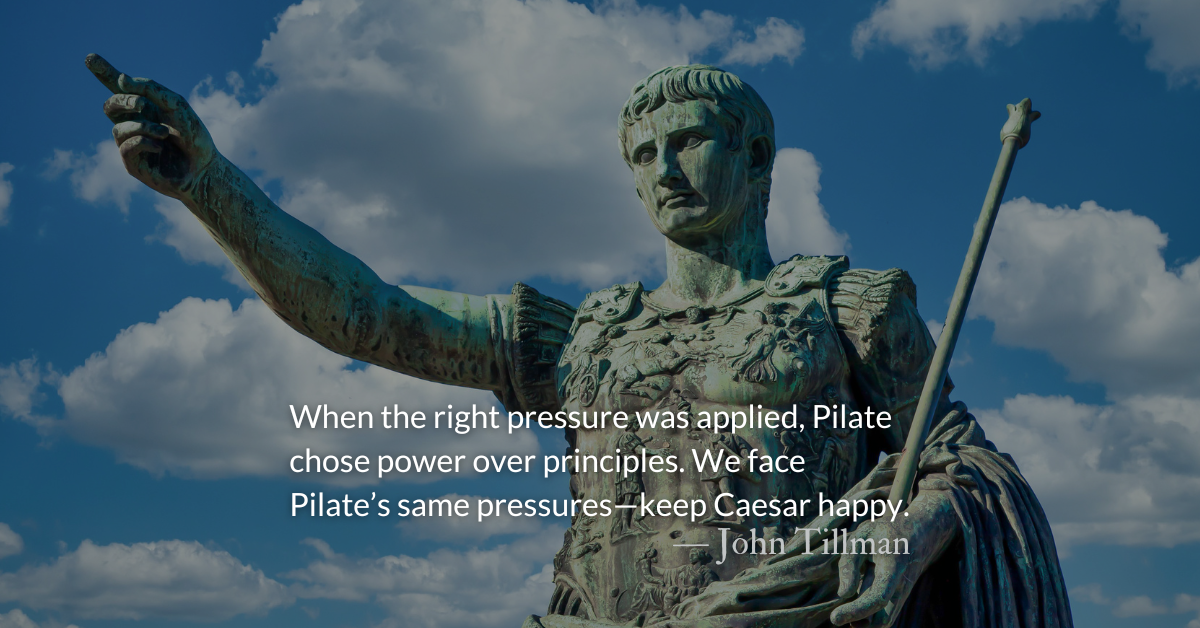
On paper, Pilate had all the power. He could do whatever he wanted. Pilate seems to have been a principled person who wanted to judge rightly and uphold the law. But when the right pressure was applied, Pilate chose power over principles.

We face Pilate’s same pressures—keep Caesar happy. Caesar’s forces today might be political, religious, relational, or career-related. We might fear loss of power, ostracization, career losses, or violence. Many will weaponize those forces and fears to manipulate us.

The religious leaders manipulated Pilate saying, “If you let this man go, you are no friend of Caesar.” What might this look like for us? “If you ___________, you are no ___________.” What goes in those blanks? Who’s your Caesar? Who threatens Caesar’s disapproval? What principles does Caesar demand you sacrifice? What injustices does Caesar expect you to ignore or defend?

Under pressure, respond like Jesus, not Pilate. Recognize that they don’t truly have power over us. Even if harmed, we know we share in Christ’s sufferings and rise in his power.

Resist pleasing Caesar by submitting to Christ.

Divine Hours Prayer: The Greeting

O God, you have taught me since I was young, and to this day I tell of your wonderful works. — Psalm 71.17

– From The Divine Hours: Prayers for Autumn and Wintertime by Phyllis Tickle.

Read more: Hounding the Wounded

Job is in pain, suffering physically, emotionally, and spiritually but his friends treat him as a spiritual enemy.

Read more: The King We Want

We want a king, we say

To cast out the unworthy

Keep away those we despise and fear

Isolate us with those we hold dear

What Job Didn’t Know

Links for today’s readings:

Jan 16  Read: Job 16-17 Listen: (3:40) Read: John 16 Listen: (4:14)

Links for this weekend’s readings:

Jan 17  Read: Job 18 Listen: (1:54) Read: John 17 Listen: (3:40)
Jan 18  Read: Job 19 Listen: (2:48) Read: John 18 Listen: (5:16)

Scripture Focus: Job 16.18-21

18 “Earth, do not cover my blood;

    may my cry never be laid to rest!

19 Even now my witness is in heaven;

    my advocate is on high.

20 My intercessor is my friend

    as my eyes pour out tears to God;

21 on behalf of a man he pleads with God

    as one pleads for a friend.

Job 17.13-16

13 If the only home I hope for is the grave,

    if I spread out my bed in the realm of darkness,

14 if I say to corruption, ‘You are my father,’

    and to the worm, ‘My mother’ or ‘My sister,’

15 where then is my hope—

    who can see any hope for me?

16 Will it go down to the gates of death?

    Will we descend together into the dust?”

Reflection: What Job Didn’t Know

By John Tillman

Job said upsetting things. It’s no wonder that his friends were offended and confused by his angry and despairing words. We understand Job better than his friends because we know things that he and his friends did not know.

We know God considered Job righteous. We know there was more at stake than Job’s well-being, comfort, or prosperity. We heard Satan’s accusations in God’s presence. The accuser claimed God’s faithful only love him when he blesses them. The accuser claimed God shows favoritism to those who love him. Both faith itself and God’s righteousness were under attack.

What Job endured had a purpose that he could not see and won a victory that he could not have imagined. But even knowing what we know doesn’t make Job’s suffering less painful. It doesn’t rebuild destroyed homes, restore destroyed crops, or return stolen livestock. It doesn’t raise to life those who died.

Job also said hopeful things. It is a wonder that anyone in his position still held any hope. Job claimed that a witness on his behalf and an advocate were defending him to God and that his intercessor and friend was in Heaven, pleading with God. To Job this friendly advocate was shadowy and undefined. Is it a human? An angel? A divine being?

We know more than Job did. We know Job’s shadowy, heavenly defender is Jesus. (1 John 2.1-2) We see him clearly in the gospels, and Jesus says, when we see him, we see the Father. (John 14.9)

Job is the oldest book (the first to be written) in the Bible. Job probably lived after the flood but before Abraham. So, before Abraham received God’s promise, Job described the hope we have in Jesus.

We know more than Job. We know the grave is not our home or our prison. We know Job’s advocate and our friend, Jesus, is the firstborn from among the dead (Romans 8.29; Colossians 1.15-18; Revelation 1.4-5) and we are his siblings, sharing his cross and resurrection. (Romans 6.4-5; Philippians 3.10) We know after returning to dust, he will descend, raising us to life everlasting. (1 Thessalonians 4.13-18)

What Job didn’t know and couldn’t imagine is our reality. But we also live with unknowns in our present and future sufferings. We don’t know what is at stake in painful times. We don’t know what purpose our sufferings serve. Like Job, we must trust without knowing fully. Like him, we can rely on our friend and advocate.

Divine Hours Prayer: The Refrain for the Morning Lessons

Righteousness shall go before him, and peace shall be a pathway for his feet. — Psalm 85.13

– From The Divine Hours: Prayers for Autumn and Wintertime by Phyllis Tickle.

Read more: Hope In the Tree of the Cross

“He has done it,” Psalm 22’s last line proclaims. “It is finished,” Christ’s last breath from the cross echoes.

Read more: Resist Weaponizing Spiritual Things

God won’t be anyone’s mercenary and he looks unkindly on weaponizing the Bible for earthly purposes.

Show Buttons
Hide Buttons
Spur a spiritual rhythm of refreshment right in your inbox
By joining this email list you are giving us permission to send you devotional emails each weekday and to communicate occasionally regarding other aspects of the ministry.
100% Privacy. We don't spam.