The Weakness in Evil’s Armor

Scripture Focus: 1 Kings 22:30, 34
30 The king of Israel said to Jehoshaphat, “I will enter the battle in disguise, but you wear your royal robes.” So the king of Israel disguised himself and went into battle.
34 But someone drew his bow at random and hit the king of Israel between the sections of his armor. The king told his chariot driver, “Wheel around and get me out of the fighting. I’ve been wounded.” 

Reflection: The Weakness in Evil’s Armor
By Erin Newton

No evil act can thwart the providence of God. No person can go unnoticed by the ever-watchful eye of our Lord. Nobody hides from an omnipresent deity.

Ahab ruled over God’s people with an oppressive hand. Confident in his power, he ignored the prophet’s threat and wore a disguise to battle. He tried to control the situation and force a favorable outcome. Then by chance—no, by God’s providence—a stray arrow pierced the king and he died.

Evil leaders seem indestructible. They promote themselves as indestructible. Ahab certainly fit the profile. He was corrupt, deceitful, proud, and merciless. He would rather harm befall his peers. He tried to place the target on his comrade, the king of Judah.

The king shielded his weakness with armor, assuming the protection would be as impenetrable as dragon scales. But even iron-clad monsters are not invincible.

The Hobbit tells a story of Smaug, a dragon who set out to destroy the people of Dale. Cocky and boastful of his armored hide, Smaug taunts the people, “My armor is like ten-fold shields, my teeth are swords, my claws spears…” This prideful spirit is just like Ahab. But a weakness in the armor of king and dragon will be found.

In each story, a single arrow strikes in the smallest gap of the armor. The miraculous “once in a lifetime” shot is an arrow finding its target. For our story, it is an arrow guided by the almighty hand of God. The undefeated Creator of the world can bring down evil leaders with a slender stick and random human efforts.

Such is the providence of God. Scheming evil leaders assume they have power to hide themselves, control the circumstances, and escape judgment. The story of Ahab reminds us of the omnipotence of our God.

But some aspects of his providence are difficult to understand. What about all the prophets harmed by Ahab’s rule and Jezebel’s rage? Why could not that arrow have flown years earlier?

We simply do not know. And this leads us to the place in our faith that we must hold in tension: God’s sovereign rule and the continuance of evil. We know God despises evil and grieves such atrocities. We fill our hearts with pleas for justice and intercession for the weak.

Rest assured, no one escapes the will of God. Not even leaders who think they can hide. 

Divine Hours Prayer: The Greeting
Who is like you, Lord God of hosts? O mighty Lord, your faithfulness is all around you.
Righteousness and justice are the foundations of your throne; love and truth go before your face. — Psalm 89.8

– From The Divine Hours: Prayers for Summertime by Phyllis Tickle.

Today’s Readings
1 Kings 22 (Listen 7:51)
Psalms 44 (Listen 2:44)

Read more about Kings Like Ahab
Ahab gets the most ink in Kings. He’s unquestionably wicked, yet God used and spoke to him frequently. Why?

Read more about Evil, Judgment, or Discipline?
Sometimes bad things happen as part of God’s judgment…as Johnny Cash sang, “…sooner or later, God’ll cut you down.”
Sluggish Grief

Scripture Focus: Psalm 42:5-7
5 Why, my soul, are you downcast?
    Why so disturbed within me
Put your hope in God,
    for I will yet praise him,
    my Savior and my God.
6 My soul is downcast within me;
    therefore I will remember you
from the land of the Jordan,
    the heights of Hermon—from Mount Mizar.
7 Deep calls to deep
    in the roar of your waterfalls;
all your waves and breakers
    have swept over me.

Psalm 43:5
5 Why, my soul, are you downcast?
    Why so disturbed within me?
Put your hope in God,
    for I will yet praise him,
    my Savior and my God.

Reflection: Sluggish Grief
By Erin Newton

In the movie, Paddington, one character reflects on his emotional journey of settling into a new place: “My body had traveled fast, but my heart… she took a little longer to arrive.” The heart can be sluggish during grief. It’s frustrating and discouraging.

I wish grief was a cycle; instead, it is a web. Our bodies are bound to the linear progression of time. We are moving from one event to another, but our hearts and minds are stuck in a tangled web of emotions and thoughts.

The repeated phrase, “Why, my soul, are you downcast?” reflects this emotional tangle. The psalmist tries to soothe himself with words of counsel. “Hope in God…Remember the good times.” Oh, I’ve heard those platitudes from others. And I’ve tried to use them to urge my heart into better spirits.

But grief is not linear. The stages—denial, anger, bargaining, depression, acceptance—don’t happen sequentially.

Psalms 42-43 show this type of tangled emotional experience. At first, we see the depth of sadness, “tears have been my food day and night” (Psalm 42.3). Then a joyous memory, “How I used to go to the house of God…with shouts of joy and praise among the festive throng” (Psalm 42.4). Then the declaration of depression, “all your waves and breakers have swept over me.”

The journey of emotional experience is like traveling across the mountains. There is the bright ascent to the peak, the crisp breeze, and clear skies. We gaze upon the view and see the other mountaintops, each basking in the pure sunlight. But to get there, we must descend into the valley, the dark woods.

Amy Carmichael calls this “The Ravine.” It is the painful memory of better days: “Yes, we were one of a festive crowd; was there any happy thing that we did not do? And we think of what used to be, so different from all that is now.”

Our minds know of God’s goodness, the joy of his presence, the hope of better days, but our hearts take a little longer to get there.

“We know that it is true. And yet there is something in the trend of our thoughts that is like the backwash of the waves, as wave after wave breaks on the shore…We have seen the lovely radiance of that upper air. But our feet must walk the ways of earth down that dreary hill, past those somber trees, and into the valley…”

Divine Hours Prayer: The Refrain for the Morning Lessons
Those who sowed with tears will reap with songs of joy.
Those who go out weeping, carrying the seed, will come again with joy, shouldering their sheaves. — Psalm 126.6-7

– From The Divine Hours: Prayers for Summertime by Phyllis Tickle.

Today’s Readings
1 Kings 21 (Listen 4:19)
Psalms 42-43 (Listen 2:32)

Read more about Be With Me
The weight of our sadness reflects the hope of a beautiful life that has been tragically altered.
But we are not alone. God is near to the brokenhearted…

Read The Bible With Us
Join our Bible reading plan. Find meaning in the Bible by reading at a sustainable, two-year pace.
https://mailchi.mp/theparkforum/m-f-daily-email-devotional

Kings Like Ahab

Scripture Focus: 1 Kings 20.28
28 The man of God came up and told the king of Israel, “This is what the Lord says: ‘Because the Arameans think the Lord is a god of the hills and not a god of the valleys, I will deliver this vast army into your hands, and you will know that I am the Lord.’ ” 

Reflection: Kings Like Ahab
By John Tillman

Ahab is the anti-David. If David shows us “a man after God’s heart,” Ahab is the mirror image. (1 Samuel 13.14; Acts 13.22) Ahab and David become moral measuring sticks. Scripture describes bad kings as following Ahab’s ways and good kings as following David’s.

Ahab gets the most ink in Kings. He’s unquestionably wicked, yet God used and spoke to him frequently. Why?

It may shock us that God blesses Ahab with victories and with his presence and voice, spoken through many prophets. Humans aren’t perfect, yet God works through them. We know this academically, but emotionally, we feel God should find someone else when he uses the wicked. We can learn from this.

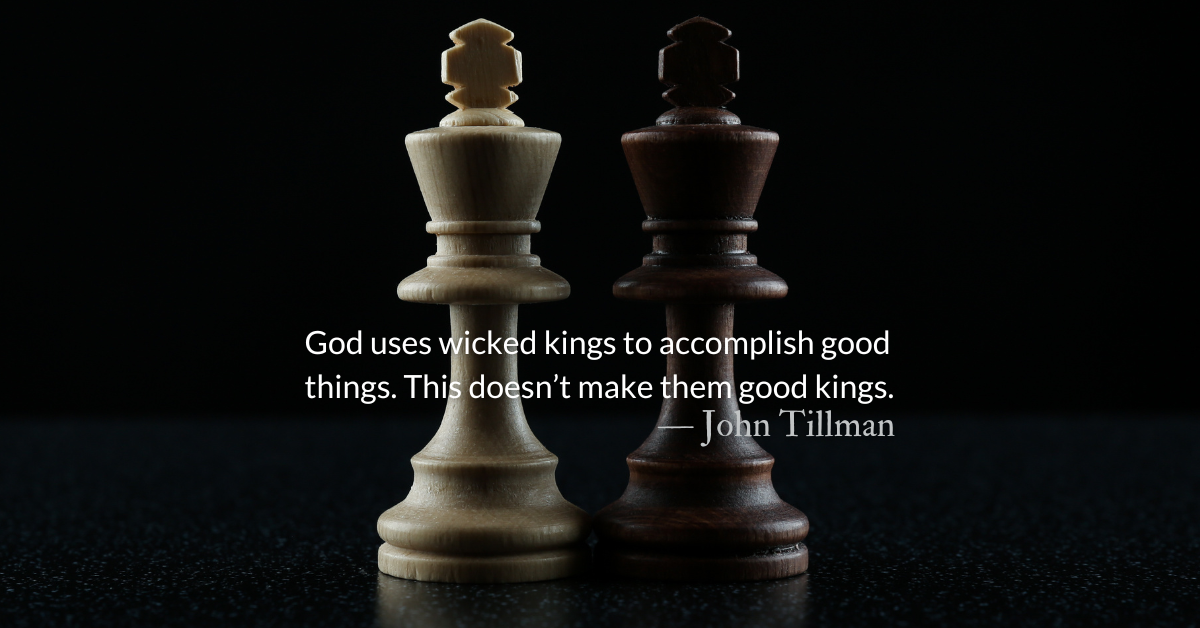
God uses wicked kings to accomplish good things. This doesn’t make them good kings. God used Ahab as a mercy to the people of Israel and for the glory of his own name, not because Ahab was good. Victories don’t grant leaders a never-expiring stamp of God’s approval or mean a leader is “God’s man or woman.” They don’t suddenly deserve praise, adoration, or unquestioning, unshakable devotion.

God pursues the wicked for salvation. God repeatedly tells Ahab, “You will know that I am the Lord.” God wanted Ahab to know him and offered himself to Ahab, who repeatedly rejected God. We typically think of God pursuing the wicked, seeking to punish or destroy them, but God also pursues the wicked to turn them to him and change their hearts.

We are among the wicked. Ahab was wicked and God used him. David was wicked and God used him. We are wicked and God will use us. Our wickedness is different by degrees when we compare them humanly, but to God wicked is wicked. Just as God pursued wicked kings for repentance, he has and will pursue us. 

Jesus is the only righteous king. God did find a better, righteous king to do the work that no imperfect king could do. Jesus is the king who accomplishes all that God wants. He is the only king to whom we can be unswervingly loyal because he is the only righteous one.

Like Ahab and all wicked kings, we are wicked ones repeatedly called to repentance. Ahab and David differ in their response to God, not in God’s offer. May we respond like David and not like Ahab.


Divine Hours Prayer: A Reading
Jesus taught us, saying: “I tell you, if anyone openly declares himself for me in the presence of human beings, the Son of man will declare himself for him in the presence of God’s angels. But anyone who disowns me in the presence of human beings will be disowned in the presence of God’s angels.” — Luke 12.8-9

– From The Divine Hours: Prayers for Summertime by Phyllis Tickle.


Today’s Readings
1 Kings 20 (Listen 7:03)
Psalms 40-41 (Listen 3:57)

Read more about Ahab and David
Even Ahab, the wickedest of wicked kings, obtained a measure of mercy from God when he showed humility and grief.

Read more about Supporting Our Work
Our ad-free content is not free to produce or publish. Give a one-time gift or join our monthly donors.


Tongues, Thumbs, and Prayers

Scripture Focus: Psalm 39.1-3
1 I said, “I will watch my ways 
and keep my tongue from sin; 
I will put a muzzle on my mouth 
while in the presence of the wicked.” 
2 So I remained utterly silent, 
not even saying anything good. 
But my anguish increased; 
3 my heart grew hot within me. 
While I meditated, the fire burned; 
then I spoke with my tongue: 

Reflection: Tongues, Thumbs, and Prayers
By John Tillman

The psalmist, presumably David, suffers in silence. He muzzles himself, not even saying good things because of the wicked. Silence increases his anguish. Inner turmoil heats up. He turns to meditation, but heat becomes a burning flame. So, he opens his mouth to speak…

If we stopped at verse three, we might assume the psalmist’s unsheathed speech became a sword, fighting for God. We might think his words laid waste to the wicked. We might imagine ourselves following the psalmist’s example by opening a social media app and delivering a diatribe of harsh truths to destroy ideological opponents. We’d be wrong.

The psalmist spoke to God, not humans. He had questions, not claims. He sought truth. He didn’t weaponize it. His faith was mixed with doubts. His courage was mixed with fears. His prayers were mixed with weeping.

Don’t forget the first verse of this psalm: “I will…keep my tongue from sin.” The Bible repeatedly warns us of sinning by speech. If James had seen us on mobile devices typing in our social media apps, he might have written “thumbs are a restless evil” instead of “tongues.” (James 3.17)

Should we—can we—use our tongues to speak or our thumbs to type without falling into sin?

Do we need better vocabulary? Surely if we eschew harsh, foul, or insulting language, our speech can’t be sinful? No.
Do we need to be less dogmatic? Surely we can avoid sin by placating both sides and avoiding hard stances? No.
Do we need greater intellect? Surely intellectualism, facts, and data can keep us from sinning by speech? No.

It is not our tongues or our thumbs that cause us to sin. It is our hearts. (Matthew 12.34; Luke 6.45) A better vocabulary won’t heal our hateful hearts. A more understanding tone won’t calm our heart’s fear of confrontation. The brightest of intellects can’t enlighten the sin-darkened pathways of our hearts. 

When avoiding sinful speech, the factor that is more important than our vocabulary, our sensitivity, or our wisdom is prayer. Our prayer life changes our hearts.

The psalmist is brutally honest with God. Are your prayers honest?
The psalmist seeks forgiveness and help. Are you confessing and requesting?

There is a time to speak up, testify to the truth, and defend what we believe. When that time comes, will our prayer life have prepared us to speak?

Divine Hours Prayer: The request for Presence
O Lord, my God, my Savior, by day and night, I cry to you. Let my prayer enter into your presence. — Psalm 88.1-2

– From The Divine Hours: Prayers for Summertime by Phyllis Tickle.


Today’s Readings
1 Kings 19 (Listen 3:53)
Psalms 39 (Listen 1:49)

Read more about Prayer When None Are Faithful
We are dismayed, Lord…
We are sheep among wicked shepherds…
Will only braggarts lead?
Will only the boastful hold sway?

Read more about Cultivation Requires Planning
For a mustard seed faith to grow, it must be cultivated. Do you have a plan to cultivate your spiritual growth?


Wide, High, Long and Deep

Scripture Focus: Psalm 36:5-9
5 Your love, Lord, reaches to the heavens,
    your faithfulness to the skies.
6 Your righteousness is like the highest mountains,
    your justice like the great deep.
    You, Lord, preserve both people and animals.
7 How priceless is your unfailing love, O God!
    People take refuge in the shadow of your wings.
8 They feast on the abundance of your house;
    you give them drink from your river of delights.
9 For with you is the fountain of life;
    in your light we see light.

Reflection: Wide, Long, High and Deep
By Jon Polk

The Psalter is replete with references to the “two ways” of living, contrasting the wicked and the righteous, good versus evil. Chapter one, verse one starts it all off, “Blessed is the one who does not walk in step with the wicked.”

Indeed, this theme cuts a well-worn path throughout the Psalms and finds beautiful poetic expression here in Psalm 36.

Our psalmist opens with a customary lament about the presence and arrogance of evil in our world. Blinded by their own high opinions of themselves, the wicked act foolishly, plot evil, and pursue a sinful course of wrongdoing. All without regard to the presence and authority of God in the world.

But never fear, gentle reader! The virtues of God reign supreme! God’s unfailing love is as limitless as the skies, God’s righteousness is solid like the mountains high, and God’s justice plumbs the depths of the oceans. God’s love is indeed woven into the fabric of our world, preserving all of creation.

Why is there so much papyri in these ancient Psalms dedicated to the eternal struggle between the righteous and the wicked? 

Could it be that we are constantly reminded of the present reality of evil, the influence of the Accuser, or the bold arrogance of the self-righteous? Could it be that even in Christ, we are not promised a carefree existence, safe from struggle or difficulty? Could it be that we are weary and long to feast in God’s house, drink from God’s fountain of life, and witness God’s justice roll down like a river?

Could it be also that were it not for that same love, faithfulness, and righteousness of God, we ourselves would be counted among the number of the wicked?

The psalmist paints a portrait for us of the radical, joyous, and inclusive love of God, a love that welcomes all to find refuge in God’s wings. As Paul reminds the church in Ephesus, we were all once far away from God, without hope, but through Christ we have been brought near to God. We can truly celebrate with humble thanksgiving the God who sustains us and continues to love us.

So, if your world is unstable, your prospects bleak, or if you need a little more strength to get by, take heart and be reminded today of “how wide and long and high and deep is the love of Christ” (Eph. 3:18).

Music: “The Love of God” by Rich Mullins

Divine Hours Prayer: The Call to Prayer
Taste and see that the Lord is good; happy are those who trust in him! — Psalm 34.8

– From The Divine Hours: Prayers for Summertime by Phyllis Tickle.


Today’s Readings
1 Kings 16 (Listen 5:31)
Psalms 36 (Listen 1:29)

This Weekend’s Readings
1 Kings 17 (Listen 3:14)Psalms 37 (Listen 4:21)
1 Kings 18 (Listen 7:08)Psalms 38 (Listen 2:14)

Read more about Make God’s Love Evident
There is great wickedness in the world. Yet, in such a world, the psalmist proclaims God’s love.

Read more about Becoming Light
We can have hope because God has love for us as his motivation. The core of who God is, is love.


Show Buttons
Hide Buttons
Spur a spiritual rhythm of refreshment right in your inbox
By joining this email list you are giving us permission to send you devotional emails each weekday and to communicate occasionally regarding other aspects of the ministry.
100% Privacy. We don't spam.