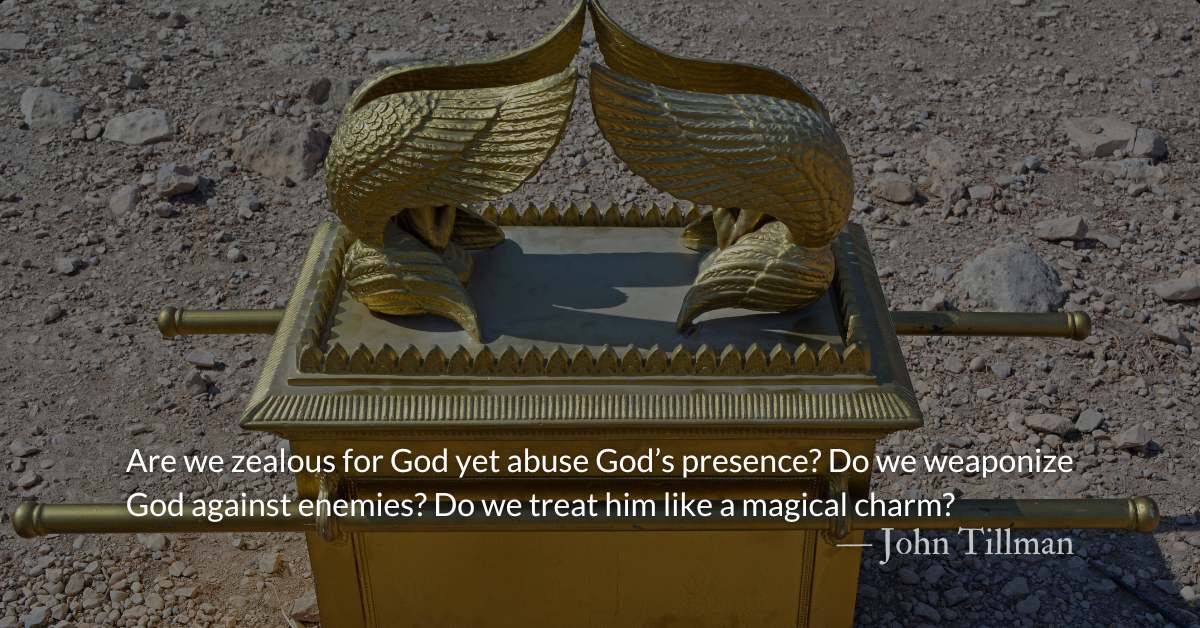
Irreverently Abusing God’s Presence

Scripture Focus: 2 Samuel 6.2-11
2 He and all his men went to Baalah in Judah to bring up from there the ark of God, which is called by the Name, the name of the Lord Almighty, who is enthroned between the cherubim on the ark. 3 They set the ark of God on a new cart and brought it from the house of Abinadab, which was on the hill. Uzzah and Ahio, sons of Abinadab, were guiding the new cart 4 with the ark of God on it, and Ahio was walking in front of it. 5 David and all Israel were celebrating with all their might before the Lord, with castanets, harps, lyres, timbrels, sistrums and cymbals.
6 When they came to the threshing floor of Nakon, Uzzah reached out and took hold of the ark of God, because the oxen stumbled. 7 The Lord’s anger burned against Uzzah because of his irreverent act; therefore God struck him down, and he died there beside the ark of God.
8 Then David was angry because the LORD’s wrath had broken out against Uzzah, and to this day that place is called Perez Uzzah.
9 David was afraid of the Lord that day and said, “How can the ark of the Lord ever come to me?” 10 He was not willing to take the ark of the Lord to be with him in the City of David. Instead, he took it to the house of Obed-Edom the Gittite. 11 The ark of the Lord remained in the house of Obed-Edom the Gittite for three months, and the Lord blessed him and his entire household.

Reflection: Irreverently Abusing God’s Presence
By John Tillman

David and all Israel zealously celebrated…but they were zealously irreverent and Uzzah paid for it.

At first, it might seem like David and the Ark-keepers committed a minor infraction and Uzzah’s “irreverent act” was his well-intended steadying of the Ark. We need context.

For centuries, Israel properly cared for the Ark, the presence of God, and no one died. But, before Saul’s reign, Israel weaponized the Ark, taking it into battle where many Israelites died and the Philistines captured the Ark. (1 Samuel 4.3-11) The Ark, God’s presence, was a curse to the Philistines (1 Samuel 5.1-12), so they sent it away on a cart towed by animals. (1 Samuel 6.7-11) When the Ark returned, the Israelites disobeyed its regulations again, and more of them died. (1 Samuel 6.19-20) After that, the Ark was put under guard and rarely consulted. (1 Samuel 7.1-2; 1 Chronicles 13.3-4)

Scripture explicitly describes the Ark as God’s throne. It is “called by the Name,” meaning God’s name. Yet, David treated it just like the Philistines did—as a treasure or weapon to be transported by animals. Uzzah and David’s irreverent act was putting the Ark on the cart in the first place, not reaching out to steady it.

In fear, David leaves the Ark with Obed-Edom, the Gittite. The Gittites were one of the Philistine tribes from Gath—the same town and tribe Goliath was from. So David, using animals to carry the Ark as the Philistines did, returned it to Philistine care. But this time, its presence is a blessing. (After this, Obed-Edom’s sons were even included by David as gatekeepers at the Temple. 1 Chronicles 26.1, 4-8)

God’s presence no longer hovers between the Ark’s cherubim. His Holy Spirit is among believers. Jesus’ presence abides with “the least of these,” and how we treat them is how we treat him. (Matthew 25.40, 45)

Let us examine ourselves. Are we zealous for God yet irreverent of him? Do we abuse God’s presence? Do we take “the Name” in vain?

Do we weaponize God against enemies? Do we treat him like a magical charm? Or like a treasure we must hide and protect? How do we treat believers who are “called by the Name”? What about “foreigners” God blesses? How do we treat them? What “irreverent acts” like Uzzah’s do we commit against humans for whom Christ died?

May God have mercy on us, as he did on Obed-Edom, the faithful foreigner. It is better to be a gatekeeper in the house of God than dwell in wickedness. (Psalm 84.10)


Divine Hours Prayer: The Request for Presence
In the morning, Lord, in your might; we will sing and praise your power. — Psalm 21.14

– From The Divine Hours: Prayers for Summertime by Phyllis Tickle.


Today’s Readings

2 Samuel 6 (Listen 3:34)
Revelation 15 (Listen 1:29)

Read more about Undignified Weeping and Dancing
When we witness undignified worship, we would be wise to train our hearts to see and expect the best possible motives from others rather than the worst. 

Read more about Supporting Our Work
Please consider becoming a donor. Support ad-free content that brings biblical devotionals to inboxes across the world.

Ecce Homo — Readers’ Choice

Scripture Focus: John 19.5, 13-16
5 When Jesus came out wearing the crown of thorns and the purple robe, Pilate said to them, “Here is the man!” 

13 When Pilate heard this, he brought Jesus out and sat down on the judge’s seat at a place known as the Stone Pavement (which in Aramaic is Gabbatha). 14 It was the day of Preparation of the Passover; it was about noon. 

“Here is your king,” Pilate said to the Jews. 
15 But they shouted, “Take him away! Take him away! Crucify him!” 
“Shall I crucify your king?” Pilate asked. 
“We have no king but Caesar,” the chief priests answered. 
16 Finally Pilate handed him over to them to be crucified. 

From John: As we have in prior years, we’ll continue to share a few “bonus” Readers’ Choice posts from time to time this fall. We thank all of you for your responses, your reading, and your support.

Originally published on January 19, 2023, based on readings from John 19.

Readers’ Choice posts are selected by our readers:
Jon, Hong Kong/TX — This is brilliant. That Ecce Homo debacle makes for a great illustration.

Reflection: Ecce Homo — Readers’ Choice
By John Tillman

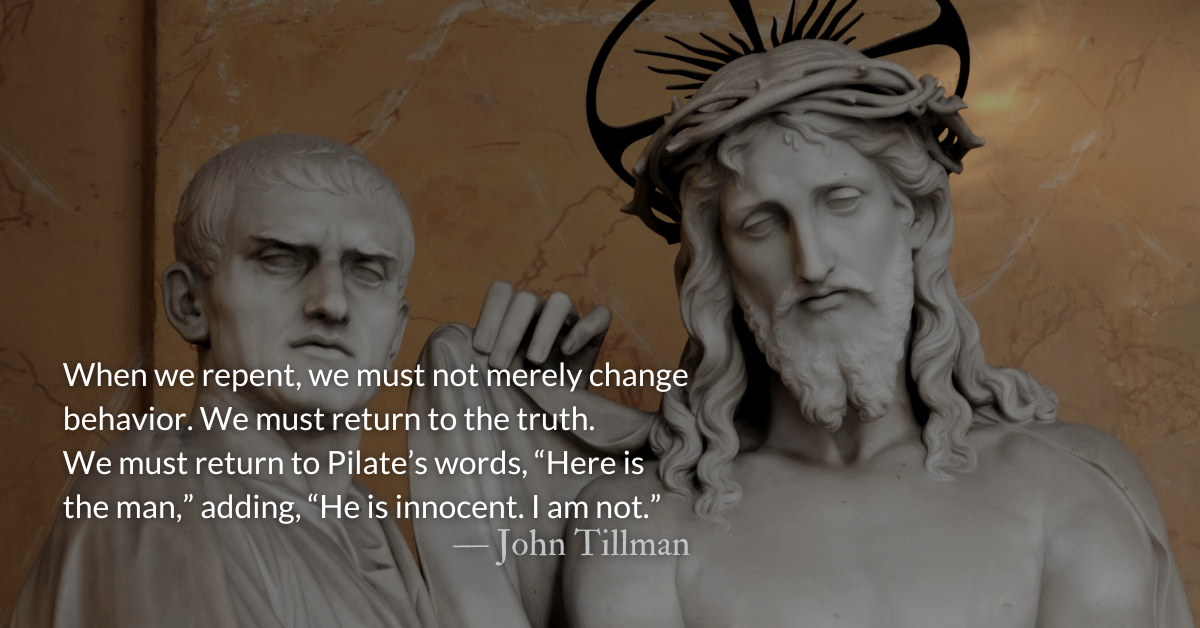
Pilate presented Jesus as innocent, saying, “Here is the man.” Ecce homo is the Latin Vulgate translation of this statement. The moment is recorded in many works of art.

In 2012, the 19th-century fresco, Ecce Homo, was in poor shape. Much of the paint had flaked away over time. An aged parishioner, who had seen it slowly deteriorating, decided to attempt to restore her favorite depiction of Jesus. Unfortunately, she had no formal art training and the result was…not good. The Internet swarmed with scorn for her work and memes of other famous artwork ruined in the same style.

Despite affection for Jesus and good intentions, her depiction of Jesus was a blurry blob, with none of the details that gave the artwork meaning.

Many of us may have a blurry, blob of affection for Jesus. It is vital for us to return to the master artists of scripture regularly to see the details they skillfully composed for us.

The details John focuses on are legal, political, and damning. Until the ecce homo moment, Pilate had been speaking informally—like banter at a press conference. But when the politicking and bargaining were over Pilate sat in “the seat of judgment” called “the Stone Pavement.” 

The precise location is unknown but this was the official seat representing justice under the law. It would be like a U.S. president sitting down behind his desk in the Oval Office, or the justices of the Supreme Court taking their seats. It just got official. 

John has carefully presented Jesus’ signs and claims to be the one true king. Yet Pilate presented Jesus as king and he was rejected. Not just by the Jews. Not just by Pilate.  By the world. This moment is the essence of all sin.

Sin is not merely behavior. It is rebellion. Every sin you’ve ever heard of or committed is a result of rebellion—a follow-on effect of our conspiratorial coup against God’s kingdom.

Therefore, when we repent, we must not merely change behavior. We must return to the truth. 

We must return to Pilate’s words, “Here is the man,” adding, “He is innocent. I am not.”

With the soldier at the foot of the cross, we say, “Surely this was the son of God.” With the rebel on the cross, we say, “Remember me when you come into your kingdom.”

Divine Hours Prayer: The Greeting
You are the Lord, “You are my God; listen, O Lord, to my supplication.” — Psalm 140.6

– From The Divine Hours: Prayers for Summertime by Phyllis Tickle.

Today’s Readings
2 Samuel 2 (Listen 5:07)
Revelation 12 (Listen 2:58)

This Weekend’s Readings
2 Samuel 3 (Listen 6:35Revelation 13 (Listen 3:20)
2 Samuel 4-5 (Listen 6:10Revelation 14 (Listen 3:51)

Read more about Were You There?
“Were you there?” is a question that asks us to reconcile our present with the past.

Read The Bible With Us
Now is a great time to invite someone on a joyful journey through scripture. Invite a friend to start reading with us today.
https://mailchi.mp/theparkforum/m-f-daily-email-devotional

Eulogize your Enemy?

Scripture Focus: 2 Samuel 1.17-18
17 David took up this lament concerning Saul and his son Jonathan, 18 and he ordered that the people of Judah be taught this lament of the bow…

Reflection: Eulogize your Enemy?
By Erin Newton

Would you write a eulogy for your enemy? If someone targeted your life, would you speak kind words in memory of their death? The questions sound absurd.

When God’s anointing passed from Saul to David, the king sought to kill him. With every turn, David’s life was in mortal danger. There was no peace between them. In the end, however, the news of Saul’s death stirred David to write a dirge, a funeral song.

The book of Psalms is filled with songs of lament that seek the favor of God and reflect upon God’s faithfulness and trustworthiness. This song is different. There are no calls to God or reflections of past hope. It is very much a eulogy for Saul and Jonathan. A funeral song for a man who hated David and a man who loved David—a friend and a foe.

It is little wonder that David felt compelled to sing praises of his closest friend. It is unthinkable that he would do the same for Saul. What compels David to give such honor to someone who, by all accounts, did not deserve it?

The answer is David’s relationship with God. The words were honoring Saul and Jonathan, but the motivation was to honor God. For all the years of hiding in the wilderness or dodging assassination attempts, David waited patiently to see the outworking of his anointing. He never raised a hand against Saul, though he was tempted on occasion!

How we speak of the dead reveals one aspect of our relationship with God. David likely struggled with hoping for Saul’s demise so that his future would be secured. He had enough reasons to be opposed to the king. His faith, however, would not allow him to act upon such thoughts.

Each person is born as the image of God. Each person dies as the same image of God. How do we easily honor new life at birth, pure and innocent, and dishonor the same life in death, ravaged by sin and broken? We cannot celebrate evil, but we must find space to honor God at death. It is a difficult task; one we may spend our lives trying to understand.

Like David, Jesus speaks words of grace about his enemies, “Forgive them, for they do not know what they are doing.” Perhaps, we can learn that relationships with our enemies are a reflection of our relationship with God.


Divine Hours Prayer: The Request for Presence
Bow down you ear, O Lord, and answer me…
Keep watch over my life, for I am faithful. — Psalm 86.1-2


– From The Divine Hours: Prayers for Summertime by Phyllis Tickle.

Today’s Readings
2 Samuel 1 (Listen 3:54)
Revelation 11 (Listen 3:24)

Read more about Eating With Enemies
When Christ leads us into the heavenly city, we will find ourselves dining and worshiping with people we harmed or who harmed us.

Read more about Do You Know The Enemy?
Do we remember who the real enemy is or are we too focused on the powers of this earth?

False Dilemmas — Readers’ Choice

Scripture Focus: Mark 12.15-17
15 Should we pay or shouldn’t we?” 

But Jesus knew their hypocrisy. “Why are you trying to trap me?” he asked. “Bring me a denarius and let me look at it.” 16 They brought the coin, and he asked them, “Whose image is this? And whose inscription?” 

“Caesar’s,” they replied. 

17 Then Jesus said to them, “Give back to Caesar what is Caesar’s and to God what is God’s.” 

And they were amazed at him.

From John: As we have in prior years, we’ll continue to share a few “bonus” Readers’ Choice posts from time to time this fall. We thank all of you for your responses, your reading, and your support.

Originally published on February 2, 2023, based on readings from Mark 12.

Readers’ Choice posts are selected by our readers:
Jason, Austin, TX — This piece encourages me to think, “How might Jesus respond to some of our polarizing issues today?”

Reflection: False Dilemmas — Readers’ Choice
By John Tillman

A “false dilemma” or “false dichotomy” is an argument that attempts to pressure someone to agree to one of two bad answers. Despite being considered a logical fallacy, it is a commonly used rhetorical device.

The Pharisees and the Herodians were political and theological enemies who came together to pose just such an argument to Jesus.

The Pharisees stressed strict interpretation of the Law. They weren’t revolutionaries but many aspects of Roman rule were despicable to them, including using Roman currency. The denarius bore an image of Caesar, which was forbidden. (Exodus 20.4) It also was stamped, “Caesar is Lord.” To many Jews, even touching a denarius meant participating in blasphemy.

The Herodians were politically minded. Power through Rome was more important than principle. They saw Herod’s dynasty as politically expedient, despite their scandals and being descended from Esau rather than Israel. Herod the Great wanted to be seen as Israel’s messianic king. This is partly why he responded with genocidal violence in his attempt to kill Jesus after his birth.

These warring groups came together with a question intended to condemn Jesus as a political revolutionary or irreligious apostate. “Choose a side,” Jesus, they say.

Jesus refuses. 

Questions asked with an impure motive reveal much about the questioner. These questioners were concerned with power and influence, not truth. They were angry about their corruption being exposed, not concerned with moral purity. (Mark 12.12)

I used to read Jesus’ answers as “burns” and “mic drop” moments where he owned his opponents, humiliating them. In our culture, that’s how a “plain reading” sounds. But instead of intending harm, Jesus intended healing. His firm, gracious answers challenged their errors, yet offered a way forward. We may celebrate sick burns but Jesus celebrates merciful healing. 

Both the political and religious systems Jesus lived in were corrupt. Jesus chose to follow God within corrupt systems. That did not mean just going along to get along. He challenged religious and political assumptions of everyone, whether Pharisee, Roman, or Samaritan.

Many forces within and without the church pressure us to “choose a side” on many issues. We don’t have to choose from the options offered. False dilemmas are truth-avoidant.

This doesn’t mean that some mushy, non-committal-middle is the right answer. But it does mean that we don’t argue by humiliating our opponents. Like, Jesus, we can offer gracious answers that push for change without pushing people away.

From John: This devotional owes a lot to the And Campaign and their book, Compassion and Conviction. We recommend putting it at the top of your reading list.

Divine Hours Prayer: The Request for Presence
Send our your light and your truth, that they may lead me, and bring me to your holy hill and to your dwelling;
That I may go to the altar of God,  to the God of my joy and gladness; and on the harp I will give thanks to you, O God my God. — Psalm 43.3-4

– From The Divine Hours: Prayers for Summertime by Phyllis Tickle.

Today’s Readings
1 Samuel 31 (Listen 2:03)
Revelation 10 (Listen 1:59)

Read more about Gift of Noticing

The other religious leaders lost their objectivity in their attempts to discredit Jesus, the wise teacher found a better path.

Read more about The King We Want
This humble king wasn’t what many wanted. Many rejected Jesus then. And many still reject him now.

Diamonds In the Rough

Scripture Focus: 1 Samuel 30.22-25
22 But all the evil men and troublemakers among David’s followers said, “Because they did not go out with us, we will not share with them the plunder we recovered. However, each man may take his wife and children and go.” 

23 David replied, “No, my brothers, you must not do that with what the LORD has given us. He has protected us and delivered into our hands the raiding party that came against us. 24 Who will listen to what you say? The share of the man who stayed with the supplies is to be the same as that of him who went down to the battle. All will share alike.” 25 David made this a statute and ordinance for Israel from that day to this. 

Reflection: Diamonds In the Rough
By John Tillman

During this period of David’s life, he was God’s anointed, the rightful king of Israel, yet Saul was determined to maintain power. David not only had no throne, he was forced into exile.

An outcast, David attracted outcasts. (1 Samuel 22.2) He took in the distressed and the discontented, the poor and the rebellious. It’s easy to lead those of exemplary character and high moral standards. David was leading those so violent they were a danger to even him.

Many events in this section of scripture depict tests of David’s character. Will he murder Nabal? (1 Samuel 25.34) Or Saul? (1 Samuel 24.3-10) Will he take the throne by force? Will he be just? Will he be a ruffian in the wilderness or a diamond in the rough?

David doesn’t pass every test. To survive Saul, he serves the enemy of his enemy, marching under the banner of King Achish and his false god. David is no king yet. At best, during this time we might call David a warlord—a mercenary. At worst, a war criminal. Scripture doesn’t hide these failings but it does highlight moments when David’s roughness is cut away and facets of kingly destiny shine.

In a moment of victory, David’s rough gang of fighters wants to shame the weak, claiming dominance and a greedy share of wealth. The narrator calls them “evil men and troublemakers.” David calls them, “my brothers.”

David does not shy away from pointing out that their arguments are foolish. His rhetorical question, “Who will listen to what you say?” shames them but calling them “brothers” lifts them up. David not only stops the madness of the moment, he establishes a just rule from that moment on. David grows into his calling and at least some of his men follow along.

Like David, we may find ourselves in exile stuck between wicked kings. We feel the tension of being in this world but not of it and being surrounded by the desperate who default to violence and selfishness.

Like David, we’ll stumble, fail, and perhaps compromise when we should stand boldly. But amidst our rough and tumble world, we must remember that in God’s reality, we are children of God and regents of his Kingdom.

We, and those around us, need to be cut, shaped, ground, and polished by the Holy Spirit from diamonds in the rough to shining facets reflecting Christ’s light.

Divine Hours Prayer: The Call to Prayer
Open my lips, O Lord, and my mouth shall proclaim your praise. — Psalm 51.16

– From The Divine Hours: Prayers for Summertime by Phyllis Tickle.

Today’s Readings
1 Samuel 29-30 (Listen 6:33)
Revelation 9 (Listen 3:30)

Read more about Blocking the Way of Wickedness
We don’t always have a choice about working with or living among wicked people, but we can choose how we respond.

Read more about Supporting Our Work
Our donors support ad-free content that brings biblical devotionals to inboxes across the world. Consider becoming one today.