From Privilege to Prisoner to Priest

Scripture Focus: Ephesians 4:1-2

As a prisoner for the Lord, then, I urge you to live a life worthy of the calling you have received. Be completely humble and gentle; be patient, bearing with one another in love.

Many churches in the United States celebrate the Feast of St Francis of Assisi on October 4 each year. The feast commemorates the life of St Francis, who was born in the 12th century. Jon provides us an excellent reflection on today’s reading in Ephesians drawn from events of Francis’s life.

Reflection: From Privilege to Prisoner to Priest
By Jon Polk

St. Francis of Assisi is generally known for his peaceful disposition and love for animals and nature. The Prayer of St. Francis (authorship uncertain, but often attributed to Francis) begins…

Lord, make me an instrument of Thy peace;
Where there is hatred, let me sow love;
Where there is injury, pardon;
Where there is doubt, faith;
Where there is despair, hope;
Where there is darkness, light;
Where there is sadness, joy.

However, this devoted follower of Christ, widely regarded for his vow of poverty, did not begin life in a humble way. Francis was born in Italy around 1181 to a wealthy cloth merchant and his beautiful French wife. By age 14, Francis, spoiled by luxury, dropped out of school and gained a reputation as a rebellious teen, known for drinking, partying, and vanity.

His privileged upbringing afforded him training in archery and horsemanship and when war broke out in 1202, he joined the cavalry. Having no combat experience, Francis was easily captured by opposing forces and imprisoned for a year before ransom was negotiated.

But during his time as a prisoner of war, Francis began to receive visions from God and arrived home a changed man. He turned his heart towards God and spent time in prayer, seeking direction.

Eventually, he felt the call of Christ to serve the Church and to live a life of extreme poverty—fully devoted to Christianity. He is considered by many to be one of the purest examples of living the Christian life, other than Jesus himself.

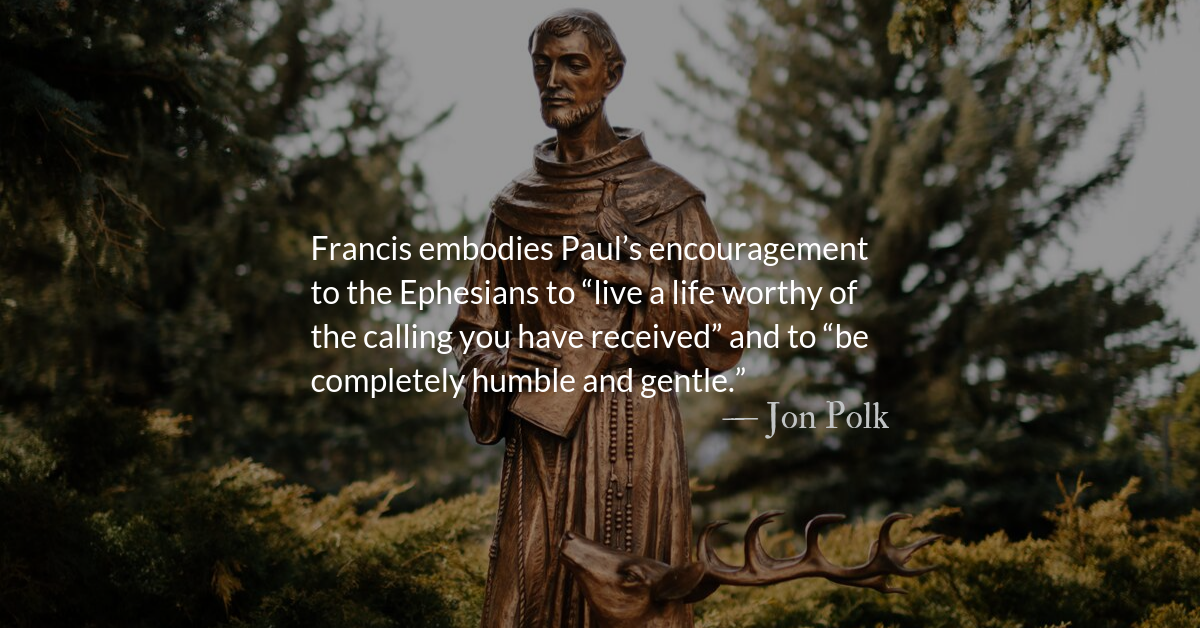
Certainly, Francis embodies Paul’s encouragement to the Ephesians to “live a life worthy of the calling you have received” and to “be completely humble and gentle.”

Francis’ deep dedication and gratitude to God is seen expressed in these excerpts from a song he composed, Canticle of the Sun. May these words guide our worship and service to Christ.

Most High, all powerful, good Lord,
Yours are the praises, the glory, the honor,
and all blessing.
To You alone, Most High, do they belong,
and no man is worthy to mention Your name.
Blessed are those who endure in peace
for by You, Most High, they shall be crowned.
Woe to those who die in mortal sin.
Blessed are those whom death will
find in Your most holy will,
for the second death shall do them no harm.
Praise and bless my Lord,
and give Him thanks
and serve Him with great humility.

Divine Hours Prayer: The Call to Prayer
Come now and see the works of God, how wonderful he is in his doing toward all people. — Psalm 66.5

– From The Divine Hours: Prayers for Summertime by Phyllis Tickle.

Today’s Readings
1 Kings 7 (Listen – 7:47)
Ephesians 4 (Listen – 3:58)

This Weekend’s Readings
1 Kings 8 (Listen – 10:23) Ephesians 5 (Listen – 3:42)
1 Kings 9 (Listen – 4:16) Ephesians 6 (Listen – 3:17)

Thank You!
Thank you to our donors who support our readers by making it possible to continue The Park Forum devotionals. This year, The Park Forum audiences opened 200,000 free, and ad-free, devotional content. Follow this link to join our donors with a one-time or a monthly gift.

Read more about Paul’s Prayer for the Power of Faith
Give us service to perform.
Give us needs to meet.
Give us debts to cancel.
Give us trouble for which you are the only answer.

https://theparkforum.org/843-acres/pauls-prayer-for-the-power-of-faith/

20191003

Read more about How to Know When to Give
As the Corinthians’ generosity caused Paul to celebrate, may our generosity bring joy and refreshment to those doing good in the world.
Let’s Take a Walk

Scripture Focus: 2 Corinthians 5.6-7
Therefore we are always confident and know that as long as we are at home in the body we are away from the Lord. For we live by faith, not by sight. We are confident, I say, and would prefer to be away from the body and at home with the Lord.

Reflection: Let’s Take a Walk
By Jon Polk

The classic KJV translation of 2 Corinthians 5:7 is frequently quoted, cross-stitched and memorized: “For we walk by faith, not by sight.”

Jews used this word walk as an idiom relating to how you live your life. We utilize a similar idea when we talk about our “Christian walk” or our “walk with God.” Our lives ought to be dependent on our faith, not on what we can see or comprehend.

Contrary to the popular phrase, faith is not about taking a “blind leap” but rather making steps towards God, following the path he lays out before us. Paul refers to confidence twice in this passage, implying that faith is not blind hope but is grounded in our trust in God.

Faith is confident movement towards the path that God has ahead for us. We may not see the path, but we have faith that the path exists. We may not see beyond the first step, but we take the first step in faith. We may not see all the reasons behind what God is calling us to do, but we have faith that he leads us as he does for a purpose.

On his first journey to China, the great British missionary Hudson Taylor traveled aboard a sailing vessel. As the ship neared the coast of New Guinea, the winds died out for a number of weeks. The ship began to drift dangerously towards the shore, at risk of running aground on the coral reefs leaving the crew to the mercy of the natives rumored to be cannibals.

The captain came to Taylor in desperation, asking him to pray for God to send wind. So Taylor and a few other men began to pray for a breeze. As they prayed, he went up on deck and asked the second mate to ready the mainsail. Initially, the mate resisted, not wanting to appear foolish in front of the crew, but Taylor insisted and he finally agreed. In the ensuing moments, a strong wind indeed came upon the ship and sailors scrambled all over the deck as the wind kicked in.

When you raise the sails in your life before you can even see the wind, you’re walking by faith.

So go take a walk. Not a walk based on what we can see in this earthly life but a walk by faith into the adventurous life God has for us.

Divine Hours Prayer: A Reading
Jesus taught the crowds, saying: “The light will be with you only a little longer now. Go on your way while you have the light, or darkness will overtake you, and nobody who walks in the dark knows where he is going. While you still have the light, believe in the light so that you may become the children of light.” Having said this, Jesus left them and was hidden from their sight. — John 12.35-36

– From The Divine Hours: Prayers for Summertime by Phyllis Tickle.

Today’s Readings
2 Samuel 16 (Listen – 4:03)
2 Corinthians 5 (Listen – 3:14)

Thank You!
Thank you to our donors who support our readers by making it possible to continue The Park Forum devotionals. This year, The Park Forum audiences opened 200,000 free, and ad-free, devotional content. Follow this link to join our donors with a one-time or a monthly gift.

Read more from Jon Polk: Faith of the Flawed
The purpose of this passage is to demonstrate how ordinary people overcame difficult situations through their faith in God.

Read more about Light for the Next Step :: Readers’ Choice
God’s word, most of the time, provides one-step-at-a-time light. A lamp for our feet forces us to engage with where we are, not look only at distant destinations.

A Congregation of Hope

Acts 9:40
Peter sent them all out of the room; then he got down on his knees and prayed. Turning toward the dead woman, he said, “Tabitha, get up.” She opened her eyes, and seeing Peter she sat up.

Reflection: A Congregation of Hope
By Jon Polk

Tabitha was a big deal in Joppa. A disciple and prominent member of the Joppa congregation, she was known for her generosity and considerable service to others, especially the widows in their midst. Apparently, her reputation carried outside the church to the larger Greek community as well, where she was known by her Greek name, Dorcas.

Tabitha’s great significance to the church is revealed after her untimely illness and death. Upon hearing that the miracle-working Peter was in nearby Lydda, not one but two witnesses were dispatched to urgently summon him. When Peter arrived on the scene, the group of weeping widows—who were not the usual professional mourners common of the day, but rather dear friends of Tabitha—showed him that the very clothes they were wearing were made by Tabitha, who distributed them to the poor and needy.

For the congregation in Joppa, Tabitha’s death was more than the loss of a close friend, it presented a serious impact on their ministry outreach to the poor. Without attempting to deal with the situation on their own, they reached out in tremendous faith for the power of God, represented by the healer, Peter.

In The Sacred Journey, author Frederick Buechner writes:

“When it comes to putting broken lives back together—when it comes, in religious terms, to the saving of souls—the human best tends to be at odds with the holy best. To do for yourself the best that you have it in you to do—to grit your teeth and clench your fists in order to survive the world at its harshest and worst—is, by that very act, to be unable to let something be done for you and in you that is more wonderful still.”

The congregation at Joppa recognized they had a God-sized need that required a God-sized solution. This congregation believed in a resurrection hope, in a God that could exceed all expectations. They came together to mourn and weep, but also to hope and pray, and eventually, to celebrate. They were vulnerable enough to accept that the situation was desperate beyond their control.

Life presents us with our share of challenges from daily nuisances to more significant needs for physical healing or spiritual resurrection. May we have the faith of the Joppa congregation and be willing to place our hope daily in our great God, the giver of life.

Prayer: The Greeting
Not to us, O Lord, not to us, but to your Name give glory; because of your love and because of your faithfulness. — Psalm 109.26

– From The Divine Hours: Prayers for Summertime by Phyllis Tickle.

Today’s Readings
Judges 5 (Listen – 4:36)
Acts 9 (Listen – 6:05)

Thank You!
Thank you to our donors who support our readers by making it possible to continue The Park Forum devotionals. This year, The Park Forum audiences opened 200,000 free, and ad-free, devotional content. Follow this link to join our donors with a one-time or a monthly gift. 

Readers’ Choice Submissions

It is once again time for us to seek out the voices of our readers and hear from you about posts from the past eleven months that have challenged and comforted you and helped you find new meaning in the scriptures.

Readers’ Choice posts will be republished during the month of August and periodically throughout the Fall.

Follow the link to fill out the form. Feel free to fill out the form multiple times for multiple submissions. Please limit your submissions to posts published this calendar year, between September of 2018 and today.

For any questions about The Park Forum, or to make suggestions of posts via email, contact John Tillman at john@theparkforum.org

Read more from Jon Polk: Generosity that Outlives Tragedy
Many people are eager to donate towards an immediate one-time need, but are resistant to living an on-going lifestyle of generosity.

Read more about Good News to the Poor
When Mary sang about filling the hungry with good things, poverty and many other personal tragedies were considered markers of spiritual failure.

A Cautionary Tale of Unbelief :: Readers’ Choice

Selected by reader, Brad Elledge
“To believe is to have faith. To have faith is to trust. To trust results in action.” As Jon points out, action is hindered by fear, by a hardening of the heart toward the thing the Holy Spirit has given us a conviction about. “An unbelieving heart does not trust in God’s ability to provide and lead.” In the current cultural climate, doing the right thing aligned with our Lord and Savior can be risky and costly. Our trust in God’s ability to provide and lead is critical to our ability to take Holy Spirit inspired action.

Originally posted on November 8, 2017 with readings from 2 Kings 21 and Hebrews 3.

See to it, brothers and sisters, that none of you has a sinful, unbelieving heart that turns away from the living God. — Hebrews 3.12

Reflection: A Cautionary Tale of Unbelief :: Readers’ Choice
By Jon Polk

From the ancient history of the Israelite people comes a familiar story, a warning from the Holy Spirit. We recall those whose rebellion against God resulted in forty years of punishment in the wilderness, those whose hearts wandered away from faith, despite what God had done for them.

And it is here we discover that the heart is, in fact, the heart of the matter. In Hebrew thought, the heart was the core of a person’s being. The heart was the locus of emotional, intellectual, and moral activity and the center of physical activity. Thus, the heart controls motivations and produces actions. A clean heart produces faithful living. A corrupt heart leads to the opposite.

The Israelites who had followed Moses out of Egyptian captivity were given the opportunity to return home, back to the Promised Land that God had provided for their ancestors. But the Israelites’ unbelief, their lack of faith, determined their action. They walked away from God’s plan and his desires for them.

The English words belief and faith are both translated from the same Greek root word. We tend to think of belief as a set of propositions to which we give intellectual assent, but it is much more than that. To believe is to have faith. To have faith is to trust. To trust results in action.

An unbelieving heart does not trust in God’s ability to provide and lead and consequently results in decision-making and action that turn away from the good nature and grace of God. And such was the demise of an entire generation of Israelites, who walked away from the Promised Land because of their unbelief and perished after forty years of wandering in the desert. Moses brought God’s salvation to the ancient Israelites, but their hearts of unbelief charted a course of disobedient action.

Let the warning of the Holy Spirit be heard by those who are followers of Christ, do not harden your hearts towards God. May our souls sing with conviction these words from the great hymn, Come Thou Fount of Every Blessing:

O to grace how great a debtor
Daily I’m constrained to be!
Let that grace now like a fetter,
Bind my wandering heart to Thee.
Prone to wander, Lord, I feel it,
Prone to leave the God I love;
Here’s my heart, O take and seal it,
Seal it for Thy courts above.

Prayer: The Call to Prayer
Love the Lord, all you who worship him; the Lord protects the faithful, but repays to the full those who act haughtily.— Psalm 31.23

– Prayer from The Divine Hours: Prayers for Summertime by Phyllis Tickle.

Prayers from The Divine Hours available online and in print.

Today’s Readings
Lamentations 4 (Listen – 3:42)
Psalm 35 (Listen – 3:21)

Additional Reading
Read More about Thoughts and Prayers
According to Paul deeds are prompted by faith, and faith is fueled by prayer life.

Read More about Justified by Works
James and Paul aren’t bickering about faith and works—they are trying to draw our attention to eternity.

Support our Work
Over 4,500 people every week read an email devotional from The Park Forum. Support our work with a monthly or a one time donation.

Finishing Well :: Readers’ Choice

Selected by reader, Susan, adjacent to the Marble Mtn. Wilderness of Northern California
As a former Special Ed teacher, I am drawn to stories of “finishers.” The competitive suggestion of “winners” has ever been unproductive in my life with Jesus, stimulating as it does the worst parts of my character.

Originally posted on November 17, 2017 with readings from 1 Chronicles 9-10 and Hebrews 12.

And let us run with perseverance the race marked out for us, fixing our eyes on Jesus, the pioneer and perfecter of faith. For the joy set before him he endured the cross, scorning its shame, and sat down at the right hand of the throne of God. — Hebrews 12.1b-2

Reflection: Finishing Well :: Readers’ Choice
By Jon Polk

In 1968, John Stephen Akhwari, a long-distance runner, was one of four athletes sent from the East African nation of Tanzania to the Olympic Games in Mexico City.

Unaccustomed to the high altitude, Akhwari began to cramp up during the marathon event. He was also involved in a collision with other runners and dislocated his right knee. Encouraged to drop out, he instead received medical treatment and continued on with the race.

Over an hour after the winning time, Akhwari finally entered the stadium, where only a handful of spectators remained. Struggling to put one foot in front of the other, he limped across the finish line, coming in dead last among the 57 who completed the race (18 others had quit along the way).

When interviewed afterwards, Akhwari was asked why he persevered through such a painful experience. He replied, “My country did not send me 5,000 miles to start the race. They sent me 5,000 miles to finish the race.”

Athletic imagery is a common New Testament analogy for the Christian life. For a faith focused on the ideals of selflessness and sacrifice, it seems odd that biblical writers draw parallels with sports events focused on individual winners. A closer look at a few of these passages, however, reveals that there is more at stake in our spiritual life than winning.

In 1 Corinthians 9, Paul emphasizes an athlete’s need for training and rigorous discipline. In Philippians 3, Paul talks about pressing on, or persevering, toward the goal. Reflecting back on his own life in 2 Timothy 4, Paul does not mention winning, but states that he is one of many who has finished the race.

The author of Hebrews also discusses training through strengthening of arms and knees, stresses running the race with perseverance, and encourages us to follow the example of Jesus who finished the task God set before him and now sits at God’s right hand, the ultimate finish line.

Our spiritual goal is not to win (as if we could somehow “win” the Christian life), but to finish the race set before us and to finish well because we’ve trained properly and persevered through difficulties and trials.

To do this, we must keep our eyes on the example of Jesus, who ran the race before us and endured great suffering on our behalf so that we might follow him on a lifelong journey of putting one foot in front of the other along the path of faith.

Prayer: The Call to Prayer
Let Israel rejoice in its Maker; let the children of Zion be joyful in their king. For the Lord takes pleasure in his people and adorns the poor with victory. — Psalm 149.2, 4

– Prayer from The Divine Hours: Prayers for Springtime by Phyllis Tickle.

Prayers from The Divine Hours available online and in print.

Today’s Readings
Jeremiah 36 (Listen – 5:54)
Psalm 9 (Listen – 2:21)

Additional Reading
Read More about The Beautiful Feet of Lepers
We may be diseased and unclean but we share the undeserved victory we have discovered.

Read More about The Uniqueness of Prayer
By no power or worthiness of our own, we are welcomed on a personal level—ushered in hastily to a God who has been waiting for us to join him.

Readers’ Choice
We have just a few spots left for your suggestions of your favorite posts of the year. Submit a Readers Choice post. Tell us about a post and what it meant to you.

Support our Work
Over 4,000 people every week read an email devotional from The Park Forum. Support our work with a monthly or a one time donation.