

Links for today’s readings:
Jun 23 Read: Isaiah 22 Listen: (3:53) Read: Acts 9 Listen: (6:05)
Scripture Focus: Isaiah 22.15-25
15 This is what the Lord, the Lord Almighty, says:
“Go, say to this steward,
to Shebna the palace administrator:
16 What are you doing here and who gave you permission
to cut out a grave for yourself here,
hewing your grave on the height
and chiseling your resting place in the rock?
17 “Beware, the Lord is about to take firm hold of you
and hurl you away, you mighty man.
18 He will roll you up tightly like a ball
and throw you into a large country.
There you will die
and there the chariots you were so proud of
will become a disgrace to your master’s house.
19 I will depose you from your office,
and you will be ousted from your position.
20 “In that day I will summon my servant, Eliakim son of Hilkiah. 21 I will clothe him with your robe and fasten your sash around him and hand your authority over to him. He will be a father to those who live in Jerusalem and to the people of Judah. 22 I will place on his shoulder the key to the house of David; what he opens no one can shut, and what he shuts no one can open. 23 I will drive him like a peg into a firm place; he will become a seat of honor for the house of his father. 24 All the glory of his family will hang on him: its offspring and offshoots—all its lesser vessels, from the bowls to all the jars.
25 “In that day,” declares the Lord Almighty, “the peg driven into the firm place will give way; it will be sheared off and will fall, and the load hanging on it will be cut down.” The Lord has spoken.
From John: We are sensitive (and wary) about politics at The Park Forum. We’ve witnessed the dangers. We’ve seen religious leaders become slaves of a politician instead of slaves of Christ. We’ve seen pastors become promoters of political agendas rather than the gospel. We’ve seen apologists go from defending theology to defending “Western Culture.” This post discusses the spiritual implications of politics without endorsing or condemning specific politicians or parties. See the resources linked at the end of this post for more encouragement about how Christians can faithfully engage in politics.
Reflection: Spiritual Practices for Politics
By John Tillman
Isaiah prophesied that a corrupt official, Shebna, would be thrown out and Eliakim would be brought in.
Shebna was proud of Judah’s Egyptian chariots, and foolishly ignored Isaiah’s warnings not to ally with Egypt. Corrupt and vain, he misused government resources to carve himself an ornate tomb like ones typically reserved for kings. His downfall was good news.
The people hung hopes, glory, and honor on Eliakim, like a peg in the wall. But the peg sheared off and everything crashed down. Eliakim couldn’t hold their hopes.
Scripture warns us not to trust in princes, (Psalm 146) but we keep doing it.
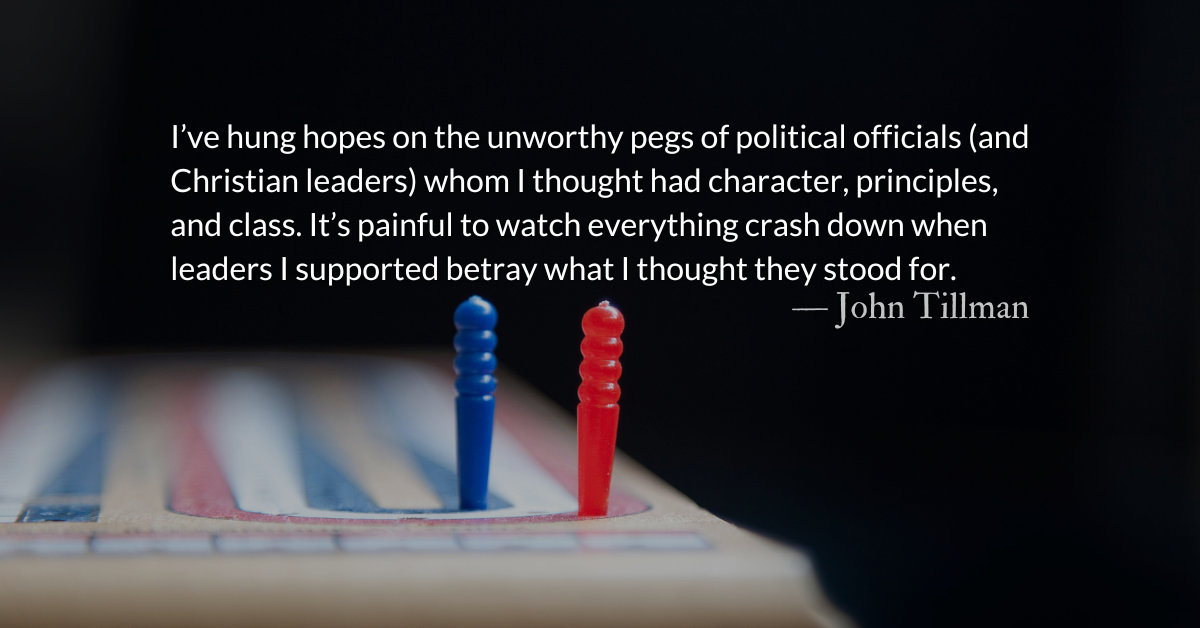
Many times, I’ve hung hopes on the unworthy pegs of political officials (and Christian leaders) whom I thought had character, principles, and class. It’s painful to watch everything crash down when leaders I supported betray what I thought they stood for. Whatever your political tribe, you probably know how this feels. It can make us cynical, jaded, or apathetic. I’ve felt that way.
However tainted we feel politics is, we can’t surrender to cynicism and apathy. We can’t hang all our hopes on the Eliakims of the world, but we can’t let the Shebnas of the world keep abusing their positions. If justice and righteousness are to be established, government and politics are one means God has given us to do so. Politics and politicians are important because policies either help or hurt people whom God loves. Isaiah, other prophets, and the faithful remnant had fewer options than we do. Yet they never stopped working, even in lost causes. Even in exile, Daniel and others were politically involved, seeking the public good. (Daniel 1.18-21)
Spiritual practices for politics should include 1) prayer, 2) principles, and 3) separating the common from the holy.
Through prayer, seek humility. Ask God to change hearts and provide wisdom. Changing leaders without changing hearts changes nothing. (Daniel 6.6-16)
Through scripture, identify defining principles of good communities. Start with the Sermon on the Mount (Matt 5-7) and interpret the rest of scripture using Jesus’ lens.
Separate moral teachings from common goods. Don’t hang holy things on common pegs. Moral teaching must remain with the church. Good things may be enacted through governments. Secular governments can provide resources, educate, and protect from wrongdoing but they cannot and should not engage in moral instruction.
Engage in politics with the right attitude and with the proper understanding of the limits of human government.
Resources: Here are some resources we feel can be helpful in the topic and practice of politics.
- Podcasts: The Church Politics Podcast by the And (&) Campaign. Reimagining Christian Politics by Michael Rhodes and Marshall Teague (this is a new one to me but the first two episodes were very good…)
- Books: Spirit of Our Politics by Michael Wear. Compassion (&) Conviction by Justin Giboney, Michael R Wear, and Chris Butler. Don’t Let Nobody Turn You Around by Justin Giboney (Haven’t read this one yet, but looking forward to it.)
- Organization: The Center for Christianity and Public Life
- News: The Pour Over, politically neutral, Christ-centered news
Divine Hours Prayer: The Small Verse
The Lord is my shepherd and nothing is wanting to me. In green pastures he has settled me. — The Short Breviary
– From The Divine Hours: Prayers for Summertime by Phyllis Tickle.
Read more: Apotheosis of Politics
We must hold our patriotism and our political activism more lightly than our faith.
Read more: Be Yoked to Christ, Not Politics
We vote with Christ’s hands and feet as we serve and care for image-bearers of God. What does this look like?

