No DARVO

Scripture Focus: Psalm 7.3
3 Lord my God, if I have done this 
and there is guilt on my hands— 
4 if I have repaid my ally with evil 
or without cause have robbed my foe— 
5 then let my enemy pursue and overtake me; 
let him trample my life to the ground 
and make me sleep in the dust.
6 Arise, Lord, in your anger; 
rise up against the rage of my enemies. 
Awake, my God; decree justice. 
7 Let the assembled peoples gather around you, 
while you sit enthroned over them on high. 
8 Let the Lord judge the peoples. 
Vindicate me, Lord, according to my righteousness, 
according to my integrity, O Most High. 
9 Bring to an end the violence of the wicked 
and make the righteous secure— 
you, the righteous God 
who probes minds and hearts. 
10 My shield is God Most High, 
who saves the upright in heart. 
11 God is a righteous judge, 
a God who displays his wrath every day. 
12 If he does not relent, 
he will sharpen his sword; 
he will bend and string his bow. 

Reflection: No DARVO
By John Tillman

David, falsely accused, tells God to let his enemies kill him if their accusations are true.

False accusations do occur, like the ones David denied in this psalm, but accused leaders often use techniques described by the acronym DARVO: Deny, Attack, Reverse Victim and Offender.

First, despite evidence or testimony, they deny allegations and repeat claims of innocence. Alternatively, they replace “deny” with “double down, ” claiming what they did was not wrong or was within their rights.

Next, they attack the character, motives, or mental health of accusers. Lastly, they claim victimhood and persecution, promoting themselves as heroic sufferers or fighters.

DARVO is not new. It is just a new description of how the powerful twist justice and public opinion to benefit them. King Ahab had his version of it when he called Elijah the “troubler” of Israel. (1 Kings 18.27) Saul, whose persecution of David is the likely subject of this psalm, used it against David.

How can we live in a world dominated by Sauls and Ahabs, the disciples of DARVO? How can we know what the truth is and who is telling it?

First, be wary of the tactic. Those aware of DARVO tactics are less likely to be fooled by them. Simple denial isn’t DARVO. Truly false allegations should be denied. But when attacks and pleas of martyrdom occur, we should beware and call it out. It’s a red flag indicating bad intent.

Second, rely on God’s justice AND seek earthly justice. We often focus on God’s destruction of evil at the end of time, but when David rejoiced at the sharpening of God’s sword, the bending of his bow, and his shield’s protection, he was thinking of his “now,” not his “not yet.” Like David in this psalm, victims entreat God, and us, for earthly justice. And God would have us deliver it.

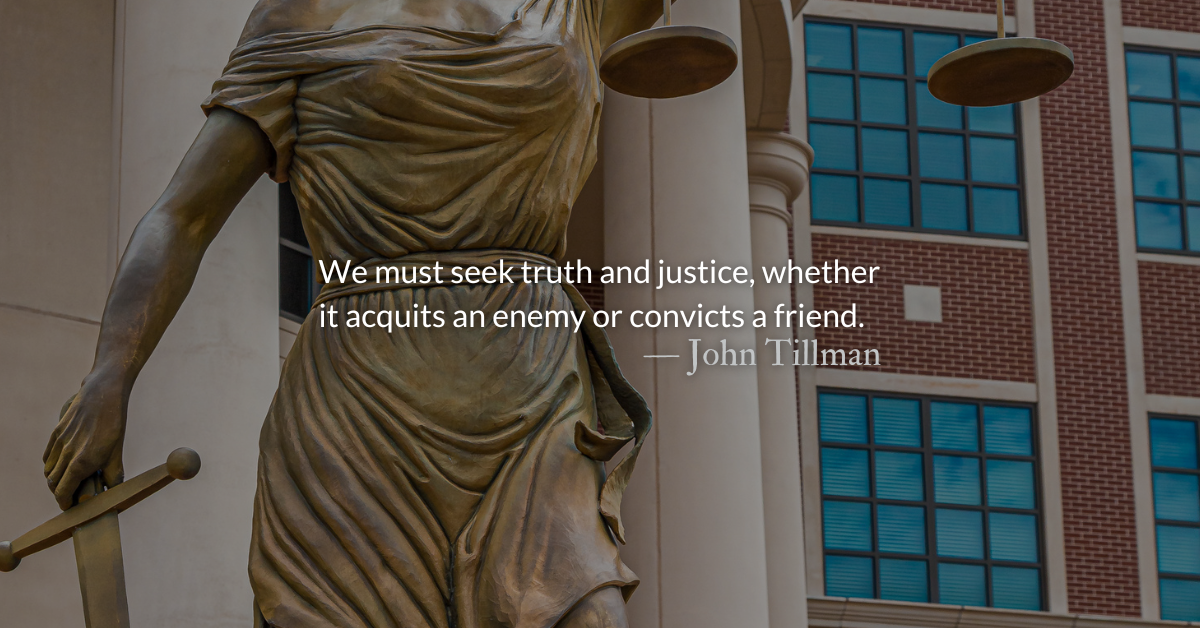
Especially if we like or support leaders, we shouldn’t let them get away with DARVO. Seeking truth does not mean seeking evidence to support specific claims of innocence or of guilt. We must seek truth and justice, whether it acquits an enemy or convicts a friend.

Whether justice cuts down a pastor, a politician, a movie mogul, or a media star, we should rejoice that victims’ voices were answered by God. We should say, paraphrasing David, “If they have done this, let their enemies overtake them.” May justice be done, and that right soon.

Music: “Better tell that long-tongued liar…
Tell ‘em that God’s gonna cut ‘em down.” 
— Johnny Cash (God’s Gonna Cut You Down — Video)


Divine Hours Prayer: The Greeting
What terror you inspire! Who can stand before you when you are angry? — Psalm 76.7


– From The Divine Hours: Prayers for Summertime by Phyllis Tickle.


Today’s Readings
2 Samuel 18 (Listen 6:16)
Psalms 7-8 (Listen 2:58)

This Weekend’s Readings
2 Samuel 19 (Listen 7:31), Psalms 9 (Listen 2:21)
2 Samuel 20 (Listen 4:51), Psalms 10 (Listen 2:13)

Read more about Hope for Mercy
Because we are tethered to this world, our sins can bring earthly consequences.

Read more about Weeping For Rebels
David was never more like Jesus than when he wished he had died on a tree rather than his beloved son.

Temple Admission

Scripture Focus: Psalm 5.7
7 But I, by your great love,
    can come into your house;
in reverence I bow down
    toward your holy temple.

Reflection: Temple Admission
By Erin Newton

Throughout Psalms, the poet focuses on the differences between the wicked and the righteous. The wicked are arrogant, bloodthirsty, and deceitful. The righteous are humble, peaceable, and honest. The wicked are barred from the presence of the Lord. The righteous enter the temple with ease.

What is the cost of admission into the temple? Sin bars the wicked from entering. The righteous—well, the righteous are not perfect either. How is one rejected and the other accepted?

Our English translation of Psalm 5.7 adequately reflects the important word order of the Hebrew text. The verse begins with the important conjunction that signals a shift in focus— “but.” The characteristics of the wicked will now stand in contrast. But not to the psalmist!

The Hebrew reads, “But I, by your great love, I come into your house…” (The NIV translates the Hebrew nearly verbatim here.)

It is not “by the great works of the righteous” or “by the pious offerings of the righteous” or “by the comparatively less horrible deeds by this guy.” It is by God’s love. The wicked are not contrasted to the righteous in this case. The wicked stand against the plumbline of God’s character, specifically, his love.

The price of admission to God’s presence is his love. The sin that bars the wicked from entering is also present within the righteous. Neither enter by their merit.

Despite our anchored belief that salvation is by faith alone, we sometimes believe that we deserve to be accepted because we are not as bad as someone else. Opening the door to God’s presence means a series of locks with keys of righteous deeds that only need to be performed. Voila! We purchased our own tickets to heaven. (Or so we delude ourselves.)

We change the word order of the verse in our hearts. “But I can come into your house…” with a haphazard inclusion, “by your great love,” just to cover our religious bases.

When we read the psalms, we identify with the righteous sufferer. We are never the wicked; we are always the accepted. In many cases, this may be true. The psalms were preserved for the benefit of a community that struggled in faith and rejoiced in God’s victories.

But in our reading, among all the “me” and “my” statements, the valiant character is always God. It is our trust in his love that grants us entrance. 


Divine Hours Prayer: The Refrain for the Morning Lessons
Blessed is he who comes in the name of the Lord; we bless you from the house of the Lord. — Psalm 118.26


– From The Divine Hours: Prayers for Summertime by Phyllis Tickle.


Today’s Readings
2 Samuel 17 (Listen 5:00)
Psalms 5-6 (Listen 2:45)

Read more about A Worn Out Welcome
When we go into the house of the Lord, is God glad we have come?

Read more about Maintaining Sacred Space
Through spiritual disciplines and practices, we maintain and carry with us sacred space.

Counting Waves

Scripture Focus: Psalm 3.5
5 I lie down and sleep;
     I wake again, because the Lord sustains me.

Psalm 4.8
8 In peace I will lie down and sleep,
     for you alone, Lord,
     make me dwell in safety.

From John: I’m pleased to tell you that for the next few weeks, you’ll be hearing twice a week from Erin while I’m working on another project. I look forward to hearing her voice more often during this time.

Reflection: Counting Waves
By Erin Newton

As a child prone to nightmares, I learned that a sleepful night was a dreamless night. As an adult, those sleepful nights were interrupted by crying babies or nagging thoughts about the day.

Restful sleep is a luxury. In our fast-paced world, our tragedy-filled world, our stress-inducing world—sleep is often minimal, fitful, or both. When was the last time I laid down in peace and slept?

Psalm 3 is a call for deliverance. Pleading for God to arise and deliver, the psalmist recounts the number of enemies and their mocking voices. Psalm 4 asks God for deliverance from distress. Calling for relief and mercy, the psalmist seeks the ear and attention of God. The world around them is not at peace.

I lie down and sleep.

In peace, I will lie down and sleep.

It is not the circumstances of life that lead the psalmist to close his eyes without fear or anxiety. God is a shield for his people. God is an open receiver for his people. God is the sustainer of his people. These two psalms can boast of a good night’s rest because God stands ready amidst their turbulent lives.

Turbulence usually keeps us awake. We toss and turn, thinking about how we will pay our next mortgage, how we will tell our kids about cancer, how lonely we are, how much we have messed up—and more. We fret well; we don’t sleep well.

One day, many centuries ago, Jesus got in a boat with his friends. The group set sail upon the winds of the Galilean Sea. The journey was underway, the day had been long, and Jesus laid down in peace to sleep. Suddenly, the winds shifted, and the waves tossed. A storm came over the sea; the boat was swamped with waves. But Jesus remained asleep within the boat.

The disciples urged Jesus to awake, their voices strained with fear. “Teacher, do you not care if we drown?” Their world was not at peace. Their hearts were not at peace.

But Jesus did care. He stood ready amidst the turbulent waves. And the waves were still. Jesus knew that God protects, God hears, and God sustains.

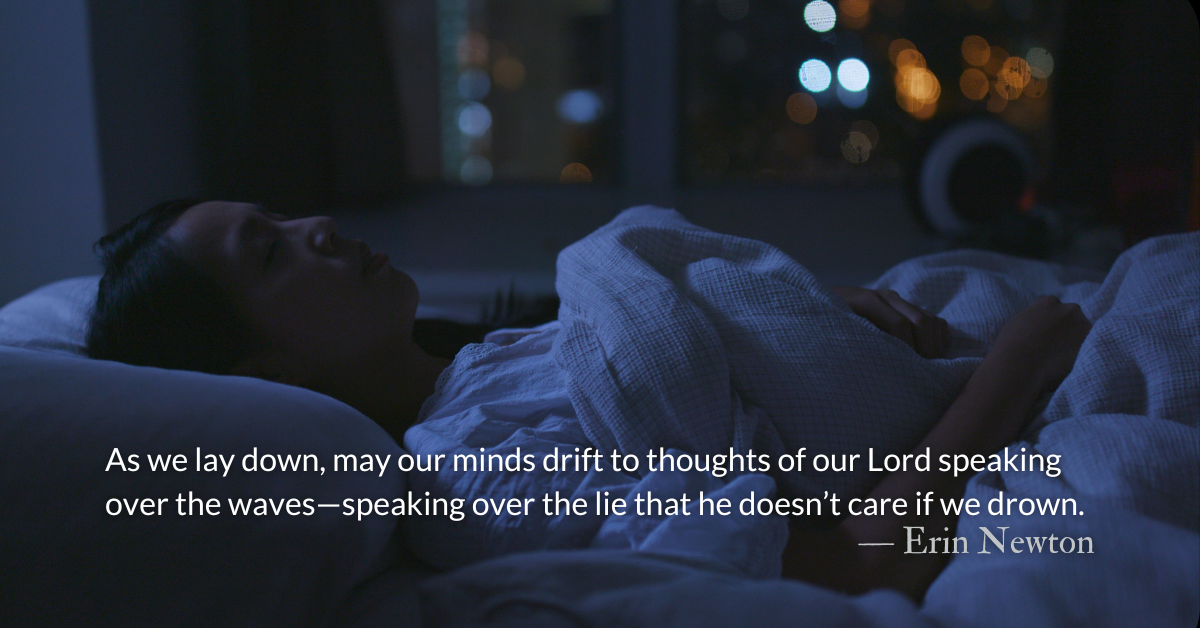
As we lay down, may our minds drift to thoughts of our Lord speaking over the waves—speaking over the lie that he doesn’t care if we drown: Hush, hush, be still.  

He cares.  


Divine Hours Prayer: Refrain for the Morning Lessons
Protect my life and deliver me; let me not be put to shame, for I have trusted in you.
Let integrity and uprightness preserve me, for my hope has been in you. — Psalm 25.19-20


– From The Divine Hours: Prayers for Summertime by Phyllis Tickle.


Today’s Readings
2 Samuel 16 (Listen 4:03)
Psalms 1-2 (Listen 1:56)

Read more about State of Our Souls
Reflecting on the work of Christ in our lives is something we must repeat…an anchor in these storm-tossed waves of life.

Read more about Bearing Cursing
Rather than lashing out, may we seek consolation in God and humbly endure insults in the name of Jesus.

Joab’s Play

Scripture Focus: 2 Samuel 14.1, 19-20
1 Joab son of Zeruiah knew that the king’s heart longed for Absalom… 

19 The king asked, “Isn’t the hand of Joab with you in all this?” 
The woman answered, “As surely as you live, my lord the king, no one can turn to the right or to the left from anything my lord the king says. Yes, it was your servant Joab who instructed me to do this and who put all these words into the mouth of your servant. 20 Your servant Joab did this to change the present situation…

Reflection: Joab’s Play
By John Tillman

Joab is one of the most fascinating and frustrating characters in the Bible. On one page, he’s a heroic general and David’s loyal friend. On the next, he’s an out-of-control assassin. He’d risk life and reputation to carry out David’s will, even when it was murder. Then he’d risk the same to subvert David’s will, even when it was peaceful.

In this chapter, Joab acts not as a military tactician but a dramatic one. He writes a script, a compelling, emotional story. He casts an actress, a wise woman in her own right. He plans the production for maximum effect on David and the public opinion of the court.

Plays often carry great truth and wisdom. Joab, as playwright, gave his actress these wise words: “But that [banishment] is not what God desires; rather, he devises ways so that a banished person does not remain banished from him.” Joab wrote a gospel play for David. Why? “To change the present situation,” the wise woman tells us.

Joab pricked David’s conscience to bring Absalom home. But Joab only cared about David, not Absalom. Also, Absalom was unrepentant. In this same chapter, Joab ignored Absalom until he burned down Joab’s field to get his attention. Later, when commanded by David to spare Absalom, Joab killed him. Joab’s play was to benefit David, not Absalom. 

Despite Joab’s callous reasoning, dishonesty, and inconsistent character, his words hold truth. God devises ways for us, the banished, to come back to him.

But God’s plot goes beyond the shortcomings of Joab’s play. God, the King of Kings, doesn’t have to be shamed into forgiving us. God initiates and accomplishes our return. God doesn’t receive us just to make himself feel better or look better. It’s us he wants, not good PR.

Unlike Absalom, we don’t need to burn anything down to get God’s attention. He doesn’t say, like David, “Come back, but you can’t see my face.” With repentance, we are fully welcomed in. And unlike Absalom, who ended his life hung in a tree, Jesus hung in a tree for us.

Let us be actors in God’s gospel play, taking up our cross and our role. Let us play our part, speaking words that the Holy Spirit puts in our mouths. Let us have faith that if we let the gospel play out in our lives, our words and actions can “change the present situation.”


Divine Hours Prayer: The Request for Presence
Protect me, O God, for I take refuge in you; I have said to the Lord, “You are my Lord, my good above all other.” — Psalm 16.1


– From The Divine Hours: Prayers for Summertime by Phyllis Tickle.


Today’s Readings

2 Samuel 14 (Listen 5:57)
Revelation 22 (Listen 3:59)

Read more about Bringing Back the Banished
Our king didn’t grant us partial forgiveness, keeping us from his presence. He died in our place, hung on the tree we were doomed for…

Read The Bible With Us
There’s never a bad time to start a Bible reading plan. Find joy in the Bible with us at a sustainable, two-year pace.

https://mailchi.mp/theparkforum/m-f-daily-email-devotional

Jesus, Our Blessed One — A Guided Prayer

Scripture Focus: Psalm 1.1-3
1 Blessed is the one
    who does not walk in step with the wicked
or stand in the way that sinners take
    or sit in the company of mockers,
2 but whose delight is in the law of the Lord,
    and who meditates on his law day and night.
3 That person is like a tree planted by streams of water,
    which yields its fruit in season
and whose leaf does not wither—
    whatever they do prospers.

Reflection: Jesus, Our Blessed One — A Guided Prayer
By John Tillman

Psalm 1 can be prayed as a framework for the working of the gospel in our lives. It is less an aspirational claim that we can strive for righteousness but a recognition that we can yield fruit only in Christ, grafted into his stream-planted trunk.

Blessed is the One
May we be among those who bless your name, Lord.
May we walk with you through the cheering crowds
Guiding a humble donkey that carries our king,
And also through the narrow streets of suffering, 
Carrying our cross, stepping in your bloody footprints of sacrifice.

Blessed is the one
    who does not walk in step with the wicked
or stand in the way that sinners take
    or sit in the company of mockers,
but whose delight is in the law of the Lord

Lord, guide our walk, day to day 
Shape our steps, words, and actions
Differentiate our gait of faith from that of the world.
May our steps follow your grace.
May our words tell of your love.
May our actions emulate your servanthood and sacrifice.

Watch over our way, Lord, but we know that we stumble…

The Lord watches over the way of the righteous,
    but the way of the wicked leads to destruction…
They are like chaff
    that the wind blows away.
Therefore the wicked will not stand

We are not blameless. We are not righteous.
When we honestly and humbly look in our hearts, we find wickedness there.
Burn up our chaff with your breath
Separate us from sin so we will not be separated from your presence.

Blessed is the one
    whose delight is in the law of the Lord,
    and who meditates on his law day and night.
That person is like a tree planted by streams of water,
    which yields its fruit in season
and whose leaf does not wither—
    whatever they do prospers.

We aspire, Lord, to fulfill this psalmist’s prayer.
We aspire to delight in your law.
We aspire to meditate day and night.

But we rely, Lord, not on our striving but on Jesus Christ.
Jesus is the Blessed One, who delights in your law.
Jesus is the Blessed One, whose leaf does not wither.
We are merely grafted in branches, partaking of his righteousness.
Our fruit, our flourishing, and our faith are drawn up from his roots.
He makes us prosper and spreads the seed of his gospel over the earth.

Divine Hours Prayer: The Request for Presence
Early in the morning I cry out to you, for in your word is my trust. — Psalm 119.147


– From The Divine Hours: Prayers for Summertime by Phyllis Tickle.


Today’s Readings
2 Samuel 15 (Listen 6:06)
Psalms 1-2 (Listen 2:05)

Read more about Family Tree
We can be grafted in to the family tree of Christ and bear the same fruit that he wants to bring about in our lives.

Read more about Supporting Our Work
Our devotionals are free to read, but they aren’t free to produce or publish. Please consider becoming a donor and supporting our ad-free content.