
Doing All Things Well :: Readers’ Choice

Selected by reader, Zachary, from Raleigh
As a Christian who has an artistic calling, I often find myself caught between cultures. Knowing that Jesus was able to live and minister in multiple cultures is so refreshing and encouraging. Jesus truly is the author and perfecter of our faith.

Originally posted on July 25, 2018 with readings from Jeremiah 21 and Mark 7.

People were overwhelmed with amazement. “He has done everything well,” they said. — Mark 7.37

Reflection: Doing All Things Well :: Readers’ Choice
By John Tillman

Mark’s seventh chapter begins with Pharisees, who never seemed to think Jesus did anything right. It ends with Gentiles in the Decapolis who proclaimed with amazement that Jesus did all things well.

The Pharisees were a culture within a culture. Paul uses his pharisaical background as a superlative, calling himself a “Hebrew of Hebrews.” The Decapolis was a region of Gentile cities that many observant Jews would avoid.

Jesus models for us a comfortable and powerful confidence that allows him to move with freedom and authority between these two different cultures. He is equally comfortable exposing the inward sinfulness of the religious elite as he is exposing the bright light of the Gentiles’ faith and both groups’ desperate need for the gospel.

That Jesus would even spend time in Gentile territory would be scandalous to the Pharisees. That he would claim that the only true God is the God of Israel would be scandalous to the Gentiles. Christ’s teaching of the gospel shocked everyone. His gospel was not watered-down, feel-good niceties. It offended easily. But it was, and is, the only source of life.

As we follow Christ, we are meant to take on this mantle of confidence and comfort. This is not a confidence in our ability or a comfort in our own power, but an indwelling, filling, and freeing expression of the Holy Spirit with us.

The crowds in the Decapolis would have known Jesus as a source of transformation and life before he arrived because Jesus had already sent a missionary there to prepare the way. Though not recorded in scripture, it is not hard to imagine that Christ, upon arriving in the cities of the Decapolis, may have been greeted with crowds led by the former demoniac of Gerasene.

May we be so transformed. May we be so sent. May we undertake whatever task is asked of us for the cities to which God sends us. May they say of us as they say of Christ, that we “doeth all things well.”

Hymn:
All the way my Savior leads me;
What have I to ask beside?
Can I doubt His tender mercy,
Who through life has been my Guide?
Heav’nly peace, divinest comfort,
Here by faith in Him to dwell!
For I know, whate’er befall me,
Jesus doeth all things well,
For I know, whate’er befall me,
Jesus doeth all things well. — Fanny Crosby (recording by Rich Mullins)

Prayer: The Refrain for the Morning Lesson
One thing have I asked of the Lord; one thing I seek; that I may dwell in the house of the Lord all the days of my life… — Psalm 27.5

– Prayer from The Divine Hours: Prayers for Springtime by Phyllis Tickle.

Prayers from The Divine Hours available online and in print.

Today’s Readings
Jeremiah 45-46 (Listen – 6:41)
Psalm 22 (Listen – 3:49)

This Weekend’s Readings
Jeremiah 47 (Listen – 1:21) Psalm 23-24 (Listen – 2:03)
Jeremiah 48 (Listen – 7:31) Psalm 25 (Listen – 2:18)

Additional Reading
Read More about Thankful Workers for Peace
Just as Jesus left the Gerasene man to spread the gospel to the Decapolis, he would soon leave the disciples to spread the gospel to the world, and he has left us here to follow in their footsteps.

Read More about Kingdom Manifestation :: A Guided Prayer
Ask God to make you the answer to this prayer. You are called to make manifest the kingdom of God.

Readers’ Choice
We have a handful of spots left for your favorite posts of the year. Submit a Readers Choice post. Tell us about a post and what it meant to you.

Support our Work
Over 4,000 people every week read an email devotional from The Park Forum. Support our work with a monthly or a one time donation.
Lewis on Prayer Without Words :: Readers’ Choice

Selected by reader, Jon Polk, from Hong Kong
Lewis’ description of praying without words is challenging and refreshing. Discovering new methods of contemplative prayer enriches my spiritual formation.

Originally posted on September 12, 2017 with readings from 2 Samuel 7 and 2 Corinthians 1.

On him we have set our hope that he will continue to deliver us, as you help us by your prayers. — 2 Corinthians 1.10-11

Reflection: Lewis on Prayer Without Words :: Readers’ Choice
By C.S. Lewis

For many years after my conversion I never used any ready-made forms except the Lord’s Prayer. In fact I tried to pray without words at all—not to verbalise the mental acts. Even in praying for others I believe I tended to avoid their names and substituted mental images of them. I still think the prayer without words is the best—if one can really achieve it. But I now see that in trying to make it my daily bread I was counting on a greater mental and spiritual strength than I really have.

To pray successfully without words one needs to be “at the top of one’s form.” Otherwise the mental acts become merely imaginative or emotional acts—and a fabricated emotion is a miserable affair. When the golden moments come, when God enables one really to pray without words, who but a fool would reject the gift?

But He does not give it—anyway not to me—day in, day out. My mistake was what Pascal, if I remember rightly, calls “Error of Stoicism”: thinking we can do always what we can do sometimes.

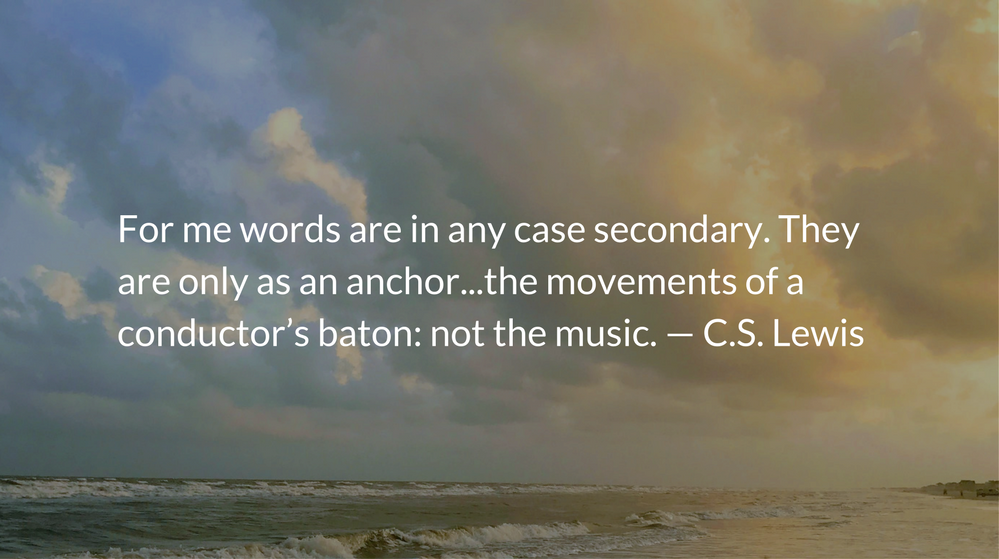
And this, you see, makes the choice between ready-made prayers and one’s own words rather less important for me than it apparently is for you. For me words are in any case secondary. They are only as an anchor. Or, shall I say, they are the movements of a conductor’s baton: not the music. They serve to canalise the worship or penitence or petition which might without them—such are our minds—spread into wide and shallow puddles.

It does not matter very much who first put them together. If they are our own words they will soon, by unavoidable repetition, harden into a formula. If they are someone else’s, we shall continually pour into them our own meaning.

*Excerpt from Letters to Malcolm: Chiefly on Prayer, C.S. Lewis.

Prayer: The Refrain for the Morning Lesson
I am like a green olive tree in the house of God; I trust in the mercy of God forever and ever. — Psalm 52.8

– Prayer from The Divine Hours: Prayers for Springtime by Phyllis Tickle.

Prayers from The Divine Hours available online and in print.

Today’s Readings
Jeremiah 44 (Listen – 6:10)
Psalm 20-21 (Listen – 2:37)

Additional Reading
Read More from Lewis on Liturgiology — Part 1
Every service is a structure of acts and words through which we receive a sacrament, or repent, or supplicate, or adore.

Read More from Lewis on Liturgiology — Part 2
Any tendency to a passionate preference for one type of service must be regarded simply as a temptation.

Readers’ Choice
We have a handful of spots left for your favorite posts of the year. Submit a Readers Choice post. Tell us about a post and what it meant to you.

Support our Work
Over 4,000 people every week read an email devotional from The Park Forum. Support our work with a monthly or a one time donation.

The Worst Churches in the Bible :: Readers’ Choice

Selected by reader, Heather Trowell
The seven churches in Revelation are a puzzle: God almost seems to damn them with faint praise. This reflection was an encouragement that God is loyal to His Church and is at work making her spotless and blameless.

Originally posted on May 31, 2018 with readings from Isaiah 32 and Revelation 2.

Whoever has ears, let them hear what the Spirit says to the churches… — Revelation 2.7

Reflection: The Worst Churches in the Bible :: Readers’ Choice
By John Tillman

There are many strange and unfamiliar images in Revelation that we have no context for and do not easily understand. But one that has a very familiar ring is the description of scandal-filled churches.

In many recent articles, such as The Fall of the Village, by Jake Meador and The Wrath of God Poured Out, by Albert Mohler, Christian writers have been agonizing over recent revelations of sins from the past as well as current scandals.

In an article on moral failings, Ed Stetzer noted that of the leaders who spoke with him at a conference in 2010, half had stepped down for some kind of moral failing.

At a time when Evangelicals have changed their minds about whether leadership requires a moral private life (they no longer think it does) most still say a church leader’s private life should be morally upright. And Christians all over are justifiably upset both at the sins that had been covered up (or ignored) and the attrition of leaders and churches falling to scandal.

For those who picture themselves in the role of prophet, this can seem like a cause for celebration.

Down with the hypocrites. Down with the failures. Let rise the greater and wiser leaders of a more humble and sacrificial church. But this is just new idolatry to replace the old.

It is notable that the first things revealed to John in the book of Revelation are not heavenly wonders, but earthly sins. But the more shocking revelation is that Jesus loves and cares for sinful and dysfunctional churches and their leaders.

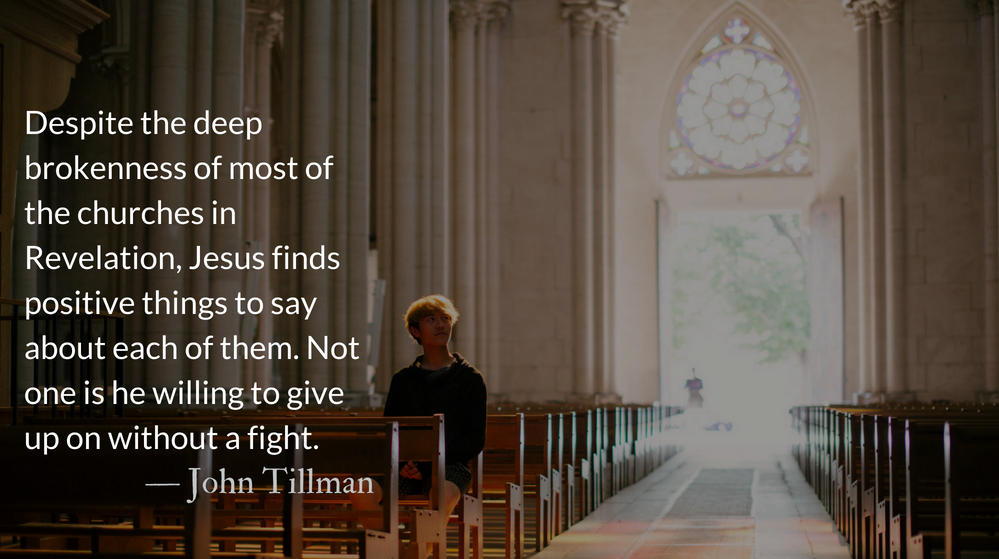
Despite the deep brokenness of most of the churches in Revelation, Jesus finds positive things to say about each of them. Not one is he willing to give up on without a fight.

He does not merely threaten them with punishment, but gives them a purpose, a path to redemption, and a reward for obedience.

Make no mistake. The redemption described is primarily for the church as a whole. Individual redemption from sin, does not require a restoration of position, power, or influence. Those individuals who have harmed others should not be back in the pulpit.

But if Christ can speak lovingly and redemptively of churches as corrupt as these, why can’t we?

When defending people from harm, may we intercede with the strength of Christ and his sword of truth.
But may we also not shirk from Christ’s call to reach out in redemption to even that most vile of sinners, the fallen leader.

Prayer: The Greeting
The words of the Lord are pure words, like silver refined from ore and purified seven times in fire. — Psalm 12.6

– Prayer from The Divine Hours: Prayers for Springtime by Phyllis Tickle.

Prayers from The Divine Hours available online and in print.

Today’s Readings
Jeremiah 43 (Listen – 2:34)
Psalm 19 (Listen – 1:52)

Additional Reading
Read More about How to Read Prophetic Judgment
Judgment-filled prophecy is one case in scripture where it is safer to assume it’s about you than others.

Read More about Where Judgment Falls
Among non-believers and those leaving the church, some common reasons are corrupt, abusive, or just plain bad leadership.

Readers’ Choice
We have a handful of spots left for your favorite posts of the year. Submit a Readers Choice post. Tell us about a post and what it meant to you.

Support our Work
Over 4,000 people every week read an email devotional from The Park Forum. Support our work with a monthly or a one time donation.
The Enemy of Pleasure :: Readers’ Choice

Selected by reader, Godsbooklover, Fort Wayne, IN
I was quite taken by the idea that our obsession with pleasure is rooted in the sin of pride. For the believer, humility and gratitude are the antidote. Then every pleasure is a gift to enjoy, rather than an entitlement to judge.

Originally posted on October 13, 2017 with readings from 1 Kings 12 and Colossians 3.

Set your minds on things that are above, not on things that are on earth. — Colossians 3.2

Reflection: The Enemy of Pleasure :: Readers’ Choice
The Park Forum

Only when a person is not dependent on an object or experience for pleasure are they truly free to enjoy it. We know this, of course, because things we’ve built anticipation for regularly find a way of letting us down. On the other hand, things for which we have little—or low—expectations find ways of impressing us greatly.

In response, some people cultivate perpetually low expectations toward everything and everyone. It’s a compensatory mechanism in which they seek to avoid life’s disappointments and, if all goes well, find themselves “pleasantly surprised.” This soothes the symptoms, but leaves the cause to fester.

The problem is not in the objects and experiences themselves, but our dependence on them to cultivate joy and happiness. It is another manifestation of the root of pride—our desire to derive primary satisfaction, pleasure, and identity from our personal experiences and achievements.

“True humility,” says Timothy Keller, in summary of C.S. Lewis, “is not thinking less of yourself or thinking more of yourself; it’s thinking of yourself less.” When our lives take on a posture of humility it affects not just our relationships with others, but our relationships with the objects and pleasures of this world.

Do not imagine that if you meet a really humble man he will be what most people call “humble” nowadays: he will not be a sort of greasy, smarmy person, who is always telling you that, of course, he is nobody.

Probably all you will think about him is that he seemed a cheerful, intelligent chap who took a real interest in what you said to him.

If you do dislike him it will be because you feel a little envious of anyone who seems to enjoy life so easily. He will not be thinking about humility: he will not be thinking about himself at all. — C.S. Lewis

The Christian posture toward the objects and pleasures of the world is neither asceticism nor hedonism. Instead, our attention, passions, and desires have been so captured by the gospel that we are free to enjoy the many pleasures of this world without falling in love with them. Boasting in the cross makes us humble toward the world.

Prayer: The Morning Psalm
Let me announce the decree of the Lord: he said to me, “You are my Son; this day have I begotten you.
Ask of me, and I will give you the nations for your inheritance and the ends of the earth for your possession.”— Psalm 2.7-8

– Prayer from The Divine Hours: Prayers for Springtime by Phyllis Tickle.

Prayers from The Divine Hours available online and in print.

Today’s Readings
Jeremiah 42 (Listen – 3:44)
Psalm 18 (Listen – 5:47)

Additional Reading
Read More about Clutching Earthly Pursuits
Clutching earthly pursuits while attempting to spiritually self-regulate—is exactly what makes us miserable.

Read More about Idolatry of Identity
Virtue signaling through conspicuous consumption of the right brands is an established norm. We define our identity by what we support and what we disdain.

Readers’ Choice
We have a handful of spots left for your favorite posts of the year. Submit a Readers Choice post. Tell us about a post and what it meant to you.

Support our Work
Over 4,000 people every week read an email devotional from The Park Forum. Support our work with a monthly or a one time donation.

The Fragrance of Faith :: Readers’ Choice

Selected by reader, Wade Edwards and reader, Kim in Vancouver, BC
Wade: I love how Mary had a vision for the future and acted based on that. Not worried about the things of this world. Truly she had faith.

Kim: This one was so aptly titled and I really liked the imagery of Jesus having Mary’s perfume as a comfort somewhat, during the lonely hours when he was crucified.

Originally posted on July 16, 2018 with readings from Jeremiah 12 and Matthew 26.

Truly I tell you, wherever this gospel is preached throughout the world, what she has done will also be told, in memory of her. — Matthew 26.13

Reflection: The Fragrance of Faith :: Readers’ Choice
By John Tillman

Mary of Bethany’s anointing of Christ on his last trip to Jerusalem is intimately connected to the gospel—Christ said that it would be.

What makes Mary’s extravagant offering in any way related to the gospel?

It was a sacrificial gift. The most obvious reason is the extravagance of the gift itself—it was worth a year’s wages. (2016 median earnings for men in the United States were $51,640 and $41,554 for women .) This jar was very likely an heirloom given to Mary to ensure financial stability and independence. It may even have passed to her when Lazarus died as a part of his provision for her.

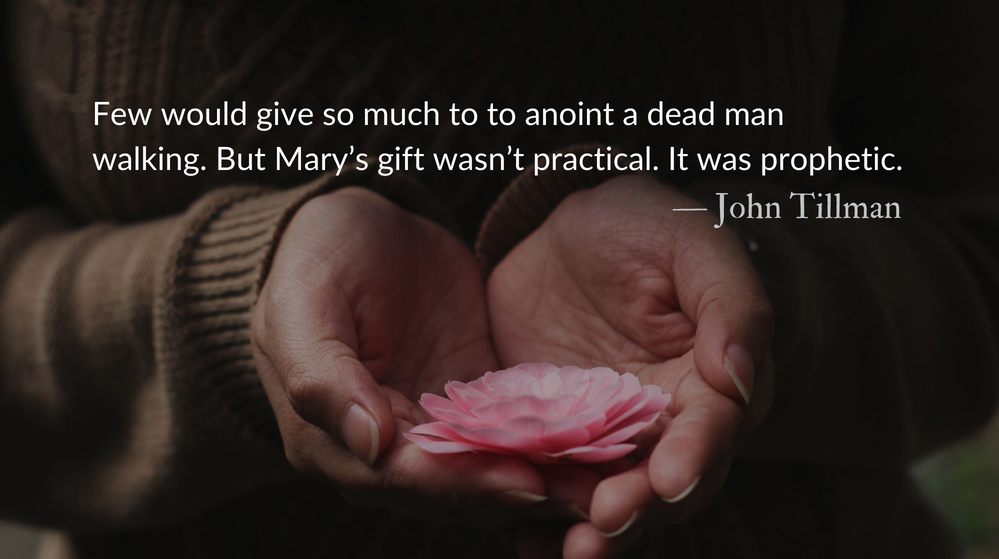
Many would give $50,000 to a practical need, like a loved one’s surgery, to feed the homeless, or to dig a well. But few would give so much to bless an intentional loss—to anoint a dead man walking.
But Mary’s gift wasn’t practical. It was prophetic.

In John’s gospel, Jesus makes clear that Mary has fulfilled the prophetic purpose of the gift as, “It was intended…for the day of my burial.“ Mary alone among the disciples has understood Christ’s prophecies. She anoints him with the same fragrance that is offered before the Lord in the Temple, because she knows that he is the the final priest, the final offering, the final sacrifice.

It was a lasting gift. Nard in this form, especially when applied to the hair and body is a long lasting fragrance. Throughout his ordeal over the next 48 hours, the gift of Mary’s faith would hang about Christ—the fragrance of her faith.

When they ripped out his beard, they would stir up the perfume. When they flogged the skin from his back, the scent would rise as his blood fell. When they pressed the thorns into his head, his hair would release more of the fragrance. When he choked on vinegar to drink, the smell of her gift would still be there.

She sacrificed her only security in this world, for the security of the next. She placed her full self on the altar with Christ. She gave up her agency in the world, gave up her ability to provide for herself, and provided Christ with a remembrance of the disciple who understood.

May we make extravagant, prophetic, and lasting gifts to Christ and to the spreading of this gospel, like a fragrance, throughout the world.

Prayer: The Call to Prayer
Worship the Lord in the beauty of holiness; let the whole earth tremble before him. — Psalm 96.9

– Prayer from The Divine Hours: Prayers for Springtime by Phyllis Tickle.

Prayers from The Divine Hours available online and in print.

Today’s Readings
Jeremiah 41 (Listen – 3:36)
Psalm 17 (Listen – 1:58)

Additional Reading
Read More about the Tomb of the Unknown Savior
Mary of Bethany may have been the only disciple who realized Jesus was about to die a sacrificial death. But it seems only his enemies remembered that Christ also promised to come back to life.

Read More about Sacrifice of Self
Ultimately we have been called to imitate our self-sacrificing savior, Jesus, by giving of ourselves to do good for the benefit of others.

Readers’ Choice
We have a handful of spots left for your favorite posts of the year. Submit a Readers Choice post. Tell us about a post and what it meant to you.

Support our Work
Over 4,000 people every week read an email devotional from The Park Forum. Support our work with a monthly or a one time donation.