Kindling Love

My heart is steadfast, O God! I will sing and make melody with all my being! — Psalm 108.1

“The heat of spontaneous love is so dangerous—no matter how great its passion—that it can very quickly become a poisonous fever,” warns Søren Kierkegaard. How many of us, still today, walk around wounded by the words or actions of someone who said they “loved” us. We know, through experience, that love rooted in sentimentality or self-interest risks running dry over the course of time or evaporating in the heat of struggle.

The enduring love referred to in the Scriptures is not a matter of deepening emotions, but embracing what Kierkegaard refers to as the “duty,” or work, of loving:

Only when it is a duty to love, only then is love eternally secured; secured against the ravages of change, eternally and happily secured against despair. However joyous, happy, indescribably confident, instinctive and inclinational, spontaneous and emotional love may be—it still needs to establish it­self more securely, in the strength of duty. Only in the security of the eternal is all anxiety cast out.

For in spontaneous love, however confident it be, there still resides an anxiety, a dread over the possibility of change. Yet in the you shall, it is forever decided; one’s love is forever secure. Every other love can be changed into something else.

The prayer of Psalm 108, “my heart is steadfast,” is not the result of “being a better Christian” or the fruit of willpower. A steadfast heart has made a thousand sacrifices—siphoning passion and energy away from everything which would pollute its commitment to God.

Kierkegaard anchors his perspective in the Torah’s command to love; “You shall love the Lord your God with all your heart and with all your soul and with all your might,” concluding:

“You shall love,” this command from God, takes all the unsoundness away and preserves for eternity what is sound. You must heed to the eternal’s you shall. This alone will preserve you. This alone will keep your love alive.

There, where the merely human wants to storm forth, the command still holds. Just when the merely human would lose courage, the command strengthens. Just when the merely human would become tired and clever, the command flames up and gives wisdom.

The command consumes and burns out what is unsound and impure in your love, but through it you shall be able to kindle it again, even when, humanly considered, all has been lost.

Today’s Reading
Daniel 4 (Listen – 7:27)
Psalms 108-109 (Listen – 4:28)
 

Abandoning Legalism

Whoever is wise, let him attend to these things; let them consider the steadfast love of the Lord. — Psalm 107.43

“Since high school days Jim had judged his own conduct, and probably the conduct of others, by what he later called his, ‘code of don’ts,’” wrote Elisabeth Elliot of her late husband Jim. “Late in his senior year in college, he began to see that this was contrary to the teaching of the apostle Paul.”

In a journal she read after his martyrdom, Jim had written about how he confronted his judgment of others through cultivating humility in response to his own sin:

I note that my [entry] of a year ago seeks a time when I shall forget all my failure. Psalm 107 has wrought much peace of heart in this regard. Just today I was thinking of how God loves in spite of all my sin and has promised to bring us to the ‘desired heaven.’ He will perform until the day.

What matters of the resident Adam? What care for my bloating pride? What concern for attacking lust whose inner fifth-column betrays me to that enemy so often?

Perfect love casts out fear, and this blessed rest—in knowing He loves through all these things—makes them seem too worthless even to be thought upon. I know them. God knows them. I confess them. He forgives them. Oh that I might praise him worthily!

This personal transformation opened his life up for deeper community. Elisabeth explains, “With a new understanding of these principles, Jim discarded some of the old inhibitions which before he had regarded as prerequisite to holiness.”

Far from sparking an unregulated life, Jim’s newfound posture connected him with others and opened up opportunity for him to deepen his connection with the Spirit while he calibrated his spiritual freedom. Later in the journal Jim wrote:

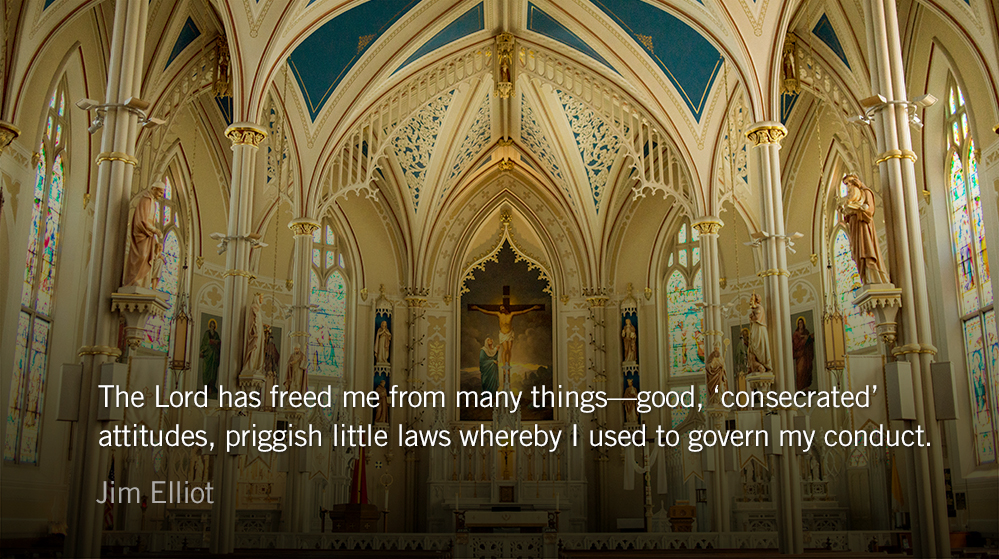
A disruption of my previously pious ‘code of don’ts’ that used to motivate much of my action has occurred in the last three months. The Lord has freed me from many things—good, ‘consecrated’ attitudes, priggish little laws whereby I used to govern my conduct.

I experience new fellowship, new freedom, new enjoyment. But my pendulum swung too far. My liberty become license in some things, and a stumbling block to some people…. Let us earnestly have these decisions before God…. We can boast with David in prosperity, ‘I shall never be moved.’ ‘My heart confided in the Lord and I was helped, therefore my heart exults.’

Today’s Reading
Daniel 3 (Listen – 5:56)
Psalms 107 (Listen – 4:12)


Through Chaos, to Hope

Our fathers, when they were in Egypt, did not consider your wondrous works; they did not remember the abundance of your steadfast love. — Psalm 106.7

Love has five stages—though many people get stuck at the third stage—according to psychologist Jed Diamond. The first stage is easy enough: falling in love. “Your partner rapidly becomes the ideal person for you; they simply have no flaws of any kind,” a Brightside article on Dr. Diamond’s five stages summarizes.

In the second stage the two become a couple; “a time of unity and joy.” This is part of what makes the third stage—disillusionment—so jarring. “You start to feel like you want a break from them or even tell yourself they’re not the one for you.” And here, after months or even years, many people exit their relationship. But this doesn’t have to be the end.

Couples that work through the third stage, Dr. Diamond says, get to create real, lasting love. “Your mind is freed from these illusions which you projected onto your partner in the early stages” And it only gets better.

Once a couple has reached the beauty of the fourth stage of love, they have the opportunity for the fifth stage: using the power of two to change the world. It’s here that the marriage so many of us long for comes into full bloom. The fruit of a thriving marriage cannot be conjured from aspirations, it must be cultivated through sacrifice.

This doesn’t just happen in love, but also in community, and faith. Decades before Dr. Diamond, Dr. M. Scott Peck wrote of the four stages of community. In the first stage, called pseudo-community we pretend to be close; in the second stage, chaos, we project our ideals on others.

The third stage of community, emptiness, is where we give up our demands for one another and build an understanding of each unique person. It’s only after we have yielded our personal pursuits that we can nurture the fourth stage: authentic community.

How often this pattern repeats. Psalm 106 laments how quickly we forget the foundation of our relationship with God when disaster batters our lives. The chaos of pain is disillusioning. Instead of progressing through the season of our trials, we are tempted to abandon the hope of our future.

But, as the Psalmist reminds, this doesn’t have to be the end. Like Israel, we can learn to cry for help as we embrace the hope of tomorrow; “Save us, O Lord our God, and gather us from among the nations, that we may give thanks to your holy name and glory in your praise.”

Today’s Reading
Daniel 2 (Listen – 8:45)
Psalms 106 (Listen – 4:52)


Peace :: Weekend Reading List

St. Augustine, in his beautiful work, The City of God, describes peace as tranquillitas ordinis—“the tranquility of order.” Far from a simple—passive—lack of strife, peace is something that is the result of intentional and sacrificial labor. George Weigel, recipient of the 2016 Peace Prize of the Universal Peace Project, observes of Augustine’s view:

This was not any “order,” of course. Rather, what Augustine sought was an “order” rooted in justice: an “order” in which men and women could live out their responsibility to promote the common good; an “order” that made possible virtue in public life. Today, we might translate Augustine’s definition of peace by thinking of tranquillitas ordinis as dynamic, rightly ordered political community, within and among states.

Weigel reminds us that Augustine penned “the tranquility of order” at a time in history “when the civilization he knew and cherished was crumbling around him.” As if his parallel to our modern predicament wasn’t clear enough, the Peace Prize recipient continues, “Such an ‘order’—such a ‘peace’—does not just happen. It is an ongoing work of moral responsibility.”

Of course, “moral responsibility” is part of what has made this election cycle so exhausting. In most elections, and with many things in this election, the language of morality is invoked more often to imbue meaning to what would otherwise be considered opinion or party difference.

For what may be the first time in our country’s history, a major party candidate has boasted that he sexually abuses women. Following the candidate’s casual dismissal of the recording—and inexplicable disregard for his victims as they came forward acknowledging that Trump did do what he so gleefully admitted to—I received a Facebook message:

I am one of many women who is a rape and sexual assault survivor. Please make no mistake that what Mr. Trump described was assault. I’ve been through trauma therapy and have been in recovery for a long time. When I heard the tape and those words, I was thrown into a PTSD episode that I’m still working through. I was blindsided.

How we long for Augustine’s tranquility of order. But it cannot be obtained by through a candidate who has no respect for such order. Christianity Today’s Executive Editor Andy Crouch laments:

There is hardly any public person in America today who has more exemplified the “earthly nature” (“flesh” in the King James and the literal Greek) that Paul urges the Colossians to shed: “sexual immorality, impurity, lust, evil desires, and greed, which is idolatry.” This is an incredibly apt summary of Trump’s life to date….

Most Christians who support Trump have done so with reluctant strategic calculation, largely based on the president’s power to appoint members of the Supreme Court…. But there is a point at which strategy becomes its own form of idolatry—an attempt to manipulate the levers of history in favor of the causes we support.

Our choice, as Christians, is not between two candidates—it is between trusting in God and placing our faith in a politician or party. In this way, today’s election is no different from years past. There is a clear moral responsibility to embrace, no doubt. But, as George Weigel concludes in his acceptance of the peace prize:

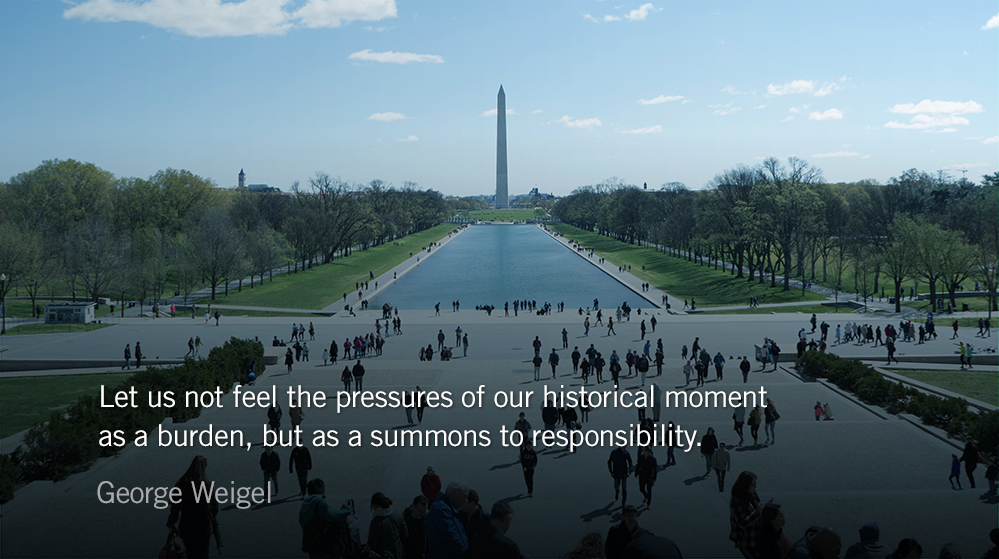
Let us not feel the pressures of our historical moment as a burden, but as a summons to responsibility. For in the exercise of that responsibility, we may come to feel a different weight, the “weight of glory” promised to those who are true peacemakers.

Weekend Reading List

Today’s Reading
Ezekiel 47 (Listen – 4:08)
Psalms 103 (Listen – 2:07)


Constant Comfort in Suffering :: Throwback Thursday

By Charles Haddon Spurgeon (1834-1892)

For my days pass away like smoke, and my bones burn like a furnace…. But you, O Lord, are enthroned forever; you are remembered throughout all generations. — Psalm 102.3, 12

Kindly notice the title of this Psalm: A Prayer Of The Afflicted, When He Is Overwhelmed, And Pours Out His Complaint Before The Lord. I call your attention to it in order to remind you what changes there are in the life of a believer.

Here, in the 102nd Psalm, the afflicted saint is pouring out his complaint; and then, in the 103rd, the rejoicing believer is blessing the Lord in a jubilant song of grateful praise. Such are a true Christian’s ups and downs, nights and days; and I can see how the 103rd Psalm blossoms out of the 102nd.

When the afflicted believer can pour out his complaint before the Lord, it will not be long before he will be able to cry, “Bless the Lord, O my soul; and all that is within me, bless his holy name.”

If you carry your complaint in your own bosom, or tell it to some earthly friend, you will probably continue to have cause to complain; but if you pour out your heart before God, it will not be long before he will give you ease and relief.

That was David’s usual way, to comfort himself in his God when he could find no comfort in himself or in his surroundings. You remember that he did so on that memorable occasion when Ziklag was burned, and the people spake of stoning him: “David encouraged himself in the Lord his God.”

We shall be wise if we follow his example; for, when every other source of joy is dried up, when all earthly wells are stopped up by the Philistines, the stream of God’s mercy flows on as freely as ever.

It is most instructive to notice how the psalmist ascribes all to God—not only his strength, but his weakness—not merely his extended life, but even the shortening of his days. It takes away the sting from our sorrow when we know that it comes from God. It helps us to bear any apparent calamity when we feel that it is our Heavenly Father’s hand that has wrought it all, or his will that has permitted it to happen.

The ever-living God is our constant comfort amidst the ever-changing scenes of this mortal life.

*Abridged and language updated from Charles Haddon Spurgeon’s Commentary on Psalm 102.

Today’s Reading
Ezekiel 46 (Listen – 4:49)
Psalms 102 (Listen – 2:45)