The Absurdity of Peace – Peace of Advent

Links for today’s readings:

Dec 11  Read: 2 Chronicles 11-12 Listen: (6:00) Read: Psalms 119.25-48 Listen: (15:14)

Scripture Focus: Psalm 119: 41-42

41 May your unfailing love come to me, Lord,
    your salvation, according to your promise;
42 then I can answer anyone who taunts me,
    for I trust in your word.

Reflection: The Absurdity of Peace – Peace of Advent

By Erin Newton

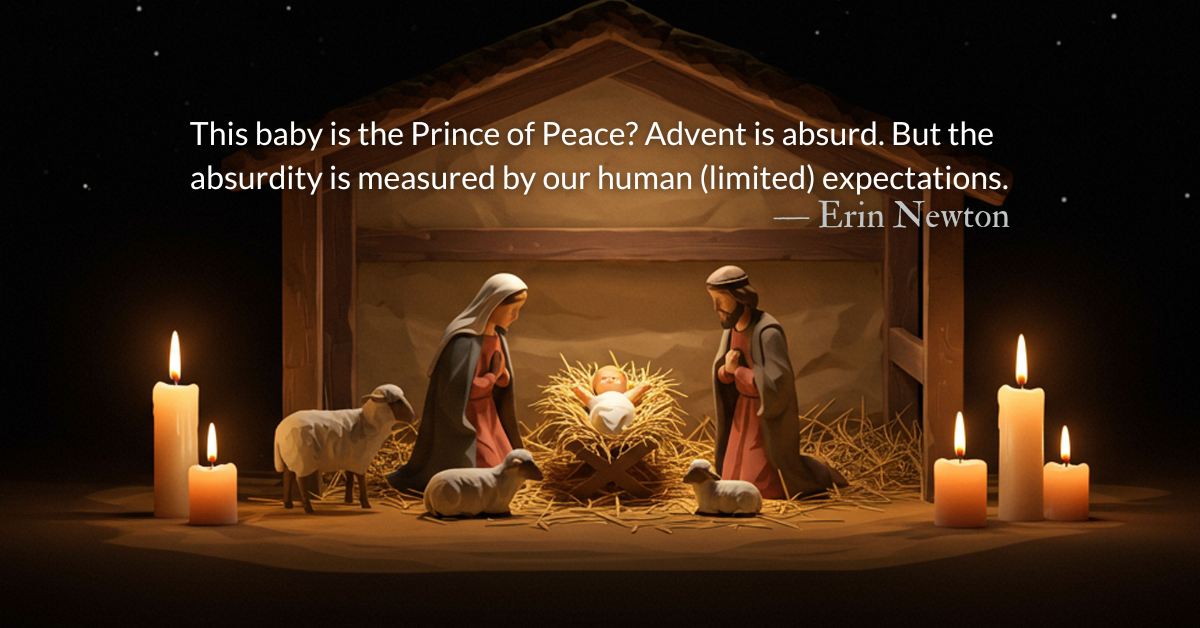
Every nativity scene portrays Jesus in his most vulnerable state. This baby is the Prince of Peace? The Almighty God? It sounds absurd.

But Advent is absurd. It is unthinkable that a God of infinite power would limit himself by taking on flesh or that a baby would rule nations. But the absurdity is measured by our human (limited) expectations.

It is the unimaginable aspect of Advent that draws us in each year. It is the unexpected works of God that we celebrate and we hope for. Advent reminds us that our hope does not align with what the world offers.

Though we know little from the text about Mary’s experience during pregnancy, we know that Joseph feared the community would shame her. Taunting was a real threat. Their journey could not have been without sideways glances or hushed whispers when she walked by. Joseph likely feared the taunts when people learned the truth. But she resolutely followed through with what God had called her to do—because she trusted in his word.

Most of us will not receive a level of taunting that causes anything more than hurt feelings, bruised egos, strained relationships, and perhaps a little embarrassment. But when we live fully trusting in God’s word, we might be questioned about our decisions or our demeanor. It is far more likely for a friend to ask a piercing “Why?” when we are following Christ.

Can we call these questions “taunts”? Probably not. We are not like Elijah on Mount Carmel battling the false prophets of Baal. But the motive behind the question hinges on the perspective that God being incarnated into a tiny baby is an absurd idea. Who is this God? Is he really all that powerful? Prove it.

The Prince of Peace’s first advent was in frailty and meekness and in a body completely dependent on two trusting parents. Mary and Joseph trusted in the words spoken to them. They faced potential ridicule because they trusted in God more than the world’s expectation.

As we look at the peace that came with Advent, we see the absurdity of it all. The Virgin pregnant. The Infinite in flesh. The Almighty swaddled.

The absurdity of the peace of Advent gives us confidence that we can face the world’s questions or criticisms. Our peace defies reality. Peace from God sometimes looks ridiculous. The peace born from Advent is unlike any other. Praise God.

Divine Hours Prayer: The Greeting

Seven times a day do I praise you, because of your righteous judgments. — Psalm 119.164

– From The Divine Hours: Prayers for Autumn and Wintertime by Phyllis Tickle.

Consider Supporting Our Work

Please consider becoming a donor. Support ad-free content that brings biblical devotionals to inboxes across the world.

Read more: Peace from Strife — Peace of Advent

There is the expectation…The Redeemer will come with swords and fire and plagues! But you turn the page and find a baby…

Peace in a World Not Our Home – Peace of Advent

Links for today’s readings:

Dec 10  Read: 2 Chronicles 10  Listen: (3:01) Read: Psalms 119.1-24 Listen: (15:14)

Scripture Focus: Psalm 119: 18-19

18 Open my eyes that I may see
    wonderful things in your law.
19 I am a stranger on earth;
    do not hide your commands from me.

Reflection: Peace in a World Not Our Home – Peace of Advent

By Erin Newton

“This world is not our own”—a phrase we have heard many times. It is an idea that ought to bring us peace. It should identify us as strangers on this earth. But we fall prey to the attempts of conforming to our world and its wishes, its desires, its motivations, its means.

But this world is not always kind, and motivations are often self-serving or abusive. The goals of one sometimes mean the subjugation of another. We cannot be at home here, not now, not as it is.

The prophets cried out in the wilderness against the same social injustices we have not found freedom from yet. We join the call: “Prepare the way for the Lord; make straight in the desert  a highway for our God” (Isa 40:3).

And so one day, Christ left his home in the heavens to abide with us. Now, he bids us all to leave our home here and join him. We are, in fact, strangers on earth.

We are estranged from the impulses of society, the human-centered goals of a self-centered populace. For such reasons, we must see the beauty and wonder of God’s law. We must find peace in going a different direction than what the world says is “the way.” The Way tells us to find our peace in him.

Wendell Berry expresses the need for “the peace of simple things” in his poem “The Want of Peace”:

     All goes back to the earth,
     and so I do not desire
     pride of excess power,
     but men who have had little:
     the fisherman’s silence
     receiving the river’s grace
     the gardener’s musing on rows.

     I lack the peace of simple things.
     I am never wholly in place.
     I find no peace or grace.
     We sell the world to buy fire,
     our way lighted by burning men,
     and that has bent my mind
     and made me think of darkness
     and wish for the dumb life of roots.

As we reflect on the peace of knowing we are truly strangers here—never exactly conforming, never assimilating to those around us—we find peace. The peace of Advent is rooting ourselves in who God calls us to be.

Let us find the peace of simple things. Let go of the ways of the world and embrace the beauty of God’s direction in your life. The peace of Advent calls us to our true home.

Divine Hours Prayer: A Reading

In due course John the Baptist appeared; he proclaimed this message in the desert of Judaea, ‘Repent, for the kingdom of Heaven is close at hand.’ This was the man spoken of by the prophet Isaiah when he said: A voice of one that cries in the desert, ‘Prepare a way for the Lord, make his paths straight.’ This man John wore a garment made of camel-hair with a leather loin-cloth round his waist, and his food was locusts and wild honey. Then Jerusalem and all Judaea and the whole Jordan district made their way to him, and as they were baptized by him in the river Jordan they confessed their sins. — Matthew 3.1-6

– From The Divine Hours: Prayers for Autumn and Wintertime by Phyllis Tickle.

Consider Supporting Our Work

If you appreciate our ad-free biblical content, please consider becoming a one-time or monthly donor.

Read more: People of Two Cities

The righteous, eternal city…is a city of people who trust God for their peace. It is a shelter for refugees escaping the wicked city.

The Law’s Heart Cries for Deliverance

Scripture Focus: Psalm 119:153-156, 159-160
153 Look on my suffering and deliver me,
    for I have not forgotten your law.
154 Defend my cause and redeem me;
    preserve my life according to your promise.
155 Salvation is far from the wicked,
    for they do not seek out your decrees.
156 Your compassion, Lord, is great;
    preserve my life according to your laws.

159 See how I love your precepts;
    preserve my life, Lord, in accordance with your love.
160 All your words are true;
    all your righteous laws are eternal.

Student Writers Month is here:
The student writers featured from July 15 to August 9 have received free coaching, ministry training, and seminars by special guests in addition to this publishing opportunity, the ability to re-publish their work elsewhere, and a stipend/scholarship for their work. A portion of all donations during these dates will be applied to the students’ stipends/scholarships. Find out more about the students at this link or give a one-time or recurring gift at this link.

Reflection: The Law’s Heart Cries for Deliverance
By Emily Bianchini 

The author of Psalm 119 is a devoted reader and follower of the Torah. In a similar way, we Christians have the Bible. Today’s reading shows us how the description of God’s character through his word teaches us to cry out to God in the midst of suffering. 

The ancient world was full of suffering. So is ours. The psalmist describes facing persecution at the hands of the wicked who reject the laws of God for their own. We may face suffering from wicked, lawless humans or unfortunate circumstances. Yet, what this psalm shows us is that we can cry out to God. 

The Bible teaches us to cry out to God because he is a responsive Father. In Exodus 3:7, God said he heard the cries of his people Israel in bondage in Egypt. The heart of the law, the psalmist knows, is God hears the cries of the oppressed and does mighty works of deliverance for his people. 

The psalmist sees the character of God through the story of the exodus and echoed in the laws for Israelite society. God heard the cry of his people once before. Now the psalmist cites his devotion to the laws and appeals to God by framing requests in accordance with God’s word. 

The psalmist knows the character of God revealed in the Torah and appeals to God to for salvation. We have the opportunity to know the character of God both through Scripture and the person of Christ. Psalm 119, which celebrates the Torah,  can serve as a model for Christians in their relationship to God through his word. 

Let’s pray a prayer based on today’s Scripture: 

Heavenly Father, you are the God who saves. 
Thank you for the gift of salvation made available by your Son Jesus.
I know that in this world I will experience trouble and I ask for your grace in the midst of suffering. 
If it is your will, please deliver me from this evil. 
Yet I will continue to trust your character, for I know that you are good. 
I pray this in the name of Jesus, Amen. 


Divine Hours Prayer: The Call to Prayer
Let all who seek you rejoice ann be glad in you; let those who love your salvation say forever, “Great is the Lord!” — Psalm 70.4

– From The Divine Hours: Prayers for Summertime by Phyllis Tickle.


​Today’s Readings
Isaiah 55 (Listen 2:11)
Psalms 119.145-176 (Listen 15:24)

​This Weekend’s Readings
Isaiah 56 (Listen 2:11), Psalms 120-122 (Listen 2:12)
Isaiah 57 (Listen 3:37), Psalms 123-125 (Listen 1:52)

Read The Bible With Us
Have you ever read the Bible all the way through? Our reading plan follows a sustainable two-year pace and it’s never a bad time to start.

https://mailchi.mp/theparkforum/m-f-daily-email-devotional

Read more about Supporting Our Work
You can help students during Student Writers Month. Part of every donation goes to stipends/scholarships for the students. Donate today.

Why Do We Weep?

Scripture Focus: Psalm 119.136
136 Streams of tears flow from my eyes, for your law is not obeyed.

Student Writers Month is here: The student writers featured from July 15 to August 9 have received free coaching, ministry training, and seminars by special guests in addition to this publishing opportunity, the ability to re-publish their work elsewhere, and a stipend/scholarship for their work. A portion of all donations during these dates will be applied to the students’ stipends/scholarships. Find out more about the students at this link or give a one-time or recurring gift at this link.

Reflection: Why Do We Weep?
By Doug Hibbard

In the midst of the Bible’s longest psalm we find weeping. 

Overwhelming sadness pervades today’s passage, with three vivid expressions of anguish over the unbearable reality of sin and oppression (v. 123, 131, 136). Darkness weighs on the psalmist like a heavy yoke. On one side of the yoke, the weight of human oppression pulls on the psalmist as the people reject God’s Word and God’s ways. 

On the other side of the yoke, the weight of God’s lack of action heightens the darkness. The psalmist longs to better understand the words of the Lord, weeping over the lack of understanding that leads to sin. 

This ancient story feels familiar, with our struggle mirroring the psalmist’s. We strive to live out God’s law to the best of our ability. But we see those who ignore God’s ways growing stronger while we grow weaker. Does the world feel this way to you? Does God seem silent or inactive in the face of oppression and injustice? This darkness can weigh us down in the core of our being, whether it is injustice on a large scale such as genocide or systemic racism, or the individual injustices of personal abuse, neglect, and harm. 

This is why we weep with the psalmist. Weep for the pain inflicted on others. Weep for the pain we feel. Weep for our own shortcomings, knowing that our imperfect obedience to God brings suffering to ourselves and others. Weep because God’s deliverance is delayed. 

We pant and weep with longing for God’s justice, but it is worth remembering that God’s delays bring space for His grace. And this grace includes us. We need God to first act in our lives, to bring us the understanding we need to live (v. 144), and then to right the wrongs around us. 

Our closing verse shares the comfort the psalmist learned, that an understanding of God’s grace lifts the weight of our darkness. It is this grace that brings life, that ties together all of God’s words and righteousness. It is this grace that we live by, day by day, and share with others. It is this grace that comforts us even when we weep.


Divine Hours Prayer: The  Refrain for the Morning Lessons
Blessed be the Lord day by day, the God of our salvation, who bears our burdens. — Psalm 68.19

– From The Divine Hours: Prayers for Summertime by Phyllis Tickle.


​Today’s Readings
Isaiah 54 (Listen 3:14)
Psalms 119.121-144 (Listen 15:24)

Read more about Supporting Our Work
Part of every donation during Student Writers Month goes to the students. Help fund stipends/scholarships for them. Donate today.

Read more about Praying Through Weeping—Guided Prayer
If prayer is relationship then when God weeps, we should join. What friend would weep, whom we would not join in weeping? 

Finding Delight

Scripture Focus: Psalm 119.103-104
103 How sweet are your words to my taste,
    sweeter than honey to my mouth!
104 I gain understanding from your precepts;
    therefore I hate every wrong path.

Student Writers Month is here: The student writers featured from July 15 to August 9 have received free coaching, ministry training, and seminars by special guests in addition to this publishing opportunity, the ability to re-publish their work elsewhere, and a stipend/scholarship for their work. A portion of all donations during these dates will be applied to the students’ stipends/scholarships. Find out more about the students at this link or give a one-time or recurring gift at this link.

Reflection: Finding Delight
By David Z. Blackwell

As a father of young children, I frequently hear my kids exuberantly shouting superlatives. “This is the best day ever!” “That was amazing!” “That was the coolest!” Psalm 119 shares a similar childlike delight, only in the word of the Lord rather than childhood adventures.

The psalmist praises the law of the Lord not with mere platitudes but with jubilant gratitude. The psalmist exalts the law because it brought wisdom greater than his enemies, teachers, and elders (vv. 98–100). For the writer, the law is the means of relationship and source of connection to the Lord (v. 102). “I do not turn aside from your rules, for you have taught me.” God’s words are not secondhand instructions but come directly from the Lord. Scripture illuminates the path, gives life to the afflicted, and is an eternal heritage and refuge (vv. 105, 107, 111, 114–120). Don’t you wish to delight in God’s word like this?

The author meditates on God’s words because, in them, he finds safety and blessing. The psalmist is also saved from adversity to continue to meditate on the words of the Lord (Psalm 119.114,117). Meditating on God’s word is not only the means but also the end. He does not meditate just to get something. He continues to meditate because of how much he has received. Meditating on God’s word is relational. 

The New Testament also emphasizes the importance of God’s word and says that it is fulfilled in Jesus. In John 1, Jesus is the embodied word of God, and in Matthew 5.17–20, Jesus says he came to fulfill the law and the prophets and praises those who keep and teach these commands.

For the Psalmist and for us, meditating on God’s word is everything. God’s words are comfort, joy, motivation, hope, peace, and the way of life. Yet, I don’t always feel this way. The Psalm suggests the psalmist doesn’t either. Do you? This passage provides an opportunity to look inward and examine our relationship with God’s word.

Let us remember that spending time reading, praying, and meditating on God’s word is the remedy for our apathy and ask him to grant us that same joy. What brings you this childlike joy? What adversity and struggles do you need saving from? How has God protected and delivered you? And how can these needs and victories lead you to meditate further on his word?


Divine Hours Prayer: The Request for Presence
To you I lift up my eyes, to you  enthroned in the heavens. — Psalm123.1

– From The Divine Hours: Prayers for Summertime by Phyllis Tickle.


​Today’s Readings

Isaiah 53 (Listen 2:39)
Psalms 119.97-120 (Listen 15:24)

Read more about The Practice of Meditation :: Running
It is not God’s ability to speak that must grow, it is our ability to listen.

Read more about Supporting Our Work
Part of every donation during Student Writers Month goes to the students. Help fund stipends/scholarships for them. Donate today.