The Church’s Historical Response to Plague

Scripture Focus: Proverbs 4.20-22
My son, pay attention to what I say;
    turn your ear to my words.
Do not let them out of your sight,
    keep them within your heart;
for they are life to those who find them
    and health to one’s whole body.

Reflection: The Church’s Historical Response to Plague
By John Tillman

*This will be quite a long post compared to our normal 400 words. The first half is a bit of a “backstage tour” of The Park Forum and an explanation of why we rarely write about current events such as COVID-19. If you’d like to skip over that and get straight to our devotional related to the pandemic and a response of faith, scroll on down to the heading “The Church’s Historical Response to Plague.”

At The Park Forum, we tie our devotional writing tightly to our reading plan. We rarely diverge from it other than to write about major seasons of the church year such as Lent, Easter, Advent, and Christmastide.

We address cultural trends but rarely, if ever, address specific current events. This is intended to keep our content timeless by relating it primarily to the timeless Word of God. It is also a bulwark, intended to prevent our work from becoming a response to the world, rather than a response to God’s Word. We succeed or fail in following these ideals to varying degrees each week, by God’s mercy.

The other reason we rarely write about current events is less idealistic and more practical—our publishing timeline is too long. In order to have our emails sent at 5:00 AM in each timezone around the world, we need to “send” them 24 hours in advance. We write them a minimum of 36 hours ahead of when you read it in the email or online. That’s an eternity in today’s news cycle. And honestly, when I am writing that close to the send deadline, it is quite nerve-wracking and mistakes can be made. My preference is to be at least five to ten days ahead. I am writing this, which will publish on Tuesday, on the preceding Friday evening. This is a bit late for my taste, but by the time you read it, any time-sensitive information will likely be out of date.

With all of this in mind, let us prayerfully approach the topic of COVID-19 and the gospel.

The Church’s Historical Response to Plague
Sickness and disease comes frequently into the pages of scripture. 

The ancient Jewish ethic of ritual washing and ritual cleanliness was at times (especially in regards to transmissible diseases and conditions, such as leprosies and dangerous molds) a practical step of keeping the community healthy. The role of the priests was to risk their own safety in order to inspect contaminated individuals and contaminated dwellings for signs of infection. To cause another person to be infected and in risk of death due to negligence to these regulations was to be in violation of the commandment, “Do not murder.” 

Today we have outsourced home inspection to the real estate industry and personal health to the healthcare industry. (When was the last time your pastor inspected your house for black mold?)

In an article for Foreign Policy Magazine, Lyman Stone writes of how Christianity took this ancient Jewish ethic further:

“The Christian motive for hygiene and sanitation does not arise in self-preservation but in an ethic of service to our neighbor. We wish to care for the afflicted, which first and foremost means not infecting the healthy. Early Christians created the first hospitals in Europe as hygienic places to provide care during times of plague, on the understanding that negligence that spread disease further was, in fact, murder.”

Throughout history (Particularly in the Antonine Plague of the 2nd century, and in the Plague of Cyprian in the 3rd) Christians were noted as the one group which consistently, century after century, took risks to their own health in their service to the infected and the suffering. The sociologist and religious demographer Rodney Stark claims that death rates in cities with Christian communities during these plagues may have been half that of other cities.

We see it again In 1527, when the bubonic plague struck Wittenberg. Martin Luther refused to flee the city but stayed instead and ministered to the sick. This decision cost him the life of his own daughter, Elizabeth. When asked whether Christians should flee a plague, Luther produced a pamphlet in answer. It can be boiled down to five words, “We die at our posts.”

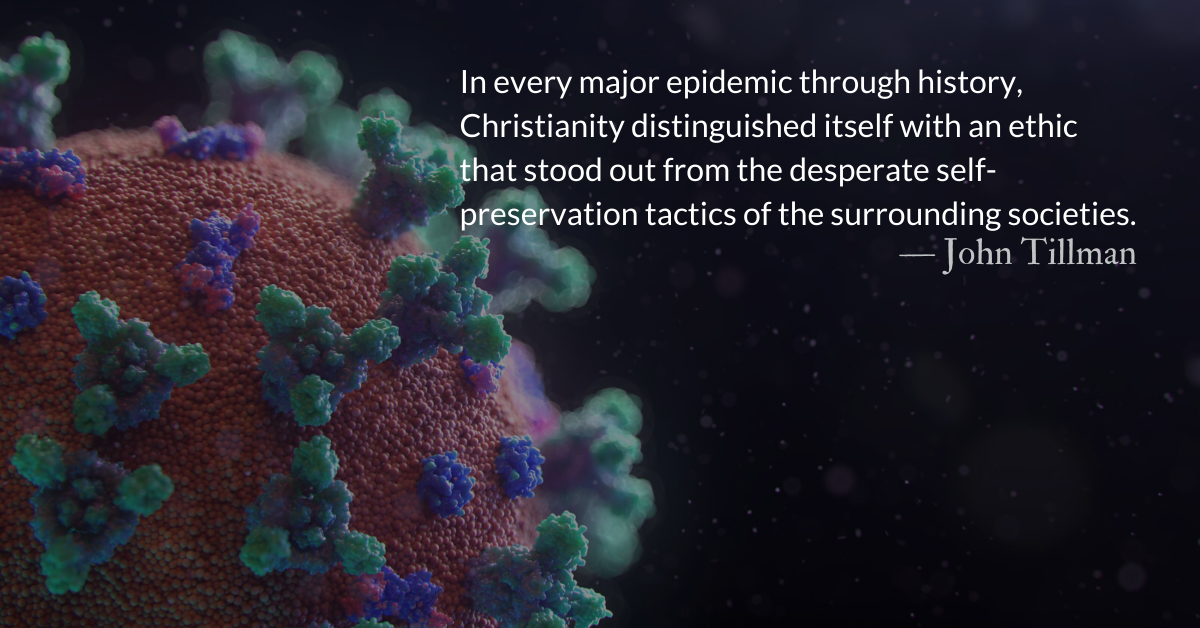
In every major epidemic through history, Christianity distinguished itself with an ethic that stood out from the desperate self-preservation tactics of the surrounding societies. 

The historic church has left us a great example and testimony based on sound application of the scriptures. 

Are we following it? Are we caring for our neighbors or just for ourselves?

Pray that the Holy Spirit would lead you and your faith community to shine in this moment of fear and uncertainty. Be safe. Follow best practices for lowering risks of transmission. Don’t be foolish. But do all this not in service of your own safety, but in service to the community. 

When this crisis passes, will every unused bottle of hand sanitizer or vital goods stashed in our homes that could have been donated to our church or sent to a senior living center, or given to a neighbor stand as a testimony that we cared more for ourselves than for others?

This is a stark challenge to our hearts to see if we are following in the example laid before us by the Church. Tomorrow we will look at the divine comfort and inexplicable peace the Church relied on to carry out its mission during past crises.

Divine Hours Prayer: The Greeting
Awesome things will you show us in your righteousness, O God of our salvation, O Hope of all the ends of the earth and of the seas that are far away.

– Divine Hours prayers from The Divine Hours: Prayers for Springtime by Phyllis Tickle.

Today’s Readings
Proverbs 4 (Listen -2:37) 
Galatians 3 (Listen -4:39)

Read more about Taking Advantage of the Desperate
From a business perspective, the noblemen confronted by Nehemiah were simply following the market. Payday lenders would describe it as filling a “financial service void.”

Read more about The Purpose of Power
After prayer and fasting, Esther’s concerns for her own life disappear and her purpose is clarified. The purpose of Esther’s power is to serve others. So it is with us.
The Importance of Resurrection :: Throwback Thursday

Scripture: 1 Timothy 1.16
I was shown mercy so that in me, the worst of sinners, Christ Jesus might display his immense patience as an example for those who would believe in him and receive eternal life.

Reflection: The Importance of Resurrection :: Throwback Thursday
By John of Damascus (676-749 C.E.)

For if there is no resurrection, let us eat and drink: let us pursue a life of pleasure and enjoyment. If there is no resurrection, let us hold the wild beasts of the field happy who have a life free from sorrow. If there is no resurrection, neither is there any God nor Providence, but all things are driven and borne along of themselves.

For observe how the righteous suffer hunger and injustice and receive no help in the present life, while sinners and the unrighteous abound in riches and every delight.

No, the divine Scripture bears witness that there will be a resurrection of the body. The Lord became Himself the first-fruits of the perfect resurrection that is no longer subject to death. For He said, “Destroy this temple, and in three days I will raise it up.” And the holy gospel is a trustworthy witness that He spoke of His own body.

But someone will say, How are the dead raised up? Oh, what disbelief! Oh, what folly!

Behold how the seed is buried in the furrows as in tombs. Who is it that gives them roots and stalk and leaves and ears and the most delicate beards? Is it not the maker of the universe? Is it not at the bidding of him who created all things?

Believe, therefore, that the resurrection of the dead will come to pass at the divine will and sign. For he has power that is able to keep pace with his will.

We shall rise again, our souls being once more united with our bodies, now made incorruptible and having put off corruption, and we shall stand beside the awful judgment-seat of Christ.

But those who have done good will shine forth as the sun with the angels into life eternal, with our Lord Jesus Christ, ever seeing Him and being in His sight and deriving unceasing joy from Him, praising Him with the Father and the Holy Spirit throughout the limitless ages of ages.

Thanks be to you, Lord Jesus Christ: your strength has been my consolation; you have not allowed my soul to perish with the wicked; you have given me your grace, the grace of your name. Now it is time for you to fortify what you have achieved in me and so to confound the adversary’s impudence.
— Euplus, prior to his martyrdom in Sicily c. 304 C.E.

Prayer: The Request for Presence
So teach us to number our days that we may apply our hearts to wisdom. — Psalm 90.12

– Prayer from The Divine Hours: Prayers for Springtime by Phyllis Tickle.

Full prayer available online and in print.

Today’s Readings
Proverbs 30 (Listen – 3:51)
1 Timothy 1 (Listen – 2:59)

The Template of Compassion

Scripture: Proverbs 29.7
The righteous care about justice for the poor,
but the wicked have no such concern.

It is a great consolation for me to remember that the Lord, to whom I had drawn near in humble and child-like faith, has suffered and died for me, and that He will look on me in love and compassion. — Wolfgang Amadeus Mozart

Reflection: The Template of Compassion
By Matt Tullos

Compassion: When we rise above our selfishness and enter into the heartbreak of others.

Jesus hangs on the cross bearing the bleak rebellion of every age. Who can measure the weight of such a burden? Who can scan the circumference of this transaction? This obelisk of sin that outweighed the mass of Jupiter leveled itself against His weakening limbs. And then on that darkening day, He speaks to the beloved ones of his life: “Woman behold thy son. Son, behold thy mother.”

This moment of compassion seems insignificant considering the immensity of humanity that would be forever changed. Jesus was a Savior but indeed He was still somebody’s boy. We hear Him tie up the loose ends of His next of kin. These details would not escape the attention of Jesus.

We look back at the compassion of Jesus as He stood at the grave of a close friend. Those around Lazarus tomb that day observed His grief.

Jesus wept. The community said, “See how he loved him!

Jesus knew the end of the story. He would call out and Lazarus would come forth, but He stepped into the moment. He stepped into the pain. He stepped into the plaintive wails of a grief-stricken family.

What are you mourning today? He is mourning with you.

He has compassion and is making accommodations on your behalf to get through this. You’ll get through it together. We often forget that even though there are pressing issues on every continent, he still has a heart for the small.

There are kings and presidents and war on every side, but Jesus still has the capacity to know your secret wounds and weep over the tombs of your cloistered dreams. He is a God of compassion. He took care of the people He loved. When we fail to remember this, we struggle.

Jesus’ eyes aren’t solely fixed on the White House, the Vatican or the United Nations. His eyes are in the marriage counselor’s office, at the funeral of a grandfather, and under the bed of an abused child who prays for the gift of peace.

He’s there, too.

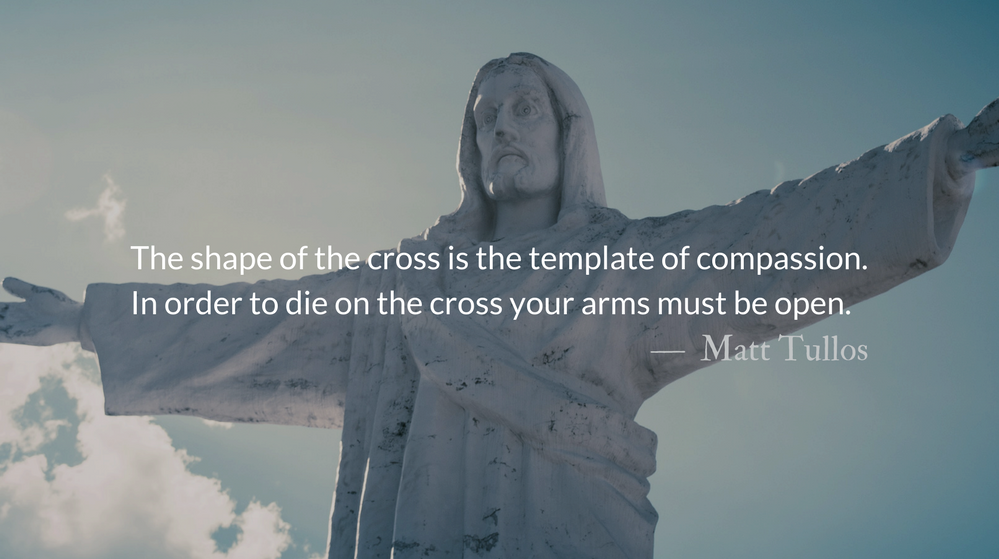
The shape of the cross is the template of compassion. In order to die on the cross your arms must be open.

God of Wonder,
King of Glory,
Grant us the courage to look beyond our own pain and enter into the pain of another.
For in this act we receive a more glorious vision of the cross of our slain Savior, Jesus Christ.
In Whose Name we pray,
Amen

*From a series Matt Tullos wrote called 39 Words. A few of these posts are available in audio form via Soundcloud. — John

Prayer: The Morning Psalm
The Lord will make good his purpose for me; O Lord, your love endures for ever; do not abandon the works of your hands. — Psalm 138.8

– Prayer from The Divine Hours: Prayers for Springtime by Phyllis Tickle.

Full prayer available online and in print.

Today’s Readings
Proverbs 29 (Listen – 2:44)
2 Thessalonians 3 (Listen – 2:16)

The Crux of Repentance

Scripture: 2 Thessalonians 2.13-14
But we ought always to thank God for you, brothers and sisters loved by the Lord, because God chose you as firstfruits to be saved through the sanctifying work of the Spirit and through belief in the truth. He called you to this through our gospel, that you might share in the glory of our Lord Jesus Christ.

Reflection: The Crux of Repentance
By John Tillman

We acknowledge that Jesus said “It is finished.” But still we often want to “do our part.” We are like a patron in a five star restaurant being served a dish prepared by a master chef which we then we drown in ketchup.

The unmerited favor of Christ is an acquired taste. Most of us are gauche enough to like our grace flavored with a little bit of earning it.

But, don’t we have to do… something? What about repentance? What about sanctification? What about growing more like Christ?

Where the call of the gospel, the work of Christ, our belief in him, and the first steps of our sanctification meet is the crux of repentance.

If you believe, you must every day renounce, as dung and dross, your privileges, your obedience, your baptism, your sanctification, your duties, your graces, your tears, your meltings, your humblings, and nothing but Christ must be held up. — Thomas Wilcox

We often are so unwilling to renounce anything. So unwilling to part with anything. So unwilling to lay down anything.

If only our repentance looked more like that of the thief on the cross. His hands are open, holding nothing. He is naked, hiding nothing. He is humble, asking nothing. He simply believes.

Our hands are full of work and achievements. Our sins we dress in the finest of intentions. Our demands are not only for Heaven in the future, but tangible blessing now. We want one pie in the sky and one on earth too.

It is important to distinguish that acts of repentance are not a precursor or a down payment that secures our forgiveness. On the contrary, the Holy Spirit—no longer behind the veil of the temple but living in us—is our down payment from Christ.

Just as Christ completed his work on the cross for us, his Holy Spirit will complete a transforming work in us, if we let him.

May we repent as the thief and allow Christ to do his work. The man lived mere hours as a believer, but look what God has done with those hours.

If a dying Saviour saved the thief, my argument is, that he can do even more now that he liveth and reigneth. All power is given unto him in heaven and in earth; can anything at this present time surpass the power of his grace? — Charles Haddon Spurgeon

What may the Holy Spirit do in you?

Prayer: The Call to Prayer
I will lift up my hands to your commandments, and I will meditate on your statutes.” — Psalm 119.48

– Prayer from The Divine Hours: Prayers for Springtime by Phyllis Tickle.

Full prayer available online and in print.

Today’s Readings
Proverbs 28 (Listen – 3:07)
2 Thessalonians 2 (Listen – 2:32)

Getting to the Heart

Scripture: Proverbs 27.19
As water reflects the face,
so one’s life reflects the heart.

Reflection: Getting to the Heart
The Park Forum

Our hearts, like fine instruments, need to be tuned. Proverbs warns, “Keep your heart with all vigilance, for from it flow the springs of life.” This may have been what Jesus was thinking of when he said, “…for out of the overflow of the heart, (the) mouth speaks.” Our heart sets the course for our life. If our heart is envious, entitled, impatient or pleasure-seeking, everything in our life will be marked by these traits.

Legalists suffer from myopic focus on behavior. If a person is angry, legalists demand the person control the outputs of anger. Don’t lash out. Pause before you react. In contrast, the target of the gospel is the heart — it address a person’s actions by moving directly to the root.

For example, is a person angry: (1) because he feels superior and sees others as a nuisance, (2) because he lusts for success and lashes out when things get shaky, or (3) because something happened in the past and he now responds disproportionally under the same circumstances.

In the first case, the root of the anger is entitlement — and the root is likely fleshing itself out as he belittles people who work in service positions or spends large amounts of money on things that refine his image. Multiple sins often draw life from the same root.

In the second case, the root is the idol of success. The person might use peers to scrape his way to the top — taking credit for other people’s work and shifting blame for failures. He could also be ignoring relationships that don’t seem to benefit his bottom line.

In the later case, the root of his anger is likely either guilt or bitterness. If the person is full of guilt, he may not have forgiven himself or walked through the necessary steps to seek forgiveness from those he has hurt. If he is bitter it’s possible he is delaying the journey to forgive someone who has hurt him.

When we get to the root issues of the heart we begin discussing motivations rather than just actions. Focusing solely on actions is like a doctor handing throat lozenges to a coughing patient who is really suffering from pneumonia.

In some ways it’s more comfortable to deal exclusively with actions rather than addressing heart issues. After all, if it’s simply an action that’s our core problem, we can often provide the solution on our own — willing ourselves into change.

Seeing God’s grace as the primary means of change doesn’t mean we stop working on our will. True change happens when a person responds with all of their heart, all of their soul, all of their mind and all of their strength. In his book, The Great Omission: Reclaiming Jesus’ Essential Teachings on Discipleship, Dallas Willard clarifies, “Grace is not opposed to effort, it’s opposed to earning.”

In this, we seek to live dedicated lives of faith empowered by the Holy Spirit. After all, what person can change their own heart? Tell two people in love to stop their hearts from loving. Tell an envious person to have a content soul. It can’t happen. When the gospel drives at our heart it takes us beyond our own sufficiency to our need for a Savior—someone who can change our heart.

Prayer: The Call to Prayer
I will lift up my hands to your commandments, and I will meditate on your statutes.” — Psalm 119.48

– Prayer from The Divine Hours: Prayers for Springtime by Phyllis Tickle.

Full prayer available online and in print.

Today’s Readings
Proverbs 27 (Listen – 2:43)
2 Thessalonians 1 (Listen – 1:52)