
The Gift of Hope :: Hope of Advent

Luke 18.8
When the Son of Man comes, will he find faith on the earth?

Reflection: The Gift of Hope :: Hope of Advent
By John Tillman

When the church decided to set its celebration of Christ’s birth around the Winter solstice, it was no accident or happenstance. And it certainly wasn’t because anyone believed that day was Christ’s actual birthdate. It was instead based on the teaching tool available in the signs of the heavens—in the darkening of the year.

As the year gets darker and darker, an ancient tension grows and a question rises. Will the light return? At the turning of the year, there is a point at which ancient astronomers could not measure whether the light was receding or had begun to return. At the year’s darkest point, humanity waits until the light returns, like a second Easter.

In the season of Advent, we confidently wait in a dimming world, knowing our hope in the return of the light is assured. The hope of Advent is not a naive or weak hope, but one that perseveres into the darkness.

During Advent we have faith in things not seen. We contemplate the signs of what is hoped for. There is reason for hope and joy in the waiting.

Hope in the Christian context—as a gift of Jesus during Advent—is not like a casual wish for a Merry Christmas or a Happy New Year. It is a synonym for faith.

And faith does not disappoint us, for the one who promised to come is soon to arrive.
He is the one whose portents are seen in the sky.
The one whose forerunner cried in the wilderness.
The one who would not break a bent reed.
The one who would not snuff a smoldering wick.
The one whose birth was a scandalous miracle.
The one with healing in his wings.
The one whose face would be set like a flint.
The one who would be kissed.
The one who would be pierced.
The one who, from the darkness of the tomb…
While the disciples waited in the dark…
He burst forth, kicking down the doors of Hell, and bringing back the Light of the World.

“Will the Son of Man find faith when he comes?”

What are you waiting for? Reach out in faith. Reach out for the gift of hope.

Prayer: The Call to Prayer
Come, let us sing to the Lord, let us shout for joy to the Rock of our salvation. — Psalm 95:1

– Prayer from The Divine Hours: Prayers for Autumn and Wintertime by Phyllis Tickle.

Prayers from The Divine Hours available online and in print.

Today’s Readings
Nahum 2 (Listen – 2:06)
Luke 18 (Listen – 5:27)

Additional Reading
Read More about Face Like Flint :: A Guided Prayer
May we, like Christ and like Thomas, set our face like flint in anticipation of suffering. May we listen, follow, and speak, and, if not for God’s intervention, suffer or die with Christ.

Read More about A Congregation of Hope
When it comes to putting broken lives back together—when it comes, in religious terms, to the saving of souls—the human best tends to be at odds with the holy best.

Support our Work
Each month over 22,000 Park Forum email devotionals are read around the world. Support our readers with a monthly or a one time donation. 
Expectation Affects Anticipation :: Hope of Advent

Nahum 1.15
Look, there on the mountains,
the feet of one who brings good news,
who proclaims peace!

Luke 17.20-21
“The coming of the kingdom of God is not something that can be observed…because the kingdom of God is in your midst.”

Reflection: Expectation Affects Anticipation :: Hope of Advent
By John Tillman

The good news that Nahum prophesied was on the other side of exile for his readers, and the kingdom that Christ’s disciples anticipated, was mysteriously already present among them. How do we anticipate the “already and not yet?” How do we wait for what is already with us? Among us? Part of us?

Advent is a time of anticipation. But anticipation with the wrong expectation, can lead to dissatisfaction or cause us to miss what we have been waiting for completely.

Those who anticipated the day of the Lord in the time of the prophets were wrong about what they waited for. Amos, Zephaniah, and other prophets knew that day would be one of darkness, not light.

Those who anticipated the coming of the Messiah were wrong about what they waited for. The Pharisees, the Zealots, and the people all expected a king who would violently defeat the Roman empire. They rejected the humble, donkey-riding healer who would violently disrupt their economic system at the Temple.

Even the Disciples expected the restoration of an earthly kingdom, asking Jesus, “Is now the time?” “Are you going to restore Israel?” Even the people who were closest to Jesus anticipated political salvation, not spiritual.

“Managing expectations” is sometimes cynically viewed as not allowing customers to get their hopes up, so that they won’t be angry when you let them down. But when it comes to our expectations of Advent, we don’t need to manage them by lowering them. We need to raise them above temporal, earthly, material matters. We already know that what we receive will be beyond what we can ask for or imagine.

The gifts we anticipate have already been purchased at great cost, and contain more than we can ever hope for. We will focus this Advent on the gifts of Jesus in the Gospel of John (which doesn’t enter our reading plan until next Monday) and on the question “What are you waiting for?”

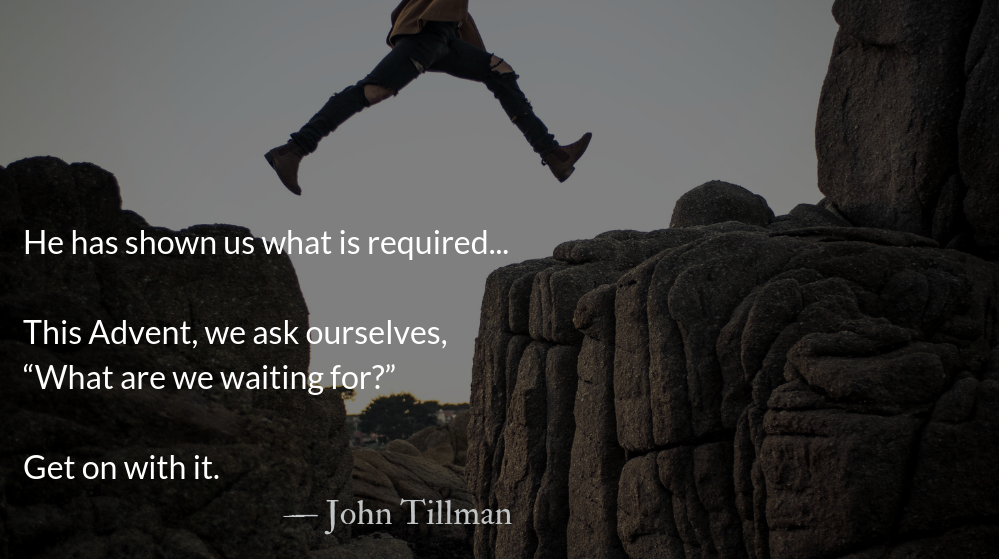
Many have asked this question during Advent, a time of waiting and anticipation. We will attempt to not just passively dream of what we would have from God, but to turn the question into a prompt to action in response to God. He has shown us what is required.
Do good.
Shun evil.
Give extravagantly.
Live sacrificed.

This Advent, we ask ourselves, “What are we waiting for?”

Get on with it.

Prayer: The Refrain for the Morning Lessons
This is the Lord’s doing, and it is marvelous in our eyes.— Psalm 118:23

– Prayer from The Divine Hours: Prayers for Autumn and Wintertime by Phyllis Tickle.

Prayers from The Divine Hours available online and in print.

Today’s Readings
Nahum 1 (Listen – 2:24)
Luke 17 (Listen – 4:22)

Additional Reading
Read More about Restful Meditations :: Advent’s Hope
Focusing our hearts on Christ, the hope of Advent, expands the holiday experience beyond mere merriness. In the gospel our hearts find rest from pain and hope for renewal.

Read More about Anticipating His Advent
In the Old Testament, hope is often translated from the Hebrew word yachal meaning “trust.” In the New Testament, the word hope is used for elpis, which can be translated “to expect or anticipate with pleasure.”

Support our Work
Each month over 22,000 Park Forum email devotionals are read around the world. Support our readers with a monthly or a one time donation. 

Anticipating His Advent

From John:
As we move into the season of Advent (the first Sunday of Advent is this weekend) we prepare our hearts with this devotional from our latest guest writer, Dena Dyer. You can connect with Dena and find out more about her writing at her Facebook page. Dena also has a prayer journal available for Christmas, called The Colors of Christmas—a prayer journal.

Reflection: Anticipating His Advent
By Dena Dyer

The people of Israel had not heard from their prophets in over 400 years. In the midst of cruel taxation laws and heavy religious burdens, the long-awaited Messiah became a distant hope, a flicker of promise almost extinguished by doubt and fatigue.

Then a star appeared over a smelly manger in Bethlehem, and rumors began to surface about a child-king who’d been born to a poor man from Nazareth and his young bride. Angels sang to sweaty shepherds, who bowed in worship at a trough housing a promise kept. Some Jews—such as Anna, Simeon, and Elizabeth–worshipped; others stayed mired in confusion.

Thirty long years passed before Jesus began his public ministry. He healed the infirm, emptied graves, and forgave sins. And still, doubts persisted. After a very public trial, crucifixion, and resurrection, thousands of skeptics believed.

Even so, many people still await the Messiah.

Because we as humans are temporal beings in an ever-decaying world, we have a hard time waiting. We have an even more difficult time believing in promises.

My youngest son has prayed like this for years: “God, I hope that Dad has a good day at work. I hope I can go to Morgan’s this weekend. I hope Uncle Marty’s cancer gets better.”

I wondered whether I should correct him when he said “hope,” because I was only familiar with the Webster’s Dictionary definition: “to want something to happen or be true and think that it could happen or be true.”

Then I learned the biblical definition of hope. In the Old Testament, hope is often translated from the Hebrew word yachal meaning “trust.” In the New Testament, the word hope is used for elpis, which can be translated “to expect or anticipate with pleasure.”

Therefore, hope–in the biblical sense–equals trust and faith. Paul wrote in Romans 8:24-25, “In this hope we were saved. Now hope that is seen is not hope. For who hopes for what he sees? But if we hope for what we do not see, we wait for it with patience.”

As our world groans from injustice, terrorism, and catastrophe; as we slog through financial and familial stress, job changes, and health crises; as our children face temptations we could have never imagined—let’s not forget that we trust in what we do not see.

Let’s wait for Jesus with patience, encouraging one another to expect and anticipate with pleasure his second Advent, when he will set all things right.

Let’s wait in peace.

Do you find waiting difficult? Why or why not?
Have you ever lost hope in a certain situation?
Has God given you scripture or people to encourage you to expect and anticipate the fulfillment of God’s promises? Spend some time thanking him.

PRAYER:
My spirit grows weak at the thought of my children inheriting a world that we haven’t stewarded well…a faith that we haven’t lived out the way we should. Father, you’re our hope and peace. You can comfort us with your presence and your word. Let us not neglect it, or you, when we are afraid, but instead run to you with open minds and hearts. And Jesus? Thank you for your ridiculous love. Give me assurance that you are still at work in this world

*This devotional was originally posted as a part of The High Calling devotional series.

Prayer: The Call to Prayer
Search for the Lord and his strength; continually seek his face.— Psalm 105:4

– Prayer from The Divine Hours: Prayers for Autumn and Wintertime by Phyllis Tickle.

Prayers from The Divine Hours available online and in print.

Today’s Readings
Micah 5 (Listen – 2:21)
Luke 14 (Listen – 4:36)

This Weekend’s Readings
Micah 6 (Listen – 2:28) Luke 15 (Listen – 4:19)
Micah 7 (Listen – 3:36) Luke 16 (Listen – 4:27)

Additional Reading
Read More from Dena on Under His Covering
The wise men gave three presents to the baby Jesus, but God also gave three presents to Mary. He gave her the Messiah, but he also granted her joy and peace.

Read More from Origen on Prayer from the Belly of the Beast
Souls that have long been barren but have become conscious of their intellects’ sterility and the barrenness of their mind, through persevering prayer have conceived of the Holy Spirit and given birth to thoughts and words of salvation full of contemplated truth.  — Origen

Support our Work
Each month over 22,000 Park Forum email devotionals are read around the world. Support our readers with a monthly or a one time donation. 
Why We Celebrate Advent

Reflection: Why We Celebrate Advent
The Park Forum

As a commercial event, Christmas seems to come too soon each year. In the church calendar—observed by Christians around the world for centuries—Christmas morning marks the beginning of the season, and our hearts now rest in the season of Advent. To put that in the language of modern music, celebrating “Joy to the World” before we cry “O Come O Come Emmanuel” misses the hope of Advent.

“The ancient theologians of the Church, such as Origen and Clement of Alexandria, look upon the Christian life as one continual festival,” observed Ida von Hahn-Hahn in the 19th century. “Because the night of sin has been overcome by redemption, because reconciliation with God has brought peace and true joy to the soul, and because from this joy no one is excluded who does not voluntarily separate himself from God.”

Hahn-Hahn, a German countess who wrote a series of books on church history, highlighted the importance of Advent throughout history in preparing the souls of the faithful for Christmas:

Particular times were set apart as festivals, which, like faithful messengers of religion, returned every year, unceasingly announcing the work of redemption, and by their attractive festivity enkindling man, and preparing his soul for the everlasting feast of heaven.

The fast of the four weeks of Advent, to prepare the sinful world for the merciful coming of the Lord… is not to be fulfilled by a trifling and superficial joy, but by the supernatural rejoicing of a heart entirely resting in God, and a life wholly consecrated to Him. Zeal for sanctification should extend over all the aims and objects of life.

Our goal in this season isn’t to usurp materialism only to restore an idyllic image of Christmas-past. Advent is a season where we seek the renewal of our souls in Christ as we prepare for Christmas-present, and long for Christmas-future—the great second Advent where the broken are restored, the dead are revived, and the hope of the gospel brings forth the restoration of all things. So in this season we joyfully, and longingly, sing together, “Come, Thou Long Expected Jesus.”

Listen: Come, Thou Long Expected Jesus, by Kings Kaleidoscope (4:07)

Prayer: The Request for Presence
Teach me your way, O Lord, and I will walk in your truth; knit my heart to you that I may fear your name.— Psalm 86:11

– Prayer from The Divine Hours: Prayers for Autumn and Wintertime by Phyllis Tickle.

Prayers from The Divine Hours available online and in print.

Today’s Readings
Micah 4 (Listen – 233)
Luke 13 (Listen – 5:02)

Additional Reading
Read More about CS Lewis on Hope
Aim at Heaven and you will get earth “thrown in”: aim at earth and you will get neither.

Read More about The Object of Hope
The proper and principal object of hope is therefore eternal blessedness.

Support our Work
Each month over 22,000 Park Forum email devotionals are read around the world. Support our readers with a monthly or a one time donation. 
The Losers Who Write History

Jeremiah 26.16-19 (quoting Micah 3.12)
Then the officials and all the people said to the priests and the prophets, “This man should not be sentenced to death! He has spoken to us in the name of the Lord our God.”

Some of the elders of the land stepped forward and said to the entire assembly of people, “Micah of Moresheth prophesied in the days of Hezekiah king of Judah. He told all the people of Judah, ‘This is what the Lord Almighty says:

“‘Zion will be plowed like a field,
Jerusalem will become a heap of rubble,
the temple hill a mound overgrown with thickets.’

“Did Hezekiah king of Judah or anyone else in Judah put him to death? Did not Hezekiah fear the Lord and seek his favor? And did not the Lord relent, so that he did not bring the disaster he pronounced against them? We are about to bring a terrible disaster on ourselves!”

Reflection: The Losers Who Write History
By John Tillman

In our passage today we read a prophecy from Micah that was quoted as precedent in defense of the prophet Jeremiah at least 80 years later.

Micah prophesied during the time of Hezekiah, one of the few kings of Judah who obeyed God and lived righteously. Yet even under a “good” king Micah spoke of the leaders of Judah when he said, “Therefore because of you, Zion will be plowed like a field, Jerusalem will become a heap of rubble, the temple hill a mound overgrown with thickets.”

Micah, it seems, lived in a time when dissent was not considered unpatriotic disloyalty. Hezekiah, listened, repented, and the prophesied disaster was, seemingly, averted. In reality it was only delayed, like Hezekiah’s prophesied death.

Jeremiah, by contrast, lived during the last gasps of a failing kingdom, amidst an evil generation and a corrupt government. There were still some who stood up to prevent the silencing of dissenting voices. But eventually, Jeremiah was killed in exile for his continued “unpatriotic” messages.

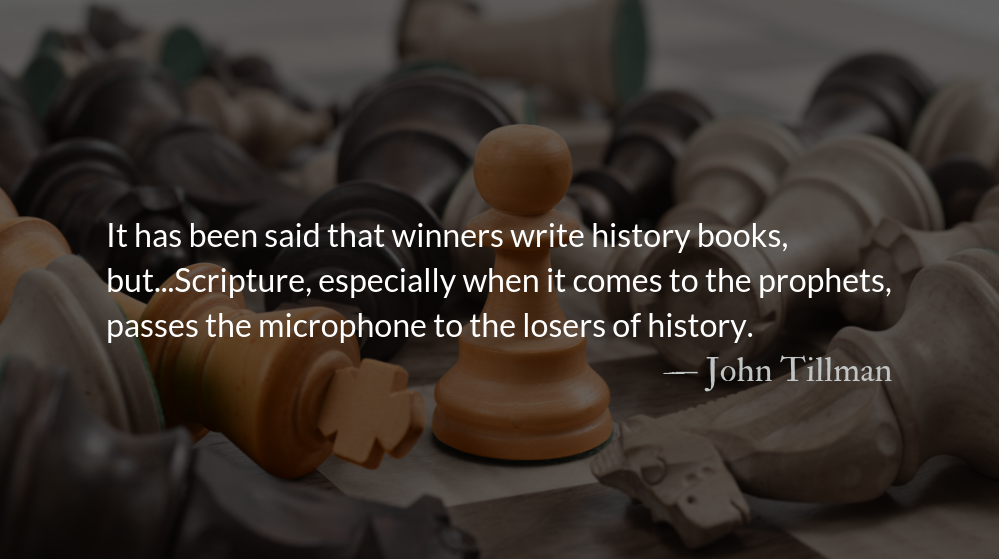
It has been said that winners write history books, but in the case of the Bible, that is decidedly not true. Scripture, especially when it comes to the prophets, passes the microphone to the losers of history.

There were prophets other than the ones in the canon of scripture. Micah mentions them in his writing. They sided with powerful kings, predicted good things to get a financial benefit, and spread the king’s vision of the country’s future instead of God’s.

From the standpoint of the time, these powerful, wealthy prophets were the winners. Yet, not one of those glowingly positive, king-praising prophets’ writings are in our Bible. Instead we have the writings of the losers. The cries of the oppressed. The letters from those imprisoned in the Concord jails, and Birmingham jails of Judah and Israel and often letters from those killed.

The same Jesus who wept over “Jerusalem, who kills the prophets” was also not afraid to utilize biting sarcasm on the topic, saying, “surely no prophet can die outside Jerusalem!”

Jesus also condemned the religious leaders who decorated the prophet’s tombs. He recognized that when we venerate prophets, we are often just venerating ourselves by proxy—envisioning ourselves in their role.

May we learn to listen to “losers” and learn what God may say through them.
May we learn to recognize ourselves as the audience of the prophets, not the prophets themselves.
May we learn from dissenting voices, testing every “prophecy” against scripture

Prayer: The Refrain for the Morning Lessons
I will bear witness that the Lord is righteous; I will praise the Name of the Lord Most High  — Psalm 7:18

– Prayer from The Divine Hours: Prayers for Autumn and Wintertime by Phyllis Tickle.

Prayers from The Divine Hours available online and in print.

Today’s Readings
Micah 3 (Listen – 1:51)
Luke 12 (Listen – 7:42)

Additional Reading
Read More about How to Read Prophetic Judgment :: Readers’ Choice
The best way to read prophecy is to imagine yourself not as the speaker, but as the spoken to.

Read More about Decorating the Tombs of the Prophets
The most difficult thing about following a risen and reigning prophet, priest, and king, is that he will not leave us alone. He will keep bugging us.

Support our Work
Each month over 22,000 Park Forum email devotionals are read around the world. Support our readers with a monthly or a one time donation.