The Radical Procedure of the Gospel

Ezekiel 36.26-27
I will give you a new heart and put a new spirit in you; I will remove from you your heart of stone and give you a heart of flesh. And I will put my Spirit in you and move you to follow my decrees and be careful to keep my laws.

Reflection: The Radical Procedure of the Gospel
By John Tillman

It’s lovely to think of God giving us a new heart and putting a new Spirit within us. But it is terrifying to admit to the diagnoses that would lead to such a radical procedure.

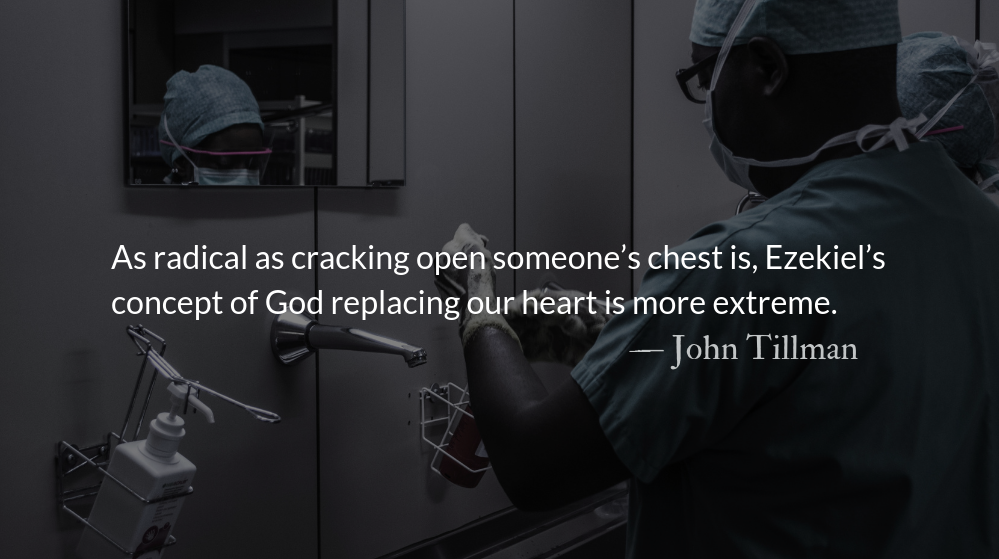
Our familiarity with miraculous examples of modern medicine have muddied this concept for us. Ezekiel wasn’t thinking of a sterile operating room where doctors replace a ten pound chunk of muscle. As radical as cracking open someone’s chest is, Ezekiel’s concept of God replacing our heart is more extreme.

The biblical language isn’t referring to the heart in either the medical or emotional sense. When the Bible talks about the heart it is referring to our complete “inner being,” not any one organ or one part. It refers to our central, inner self. It is our spirit, mind, and emotions.

In the Bible, the heart, whether of a country or one person, is that which is central and vital, without which, meaning and purpose are lost. This is the heart that Ezekiel says is irreparable and dead and must be replaced.

A spiritually relevant question to ask would be, “How did it get that way?”

Israel’s heart was hardened by their determined pursuit of idols of wealth and power at the expense of the poor and the unfortunate. God repeatedly says through Ezekiel that they have caused “bloodshed” in the land. Ezekiel is clear that this means enriching themselves by directly and indirectly causing the deaths of the voiceless, the weak, and the powerless.

Repeated uncaring actions. Repeated justifications of wrongdoing. Repeatedly using legalism to escape our responsibility to others. Repeatedly taking advantage and accepting the benefits of advantages given to us.

This repeated friction as we strain against God’s promptings creates calluses, roughening hearts intended to be tender. These heart-hardening steps tread the path to exile. These are the actions of those whose idols are leading them to be insensitive to God’s voice, to be unmoved by God’s spirit.

After the shockingly violent and bloody experience Jesus undertook to make this transplant possible he quietly comes to his disciples to begin the procedure. There in the upper room, he intimately prays a simple prayer that would not be answered for nearly fifty days: “he breathed on them and said, ‘Receive the Holy Spirit.’

May this prayer of Christ be made real in our lives.
May our hearts be made sensitive enough to feel his breath, hear his voice, and move as he directs.

Prayer: The Morning Psalm
…For you have rescued my soul from death and my feet from stumbling, that I may walk before God in the light of the living. — Psalm 56.12

– Prayer from The Divine Hours: Prayers for Summertime by Phyllis Tickle.

Prayers from The Divine Hours available online and in print.

Today’s Readings
Ezekiel 36 (Listen – 6:40)
Psalm 86 (Listen – 1:39)

Additional Reading
Read More about Killing With our Hearts
Christ’s words about how murder begins with inner violence, adultery begins with inner lust, and divorce is not only adultery, but a victimization of the vulnerable party are as shockingly harsh to modern ears as they would have been to the original audience.

Read More about A Cautionary Tale of Unbelief :: Readers’ Choice
Moses brought God’s salvation to the ancient Israelites, but their hearts of unbelief charted a course of disobedient action. Let the warning of the Holy Spirit be heard by those who are followers of Christ, do not harden your hearts towards God.

Support our Work
Each month over 22,000 Park Forum email devotionals are read around the world. Support our readers with a monthly or a one time donation.
Learning to Pray :: Readers’ Choice

From John:
We have, this week, dipped our toes in the waters of Christian meditative prayer. This is only, however, one branch of the discipline of prayer. So we take the opportunity to look back at this Readers’ Choice post on learning to pray.

Prayer, like cultivation, is not natural. God created a wild, natural world. But he cultivated a park, a garden, for his relationship with us. May we work to cultivate a varied garden of prayer in which to walk with God daily.

Suggested by reader, Suzanne Coupe
I’m not naturally a “prayer warrior” and this devo brought to mind that there are many things I do that aren’t comfortable or pleasant within my earthly relationships, but I do them because I care about that person. My time in prayer with the LORD is an expression of how important He is to me, and sometimes that means putting aside what I want to do in order to do what He wants me to do…what will be best for the strength of our relationship and the glory of Jesus.

Posted February 21, 2018 with readings from Job 21 and 1 Corinthians 8.

Is my complaint directed to a human being? Why should I not be impatient? — Job 21.4

Reflection: Learning to Pray :: Readers’ Choice
The Park Forum

“This is a dangerous error,” warns Dietrich Bonhoeffer, “to imagine that it is natural for the heart to pray.” The great theologian, who lost his life in a Nazi concentration camp in 1945, was no stranger to unanswered prayer. He wrote:

It can become a great torment to want to speak with God and not to be able to do it—having to be speechless before God, sensing that every cry remains enclosed within one’s own self, that heart and mouth speak a perverse language which God does not want to hear.

This may have contributed to the reason Bonhoeffer did not believe it was possible to pray without the power of God:

We confuse wishing, hoping, sighing, lamenting, rejoicing—all of which the heart can certainly do on its own—with praying. But in doing so we confuse earth and heaven, human beings and God. Praying certainly does not mean simply pouring out one’s heart. It means, rather, finding the way to and speaking with God, whether the heart is full or empty. No one can do that on one’s own. For that one needs Jesus Christ.

Not wanting “needs Jesus Christ” to devolve into mere platitude, Bonhoeffer explains how to pray the words of God—Scripture—through the power of God—Spirit:

Jesus Christ has brought before God every need, every joy, every thanksgiving, and every hope of humankind. In Jesus’ mouth the human word becomes God’s Word. When we pray along with the prayer of Christ, God’s Word becomes again a human word.

If we want to read and to pray the prayers of the Bible, and especially the Psalms, we must not, therefore, first ask what they have to do with us, but what they have to do with Jesus Christ. We must ask how we can understand the Psalms as God’s Word, and only then can we pray them with Jesus Christ. Thus it does not matter whether the Psalms express exactly what we feel in our heart at the moment we pray.

Perhaps it is precisely the case that we must pray against our own heart in order to pray rightly. It is not just that for which we ourselves want to pray that is important, but that for which God wants us to pray. If we were dependent on ourselves alone, we would probably often pray only the fourth petition of the Lord’s Prayer. But God wants it otherwise. Not the poverty of our heart, but the richness of God’s word, ought to determine our prayer.

Prayer: The Call to Prayer
Know this: The Lord himself is God; he himself has made us, and we are his; we are his people and the sheep of his pasture. — Psalm 100.2

– Prayer from The Divine Hours: Prayers for Summertime by Phyllis Tickle.

Prayers from The Divine Hours available online and in print.

Today’s Readings
Ezekiel 31 (Listen – 3:31)
Psalm 79 (Listen – 1:50)

This Weekend’s Readings
Ezekiel 32 (Listen – 5:30) Psalm 80 (Listen – 1:58)
Ezekiel 33 (Listen – 6:03) Psalm 81-82 (Listen – 2:36)

Additional Reading
Read More about Persistence in Prayer
When Paul says, “I’ll pray for you,” he actually follows through. May we share that same sense of commitment the next time we utter those simple words, “I’ll pray for you.”

Read More about Uniqueness of Prayer
Our prayer is unique. But this does not mean that it can be merely whimsical, without definite patterns and commitment.

Support our Work
Each month over 22,000 Park Forum email devotionals are read around the world. Support our readers with a monthly or a one time donation.
The Practice of Meditation :: Tea

Psalm 78.70-71
He chose David his servant
and took him from the sheep pens;
From tending the sheep he brought him
to be the shepherd of his people Jacob,
of Israel his inheritance.

Reflection: The Practice of Meditation :: Tea
By John Tillman

All analogies are limited, so it is helpful to consider many of them.

Yesterday we explored meditating on scripture through a visualization of running around a track. As users get used to this visualization, they can adapt the practice to visualize running through a park or leave visualizing behind and actually walk or run. Today we will explore a different contemplative visualization.

This helpful analogy of biblical meditation comes from Donald Whitney, in Spiritual Disciplines for the Christian Life. He describes the benefits of meditating on God’s word using the image of a tea bag in hot water.

The tea analogy is helpful to explain the contrast between Christian meditation and other meditative practices. In other meditative traditions the practitioner seeks to suppress conscious thought, seeking blankness or emptiness. The image of other meditative practices might be the water becoming more and more pure, empty, and blank. In Christianity, we seek to be filled and transformed.

Christian meditation does not seek emptiness, but fullness. We do not seek unconscious, impersonal revelation, but personal revelation from a conscious and communicative God.

Hearing the word, or reading it, or listening to a sermon is dipping the tea bag and removing it. There is some change, some transfer of the tea to the water, but not much. Meditation, however, is allowing the tea bag to soak in the water so that the flavor and power of the tea is transferred to and integrated throughout the water. The water becomes tea.

For the tea analogy, imagine yourself as the water, the scripture as the tea bag, and God’s spirit as the tea itself. Allow the scripture to soak in your mind, repetitively dip it in your thoughts as you would a tea bag into warm water. Listen in faith, believing that God will speak to you through his word. Allow the spirit and nature of God to steep in your spirit, entering your heart and mind through his word.

In meditation, the goal cannot be gaining a new insight for a sermon or Bible study group. It cannot be for a stunning exegetical analysis. It cannot be for a shiny trophy of biblical knowledge.

Let your goal be simply to sit, to steep, in God’s presence in his word.

Prayer: The Call to Prayer
Know this: The Lord himself is God; he himself has made us, and we are his; we are his people and the sheep of his pasture. — Psalm 100.2

– Prayer from The Divine Hours: Prayers for Summertime by Phyllis Tickle.

Prayers from The Divine Hours available online and in print.

Today’s Readings
Ezekiel 30 (Listen – 4:07)
Psalm 78.40-72 (Listen – 7:12)

Additional Reading
Read More about Fear in the Boat :: Readers’ Choice :: TBT
No one has to go through so much anxiety and fear as do Christians. But this does not surprise us, since Christ is the Crucified One, and there is no way to life for a Christian without being crucified.

This devotion spoke to me in a moment where I almost forgot where I was. The words reminded me of the faithfulness of Jesus. I pictured myself in that ‘boat’, and Christ showing me who he is, I was on the Rock. — Reader, Azikiwe Calhoun

Read More about Praying Through the Stress of Work
The beauty of the psalms is they are not simply inspiration and instruction, but example. In hearing and praying through the psalms we find spiritual vitality in a world austere to the divine.

Support our Work
Each month over 22,000 Park Forum email devotionals are read around the world. Support our readers with a monthly or a one time donation.
The Practice of Meditation :: Running

Psalm 78.1-3
My people, hear my teaching;
listen to the words of my mouth.
I will open my mouth with a parable;
I will utter hidden things, things from of old—
things we have heard and known,
things our ancestors have told us.

Reflection: The Practice of Meditation :: Running
By John Tillman

If the elevator is out and you have to climb fifteen flights of stairs, going outside and running a mile first won’t help much. But if you have been running a mile every day for two months, when you need to climb the stairs, the increased lung capacity and strength you have gained will be there to support you.

One way of thinking of meditative prayer is exercise to expand your spiritual lung capacity, allowing you to breathe in God’s spirit more naturally at any time—including during a crisis.

Today we will explore an imaginative guide for meditation on the scripture. We will use the visual image of walking or running to aid us in an analogy of exploring scripture. You can practice this exercise using your imagination while sitting still. Later, if you wish, you can repeat the experience while actually walking around a track or a park or even your apartment or office.

Meditative prayer, especially for beginners, is best begun with scripture. Memorized scripture is helpful, but not necessary. Reading the passage repetitively can be equally helpful. Choose a short passage of scripture. A couple lines from today’s psalms passage would work well. Perhaps Psalm 78.1-3 or Psalm 78.38-39.

Read the passage several times, while simultaneously asking God, through prayer to meet with you and speak to your through this passage.

Now imagine running or walking on an extremely short running track—no more than a tenth of a mile. The repetitive action of circling the track over and over will mirror the repetitive action of reading the scripture in meditation.

Imagine the scripture written on the pathway of the track. Imagine treading each word as you read it. Another option would be to imagine making one circuit of the track each time you read the scripture. Remember your goal isn’t “distance,” to read the passage many times, but depth, to hear God’s spirit speak to you through his word.

Don’t feel pressured to have some surpassingly great breakthrough. To stick with the running analogy, you aren’t going to hit a four-minute mile your first time out. Be humble. Be persistent. Be steady.

It is not God’s ability to speak that must grow, it is our ability to listen.

Prayer: The Morning Psalm
I will listen to what the Lord God is saying, for he is speaking peace to his faithful people and to those who turn their hearts to him… — Psalm 85.8

– Prayer from The Divine Hours: Prayers for Summertime by Phyllis Tickle.

Prayers from The Divine Hours available online and in print.

Today’s Readings
Ezekiel 29 (Listen – 3:43)
Psalm 78.1-39 (Listen – 7:12)

Additional Reading
Read More about Finding Words to Pray
The remedy for spiritual dryness is prayer saturated with scripture. When we pray the words of scripture they enliven our prayers by allowing God’s word to blossom inside our heart, mind, and soul.

Read More about Praying Through the Stress of Work
The beauty of the psalms is they are not simply inspiration and instruction, but example. In hearing and praying through the psalms we find spiritual vitality in a world austere to the divine.

Support our Work
Each month over 22,000 Park Forum email devotionals are read around the world. Support our readers with a monthly or a one time donation.

A Discipline for the Anxious

Psalm 77.2-3
When I was in distress, I sought the Lord;
at night I stretched out untiring hands,
and I would not be comforted.
I remembered you, God, and I groaned;
I meditated, and my spirit grew faint.

Reflection: A Discipline for the Anxious
By John Tillman

We live in distressing times. If there are corners of our world not touched by division, aggression, worry, and angst, you probably can’t get email there.

Anxiety, depression, and other mental health issues are on the rise—especially among younger adults. National Survey of Children’s Health researchers found a 20 percent increase in diagnoses of anxiety among children ages 6 to 17, between 2007 and 2012. The American College Health Association found that anxiety, rather than depression, is the most common reason college students seek counseling services and that in 2016, 62 percent of undergraduates reported “overwhelming anxiety” in the previous year. (An increase from 50 percent in 2011.)

Studying this, science is discovering things that are not exactly new under the sun. A recent Harvard study found that church attendance paired with spiritual disciplines such as meditation and prayer have a beneficial effect on mental health. In a Forbes article, study author Ying Chen noted that being raised religiously, “can powerfully affect [children’s] health behaviors, mental health, and overall happiness and well-being.”

The psalmists would not express surprise at these findings. Though we think of our society as facing pressures unknown to humanity until now, we would be mistaken to think of ancient times as idyllic and calm.

David and the other psalmists certainly knew what it was like to live under threat, under financial pressure, under the constant weight of political instability and the wavering loyalty of an unpredictable government.

Amidst such pressures, they had a safe haven. Their help for the stresses of life was meditation and prayer.*

The psalmist writes of being “too troubled to speak,” yet he cries to God. He writes of insomnia, yet he rests in God. He writes of doubts and of feeling that God has rejected him, that his love has vanished, that he had forgotten to be merciful. Yet in the midst of doubts and fears, he remembers God’s faithfulness in the past. He meditates on these memories in the heated moment of stress.

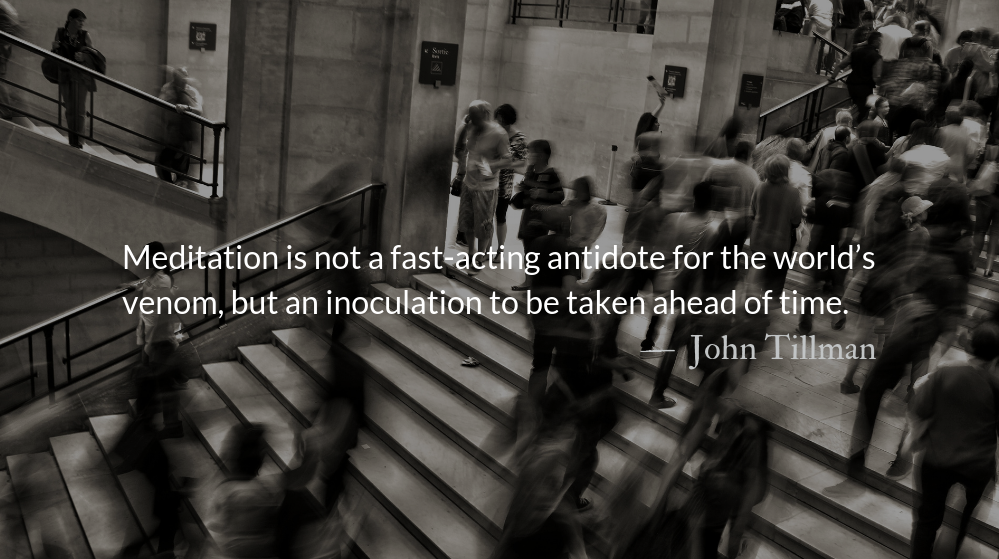
Although the benefits of meditation can help in a crisis, meditation is not a quick fix. It is not a fast-acting antidote for the world’s venom, but an inoculation to be taken ahead of time.

When beginning (or returning to) meditative prayer, start small and short. Use the prayer provided at the end of this devotional (Psalm 119.147) as a start. Spend two to five minutes simply re-reading the prayer with an expectant heart, asking God to be with you.

This week we will explore a bit more about this practice.

*We are in no way implying that meditation should be pursued in lieu of proper medical treatment. If you are in need of counseling and professional services, please consider the following resources:

Mental Health Grace Alliance
Not A Day Promised Resource Page
Life Recovered (Resources for Ministers)
Suicide Prevention Lifeline
Action Alliance for Suicide Prevention
Suicide Prevention Resource Center

Prayer: The Request for Presence
Early in the morning I cry out to you, for in your word is my trust. — Psalm 119.147

– Prayer from The Divine Hours: Prayers for Summertime by Phyllis Tickle.

Prayers from The Divine Hours available online and in print.

Today’s Readings
Ezekiel 28 (Listen – 4:32)
Psalm 77 (Listen – 2:12)

Additional Reading
Read More about Treatment of Mercy
May we seek to treat those suffering from mental illness medically, spiritually, and relationally, as we support them within our communities as treasured ones, loved by Christ.

Read More about When Help Isn’t Help :: Readers’ Choice
May we understand that times of trial and hardship will come into our lives. May we listen to understand, and when we do respond, may it be with sincerity and sensitivity.

Support our Work
Each month over 22,000 Park Forum email devotionals are read around the world. Support our readers with a monthly or a one time donation.