Justice to Wormwood

Scripture Focus: Amos 5.7, 10, 25-26
7 There are those who turn justice into bitterness 
and cast righteousness to the ground.

10 There are those who hate the one who upholds justice in court 
and detest the one who tells the truth.

25 “Did you bring me sacrifices and offerings 
forty years in the wilderness, people of Israel? 
26 You have lifted up the shrine of your king, 
the pedestal of your idols, 
the star of your god— 
which you made for yourselves.

Reflection: Justice to Wormwood
By John Tillman

As the people ignored Amos’s calls to repent, God called into question Israel’s entire history of worship, implying that in their hearts they always had worshiped a god of success, wealth, and comfort rather than him.

Rather than provide justice (mishpat) to the poor, they were frustrating justice and causing bitterness, more literally “wormwood.” Wormwood is translated as “bitterness” multiple times. It is symbolic of a curse or poison and may refer to hemlock. For example, wormwood is used to describe the poison of an adulteress whose lips “drip honey” but in the end, she leads victims to a bitter death. (Proverbs 5.4)

Justice is very much the business of people of faith and when people ignore it or frustrate it…God notices. God points out that the wealthy enjoy great benefits of stone mansions and lush vineyards, (Amos 5.11) but because of their treatment of the poor, the vineyards will be filled with wailing instead of joy and they will be exiled from their comfortable homes. (Amos 5.16-17)

Amos is sympathetic to the plight of living in a corrupt land where justice is denied. “The times are evil” Amos acknowledges and points out that “the prudent keep quiet.” (Amos 5.13) But this acknowledgment of the evil state of the world is not an endorsement of doing nothing or a command to be quiet. Prudence should mean “approaching a problem wisely,” but too often it means “avoiding a problem selfishly.” Rather than avoid trouble, God charges the people to “hate evil, love good” and to “maintain justice in the courts” despite the days being evil.

We are under the same charge. Is there bitterness and poison? We must counter it with justice and righteousness. Justice, or mishpat, is the law being upheld. Righteousness, or sedeq, implies the actions that uphold it. We must not sit quietly but speak out. We must not avoid the unjust but confront them and comfort their victims.

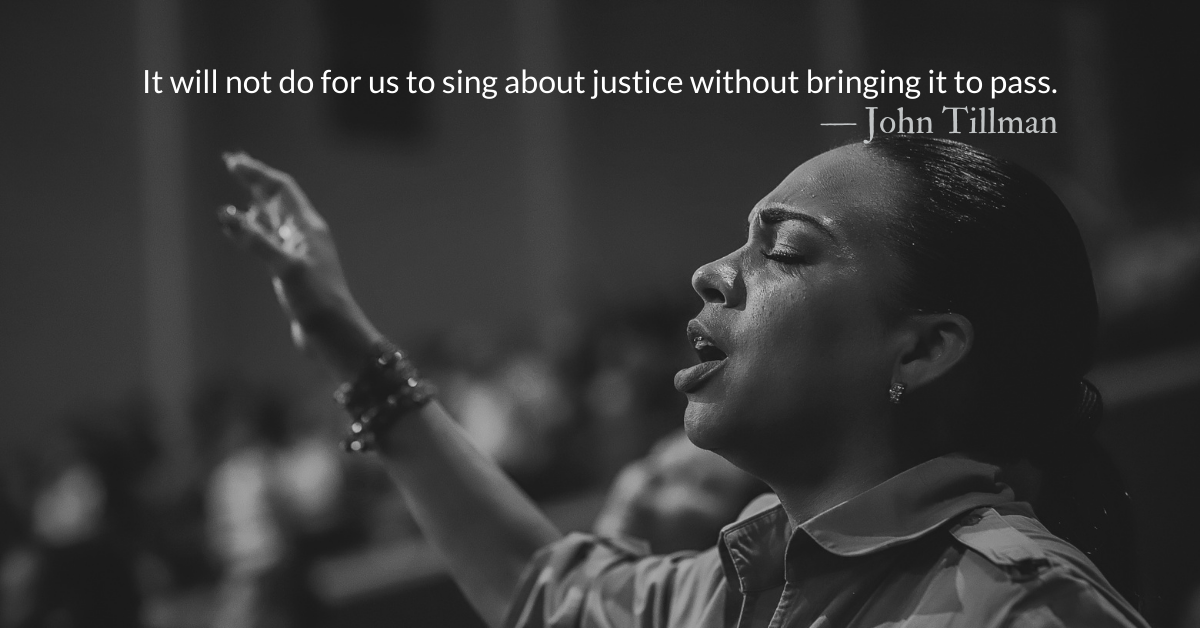
It will not do for us to sing about justice without bringing it to pass. We must bring justice to counter bitterness. We must bring a flood of mishpat to wash away wormwood.

23 Away with the noise of your songs! 
I will not listen to the music of your harps. 
24 But let justice roll on like a river, 
righteousness like a never-failing stream! — Amos 5.23-24


Divine Hours Prayer: The Cry of the Church
In the evening, in the morning, and at noonday, I will complain and lament, and he will hear my voice. — Psalm 55.18

– Divine Hours prayers from The Divine Hours: Prayers for Autumn and Wintertime by Phyllis Tickle


Today’s Readings
Amos 5 (Listen – 3:44)
Luke 1:1-38 (Listen – 9:26)

Read more about Under His Covering
God…like a master craftsman…has given us everything we need. His gifts are beautiful, well-built, and practical.

Read more about Three Strikes
Israel, the prosperous nation, is held collectively responsible for the abuse and oppression of the poor.
Three Strikes

Scripture Focus: Amos 2.6-7; 11-12
6 This is what the LORD says: 
“For three sins of Israel, 
even for four, I will not relent. 
They sell the innocent for silver, 
and the needy for a pair of sandals. 
7 They trample on the heads of the poor 
as on the dust of the ground 
and deny justice to the oppressed. 

11 “I also raised up prophets from among your children
and Nazirites from among your youths.
Is this not true, people of Israel?”
declares the Lord.
12 “But you made the Nazirites drink wine
and commanded the prophets not to prophesy.

Reflection: Three Strikes
By John Tillman

Amos, after laying out prophecies against the enemies of Israel, turns around and lays into Israel for her own sins. Amos shines a spotlight on the treatment of the poor.  

It is one thing for there to be poor people among us. Jesus told us this would always be so. It is another to collectively refuse to do the God-commanded work of helping them. It is another to sell them for one’s own profit. It is another to live a life of ease that is funded by oppressing the poor and ensuring they remain so. The prosperous nation is held collectively responsible for the abuse and oppression of the poor.
Amos also condemns Israel for not listening to the young Nazarites and prophets he sent. 

Nazarites made special vows of devotion to God, including abstaining from wine and from cutting the hair. This could be a lifelong commitment or only a few days. Paul seems to have completed a Nazarite vow in Acts (Acts 18.18) and it may have been a Nazarite vow he was participating in when he was arrested. (Acts 21.20-30) 

Nazarites were not always prophets but were those who were dedicating themselves to God for a special purpose. Amos condemns Israel for working to tempt the Nazarites to break their vows. 

The prophets, the Israelites did not tempt, they simply told them to be quiet. These reactions may have been the result of the prophets and Nazarites being “children” and “youths.” God specifically moved among the young people of the land and the older generation did not take them seriously. They dismissed their words and corrupted their devotion to God.

At the height of her power, Israel strikes out with God by ignoring three groups God cares greatly about: the poor, the pure, and the young.

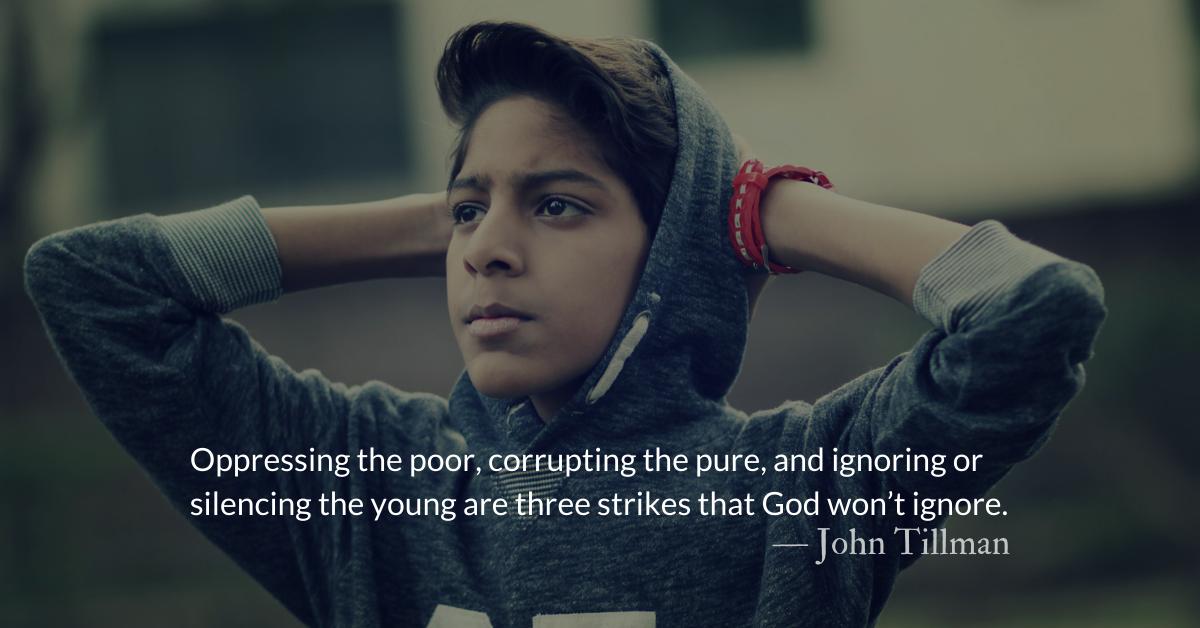
Oppressing the poor, corrupting the pure, and ignoring or silencing the young are three strikes that God won’t ignore.

Let us pray that these will not be strikes against us.
May we rise up from couches of comfort built on the backs of the poor and help them.
May we not corrupt the principles of the pure with our jaded cynicism.
May we listen to the passionate voices of the youth that God moves to speak out. May we listen rather than silence them. 
Give us ears to hear and feet and hands to obey.

Divine Hours Prayer: The Call to Prayer
Come now and see the works of God, how wonderful he is in his doing toward all people. — Psalm 66.4

– Divine Hours prayers from The Divine Hours: Prayers for Autumn and Wintertime by Phyllis Tickle


Today’s Readings
Amos 2(Listen – 2:12)
Psalm 145 (Listen – 2:19)

This Weekend’s Readings
Amos 3(Listen – 2:11), Psalm 146-147 (Listen – 3:09)
Amos 4(Listen – 2:21), Psalm 148-150 (Listen – 3:04)

Read more about The Church, Politics, and the Future
If our political goals are to ease our own suffering, they have nothing to do with living out the gospel.

Read more about Spiritual Vigilance Needed :: Worldwide Prayer
The dangers of spiritual life are more subtle than a home invasion—and more dangerous.

Burden Bearers

Scripture Focus: Amos 1.1-2
1 The words of Amos, one of the shepherds of Tekoa—the vision he saw concerning Israel two years before the earthquake, when Uzziah was king of Judah and Jeroboam son of Jehoash was king of Israel. 
2 He said: 
“The LORD roars from Zion 
and thunders from Jerusalem; 

Reflection: Burden Bearers
By John Tillman

Amos, the fig picker and shepherd prophet, was an outlier. He was not trained as a prophet, was not a part of the priestly lineage or profession, and was not a part of the higher class of educated people from whom most prophets came. And even if all of that were not the case, he was an out-of-towner. He came from the southern kingdom of Judah to the northern kingdom of Israel to confront one of Israel’s most powerful and successful kings.

Financially and militarily, Israel was at a peak of power when Amos arrived. 

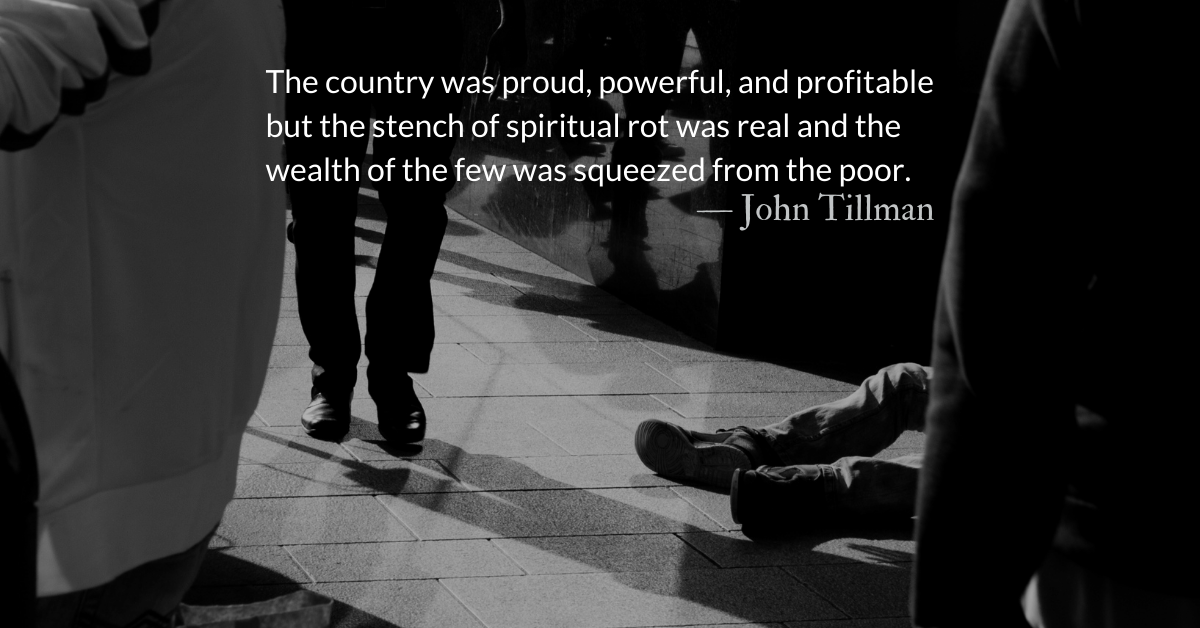
Because of God’s compassion for the people, God had used Jeroboam II to save them militarily, despite him being an evil king. (2 Kings 14.23-27) But God would also remove him. Bad news was coming. The good times were about to be over. The country was proud, powerful, and profitable but the stench of spiritual rot was real and the wealth of the few was squeezed from the poor. (Amos 4.1-2)

Amos would have been comfortable among the fishermen-followers of Jesus. When these men confronted the religious elite of their day, the Sanhedrin were astonished that “they were unschooled, ordinary men…” (Acts 4.13) 

Amos shared the background of the shepherds in the fields who heard of Jesus’ birth. He would have been more familiar with the smell of the sheep and the fields than temple courts and palaces. But instead of carrying “good news of great joy,” Amos carried news of great suffering, judgment, and disaster.

Amos’s name means “burden” or “burden bearer” and he certainly bore a burden. He was burdened with bad news. Yet, the Lord was still willing to relent. (God turned back two judgments due to Amos’s prayers. Amos 7.1-6) Amos was burdened with a love for Judah and Israel. Yet, he would be accused of being an unpatriotic outsider and a conspirator against the king. (Amos 7.10-17)

Often, part of the “good news” of the gospel is the “bad news” of our sins. This is a part of the burden we bear toward others to speak this truth to them in love.

May we, like Amos, be burdened to intercede and intervene. 

May we bring to others the news that Jesus Christ will, if we ask him to, bear our burdens of sin and spare us as a remnant from the judgment to come.

Divine Hours Prayer: The Greeting
To you, O Lord, I lift up my soul; my God, I put my trust in you; let me not be humiliated, nor let my enemies triumph over me. 
Let none who look to you be put to shame. — Psalm 25.1-2

– Divine Hours prayers from The Divine Hours: Prayers for Autumn and Wintertime by Phyllis Tickle


Today’s Readings

Amos 1
(Listen – 2:38)
Psalm 144 (Listen – 1:56)

Read more about Pie In The Sky and Strange Fruit
The trees in the kingdom of God will bear fruit that heals the nation, redeeming the “strange fruit” of oppression and hate.

Read more about The Losers Who Write History
Even under a “good” king Micah spoke of the leaders of Judah when he said, “Therefore because of you, Zion will be plowed like a field…


Unprecedented Peace

Scripture Focus: Joel 3.9-11
9 Proclaim this among the nations: 
Prepare for war! 
Rouse the warriors! 
Let all the fighting men draw near and attack. 
10 Beat your plowshares into swords 
and your pruning hooks into spears. 
Let the weakling say, 
“I am strong!” 
11 Come quickly, all you nations from every side, 
and assemble there. 

Reflection: Unprecedented Peace
By John Tillman

“Beat your plowshares into swords.” is part of a challenge God issues to the nations and it sounds like the taunts of brash pro-wrestlers. 

“Gather all your best warriors. You are all weak, compared to me! But for the moment, fool yourself and say ‘I’m strong.” Grab that plowshare. Make a sword out of it. Grab a metal chair and take your best shot. Weaponize everything. You want a fight? Come and get it..” — based on Joel 3.9-13

Sinful nations need few excuses to turn resources of cultivation into resources of destruction. Rather than plant and grow, they prefer to slash and burn and kill. With this sarcastic taunt, God turns them over to their sin. 

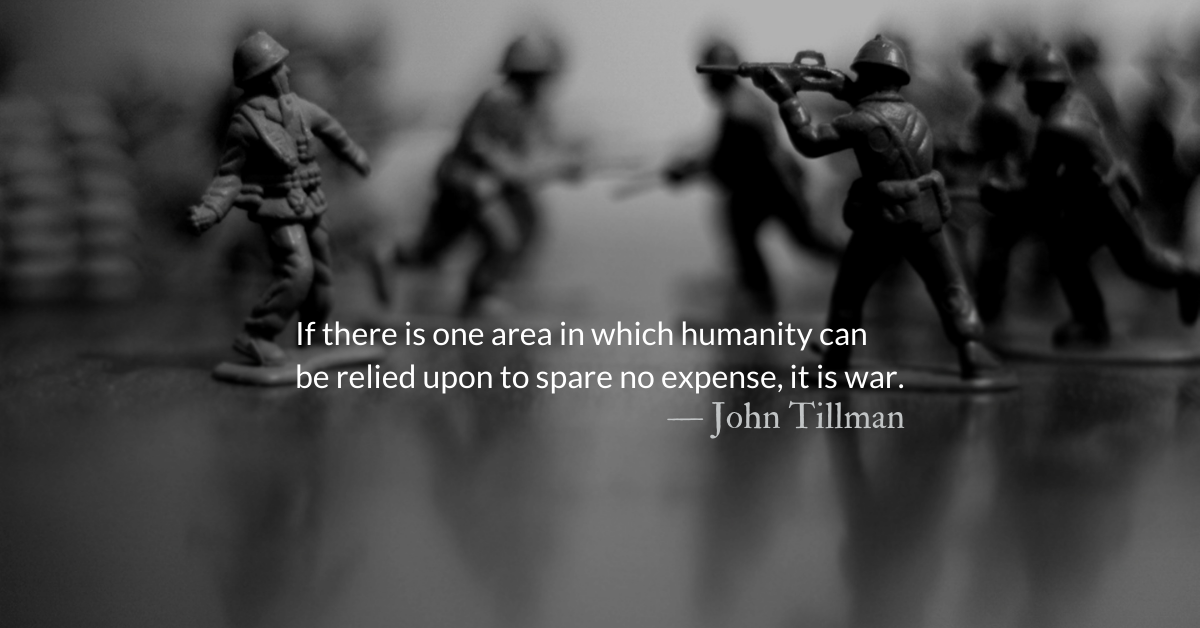
If there is one area in which humanity can be relied upon to spare no expense, it is war. Many nations, not just those of crackpot dictators, allow their populations to suffer or even starve in order to spend more on war. Even peaceful countries which go to war, lose any shyness about deficits. Going all in on war is the default setting.

This is also true in wars of rhetoric. We see this in our culture’s online dialogue. In desperation, every scrap of information is weaponized and our debt to truth is defaulted. We keep beating on conspiracies until we mistake them for a sword of truth.

One group which suffers when leaders dive anxiously into war is soldiers. Most veterans see their service as an honor and spend the majority of their time securing the peace. But honorable soldiers often die in service of dishonorable leadership.

“Beat your plowshares into swords” is not a call for God’s people to answer. This is why Isaiah and Micah both reverse Joel’s warlike taunt, making it a promise of peace, highlighting God’s incredible mercy and redemption. (Joel 3.10; Isaiah 2.4; Micah 4.3) God will put an end to war. 

This reversal is only possible because of Jesus. Without Jesus, we are at war and enemies with God. (Job 19.11; Psalm 68.21; Romans 5.10; Philippians 3.18; Colossians 1.21) Christ not only makes peace with us but makes us agents of peace. (Philippians 4.2-7) This unprecedented peace beyond all understanding, helps us intercede in conflict to make peace.

War is so entrenched in our culture. Violence so widely lauded as a solution. Christians can shine in darkness by clinging to our identity as people of peace.

May we beat our swords into plowshares.
May we make tools of destruction into implements of cultivation.

Divine Hours Prayer: The Morning Psalm
Rescue me from the hurtful sword and deliver me from the hand of foreign peoples,
Whose mouths speak deceitfully and whose right hand is raised in falsehood… — Psalm 144.11.12

– Divine Hours prayers from The Divine Hours: Prayers for Autumn and Wintertime by Phyllis Tickle


Today’s Readings

Joel 3 (Listen – 3:20)
Psalm 143 (Listen – 1:34)

Read more about Unexpected Contents of God’s Cup of Wrath
God punishes us, more often than not, by handing us the bottle of our bad choices and letting us drink up.

Read more about Transcendent Peace and Rest
This is a spiritual rest that can exist in the midst of strenuous activity. It is transcendent rest, that is unassailable by physical suffering.


Unprecedented Spirit

Scripture Focus: Joel 2.32
And everyone who calls 
on the name of the LORD will be saved; 
for on Mount Zion and in Jerusalem 
there will be deliverance, 
as the LORD has said, 
even among the survivors 
whom the LORD calls. 

Psalm 142.5
5 I cry to you, LORD; 
I say, “You are my refuge, 
my portion in the land of the living.” 

Acts 2.39
39 The promise is for you and your children and for all who are far off—for all whom the Lord our God will call.”

Reflection: Unprecedented Spirit
By John Tillman

When joyous prophets pour into the streets, people want to know why. This is especially true if this joy comes at a time of suffering, a time of oppression, and a time of sadness.
 
This was the situation in Jerusalem when the Holy Spirit directed Peter to Joel to describe the experience of being filled with the Spirit of God and explain why men and women, sons and daughters, were prophesying in the streets. (Acts 2.2-21) 

Peter’s audience would have also been familiar with the locust images in Joel’s description of the Babylonian invasion. The Roman legions Peter’s contemporaries were familiar with would, perhaps be an even better visual match than the Babylonians had been for Joel’s images of locusts marching in perfect rows of chitinous, armored doom.

Joel’s prophecy was multilayered in meaning. It referred to the near future of the Babylonian invasion. It also foresaw the far future in which the Lord’s armies will destroy evil, dispelling and disposing of the armies of the opposing empires of this world. Afterward, God will cause growth and abundance to replace barrenness and want.  

God himself will repay the suffering caused by evil upon the earth. The explanation for the significance of this prophecy’s fulfillment is also a part of Peter’s Pentecost sermon. God’s victory over evil, his repayment for loss, and the coming of the Holy Spirit to all who call upon him are all direct outcomes of the death and resurrection of Jesus. 

The very Spirit promised in Joel and poured out in Acts is a deposit, a guarantee, of the inheritance God has for each of us in Christ. (2 Corinthians 1.22; 5.5; Ephesians 1.13-14)

No matter the disaster that seems to surround us or is on its way, there is time to turn to the Lord. There is a time when he will relent. There is always a time when the Lord will relent.

But relenting only comes after repenting. No matter what we have done in the past, up to and including murdering his only son, we can repent and return to God. And the time for repentance is now. It is always now. 

The pouring out of God’s Spirit comes after repentance. It always comes after repentance.

May that day be soon.

And everyone who calls on the name of the LORD will be saved… — Joel 2.32

Divine Hours Prayer: A Reading
Jesus taught us, saying: “Remain in me, as I in you. As a branch cannot bear fruit all by itself, unless it remains part of the vine, neither can you unless you remain in me. I am the vine, you are the branches.” — John 15.4-5

– Divine Hours prayers from The Divine Hours: Prayers for Autumn and Wintertime by Phyllis Tickle

Today’s Readings
Joel 2 (Listen – 5:26)
Psalm 142 (Listen – 1:01)

Read more Rend Your Hearts
God will replace what is lost—including replacing our hearts of stone with the pierced-heart of Jesus.

Read more about The Radical Procedure of the Gospel
It’s lovely to think of God giving us a new heart and putting a new Spirit within us. But it is terrifying to admit to the diagnoses that would lead to such a radical procedure.

Show Buttons
Hide Buttons
Spur a spiritual rhythm of refreshment right in your inbox
By joining this email list you are giving us permission to send you devotional emails each weekday and to communicate occasionally regarding other aspects of the ministry.
100% Privacy. We don't spam.