
Listen and Change

Scripture Focus: Acts 11.1-2
1 The apostles and the believers throughout Judea heard that the Gentiles also had received the word of God. 2 So when Peter went up to Jerusalem, the circumcised believers criticized him 3 and said, “You went into the house of uncircumcised men and ate with them.”
4 Starting from the beginning, Peter told them the whole story:…

18 When they heard this, they had no further objections and praised God, saying, “So then, even to Gentiles God has granted repentance that leads to life.” 

Reflection: Listen and Change
By John Tillman

We’ve heard Peter defend himself to the Pentecost crowds when accused of being drunk too early in the morning. We’ve heard Peter defend himself before the Sanhedrin for healing a crippled man. But now we hear Peter defending himself, not to strangers or Romans or the powerful Jewish leaders, but to fellow Jesus followers!

These Jewish Jesus followers were incensed that Peter had eaten with the “uncircumcised.” He had done something that, according to their interpretation of the Bible and of Jesus, was unquestionably wrong.

Sometimes we must defend ourselves from those who should be standing with us. Sometimes those whose beliefs are the closest to ours attack us more often and with more vitriol than atheists or adherents to other faith systems. However, Peter’s confrontation doesn’t drag on forever like endless Christian-on-Christian attacks on Twitter.

First, Peter explained himself. But then, two things happened that rarely seem to happen today. First, the confronting parties listened to what Peter said. Then they changed their opinion about what he had done.

We can’t get too idealistic about the New Testament church. They were learning how to be the church following Jesus’ ascension. Many things went wrong. Like us, they had scandals, squabbles, and horrible errors. Church history after the canon of scripture includes even greater fights, arguments, and power struggles. There are heresies, councils, ex-communications, and according to tradition, at least one famous punch/slap thrown by Saint Nicolas.

The New Testament church had many of the same problems we do but they did at least one thing better than us by far. They listened to one another and changed. The apostles listened to the neglected Greek widows. And they changed. They listened to Barnabus about Saul. And they changed. The Jerusalem church listened to Peter about the Gentiles. And they changed. Peter listened to Paul when challenged about slipping back into hypocrisy. And he changed.

When was the last time you listened to a brother or sister in Christ…and you changed? I don’t mean abandoning the gospel or losing trust in the scriptures or compromising biblical principles… When have you listened and turned away from an idol? When have you changed your treatment of others? When have you apologized and made amends? When have you repented? When have you admitted you were wrong?

May we, when confronted with truth, be willing to listen and to change.


Divine Hours Prayer: The Request for Presence
Show us the light of your countenance, O God, and come to us. — Psalm 67.1

– From The Divine Hours: Prayers for Springtime by Phyllis Tickle.

Today’s Reading
Leviticus 15 (Listen 4:59
Acts 11 (Listen 3:59)

Read more about Cultivation Means Tending
Cultivation begins with destruction, but continues with tenderness and care…cultivated ground…is carefully controlled.

20190110

Read The Bible With Us
It’s never too late to join our Bible reading plan. Our sustainable, two-year pace cultivates deep knowledge and roots for faith.

https://mailchi.mp/theparkforum/m-f-daily-email-devotional

Knocking on Heaven’s Door

Scripture Focus: Acts 10.36-43
36 You know the message God sent to the people of Israel, announcing the good news of peace through Jesus Christ, who is Lord of all. 37 You know what has happened throughout the province of Judea, beginning in Galilee after the baptism that John preached—38 how God anointed Jesus of Nazareth with the Holy Spirit and power, and how he went around doing good and healing all who were under the power of the devil, because God was with him. 

39 “We are witnesses of everything he did in the country of the Jews and in Jerusalem. They killed him by hanging him on a cross, 40 but God raised him from the dead on the third day and caused him to be seen. 41 He was not seen by all the people, but by witnesses whom God had already chosen—by us who ate and drank with him after he rose from the dead. 42 He commanded us to preach to the people and to testify that he is the one whom God appointed as judge of the living and the dead. 43 All the prophets testify about him that everyone who believes in him receives forgiveness of sins through his name.” 

Reflection: Knocking on Heaven’s Door
By John Tillman

The time of Cornelius’ afternoon prayer and vision is the same time that devout Jews prayed. During his regular practice of prayer, God’s message came to Cornelius.

Even though he was a Yahweh worshiper, Cornelius would only have been allowed into the outer court of the Temple to pray. However, his acts of generosity to the poor and his devotion to prayer were better than the offerings of goats or bulls he might have made. Cornelius knocked and Heaven’s door opened. (Luke 11.9)

Peter would also have been in prayer and meditation when he was confronted by a vision in which God began to chip out of Peter’s heart the prejudices he held against non-Jews and the favoritism he held for his own race. God is still working in our hearts today to shatter favoritism and prejudice.

Tucked into Peter’s meeting with Cornelius is a tidy summary of the gospel that would be easy to overlook. We already heard Peter preach to faithful Jews. We heard him speak before the Sanhedrin. We heard him speak in the Temple. But now, Peter explains the gospel to an outsider…to a Roman Centurion.

Peter assumes Cornelius is aware of most of Jesus’ ministry, saying “You know what has happened…” Even an outsider like Cornelius would have heard of healings, rumors of rebellion, rumblings of riots, and the scandal of Jesus’ execution. More than that, Cornelius knew what it meant for someone to be killed on a cross.

It is important for us to remember that nearly everything that happened to Jesus happened in public. His teaching, miracles, fame, conflict with authorities, and death would all have been public knowledge and, in many cases, public record. What Cornelius needed, and what our unbelieving friends need today, is to hear the testimony that Jesus’ death wasn’t the end. All the evidence Cornelius needed was standing in his home, telling him that Jesus was alive.

Cornelius and Peter found the truth and freedom from sin by seeking God through prayer. Their prayers were invaded by the Holy Spirit. When has the Holy Spirit invaded your prayers to confront you? To call you to reach out? To tell you “there’s more.”

The key to evangelism is not better strategies. It’s prayer. The key to sanctification is not working harder. It’s prayer. If we are purposeful and consistent in prayer, when we knock, doors for the gospel will be opened.

Divine Hours Prayer: The Cry of the Church
Christ has died. Christ has risen. Christ will come again!
– From The Divine Hours: Prayers for Springtime by Phyllis Tickle.

Today’s Reading
Leviticus 14 (Listen 8:11
Acts 10 (Listen 5:49)

Read more about A Mutual Conversion
The conversion of Cornelius and company…God’s impartial love for all humanity impacted Peter…it also compels us as well.

Read more about Putting To Death Racial Hostility
The wellspring of the concept of racial equality is the cross of Christ.

Our Good Friday—Guided Prayer

Scripture Focus: Acts 7.59
59 While they were stoning him, Stephen prayed, “Lord Jesus, receive my spirit.” 60 Then he fell on his knees and cried out, “Lord, do not hold this sin against them.” When he had said this, he fell asleep.

Reflection: Our Good Friday—Guided Prayer
By John Tillman

Dr. Shadrach Meshach Lockridge’s poetic description of Good Friday has often been quoted but I recently attended a performance in which it was set to gospel music. (There’s no video of it, or I would link it for you.) 

Lockridge’s “It’s Friday, but Sunday’s Coming” sits with us in the tension of seeming disaster, the pain of loss, and the feeling that everything has gone wrong.

Each of us may find ourselves in our own “Good Friday” experiences. Like Peter and the other disciples, we may see no hope and want to flee. Like the women and John at the cross, we may be powerless to do anything but weep.

Stephen was the first follower of Christ to face a more literal version of a “Good Friday” when he was put on trial for false accusations and killed for his testimony about Jesus. No matter what kind of despair we find ourselves in, we can know that Sunday is already here in our hearts, even if it hasn’t been fully realized on Earth.

Today, we close with a prayer reflecting on how Stephen faced his accusers by modeling himself after Jesus.

Our Good Friday
Lord Jesus help us to pattern our life after yours.
May we love the unlovable outcasts.
May we love our enemies.
May we speak truth that both challenges and comforts.
May we speak of sins to those who think themselves righteous and of mercy to those who know themselves to be unworthy.

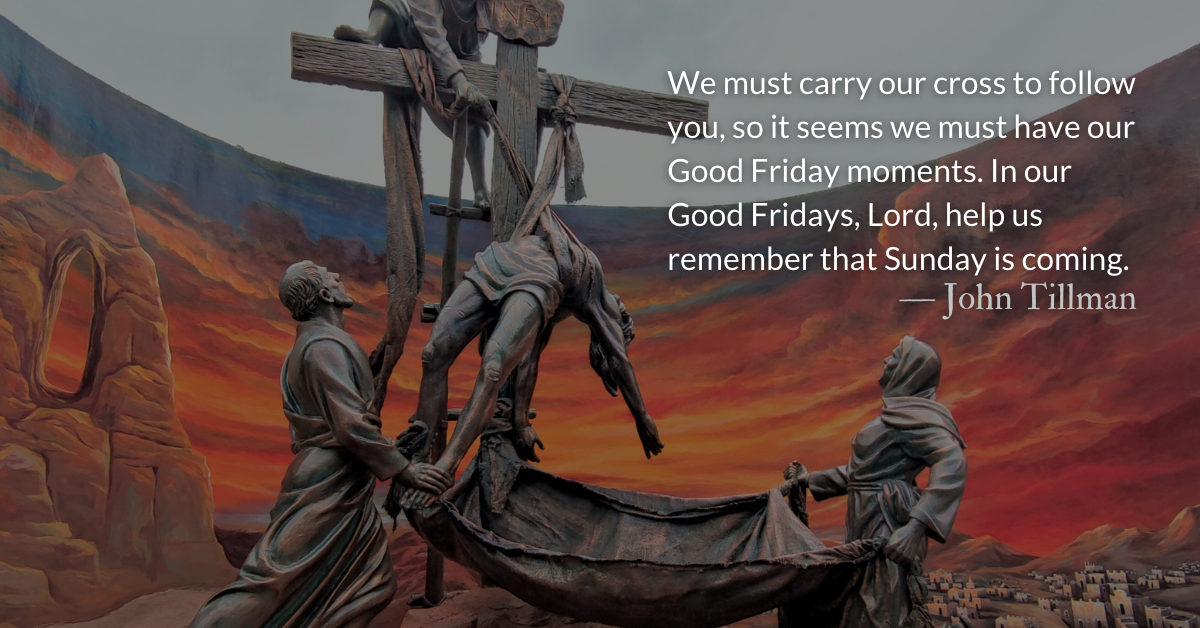
We must carry our cross to follow you, so it seems we must have our Good Friday moments.
When we are insulted and attacked for good works.
When we are unjustly accused and humiliated for the gospel.

In our Good Fridays, Lord, help us remember that Sunday is coming.
That the humble will be lifted
That the meek will inherit
That the weeping will rejoice
That the days of our sojourn, our suffering, and our sanctification will come to an end.

We know that Sunday is coming for us because we are in Friday now and we are following your path.
Sunday is coming for us, because it came for you.
Resurrection is given to us, because we are in you.
Because you got up, we will get up.
Because you rose, we will rise.

We can hold on through the Fridays, Lord, because Sunday is coming.

Divine Hours Prayer: The Refrain for the Morning Lessons
My God, my God, why have you forsaken me? And are so far from my cry and from the words of my distress? — Psalm 22.1


– From The Divine Hours: Prayers for Springtime by Phyllis Tickle.

Today’s Reading
Leviticus 10 (Listen 3:25)
Acts 7 (Listen 8:49)

This Weekend’s Reading
Leviticus 11-12 (Listen 7:20), Acts 8 (Listen 5:10)
Leviticus 13 (Listen 9:34), Acts 9 (Listen 6:05)

Read more about The Wrong People
God doesn’t just use the Stephens. He uses Tamars…Rahabs…Pauls…
If we’ll let him, God will use us, too.

Read more about Much Given, Much Expected
If Abihu and Nadab were given much, how much more have we been given?
We serve a greater High Priest…we bear a greater responsibility.

A Jesus-like Life

Scripture Focus: Acts 6.15
15 All who were sitting in the Sanhedrin looked intently at Stephen, and they saw that his face was like the face of an angel. 

From John: On Maundy Thursday, many Christians observe a ceremony of foot-washing in memory of Jesus washing the disciple’s feet as a model of service. It is fitting then that today we focus on Stephen, one of the church’s first servants, or deacons.

Reflection: A Jesus-like Life
By John Tillman

What does it look like to follow Jesus? To be one who devotes the pattern of their thinking, acting, and speaking to follow him? In two short chapters, Luke tells us.

In less than 2,000 words in the NIV, we read the life, ministry, and death of the church’s first martyr, Stephen. It’s shorter than your average online article. Nearly 1300 words are Stephen’s sermon to the Sanhedrin, so narratively, we have a 700-word story of a life patterned after Jesus.

Stephen’s life maps onto the ministry of Jesus. We can both observe and adopt this pattern.

Stephen was filled with the Holy Spirit. Stephen’s faith was strong and he knew the scriptures well. We can make an intimate inner life of devotion, filled with prayer and scripture, our foundation. (Luke 3.21-22; John 3.34; Acts 7.55-56)

Stephen’s first ministry was serving outcasts and those hurt in a church controversy. He brought justice to an unjust situation, healing to those harmed, and restored the good name of the church in the process. We must serve the hurting and hungry for the sake of the gospel. (Luke 4.16-25; Acts 6.1)

Stephen performed “signs” among the people. We don’t know what kind of “signs” Stephen performed, but we know they were evidence of grace and pointed people to Jesus. We can be known for powerful, beneficial work in our community. God’s power must be used for his purposes, not our own. (Luke 4.2-4; Luke 9.12-17; Acts 6.8)

Stephen faced trouble boldly, but with grace and love. Even in his sharp critique of the leaders, Stephen held out hope and the gospel to them. And he forgave those who killed him. We can be both convincing and winsome. We can forgive our enemies and offer them God’s redemption. (Luke 23.1-4, 33-34; Acts 6.15, 7.59-60)

The pattern of Stephen’s life is the pattern of Jesus’ life and that pattern is the pattern of the cross. Not many Christians will face physical death for the sake of the gospel but we all must lay down our lives on the cross.

What would have to die in our lives for us to live according to this pattern?
…to be more devoted to scriptures and prayer?
…to serve the outcast and the hurting?
…to seek God’s purposes and rely on his power?
…to contend with grace for the gospel?
…to forgive our enemies and do good to them?

Stephen-like, Jesus-like lives will bring salvation to people and growth to the church.

Divine Hours Prayer: The Greeting
Remember your word to your servant, because you have given me hope.
This is my comfort in my trouble, that your promise gives me life. — Psalm 119.49-50

– From The Divine Hours: Prayers for Springtime by Phyllis Tickle.

Today’s Reading
Leviticus 9 (Listen 3:18)
Acts 6 (Listen 2:35)

Read more about The Overflowing Plate
When tempted to add to an already full plate, know that it is wise to ask for help.

Read more about Intimidating, Liberating Glory
When we know the forgiveness of Jesus, God’s glory goes from intimidating to liberating, from terrifying to electrifying.

Worthy of Suffering

Scripture Focus: Acts 5:38-41
 38 Therefore, in the present case I advise you: Leave these men alone! Let them go! For if their purpose or activity is of human origin, it will fail. 39 But if it is from God, you will not be able to stop these men; you will only find yourselves fighting against God.”
40 His speech persuaded them. They called the apostles in and had them flogged. Then they ordered them not to speak in the name of Jesus, and let them go.
41 The apostles left the Sanhedrin, rejoicing because they had been counted worthy of suffering disgrace for the Name. 

Reflection: Worthy of Suffering
By Erin Newton

In a typical counseling session, I begin stories like this: “I had to perform CPR on my child” or “I felt so sad and had to cry.” In a gentle voice, my counselor redirects my words, “You get to…”

I have learned, in time, that her gentle redirections have been a way to change my perspective on the traumatic event. “You get to be the parent of a medically dependent child.” “You get to love someone so much you need to cry.” The pain is always present, but I’ve learned to see the honor of participating in such suffering.

The book of Acts presents the powerful genesis of the church. The Spirit which hovered over the waters in creation descends upon the women and men in the Upper Room. At creation, the breath of God gave life to the newly formed humans. In Acts, the divine tongues of fire bring gifts to the newly formed church. As the church set forth to bring salvation to the people, the apostles healed the sick and performed many signs and wonders.

Although we read the story with excitement and joy, the early church was met with opposition and persecution. The miracles and signs were viewed as problematic and irritating. Every time the work was hindered, the apostles persevered.

The gospel was so important they had to..no, they got to continue preaching through many dangers.

Through the words of Gamaliel, the apostles’ lives were spared. But their flesh was not. They were flogged, just as Jesus has been flogged. They carried on their backs bruises, gashes, and pain.

As they walked home from that meeting with the Sanhedrin, warned once more to keep quiet about Christ, they rejoiced. They got to suffer for Christ. They got to endure pain in the name of the Gospel.

Rejoicing because you suffer is not a typical reaction. It is something given to you by God. It is the joy that surpasses understanding.

I’d like to say that I understand their joy and share in the same but it’s not always the case. We often need a gentle voice that helps us reframe our pain and suffering.

The backs of the apostles undoubtedly hurt for a long time. Pain is not something we smile away. There is the opportunity, at some God-given time afterwards, to rejoice in suffering. May we ask God for this type of joy. 


Divine Hours Prayer: The Refrain for the Morning Lessons
Send forth your strength, O God; establish, O God, what you have wrought for us. — Psalm 68.28

– From The Divine Hours: Prayers for Springtime by Phyllis Tickle.


Today’s Reading

Leviticus 8 (Listen 5:06)
Acts 5 (Listen 6:49)

Read more about In Trouble for Good
There are still Christians today who rejoice in being persecuted. But are they suffering for the name of Jesus or for something else?…for healing…or for harming?

https://theparkforum.org/843-acres/in-trouble-for-good

Read The Bible With Us
It’s never too late to join our Bible reading plan. Immerse in the Bible with us at a sustainable, two-year pace.

https://mailchi.mp/theparkforum/m-f-daily-email-devotional