
Wounded Nobility

“It would seem that unless we see through and beyond the physical, we shall not even see the physical as we ought to see it: as the very vehicle for the glory of God.”

― Elisabeth Elliot

Scripture: Genesis 2.25 – 3.1

And the man and his wife were both naked and were not ashamed.

Now the serpent was more crafty than any other beast of the field that the Lord God had made.

Reflection: Wounded Nobility
The Park Forum

The opening of the book of Genesis, like all ancient creation narratives, is designed to help us understand ourselves and the world we live in—it is the tuning pitch before the chorus of Scripture resounds with the story of God’s everlasting love.

The first narrative of evil in Scripture is meant to shatter the beauty of the two poems that precede it. Observing the stark contrast between the second and third chapter of Genesis, journalist Avi Steinberg comments:

The Hebrew word for naked is ’arum. In the very next sentence, almost as a non sequitur, we are introduced to a new character: “Now the snake was more shrewd (’arum) than all the living-things of the field…” In two consecutive verses, this word ’arum is used to describe the main characters—but the meaning of this single uncommon word is completely different in each verse, indeed opposite.

The humans are naked, ’arum; everything, including their motives, is out in the open. They are guileless. But in the next sentence, in connection with the Snake, the word ’arum means shrewd, sly; the Snake is a trickster who keeps his intentions hidden….

Whoever he might be, the Snake is something more than a snake. He’s a complex character, torn by mixed motives, who seeks justice while also indulging in petty ambition; he is tormented and ultimately undone by his wounded nobility.

The creation account reveals that we share in the beauty of what it means to be created in the image of God—yet we also carry the burden of “wounded nobility” and all its discontents.

Augustine prayed, “our hearts are restless till they find their rest in thee.” This is surely the result of what we read in the third chapter of Genesis—what if it were also our longing each day?

The Call to Prayer

But I will call upon God, and the Lord will deliver me. In the evening, in the morning, and at noonday, I will complain and lament, he will bring me safely back… God, who is enthroned of old, will hear me. — Psalm 55.17ff

— From The Divine Hours: Prayers for Autumn and Wintertime by Phylis Tickle

Full prayer available online and in print.

Today’s Reading
Genesis 4 (Listen – 3:54)
Matthew 4 (Listen – 3:09)
Laboring for Christ

“The grand premise of religion is that man is able to surpass himself; that man who is part of this world may enter into relationship with him who is greater than the world.”

― Abraham Joshua Heschel

Scripture: Genesis 2:15

The Lord God took the man and put him in the garden of Eden to work it and keep it.

Reflection: Laboring for Christ
By Augustine of Hippo (c. 420 C.E.)

We were made, it is true, by the hands of Truth, but because of sin we were cast forth upon days of vanity. “We were made after the image of God,” but we disfigured it by sinful transgression.

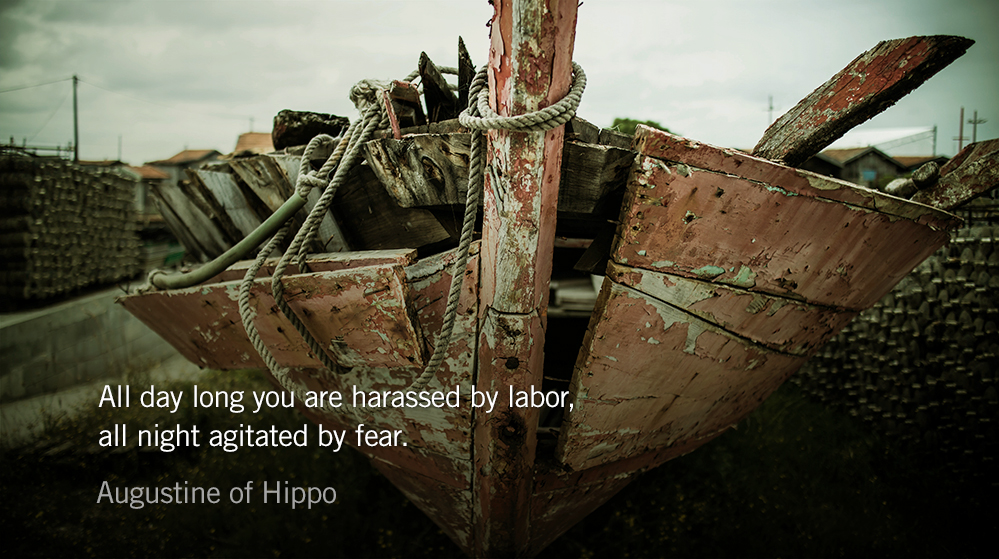
Man walks in the image of truth, and will be disquieted in the counsel of vanity. He is disquieted, he heaps up treasure, he thinks, and toils, and is kept awake by anxiety. All day long you are harassed by labor, all night agitated by fear.

That your coffer may be filled with money, you soul is in a fever of anxiety. Why are you preparing a strong defense for your riches? Hear the Power of God, nothing is more strong than he. Why are you preparing wise counsel to protect your riches? Hear the Wisdom of God, nothing is more wise than he.

“Lay not up for yourselves treasures on earth, where moth and rust doth destroy, and where thieves break through and steal: But lay up for yourselves treasures in heaven, where no thief approaches, nor moth corrupts: For where your treasure is, there will your heart be also.”

I am giving you counsel for keeping, not for losing. The enemy has broken up our house; but could he break heaven open? Though he is the Lord, and does not need our goods—yet that we might do something even for Him—he has granted to be hungry through his poor.

“I was hungry,” he says, “and you gave me food.” Lord, when saw we you hungry? “Forasmuch as you did it to one of the least of mine, you did it to me.” To be brief then, let men hear, and consider as they ought, how great a merit it is to have fed Christ when He hungers.

— Excerpted, and language updated, from Saint Augustin: Sermon on the Mount, Harmony of the Gospels, Homilies on the Gospels.

Prayer: The Refrain for the Morning Lessons

Our Help is in the Name of the Lord, the maker of heaven and earth. — Psalm 124.8

— From The Divine Hours: Prayers for Autumn and Wintertime by Phylis Tickle

Full prayer available online and in print.

Today’s Reading
Genesis 3 (Listen – 4:14)
Matthew 3 (Listen – 2:17)

A New Look at Creation

“Being human always points, and is directed, to something or someone, other than oneself—be it a meaning to fulfill or another human being to encounter. The more one forgets himself—by giving himself to a cause to serve or another person to love—the more human he is.”

— Viktor Frankl

Scripture: Genesis 1.27

So God created man in his own image,
in the image of God he created him;
male and female he created them.

Reflection: A New Look at Creation
The Park Forum

Ancient creation narratives have fallen out of favor in the modern world. Yet even a cursory glance at history reveals a link between a civilization’s understanding of creation and how its people live in the world.

The Ancient Egyptians believed men and women were projected out of the god Atum’s nose as he sneezed over the earth—and their understanding of human rights was a derivative of their understanding of creation. Accounts of ancient Egyptian life document near-perpetual war, systematic injustice, and brutal slavery (pyramids don’t build themselves).

In our own culture, the foundation of human rights is drawn directly from the pages of the Judeo-Christian Scriptures. If humanity were created by chance, as many modern creation accounts hold, what justification is there for individual rights?

In The Idea of Human Rights, Yale law professor Michael Perry concludes, “There is, finally, no intelligible (much less persuasive) secular version of the conviction that every human being is sacred; the only intelligible versions are religious.” The Christian creation narrative teaches that each human being is made in the image of God, and is therefore valuable.

In the Christian creation account we also see:

Genesis’ picture of a world untouched by evil, combines with Christ’s renewal of all things in a world scarred by evil, to give us hope that cannot be taken. A renewed understanding of the Christian creation account not only answers our world’s most difficult questions—like human rights—it reorients our own lives in ways which give us hope, purpose, and joy through the Creator Himself.

The Prayer Appointed for the Week

O God, who wonderfully created, and yet more wonderfully restored, the dignity of human nature: Grant that we may share the divine life of him who humbled himself to share our humanity, your Son, Jesus Christ.

— From The Divine Hours: Prayers for Autumn and Wintertime by Phylis Tickle

Full prayer available online and in print.

Today’s Reading
Genesis 2 (Listen – 3:42)
Matthew 2 (Listen – 3:18)

Rohr on Transformative Faith  :: Reflections for a New Year

By Father Richard Rohr:

Moralism (as opposed to healthy morality) is the reliance on largely arbitrary purity codes, needed rituals, and dutiful “requirements” that are framed as prerequisites for enlightenment. Every group and individual usually begins this way, and I guess it is understandable.

People look for something visible, seemingly demanding, and socially affirming to do or not do rather than undergo a radical transformation of the mind and heart. It is no wonder that Jesus so strongly warns against public prayer, public acts of generosity, and visible fasting in his Sermon on the Mount (Matthew 6:1-18). Yet that is what we still do!

Any external behavior that puts you on moral high ground is always dangerous to the ego because, as Jesus says, “you have received your reward” (Matthew 6:2). Moralism and ritualism allow you to be independently “good” without the love and mercy of God and without being of service to anybody else for that matter. That’s a far cry from the full and final participation we see Jesus offering or any outpouring love of the Trinity.

Our carrot-on-the-stick approach to religion is revealed by the fact that one is never quite pure enough, holy enough, or loyal enough for the presiding group. Obedience is normally a higher virtue than love. This process of “sin management” has kept us clergy in business. There are always outsiders to be kept outside.

Hiding around the edges of this search for moral purity are evils that we have readily overlooked: slavery, sexism, wholesale classism, greed, pedophilia, national conquest, gay oppression, and the oppression of native cultures. Almost all wars were fought with the full blessing of Christians. We have, as a result, what some cynically call “churchianity” or “civil religion” rather than deep or transformative Christianity.

The good news of an incarnational religion, a Spirit-based morality, is that you are not motivated by any outside reward or punishment but actually by participating in the Mystery itself. Carrots are neither needed nor helpful. “It is God, who for [God’s] own loving purpose, puts both the will and the action into you” (see Philippians 2:13). It is not mere rule-following behavior but your actual identity that is radically changing you.

Henceforth, you do things because they are true, not because you have to or you are afraid of punishment. Now you are not so much driven from without (the false self method) but you are drawn from within (the True Self method). The generating motor is inside you now instead of a lure or a threat from outside.

*From Richard Rohr’s Meditation: Drawn from Within.

Today’s Reading
Malachi 3 (Listen – 3:13)
John 20 (Listen – 4:17)


Elisabeth Eliot on the Future :: Reflections for a New Year

By Elisabeth Eliot

While a new year offers us a fresh start, it can also bring anxiety. Questions crowd into our minds. Will my job become redundant? Is God going to keep me single for another whole year? Where is that mate he’s supposed to be bringing me? Where will the money come from for college, rent, clothes, food? Must I continue to suffer this person, this church, this handicap, this pain, this loneliness?

We have a calming word in Psalm 138.8; “The Lord will fulfill his purpose for me; your love, O Lord, endures forever—do not abandon the works of your hands.” That word stands. He will fulfill. His love endures. He will not abandon.

We are meddling with God’s business when we let all the manner of imaginings loose, predicting disaster, contemplating possibilities instead of following one day at a time, God’s plain and simple pathway. When we try to meet difficulties prematurely we have neither a light nor the strength for them yet.

“As thy days, so shall thy strength be” was Moses’ blessing for Asher—in other words, your strength shall equal your days. God knows how to apportion each one’s strength according to that day’s need, however great or small. The psalmist understood this when he wrote, “Lord, you have assigned me my portion and my cup; you have made my lot secure.”

Whatever may be tomorrow’s cross I never seek to find. My father says, ‘Leave me to that, and keep a quiet mind.” — Anonymous

To lug into this new year all the baggage of the last year would greatly impair our ability to concentrate on what our heavenly father wants us to do…. Oswald Chambers wrote:

Our yesterdays present irreparable things to us; it is true that we have lost opportunities which will never return, but God can transform this destructive anxiety into a constructive thoughtfulness for the future. Let the past sleep, but let it sleep on the bosom of Christ. Leave the irreparable past in his hands, and step out into the irresistible future with him.

Can we wholeheartedly surrender to God, leaving quietly with him all the “what ifs” and “but what abouts”? Will we truthfully say to him, “Anything you choose for me Lord—to have, to be, to do, or to suffer. I am at your orders. I have no agenda of my own”?

*Abridged from the Elisabeth Elliot Newsletter.

Today’s Reading
Malachi 2 (Listen – 3:12)
John 19 (Listen – 6:23)


Show Buttons
Hide Buttons
Spur a spiritual rhythm of refreshment right in your inbox
By joining this email list you are giving us permission to send you devotional emails each weekday and to communicate occasionally regarding other aspects of the ministry.
100% Privacy. We don't spam.