Born to Serve

Scripture Focus: Philippians 2.5-8
5 In your relationships with one another, have the same mindset as Christ Jesus:

6 Who, being in very nature God,
    did not consider equality with God something to be used to his own advantage;
7 rather, he made himself nothing
    by taking the very nature of a servant,
    being made in human likeness.
8 And being found in appearance as a man,
    he humbled himself
    by becoming obedient to death—
        even death on a cross!

Reflection: Born to Serve
By Jon Polk

In what is traditionally known as the “Christ Hymn” in Philippians 2, Paul describes who Christ is, and by extension, who God is, and furthermore by example, who we should be.

Who is Christ? Christ was in his very nature God. He was God himself, even though he was uniquely human, too. 

However, Christ didn’t behave the way people expected gods to behave. In the first century, they were more familiar with the volatile, angry gods of the Greek pantheon, who used power to advance themselves or to subdue others. 

Gods didn’t live their lives in humility. Gods didn’t come among their people as servants. And gods especially didn’t sacrifice their lives for the sake of their subjects. 

Paul writes that Christ took the very nature of a servant. He uses the Greek word doulos, which is more properly translated “slave.” A slave existed in servitude to others without advantages, rights or privileges.

Christ became nothing. He emptied himself by pouring out his grace to others. He humbled himself by entering into relationship with lowly humans. He obeyed death, freely giving his life.

Who is God? God’s strength is not in his ability to manipulate or subdue his subjects, but in his willingness to take on the form of his subjects. Not only does God condescend to human form, he chose not to come as a ruler or king but a servant.

Jürgen Moltmann writes in The Crucified God, “God is not greater than he is in this humiliation. God is not more glorious than he is in this self-surrender. God is not more powerful than he is in this helplessness. God is not more divine than he is in this humanity.”

Who should we be? Paul states we should “have the same mindset as Christ Jesus.” Not only does Christ present us with a radical picture of who God is, he presents us with a radical challenge about who we should be: humble servants giving ourselves on behalf of others.

Dietrich Bonhoeffer writes “The church is the church only when it exists for others… It must not underestimate the importance of human example which has its origin in the humanity of Jesus.” 

Jesus Christ is our ultimate example. For certain, none of us could ever be sinless and perfect, but that’s not the example that Paul wants us to see. Jesus is the full representation of God, but he also represents what it means to be fully human: to live life completely in service of others. 

Divine Hours Prayer: A Reading
Jesus taught us, saying: “Enter by the narrow gate, since the road that leads to destruction is wide and spacious, and many take it; but it is a narrow gate and a hard road that leads to life, and only a few find it.” — Matthew 7.13-14

– From The Divine Hours: Prayers for Summertime by Phyllis Tickle.

Today’s Readings
Joshua 20-21 (Listen 7:02)
Philippians 2 (Listen  3:45)

Today’s Readings
Joshua 22 (Listen 6:16), Philippians 3 (Listen  3:21)
Joshua 23 (Listen 2:31), Philippians 4 (Listen  3:20)

Read more about He Stoops to Raise
In every aspect of his life, and death, he intentionally moves from the highest place, to the lowest place.

Read more about Greater Footstool, Greater God, Greater Redeemer
Christ, who is higher and greater than anyone has imagined, would become less and lower than anyone would imagine, to do for us what no one could imagine.

From Privilege to Prisoner to Priest

Scripture Focus: Ephesians 4:1-2
As a prisoner for the Lord, then, I urge you to live a life worthy of the calling you have received. Be completely humble and gentle; be patient, bearing with one another in love.

From John: Our friend and fellow writer, Jon Polk, no longer lives on the other side of the world. We are sad for their time there to end but joyful they will be near to us. As we welcome Jon back to Texas from Hong Kong, we share today his excellent reflection from a few years ago, considering today’s reading in light of events of Saint Francis’s life.

Reflection: From Privilege to Prisoner to Priest
By Jon Polk

St. Francis of Assisi is generally known for his peaceful disposition and love for animals and nature. The Prayer of St. Francis (authorship uncertain, but often attributed to Francis) begins…

Lord, make me an instrument of Thy peace;
Where there is hatred, let me sow love;
Where there is injury, pardon;
Where there is doubt, faith;
Where there is despair, hope;
Where there is darkness, light;
Where there is sadness, joy.

However, this devoted follower of Christ, widely regarded for his vow of poverty, did not begin life in a humble way. Francis was born in Italy around 1181 to a wealthy cloth merchant and his beautiful French wife. By age 14, Francis, spoiled by luxury, dropped out of school and gained a reputation as a rebellious teen, known for drinking, partying, and vanity.

His privileged upbringing afforded him training in archery and horsemanship and when war broke out in 1202, he joined the cavalry. Having no combat experience, Francis was easily captured by opposing forces and imprisoned for a year before ransom was negotiated.

But during his time as a prisoner of war, Francis began to receive visions from God and arrived home a changed man. He turned his heart towards God and spent time in prayer, seeking direction.

Eventually, he felt the call of Christ to serve the Church and to live a life of extreme poverty—fully devoted to Christianity. He is considered by many to be one of the purest examples of living the Christian life, other than Jesus himself.

Certainly, Francis embodies Paul’s encouragement to the Ephesians to “live a life worthy of the calling you have received” and to “be completely humble and gentle.”

Francis’ deep dedication and gratitude to God is seen expressed in these excerpts from a song he composed, Canticle of the Sun. May these words guide our worship and service to Christ.

Most High, all powerful, good Lord,
Yours are the praises, the glory, the honor,
and all blessing.
To You alone, Most High, do they belong,
and no man is worthy to mention Your name.
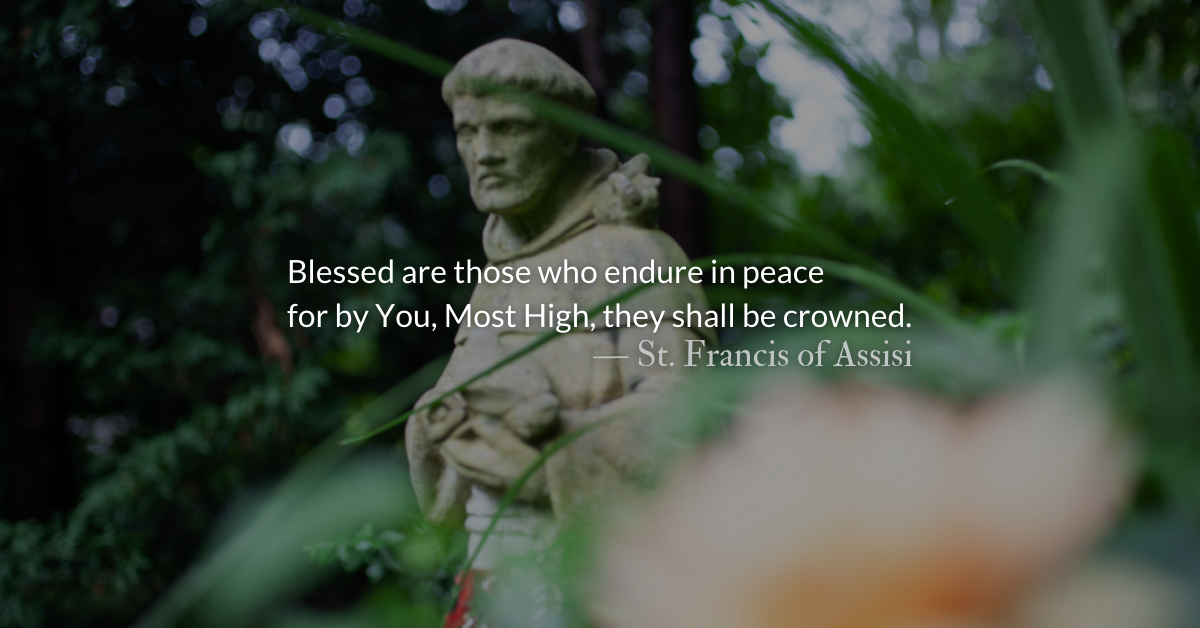
Blessed are those who endure in peace
for by You, Most High, they shall be crowned.
Woe to those who die in mortal sin.
Blessed are those whom death will
find in Your most holy will,
for the second death shall do them no harm.
Praise and bless my Lord,
and give Him thanks
and serve Him with great humility.

Divine Hours Prayer: The Greeting
Let the words of my mouth and the meditation of my heart be acceptable in your sight, O Lord, my strength and my redeemer. — Psalm 19.14

– From The Divine Hours: Prayers for Summertime by Phyllis Tickle.

Today’s Readings
Joshua 12-13 (Listen 8:18)
Ephesians 4 (Listen  3:58)

Read more about Choosing and Being Worthy Overseers
We may be shaped more by secular political media than by Christian voices or our local church…are we choosing our “overseers” wisely?

Read more about Anger Industrial Complex
Anger can form grooves, patterns, in our lives that affect our identity, transforming us into people of anger, rather than people of God.

Not in the Brochure

Scripture Focus: 1 Corinthians 1:21-22, 25
21 For since in the wisdom of God the world through its wisdom did not know him, God was pleased through the foolishness of what was preached to save those who believe. 22 Jews demand signs and Greeks look for wisdom, 23 but we preach Christ crucified: a stumbling block to Jews and foolishness to Gentiles, 24 but to those whom God has called, both Jews and Greeks, Christ the power of God and the wisdom of God. 25 For the foolishness of God is wiser than human wisdom, and the weakness of God is stronger than human strength. 

Reflection: Not in the Brochure
By Jon Polk

Expectations. We all have them. When fulfilled they can be a powerful source of excitement. When dashed, they can lead to tremendous disappointment.

Time for that family holiday to visit the amazing national park which you’ve heard so much about. You’ve studied the brochures, plotted your route and set out with great anticipation. You arrive to discover that the cabins aren’t as clean as they looked in the photos, the mosquitos are large and hungry, and you have to pay extra for firewood! This was not in the brochure!

Jews in Jesus’ day had read the prophets, their brochures describing the coming of the Messiah. Paul writes that “Jews demand signs and Greeks look for wisdom.” Jews expected a victorious Messiah, signs and wonders accompanying a conquering King with power, majesty and glory. The Greeks were sophisticated; they were concerned with the pursuit of wisdom and knowledge for its own sake.

Jesus dashed both their expectations. He did not come as a conqueror to please the Jews, nor as a philosopher to please the Gentiles. Instead, Jesus was a King who demonstrated his power through the sacrifice of his own life and his wisdom by preaching a message of selflessness and humility.

Imagine what even Jesus’ own followers might have felt seeing their beloved master, teacher and friend taken down from the cross and carried off for burial. “What just happened? Wait a minute, Jesus, this is not what we followed you for! This was not in the brochure!”

How would our life brochure read if we wrote it? It probably wouldn’t be much different than the expectations the Jews had for the Messiah. Jesus will solve all your problems. Jesus will make you happy. Jesus will defeat your enemies and those who have done you wrong. Jesus will bring roses and ponies and rainbows.

Now to be fair, Jesus does provide peace, comfort, joy, and satisfaction in life, but not always in the way we might expect. Come to Jesus and sacrifice yourself? Follow Jesus and give your life away? That’s not in our brochure.

The Christian life has a way of not turning out the way we expect. We make our plans, we have our ideas about what God should do for us, we have our own self-focused motivations, but the foolishness of God is wiser than human wisdom. We strive to provide for our own security and comfort in this life, but the weakness of God is stronger than human strength. 

Thankfully, through that foolishness and weakness, we are saved from our own expectations to discover God’s higher wisdom and humble strength and we learn to live a new life, one that we may not have expected.

Divine Hours Prayer: The Request for Presence
Bow down your ear, O Lord, and answer me, for I am poor and in misery.
Keep watch over my life, for I am faithful; save your servant who puts his trust in you. — Psalm 86.1-2

– From The Divine Hours: Prayers for Springtime by Phyllis Tickle.

Today’s Readings
Numbers 27 (Listen 3:08)
1 Corinthians 1 (Listen 4:03)

Read more about A Path Into Darkness
Luke 22 is a turning point…A path into darkness and death…And not just of Jesus. Many of the disciples’ expectations and trusted truths would die.

Read more about Crucified, By Nature
To preach a crucified Christ is to proclaim a King whose very nature is wrapped up in sacrifice.

Carol of the Bells — Carols of Advent Hope

Scripture Focus: Hebrews 13:15-16
15 Through Jesus, therefore, let us continually offer to God a sacrifice of praise—the fruit of lips that openly profess his name. 16 And do not forget to do good and to share with others, for with such sacrifices God is pleased.

Luke 2:10-11
10 But the angel said to them, “Do not be afraid. I bring you good news that will cause great joy for all the people. 11 Today in the town of David a Savior has been born to you; he is the Messiah, the Lord.”

Psalm 150:3-6
3 Praise him with the sounding of the trumpet,
    praise him with the harp and lyre,
4 praise him with timbrel and dancing,
    praise him with the strings and pipe,
5 praise him with the clash of cymbals,
    praise him with resounding cymbals.
6 Let everything that has breath praise the Lord.
Praise the Lord.

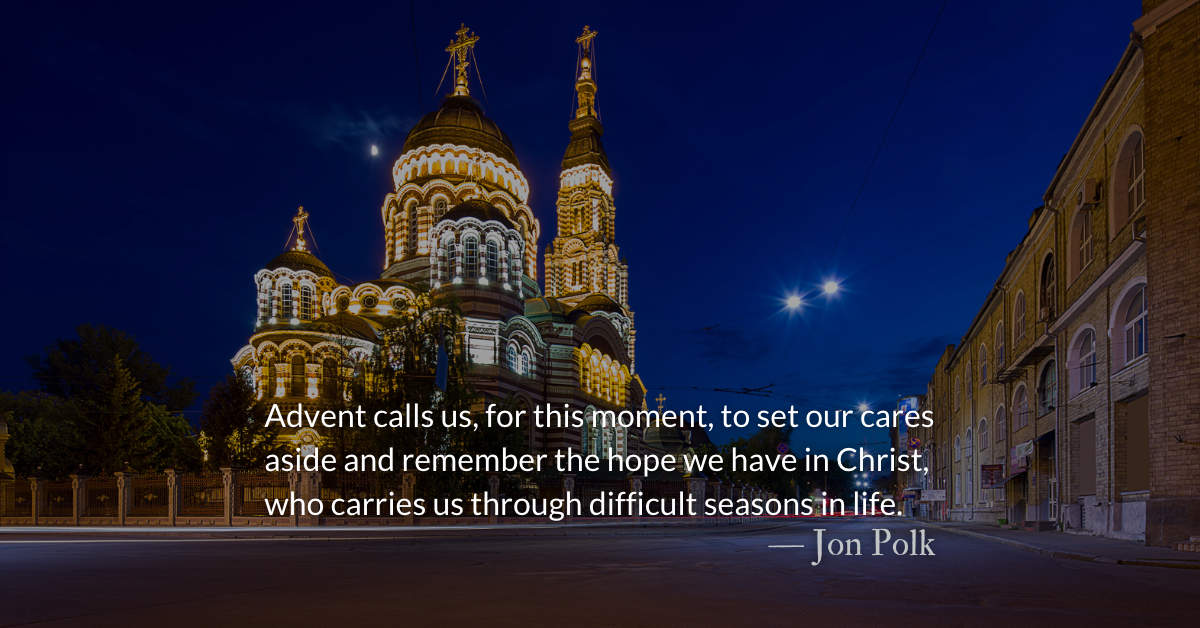
Image: Today’s image is a picture of Blagoveshchensky Cathedral in Kharkiv, Ukraine.

Reflection: Carol of the Bells — Carols of Advent Hope
By Jon Polk

Perhaps recognized less for its lyrics and more for its chime-like melody in three-quarter time, the rhythmic “Carol of the Bells” provides the perfect accompaniment for the holiday season.

Hark how the bells,
sweet silver bells,
all seem to say,
throw cares away
Christmas is here,
bringing good cheer,
to young and old,
meek and the bold.

While now indelibly connected with Christmas, the origins of this carol trace back to a Ukrainian folk song written for New Year celebrations.

The conductor of the Ukrainian Republic Choir commissioned Mykola Leontovych to write a new piece based on traditional folk songs. Leontovych was a composer, conductor and music teacher, but he was also educated as a priest in a Ukrainian seminary and composed the first liturgy in the modern Ukrainian language.

Leontovych wrote “Shchedryk” (“Bountiful Evening”) in 1914 and it was first performed in 1916 by students from Kyiv University. The song, also known by the English title “The Little Swallow,” tells the tale of a swallow who flies into a home, singing a prediction of a bountiful and wonderful year ahead for the family inside.

Bountiful evening, bountiful evening, a New Year’s carol;
A little swallow flew into the household
and started to twitter,
to summon the master:
“Come out, come out, O master,

Your goods [livestock] are great,
you will have a lot of money, by selling them.
If not money, then chaff from all the grain you will harvest
you have a dark-eyebrowed beautiful wife.”

As you can tell, although “Shchedryk” and “Carol of the Bells” may share the same melody, their lyrics are not at all the same.

Leontovych’s song was written during a time of intense political and social turmoil in Ukraine during World War I. In fact, Leontovych himself was killed by a Russian agent in 1921 and he is considered a martyr by the Eastern Orthodox Church in Ukraine. The swallow was a herald of springtime and its presence in the song would have given listeners hope for better days ahead in the New Year. 

When “Shchedryk” was performed by the Ukrainian National Choir in the United States in 1919, American choir conductor Peter Wilhousky, himself of Ukrainian descent, thought the song sounded like handbells ringing. Wilhousky eventually wrote new lyrics and performed his version, focused on Christmas, with the NBC radio orchestra during the Great Depression. Once again, the carol lifted the spirits of listeners during a challenging and difficult time.

Advent calls us, for this moment, to set our cares aside and remember the hope we have in Christ, who carries us through difficult seasons in life. May our hearts be stirred to worship the One who truly brings us hope.

Listen: Carol of the Bells by Fleming & John
Listen: Shchedryk (Ukrainian and English Translation) by Eileen
Read: English Lyrics from LyricsForChristmas.com
Read: Ukrainian Lyrics (with translation) from Wikipedia.org

From John: As the conflict in Ukraine enters its tenth month, please continue to pray. A fellow seminarian Jon and I served with was in Ukraine just before war broke out. Although she is back in the states, the ministry team she served continues their work from Poland, doing what they can to spare and save lives, to provide for refugees, and to spread the gospel as they minister. Pray for their safety as they frequently enter the country to assist those evacuating or to deliver supplies. Pray for the end of the conflict and that people can return to rebuild their lives, cities, and churches.

Divine Hours Prayer: The Request for Presence
Show me your marvelous loving-kindness, O Savior of those who take refuge at your right hand from those who rise up against them.
Keep me as the apple of your eye; hide me under the shadow of your wings. — Psalm 17.7-8

Today’s Readings
Esther 3 (Listen 3:12)
Hebrews 13 (Listen 3:31)

Read more about Supporting Our Work
Give to support biblical literacy, rhythmic Bible reading and prayer, and gospel-centered discipleship.

Read more about Facts and Harsh Realities
The pastors and churches they support in Eastern Ukraine are in real, tangible danger…harsh realities surround them.

The Huron Carol — Carols of Advent Hope

Scripture Focus: Hebrews 12:1-31
Therefore, since we are surrounded by such a great cloud of witnesses, let us throw off everything that hinders and the sin that so easily entangles. And let us run with perseverance the race marked out for us, 2 fixing our eyes on Jesus, the pioneer and perfecter of faith. For the joy set before him he endured the cross, scorning its shame, and sat down at the right hand of the throne of God. 3 Consider him who endured such opposition from sinners, so that you will not grow weary and lose heart.

John 1:14-18
14 The Word became flesh and made his dwelling among us. We have seen his glory, the glory of the one and only Son, who came from the Father, full of grace and truth.

15 (John testified concerning him. He cried out, saying, “This is the one I spoke about when I said, ‘He who comes after me has surpassed me because he was before me.’”) 16 Out of his fullness we have all received grace in place of grace already given. 17 For the law was given through Moses; grace and truth came through Jesus Christ. 18 No one has ever seen God, but the one and only Son, who is himself God and is in closest relationship with the Father, has made him known.

Reflection: The Huron Carol — Carols of Advent Hope
By Jon Polk

Jean de Brébeuf was born in 1593 in France, became a Jesuit at 24 years old, and was ordained as a priest in 1622. As a student, he showed a disposition for language learning. In 1625, Brébeuf was selected as a missionary to Canada, where he began working among the Wendat, several tribes of indigenous peoples which the Jesuits called Hurons.

Brébeuf lived with the natives, becoming an expert in their customs and language, even mastering their oratory style. He also wrote the first dictionary of the Huron language, which he taught to other missionaries.

To effectively communicate the message of Christ, Brébeuf searched for similarities between Christianity and the Huron religion. Embracing their way of life endeared him to the Huron people who gave him the name Echon, meaning “one who carries a heavy burden.”

In 1642, Brébeuf composed a song in the native Huron-Wendat language titled “Jesous Ahatonhia” (“Jesus, he is born”), widely acknowledged as Canada’s oldest Christmas carol. The lyrics framed the birth of Jesus in cultural metaphors of the Huron-Wendat people. Translated, the opening lines read,

Have courage, you who are humans. Jesus, He is born.
Behold, it has fled, the spirit who had us as prisoner.

The English version known as the “Huron Carol” was not written until 1926 by Jesse Middleton, journalist and son of a Methodist minister. Middleton’s version is not a literal translation, but a revision based on Brébeuf’s original, maintaining the concept of utilizing Huron cultural and religious imagery: Jesus is born in a lodge, wrapped in rabbit skin, attended by hunters and chiefs.

Within a lodge of broken bark the tender babe was found
A ragged robe of rabbit skin enwrapped his beauty round
But as the hunter braves drew nigh
The angel song rang loud and high

The earliest moon of wintertime is not so round and fair
As was the ring of glory on the helpless infant there
The chiefs from far before him knelt
With gifts of fox and beaver pelt

Jesus your King is born, Jesus is born,
In excelsis gloria.

Brébeuf was captured with another priest and many Huron-Wendat converts in an Iroquois raid on the Huron mission in 1649. While being tortured, it was reported that he was concerned more about the fate of his fellow missionaries and the natives than he was for himself. 

Christian missionaries throughout history like Brébeuf have demonstrated by the commitment of their lives that Jesus was indeed born for all peoples, in all places, at all times. Jean de Brébeuf gave his life for Christ, yes, but also for the Wendat people, imitating the very Christ he served, who left his heavenly home to live and walk among us, and yes, even sacrifice himself for us.

Listen: Huron Carol by Sarah McLachlan
Listen: Iesus Ahatonnia by Bruce Cockburn
Read: Lyrics from Wikipedia.org

Divine Hours Prayer: The Call to Prayer
Know this: The Lord himself is God; he himself has made us, and we are his; we are his people and the sheep of his pasture. — Psalm 100.2

Today’s Readings
Esther 2 (Listen 4:31)
Hebrews 12 (Listen 4:36)

Read more about Supporting Our Work
We need your help to provide biblical content for free with no ads. Biblical literacy is the foundation of effective discipleship.

Read more about Beyond Self-Centered Religion
Jesus shows up and announces hope…To none other than the “islands” and the “distant nations”— not just Israel.