Orchestrating Our Prayers

Scripture Focus: Nehemiah 12.31, 38, 40, 42-43
I had the leaders of Judah go up on top of the wall. I also assigned two large choirs to give thanks. One was to proceed on top of the wall to the right, toward the Dung Gate….the second choir proceeded in the opposite direction…The two choirs that gave thanks then took their places in the house of God…the choirs sang under the direction of Jezrahiah. And on that day they offered great sacrifices, rejoicing because God had given them great joy. The women and children also rejoiced. The sound of rejoicing in Jerusalem could be heard far away.

Reflection: Orchestrating Our Prayers
By John Tillman

Imagine John Williams walking in to conduct Star Wars or the Jurassic Park score or one of his other masterpieces and there being one banjo and a kazoo… 

Ezra and Nehemiah were rebuilding not just the physical structures of the wall and the Temple, but the logistics and schedules of the workers and musical performers who made worship happen. And as the text emphasizes, this took a considerable investment (Nehemiah 12.47) from the community. 

Music, like little else, has the power to move us, touching us on an emotional and spiritual level. For many reasons (often involving finances) church music in many, many places has retreated from the large orchestras and choirs of the past to pragmatic, small combos of musicians. 

Expansive worship can be expensive. Especially if you are, as Nehemiah and Ezra were, following the precise directions and orchestrations dictated a few centuries ago by a master musician (David) composing in his golden age and having his music performed and arranged by the virtuosic voice of Asaph. Virtuosos don’t skimp on instrumentation.

As much as I personally enjoy a variety of instrumentation and both modern and ancient musical styles, there is something powerful about hearing the full range of sound that orchestral composers imagine. 

Hans Zimmer, for the score of the mind-bending film, Inception, assembled the largest brass section that had ever been recorded. For his lofty, dreamlike score for the film, Interstellar, Zimmer employed the unique sounds of the 1926 four-manual Harrison & Harrison organ, currently housed at the 12th-century Temple Church in London and played in the movie by its director of music, Roger Sayer.

We worship in spirit and truth, not according to musical styles and yet, at times, I long for the thick, layered instrumentation that stories in movie houses get, but are rarely supplied to the story of the gospel. Sometimes I miss the inclusive sound of a choir that carries my voice with theirs.

In our hearts, however, we are the new temple of God to replace the one Nehemiah built. No matter what echoes around our ears, in our hearts, we can antiphonally sing scripture back and forth with the Holy Spirit in perfect harmony.

May we become virtuosos of prayer, playing every note in a harmonious crescendo.
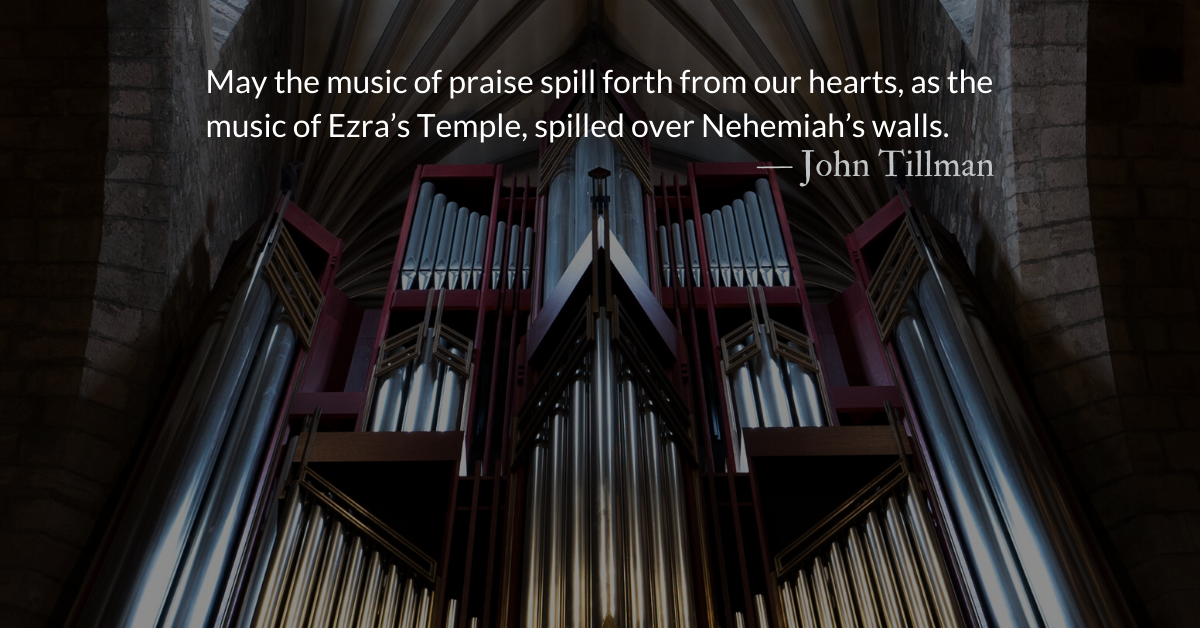
May the prayers of our hearts be louder than a thousand brass instruments, and the sighs of our spirit be more vibrant than the air thrumming through a thousand pipe organs.
May the music of praise spill forth from our hearts, as the music of Ezra’s Temple, spilled over Nehemiah’s walls.

Divine Hours Prayer: The Greeting
I will offer you the sacrifice of thanksgiving and call upon the Name of the Lord. — Psalm 116.15

– From The Divine Hours: Prayers for Autumn and Wintertime by Phyllis Tickle.

Today’s Readings
Nehemiah 12 (Listen -6:30)
Acts 22 (Listen -4:26)

Read more about Praying as Music
If music is a universal language, prayer can be similarly described.

Read more about Praying Through Ancient Hymns :: Worldwide Prayer
All creatures of our God and King, lift up your voice with us sing…Alleluia…
Moving Into the City

Scripture Focus: Nehemiah 11.1-2
Now the leaders of the people settled in Jerusalem. The rest of the people cast lots to bring one out of every ten of them to live in Jerusalem, the holy city, while the remaining nine were to stay in their own towns. The people commended all who volunteered to live in Jerusalem.

Reflection: Moving Into the City
By John Tillman

In our urban-slanted view of culture, it is hard for us to imagine why the population of Jerusalem needed to be propped up by a lottery, choosing one-in-ten men to move into the city. “Who wouldn’t want to live in the city?”, we might think to ourselves.

But when we drill down, we find that in this situation, the city was literally being rebuilt from the ground up and there were armed forces threatening attack. Jerusalem wasn’t a glittering capital, even with its restored Temple and rebuilt wall. Being chosen to move there was more like being drafted into military service than getting to move to a midtown condo.

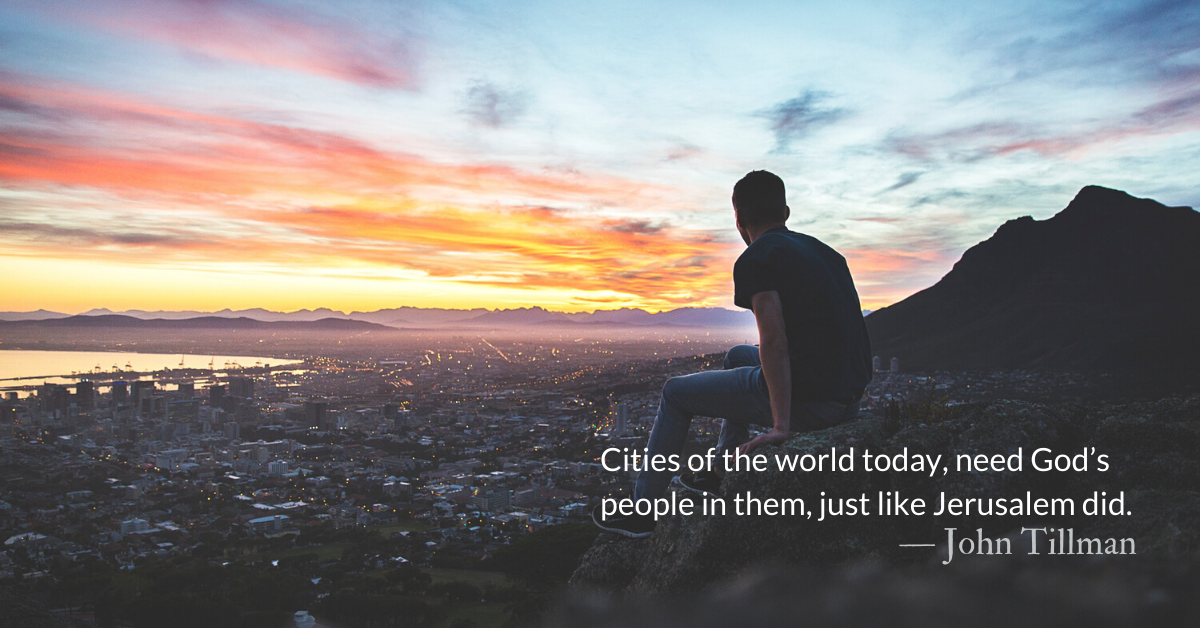
Cities of the world today need God’s people in them, just like Jerusalem did. Cities simultaneously hold some of the greatest potential for our planet and the greatest evils. 

The urban population, 34% in 1960, has continued to grow over the past 60 years. Today 55% of the world’s population live in urban areas. By 2050, it may be 68%.

The growth isn’t happening primarily in Western mega-cities. Urban population growth is concentrated in less developed regions of the world where for the first time a majority of people are living in urban areas. 

But this is not a situation in which people are trading horrible conditions and deprivation in the country for blissful, glittering, city-of-tomorrow dwellings that futurists expected humanity to be living in a fifth of the way through the 21st century. In fact, 40% of global urban population growth is happening in slums which exacerbates health risks and introduces new hazards.

Cities also produce 80% of the world’s GDP but this statistic is misleading. All the financial productivity of the cities is literally fed by the rural areas surrounding them. Also, very little of the financial benefits earned by cities ever manages to make its way to helping the workers who live in the slums or the rural residents who support the city’s elite.

As we wait for the day we will live in the New Jerusalem, let us not abandon the “Jerusalems” in our own nations.
May we, the church, pray earnestly for cities and ask the Holy Spirit to prompt us what we can do to help the most helpless, and confront the most powerful.
May we make our light shine through good deeds, showing God’s mercy and his grace to us, and turning slums and suburbs into cities on a hill.

*Statistics from World Health Organization.

Divine Hours Prayer: The Request for Presence
Early in the morning I cry out to you, for in your word is my trust. — Psalm 119.147

– From The Divine Hours: Prayers for Autumn and Wintertime by Phyllis Tickle.

Today’s Readings
Nehemiah 11 (Listen -5:05)
Acts 21 (Listen -5:55)

Read more about Christ: Temple, River, and City
Christ is our city. He is our refuge and rest—our strong tower and protected place—our park of peace in the midst of a frantic and fracturing world

Read more about Christ, the True Hero
It is Christ, not us, who is the hero of our cities and our world.

A Recurring Nightmare

Scripture Focus: Nehemiah 10.39
We will not neglect the house of our God.

Acts 20.20-21
You know that I have not hesitated to preach anything that would be helpful to you but have taught you publicly and from house to house. I have declared to both Jews and Greeks that they must turn to God in repentance and have faith in our Lord Jesus. 

From John:

Again this year, on Martin Luther King Jr. Day in the United States, we look back to a sermon from Dr. King

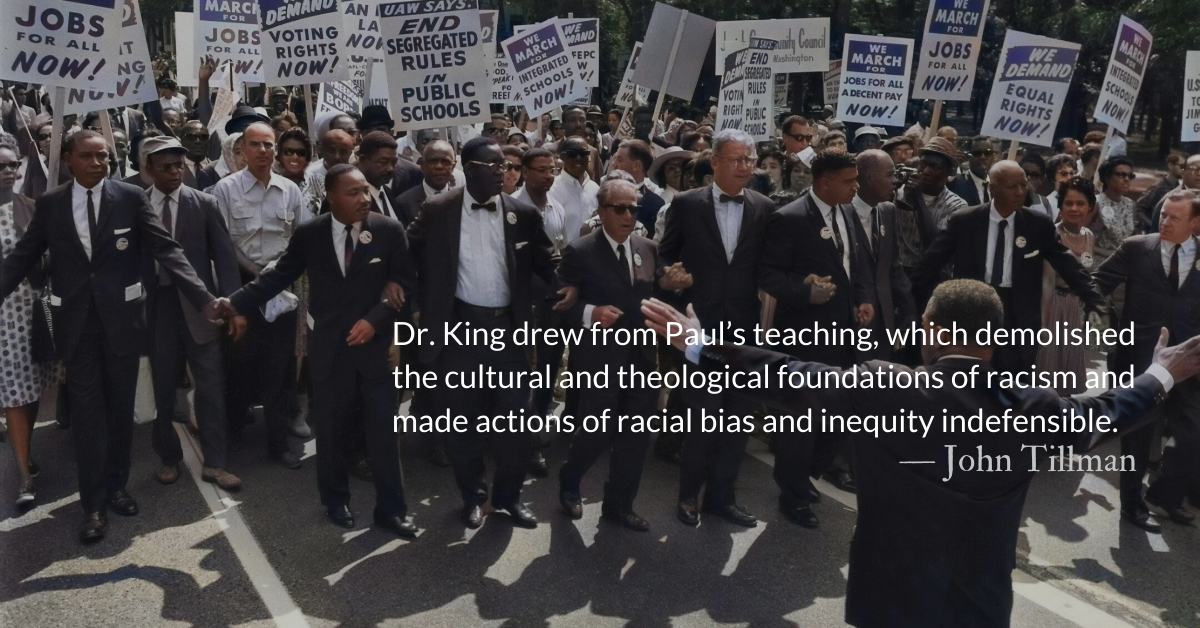
Like Dr. King, Paul was interested in actions which spring from the full implications of the gospel. Though racism and slavery took centuries to fall, it was Paul’s theology that struck the killing blow in the 1st century. Dr. King drew from Paul’s teaching, which demolished the cultural and theological foundations of racism and made actions of racial bias and inequity indefensible. (Though some will still try to defend them…)

The gospel is the only theology or philosophy which poisons racism at its root.

When we speak of spreading the gospel, may it be with the purpose of eradicating the scourge of racism, rather than apathetically denying its existence or mitigating our responsibility to oppose it.

Reflection: A Recurring Nightmare

By Dr. Martin Luther King Jr. (1929-1968)

In 1963, on a sweltering August afternoon, we stood in Washington, D.C. and talked to the nation about many things. Toward the end of that afternoon, I tried to talk to the nation about a dream that I had had—and I must confess to you today that not long after talking about that dream I started seeing it turn into a nightmare.

I remember the first time I saw that dream turn into a nightmare, just a few weeks after I had talked about it. It was when four beautiful, unoffending, innocent Negro girls were murdered in a church in Birmingham, Alabama. I watched that dream turn into a nightmare as I moved through the ghettos of the nation and saw my black brothers and sisters perishing on a lonely island of poverty in the midst of a vast ocean of material prosperity, and saw the nation doing nothing to grapple with the Negroes’ problem of poverty.

I saw that dream turn into a nightmare as I watched my black brothers and sisters in the midst of anger and understandable outrage, in the midst of their hurt, in the midst of their disappointment, turn to misguided riots to try to solve that problem. I saw that dream turn into a nightmare as I watched the war in Vietnam escalating, and as I saw so-called military advisors, sixteen thousand strong, turn into fighting soldiers until today over five hundred thousand American boys are fighting on Asian soil.

Yes, I am personally the victim of deferred dreams, of blasted hopes, but in spite of that I close today by saying I still have a dream, because, you know, you can’t give up in life. If you lose hope, somehow you lose that vitality that keeps life moving, you lose that courage to be, that quality that helps you go on in spite of all. And so today I still have a dream.…

I still have a dream today that one day every valley shall be exalted and every mountain and hill will be made low, the rough places will be made smooth and the crooked places straight, and the glory of the Lord shall be revealed, and all flesh shall see it together. I still have a dream that with this faith we will be able to adjourn the councils of despair and bring new light into the dark chambers of pessimism.

With this faith we will be able to speed up the day when there will be peace on earth and good will toward men. It will be a glorious day, the morning stars will sing together, and the sons of God will shout for joy.

*Abridged from A Christmas Sermon by Dr. Martin Luther King Jr. — audio on YouTube (29:52)

Divine Hours Prayer: The Refrain for the Morning Lessons

Then shall all the trees of the wood shout for joy before the Lord when he comes, when he comes to judge the earth. — Psalm 96.12

– From The Divine Hours: Prayers for Autumn and Wintertime by Phyllis Tickle.


Today’s Readings
Nehemiah 10 (Listen -4:41)
Acts 20 (Listen -5:22)

Extremism as a Discipleship Problem

Scripture Focus: Acts 17.4-5
Some of the Jews were persuaded and joined Paul and Silas, as did a large number of God-fearing Greeks and quite a few prominent women. 
But other Jews were jealous; so they rounded up some bad characters from the marketplace, formed a mob and started a riot in the city.

1 Thessalonians 4.6
You became imitators of us and of the Lord, for you welcomed the message in the midst of severe suffering with the joy given by the Holy Spirit.

Reflection: Extremism as a Discipleship Problem
By John Tillman

Audiences have long been fascinated with extremism and the process of radicalization. In 2018 a TV series retelling events surrounding the 1993 raid that killed David Koresh and the Branch Davidians, served as a reminder that radicalization is not merely a third-world or a Muslim problem.

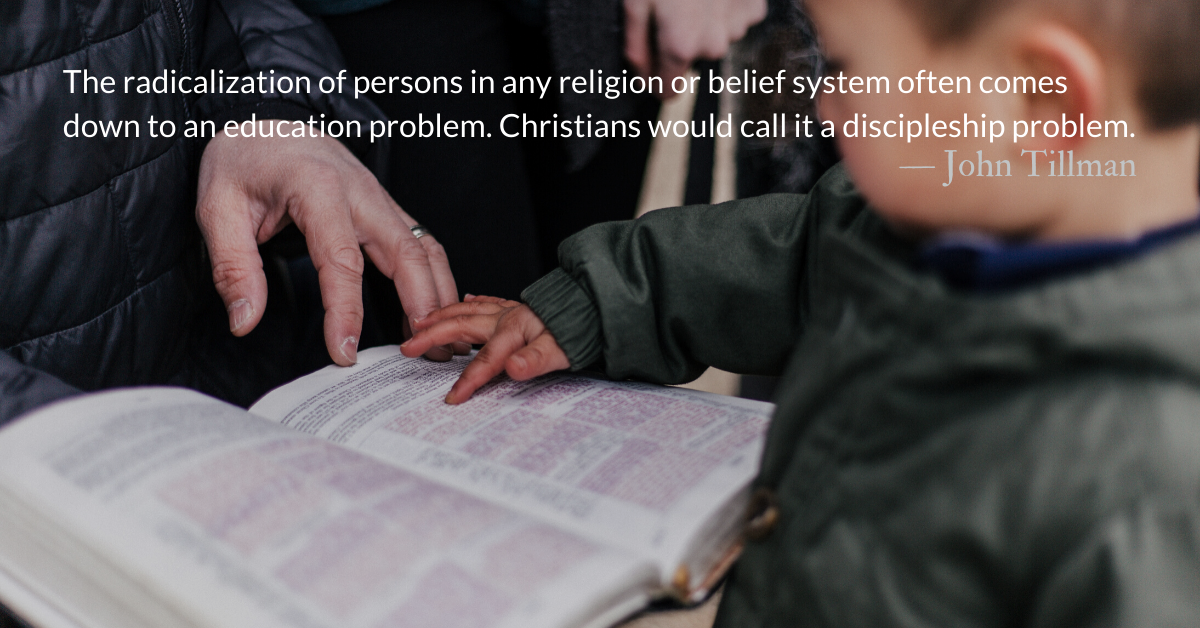
Radicalization has been imagined in fiction as psychological manipulation, as brainwashing, and as bribery. It has even been sympathetically redressed as the rational actions of those with legitimate grievances. But the radicalization of persons in any religion or belief system often comes down to an education problem. Christians would call it a discipleship problem.

Islamist terrorists such as, Sayfullo Saipov, who carried out a truck attack in Manhattan in 2017, are often motivated by a faith that in the end is little more than a political and ethnic identity.

After acts of violence from their members, many Imams and Christian pastors can be found saying some version of, “That’s not what we teach.” Whether these statements are true or not, they are a confession of poor discipleship which has far wider-ranging effects than the infinitesimal percentage of Christians (or Muslims) who resort to violent attacks.

Poor discipleship in Western faith is allowing Christianity to become little more than a political distinction and in some cases, a racial one. Our brand of moralism is a hair’s breadth off from the Pharisees of the New Testament. Like the Pharisees, we use moralistic interpretations of scripture to justify denying assistance to the needy. We are not ashamed to make embarrassing political alliances to ensure that we don’t lose our place of cultural influence.

We can find hope, however, in today’s readings in Acts. Though the Bereans are called “more noble” than the Thessalonians, it is the Thessalonian church that is more well known to us through the letters Paul writes to them. First Thessalonians is a joyful celebration of those who were left in a difficult situation, without Paul who introduced them to Christianity. (And without Google.) Yet through diligence, faith, and the guidance of the Holy Spirit, persevered and blossomed in faith.

Even in a culture dominated by a brutal empire, those willing to devote themselves to prayer, Bible reading, and connecting to the Holy Spirit, can not only survive our culture but continue the process of transforming it one life at a time.

Divine Hours Prayer: A Reading
Jesus taught us, saying: “Why do you observe the splinter in your brother’s eye and never notice the great log in your own? How can you say to your brother, ‘Brother, let me take that splinter out of your eye,’ when you cannot see the great log in your own? Hypocrite! Take the log out of your own eye first, and then you will see clearly enough to take out the splinter in your brother’s eye.” — Luke 6.41-42

– From The Divine Hours: Prayers for Autumn and Wintertime by Phyllis Tickle.

Today’s Readings
Nehemiah 7 (Listen -6:37)
Acts 17 (Listen -5:28)

This Weekend’s Readings
Nehemiah 8 (Listen -4:07) Acts 18 (Listen -4:06)
Nehemiah 9 (Listen -7:48) Acts 19 (Listen -5:47)

Read more about The Church of Acts
The clue Luke gives us is in the title—Acts. They will know we are Christians by our love. By our actions.

Read more about The Energy of Expectancy
The time of waiting is past. The light is here. The starting pistol has fired. The gate is open. The race has begun.

Detoured by the Holy Spirit

Scripture Focus: Scripture: Acts 16.6-7
Paul and his companions traveled throughout the region of Phrygia and Galatia, having been kept by the Holy Spirit from preaching the word in the province of Asia. When they came to the border of Mysia, they tried to enter Bithynia, but the Spirit of Jesus would not allow them to.

Reflection:  Detoured by the Holy Spirit

By Jon Polk

Paul, Silas and Timothy intended to go and spread the message of Christ in some very major and influential cities in Asia Minor, cities that had access to roads and commerce which would help the gospel message spread. While this certainly sounds like a smart idea, God had other plans for them in Macedonia. God often changes the plans of even those with the best intentions.

Scottish pioneer medical missionary and explorer David Livingstone had hoped to travel to China as a missionary, but the Opium Wars kept him from going. He later met a missionary on leave from South Africa who convinced him to go there instead. It was there that Livingstone laid the groundwork for several major European missionary efforts to Africa.

Adoniram Judson
, one of the first American missionaries to travel overseas, initially began his work in India, but along with many others, he was ordered out of the country by the British East India Company. He then moved to Burma, where he started a number of churches and translated the Bible into Burmese.

The legendary William Carey, called the “father of modern missions,” wanted to go to the Polynesian Islands, but God had directed another missionary there, so William Carey ended up in India instead. While there, he helped form the Baptist Missionary Society, one of the first major modern mission sending organizations.

Sometimes we like to think we have everything in our life so planned out that all we need to do is pray to God and ask him to bless our plans. We expect everything to unfold exactly as we’ve scripted it, but in reality that is almost never the case. Often, it is the interruptions, the redirections, and the unexpected changes that shape and mold us most. When following God, we need to be ready and willing to take a detour in unexpected directions.

This is the perspective that Paul, Silas and Timothy had to have as they were time and again redirected by God on their travels. This perspective helps keep us in touch with God’s leading in our lives, allowing him to take us where he pleases, rather than us trying to find the easiest or shortest path between two points. Growth can occur most along the twisting, winding path and God knows the way much better than we do.

Divine Hours Prayer: The Request for Presence
Teach me your way, O Lord, and I will walk in your truth; knit my heart to you that I may fear your name. — Psalm 86.11

– From The Divine Hours: Prayers for Autumn and Wintertime by Phyllis Tickle.

Today’s Readings
Nehemiah 6 (Listen -3:19)
Acts 16 (Listen -5:53)

Read more about Following Through Jerusalem
When Jesus calls us to follow him, …the path leading to glory with Christ is the path leading through suffering to death.

Read more about Christ’s Supremacy :: A Guided Prayer
People, issues, politics, career—these things all push to the front of our minds and demand our supreme attention and commitment.

Show Buttons
Hide Buttons
Spur a spiritual rhythm of refreshment right in your inbox
By joining this email list you are giving us permission to send you devotional emails each weekday and to communicate occasionally regarding other aspects of the ministry.
100% Privacy. We don't spam.