Discipline for the Anxious

Scripture Focus: Psalm 77.1-4
1 I cried out to God for help; 
I cried out to God to hear me. 
2 When I was in distress, I sought the Lord; 
at night I stretched out untiring hands, 
and I would not be comforted. 
3 I remembered you, God, and I groaned; 
I meditated, and my spirit grew faint. g 
4 You kept my eyes from closing; 
I was too troubled to speak.

From John: This rewritten post was first posted in 2018. Since then, suicide rates continue to rise in the United States among Christians and Christian ministers. With Covid and political strife crossing into church life, it hasn’t exactly gotten any easier for pastors in the past few years. Many have left the ministry under these pressures. For ministers and laypersons, Christian meditation and prayer is vital to surviving our world but Jesus and Paul would both testify that some problems can’t be “prayed away.” Seeing a counselor or doctor does not make one unfaithful. See the resources at the end of this post for help and more information.

Reflection: Discipline for the Anxious
By John Tillman

We live in distressing times. If there are corners of our world not touched by division, aggression, worry, and angst, you probably can’t get email there.

Anxiety, depression, and other mental health issues have long been on the rise—especially among younger adults. Depression used to be the leading mental health issue. It’s been overwhelmingly surpassed by diagnoses of anxiety. In 2020 and 2021, Covid and the distressing task of sorting through the disinformation and politicization of the deadly disease drove anxiety to new heights. According to the CDC, symptoms of anxiety and depression peaked in December 2020 and January 2021 but are still far above previous norms.

A Harvard study found that church attendance paired with spiritual disciplines such as meditation and prayer have a beneficial effect on mental health. In a Forbes article, study author Ying Chen noted that being raised religiously, “can powerfully affect [children’s] health behaviors, mental health, and overall happiness and well-being.”

The psalmists would not express surprise at these findings. Though we think of our society as facing pressures unknown to humanity until now, we would be mistaken to think of ancient times as idyllic and calm.

David and the other psalmists certainly knew what it was like to live under threat, under financial pressure, under the constant weight of political instability and the wavering loyalty of an unpredictable government.

Amidst such pressures, they had a safe haven. Their help for the stresses of life was meditation and prayer.*

The psalmist writes of being “too troubled to speak,” yet he cries to God. He writes of insomnia, yet he rests in God. He writes of doubts and of feeling that God has rejected him, that his love has vanished, that he had forgotten to be merciful. Yet in the midst of doubts and fears, he remembers God’s faithfulness in the past. He meditates on these memories in the heated moment of stress.

The benefits of meditation can help in a crisis but are no quick fix. Meditation is not a fast-acting antidote for the world’s venom, but an inoculation to be taken ahead of time.

When beginning (or returning to) meditative prayer, start small and short. Use the prayer provided at the end of this devotional (Psalm 119.147) as a start. Spend two to five minutes simply re-reading the prayer with an expectant heart, asking God to be with you.

*We are in no way implying that meditation should be pursued in lieu of proper medical treatment. If you are in need of counseling and professional services, please consider the following resources:

Mental Health Grace Alliance
Not A Day Promised Resource Page
Life Recovered (Resources for Ministers)
Suicide Prevention Lifeline
Action Alliance for Suicide Prevention
Suicide Prevention Resource Center

Divine Hours Prayer: The Call to Prayer
Search for the Lord and his strength; continually seek his face. — Psalm 105.4

Today’s Readings
Proverbs 13 (Listen – 2:45)
Psalm 77 (Listen – 2:12)

Read more about The Practice of Meditation :: Running
One way of thinking of meditative prayer is exercise to expand your spiritual lung capacity, allowing you to breathe in God’s spirit more naturally.

Read more about Breathing Prayers
The social, financial, and mental health costs of this sickness are pushing our culture to the end of the ability of the “human spirit” to endure.
Curses We Speak Curse Us

Scripture Focus: Proverbs 12.13-20
13 Evildoers are trapped by their sinful talk, 
and so the innocent escape trouble. 
14 From the fruit of their lips people are filled with good things, 
and the work of their hands brings them reward. 
15 The way of fools seems right to them, 
but the wise listen to advice. 
16 Fools show their annoyance at once, 
but the prudent overlook an insult. 
17 An honest witness tells the truth, 
but a false witness tells lies. 
18 The words of the reckless pierce like swords, 
but the tongue of the wise brings healing. 
19 Truthful lips endure forever, 
but a lying tongue lasts only a moment. 
20 Deceit is in the hearts of those who plot evil, 
but those who promote peace have joy. 

Reflection: Curses We Speak Curse Us
By John Tillman

Righteous speech matters to God.

Like most people, I was taught that God wanted us to not use “curse words.” “Cussing” was something I commonly confessed or prayed that God would help to eliminate from my life. Avoiding these words was a cultural marker that defined an outward kind of righteousness.

The language of our culture has coarsened over time. Today, “locker room talk” has spilled over into public life. Obscenities are often worn openly on clothing and used in political signs and slogans. Many Christians have abandoned language norms in service of politics. Vulgar attacks of political candidates can be found on bumper stickers in church parking lots on Sunday mornings.

Righteous speech matters more today than it ever has before. It can be an important marker of difference that sets us apart. However, righteous speech, as the Bible describes it, is not so much a change of vocabulary as a change of heart. Scripture condemns words that curse others but nowhere is there a specific list of “curse words.” Even loudly “blessing” someone too early in the morning can be considered a curse. (Proverbs 27.14)

Righteous speech goes beyond avoiding certain words but if eliminating course vocabulary doesn’t make our speech righteous, what does?

The key proverb in this section on speech says that our speech should “fill others with good things.” The connected phrase says that the “work of our hands” will reward us. Words affect work. Speech, whether harsh or helpful, shapes actions.

New revelations this past week about the hate-filled language of Ahmaud Arbery’s killers reveal the regularity of their course language about African Americans. This harshness and cruelty was part of how they thought and felt, and became a part of how they acted. Out of their hearts, these words flowered with poisonous fruit. The “work of their hands” condemned them. 

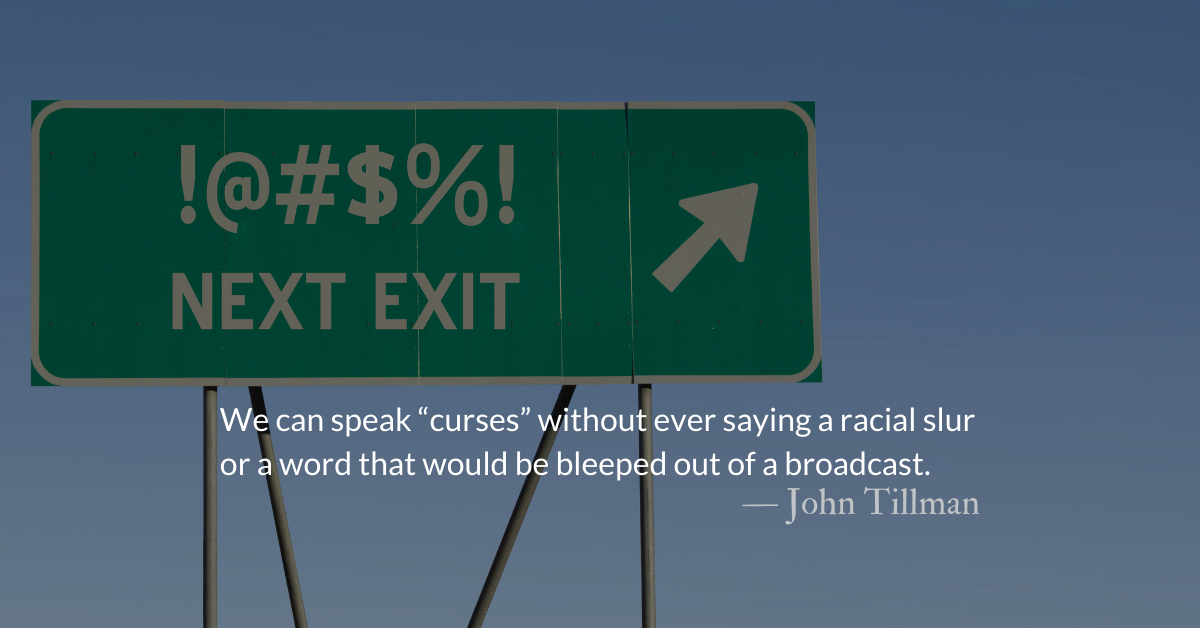
Jesus taught that what comes out of our mouths defiles us. Words come from the heart and this is why they matter. Because of this we can speak “curses” without ever saying a racial slur or a word that would be bleeped out of a broadcast. When we speak hatefully, it doesn’t matter what vocabulary we use, we are cursing.

Curses we speak curse us. Blessings we speak bless us. Let us honor Christ and others with righteous speech that flowers with blessing and not cursing.

Divine Hours Prayer: The Small Verse
Open, Lord, my eyes that I may see.
Open, Lord, my ears that I may hear.
Open, Lord, my heart and my mind that I may understand.
So shall I turn to you and be healed. — Traditional

Today’s Readings
Proverbs 12 (Listen – 3:07)
Psalm 75-76 (Listen – 2:33)

Read more about Praying Priestly Blessings
May we pronounce this priestly blessing not with words alone, but in how we live and walk through our world.

Read more about Becoming a Blessing
Our broken world seeks righteousness.
Bring it through us.
Our lost world seeks truth.
Speak it through us.


RSVP to Wisdom or Folly

Scripture Focus: Proverbs 9.1-6; 13-18
1 Wisdom has built her house; 
she has set up its seven pillars. 
2 She has prepared her meat and mixed her wine; 
she has also set her table. 
3 She has sent out her servants, and she calls 
from the highest point of the city, 
4 “Let all who are simple come to my house!” 
To those who have no sense she says, 
5 “Come, eat my food 
and drink the wine I have mixed. 
6 Leave your simple ways and you will live; 
walk in the way of insight.”

13 Folly is an unruly woman; 
she is simple and knows nothing. 
14 She sits at the door of her house, 
on a seat at the highest point of the city, 
15 calling out to those who pass by, 
who go straight on their way, 
16 “Let all who are simple come to my house!” 
To those who have no sense she says, 
17 “Stolen water is sweet; 
food eaten in secret is delicious!” 
18 But little do they know that the dead are there, 
that her guests are deep in the realm of the dead. 

Reflection: RSVP to Wisdom or Folly
By John Tillman

Two banquets are prepared.
Two invitations go out.
Two hostesses beckon.
Which banquet will you enter? Who gets your RSVP?

In Proverbs 9 the character of Lady Wisdom has prepared a banquet for the simple, for anyone who will come. There is no cost. There is no requirement other than to enter and be transformed from simple to wise.

Lady Folly mimics Lady Wisdom. She positions herself in the same location. She targets the same market. She calls to the people in a similar way. She offers food and drink as well, saying “Stolen water is sweet,” (As if Lady Wisdom’s was not free of charge). It would be easy to fall into a dualistic view of these women, as if their powers, intentions, and offers were roughly equivalent. However, as much as Lady Folly may try, the contrast between them is stark. They are nothing alike.

Lady Folly, sits by her door, waiting for the lazy, the foolish, and the senseless. Lady Folly implies that her stolen water is sweet and free for the taking, but she conceals that it is drugged—poisoned! The guest of honor, at the head of the table, is death. Rather than experience freedom or life Lady Folly’s guests are being murdered. They will be left for dead on the floor.

Lady Wisdom stands, serving all who come with honor. Her food and drink are homemade, lovingly prepared. Lady Wisdom’s banquet is better than free. It comes with benefits. Learning and insight are the side dishes and walking in the way of life is the dessert. At the head of the table, the guest of honor is the Lord, the Holy One. Those who dine with him will forever be with the Lord.

In a metaphorical poem, like this one, the choice of which banquet to attend is only made once. Choose wisely, and the story ends happily and forever after. However, we relive and repeat this story every day, perhaps multiple times a day. This means that even those who were victimized by folly, can choose this day to attend (in both senses of the word) to wisdom.

Each day and each moment, Lady Wisdom calls out to us and Lady Folly’s voice tries to drown out her call.

Every day we receive two invitations. One to Lady Folly’s banquet of death. One to Lady Wisdom’s banquet of life. By God’s grace, choose life.

From John:
As we talk about Lady Folly and Lady Wisdom this week, we’ll share this poem dramatizing the two ladies. It’s worth the repetition and meditation.

Music: “Again and One Mo’ Time” Aaron Smith

Divine Hours Prayer: The Morning Psalm
Happy are they who dwell in your house! They will always be praising you…For one day in your courts is better than a thousand in my own room, and to stand at the threshold of the house of my God than to dwell in the tents of the wicked. — Psalm 84.3, 9

Today’s Readings
Proverbs 9 (Listen – 1:50)
Psalm 72 (Listen – 2:21)

This Weekend’s Readings
Proverbs 10 (Listen – 3:34), Psalm 73 (Listen – 2:56)
Proverbs 11 (Listen – 3:41), Psalm 74 (Listen – 2:34)

Read more about Lady Folly
The seductress…Lady Folly. The woman is crafty. She is wealthy and intelligent. She has an aim and meticulously sets her trap.

Read more about The Undeserved Banquet of the Gospel
Christ invites all to the banquet. We will surprise someone by being there, and be surprised in return.

Lady Wisdom

Scripture Focus: Proverbs 8.23-29
23 I was formed long ages ago, 
at the very beginning, when the world came to be. 
24 When there were no watery depths, I was given birth, 
when there were no springs overflowing with water; 
25 before the mountains were settled in place, 
before the hills, I was given birth, 
26 before he made the world or its fields 
or any of the dust of the earth. 
27 I was there when he set the heavens in place, 
when he marked out the horizon on the face of the deep, 
28 when he established the clouds above 
and fixed securely the fountains of the deep, 
29 when he gave the sea its boundary 
so the waters would not overstep his command, 
and when he marked out the foundations of the earth.

Reflection: Lady Wisdom
By John Tillman

We sometimes think of Proverbs as a collection of unrelated quips and quotes. Most people have probably quoted proverbs as proof-texts of indisputable facts of wisdom. We can reach into Proverbs as if it was a heap of fortune cookie sayings and pull from the pile a pithy quip to punch up an argument. It’s not that Proverbs doesn’t provide wise sayings. It does. But Proverbs also contains narratives that mirror the larger biblical story.

The writer speaks in the voice of a father teaching a child and uses characters who speak to illustrate his lessons. After the cloying voice of the temptress, and vivid descriptions of her hapless victims, a new voice speaks out in Proverbs—Lady Wisdom.

The description of Lady Wisdom reflects on the creation account of Genesis. There are metaphorical parallels in her description that apply to God, God’s Spirit, or even to Jesus as the Logos that John spoke of who created the world (John 1.1-4). However, this passage is not describing a member of the triune God or a separate, literal, spiritual being. Lady Wisdom is a personification of one of God’s qualities. It is one of the many places in which God, or an aspect of God, is described in explicitly feminine terms.

Wisdom and folly are competing voices. These women, the temptress of folly and the mistress of wisdom, represent a choice being set before all people. This choice echoes back to God’s words as the people entered the promised land: “I have set before you life and death.” (Deuteronomy 30.19-20) They echo the choice described when humans were placed in Eden: “you must not eat from the tree…when you eat from it you will certainly die.: (Genesis 2.17

The writer is using these metaphorical women’s voices to instruct his students: “There are choices before you. Choose life.”

“Does not wisdom call out?” (Proverbs 8.1) She does, indeed. And those with ears to hear will hear her call. The narrative of proverbs is one in which one generation is training another to hear wisdom’s voice. Let us train our ears to hear the voice of wisdom. Let us be proactive, as the writer of proverbs is, to train others to recognize the difference between the keening voice of folly and wail of wisdom. “Why will you die?” (Ezekiel 33.11) God calls out, begging us to turn from folly and live.

From John:
As we talk about Lady Folly and Lady Wisdom this week, we’ll share this poem dramatizing the two ladies. It’s worth the repetition and meditation.

Music: “Again and One Mo’ Time” Aaron Smith

Divine Hours Prayer: A Reading
In the beginning was the Word: the Word was with God and the Word was God. He was with God in the beginning. Through him all things came into being, not one thing came into being except through him. What has come into being in him was life, that life that was the light of men; and light shines in the darkness, and darkness could not overpower it. — John 1.1-5


Today’s Readings
Proverbs 8 (Listen – 3:26)
Psalm 70-71 (Listen – 3:29)

Read more about Lady Folly
The seductress…Lady Folly. The woman is crafty. She is wealthy and intelligent. She has an aim and meticulously sets her trap.

https://theparkforum.org/843-acres/lady-folly

Read more about Solomon’s Folly
None of us are Solomon but we can all fall for Solomon’s folly…Any of us can apply a God-given skill, like wisdom, in a foolish and sinful way.

Emulating Christ’s Love

Scripture Focus: Proverbs 5.20-23
20 Why, my son, be intoxicated with another man’s wife? 
Why embrace the bosom of a wayward woman? 
21 For your ways are in full view of the Lord, 
and he examines all your paths. 
22 The evil deeds of the wicked ensnare them; 
the cords of their sins hold them fast. 
23 For lack of discipline they will die, 
led astray by their own great folly.

Reflection: Emulating Christ’s Love
By John Tillman

Famous couples often make romance appear flawless and easy.

Over the pandemic, while Stephen Colbert’s The Late Show was filming in his home, his wife, Evie, and the couple’s sons were the crew of the production. Many people fell in love with the on screen, real-life romance of the Colberts.

Everyone loves romance. We love love. We love romantic movies, music, and news about the romances of our favorite celebrities. People respond to cute moments of celebrity couples on social media with “#Goals” as a way of calling their romance an aspirational pursuit.

In Ragtime, a musical I am now rehearsing, the characters witnessing Coalhouse’s wooing of Sarah question their own relationships. “Haunting me, and somehow taunting me, my love was never half as true,” we sing. We do this in life as well. We idealize what we see of others’ relationships and despair at the problems we face in our own.

Watching idyllic romances play out can be inspiring but there are also famous flame-outs and failures. There are multiple examples of famous couples whose “perfect” marriages broke up over infidelity. No matter how perfect a relationship might seem, the things we see from the outside don’t sustain a marriage. Public infidelity has proven over and over that there is no wife (or husband) “hot enough” to keep a cheat from cheating. Attractiveness, public affection, adoring fans supporting you, and even extreme wealth can’t ensure marital purity.

Proverbs chides its readers, “Why commit sexual sin?” There are no benefits. Those who do this, do so because of folly and a lack of wisdom. The writer compares it to intoxication and to being tied up and trapped in a snare of sin. The beginning of this speech (Proverbs 5.1-6) tells us about the adulteress. She wanders aimlessly. She “gives no thought to the way of life.” She is bitterness and harshness covered over with smooth honey and oil.

Cultivating loving relationships is not just for romantic couples. All our ways, public and private, are to be honoring to our God who is with us. Singles also need life-giving, loving relationships. Loving relationships (whether sexual or platonic) can be achieved through the wisdom shared here. Rather than bitterness, let us spread the sweetness of Christ. Rather than thoughtless, selfish pursuits, let us emulate Christ’s self-sacrificing purpose for others.

Emulating Christ’s love enriches every relationship from the inside out.

Divine Hours Prayer: The Request for Presence
O Lord, watch over us and save us from this generation forever. — Psalm 12.7

Today’s Readings
Proverbs 5 (Listen – 2:08)
Psalm 66-67 (Listen – 2:42)

Read more On Balaam
The Israelites’ culture was most susceptible to the sexual temptations of ancient fertility cults…Greed is the fertility god of our age and our culture is addicted to it.

Read more about Restoring Relationship
The heartbreak of losing romantic intimacy causes grief unlike anything else. God understands this heartbreak and offers hope to those suffering.

Show Buttons
Hide Buttons
Spur a spiritual rhythm of refreshment right in your inbox
By joining this email list you are giving us permission to send you devotional emails each weekday and to communicate occasionally regarding other aspects of the ministry.
100% Privacy. We don't spam.