Temptation Has No Gender

Scripture Focus: Proverbs 2.12-19
12 Wisdom will save you from the ways of wicked men, 
from men whose words are perverse, 
13 who have left the straight paths 
to walk in dark ways, 
14 who delight in doing wrong 
and rejoice in the perverseness of evil, 
15 whose paths are crooked 
and who are devious in their ways.

16 Wisdom will save you also from the adulterous woman, 
from the wayward woman with her seductive words, 
17 who has left the partner of her youth 
and ignored the covenant she made before God.
18 Surely her house leads down to death 
and her paths to the spirits of the dead. 
19 None who go to her return 
or attain the paths of life.

Reflection: Temptation Has No Gender
By John Tillman

Much ink has been spent in Christendom warning men to avoid female temptresses. Today’s reading, a warning to “my son” about an “adulterous woman,” is one that is often cited. The lessons are valid and needed.

The proliferation of pornography is exploding and prostitution and pornography are seeking normalization, even for minors. The pornography industry, like the tobacco industry before it, taps addiction as an income stream. Physical and psychological damage to customers and performers is callously counted as the cost of doing business.

However, porn isn’t just for men, and men also commonly initiate adulterous (or abusive) sexual relationships. All people need to be warned about infidelity and the predatory industry of porn. 

In addition, these passages have been often misused to paint all women as temptresses and all men as victims. The twisted extremes of “purity culture” taught women to treat their bodies like unexploded lust bombs on a hair-trigger. If a dress strap fell off of a shoulder, or a skirt hem rose up too high when sitting down, the lust explosion that could destroy a young (or old) man’s morality would be their fault. Men, instead of being protectors, demanded protection. Women were taught to bear the burden of dressing to protect men’s eyes and souls.

One way to prevent abuse of this passage is to recognize that it sits in balance with the four lines before it. A father is telling his son of the dangers that wisdom will save him from—but female seduction is not the first thing on his mind. The first dangers mentioned are the temptations of evil men. 

Sections of scripture that mirror each other like this are intended to cast light on each other. We must widen our gaze in the scriptures, especially in Proverbs, where matched pairs in tension with each other draw us deeper than the surface reading of either one alone.

The picture of the female temptress informs the image of the men of wickedness. The temptations of leaving straight paths for ones that are dark and wicked tell us more about how one is seduced sexually.

Seduction and temptation are not feminine (or masculine), nor are they limited to sexual pleasures. Carnality includes the lust of the eyes and of pride, not just the lust of the flesh. (1 John 2.16) Power, wealth, indulgence, sexuality…nothing escapes the corruption of sin and no gender is exempt from responsibility.

Divine Hours Prayer: A Reading
Jesus said: “If your right eye should be your downfall, tear it out and throw it away; for it will do you less harm to lose one part of yourself than to have your whole body thrown into hell. And if your right hand should be your downfall, cut it off and throw it away; for it will do you less harm to lose one part of yourself than to have your whole body thrown into hell.” — Matthew 5.29-30

– From The Divine Hours: Prayers for Autumn and Wintertime by Phyllis Tickle.

Today’s Readings
Proverbs 2 (Listen – 1:53)
Psalm 60-61 (Listen – 2:27)

This Weekend’s Readings
Proverbs 3 (Listen – 3:05) Psalm 62-63 (Listen – 2:44)
Proverbs 4 (Listen – 2:37) Psalm 64-65 (Listen – 2:39)

Read more about The Sins Behind Sexual Sins
Many times sexual sins are a symptom of other sins such as greed, selfishness, inequality, and oppression.

Read more about Ancient #MeToo Story
It might be beneficial to meditate on how sin can be so easily embraced. No one is immune to sin.

Samples of Wisdom

Scripture Focus: Proverbs 1.1-7
1 The proverbs of Solomon son of David, king of Israel: 
2 for gaining wisdom and instruction; 
for understanding words of insight; 
3 for receiving instruction in prudent behavior, 
doing what is right and just and fair; 
4 for giving prudence to those who are simple, d 
knowledge and discretion to the young— 
5 let the wise listen and add to their learning, 
and let the discerning get guidance— 
6 for understanding proverbs and parables, 
the sayings and riddles of the wise. i 
7 The fear of the Lord is the beginning of knowledge, 
but fools despise wisdom and instruction. 

Reflection: Samples of Wisdom
By John Tillman

Proverbs are often treated as independent nuggets of wisdom. As slogans of godliness or morality, they are seen frequently on tee-shirts, on bumper stickers, and on cross-stitch patterns called samplers.

Samplers were originally a way for people to store knowledge. Complex and beautiful stitches would be placed on a scrap or long strip of material. Complex stitches and the simpler stitches that were needed to create them would be placed side by side to be referenced for future work. The first samplers were tucked in drawers or pockets not hung on walls. Samplers gradually became more than just a filing system of stitching knowledge and became a kind of simple artwork of their own.

Samplers became connected to education and morality, especially in the United States. Children stitched the alphabet or moral sayings to aid memorization and to instill values while also learning a valuable decorative skill.

Today, the idea that samplers contained wisdom is played for irony by generations that are equally cynical and whimsical. Samplers can be found now with quotes from Star Wars, Anime films, and many other fandoms. Rather than a disdain for wisdom, this shows that our culture is crying out for wisdom. Wise sayings can be found in many forms and places. True wisdom, however, has its purest and greatest source in God. The well from which we can draw God’s wisdom is found in scripture.

Proverbs, like many statements pulled from the Bible, have meaning that goes beyond a surface interpretation. Proverbs are like pools that at first seem like shallow puddles—until you look deeper. 

We need to take the time to look beyond the simple reading of sayings. Let us sit by these pools of wisdom and gaze deeply. Look for the patterns. Read them repetitively as they would have been read to a non-reading culture being educated by rote memorization. Read them long enough that you begin to see and recognize their interconnectedness both with the proverbs before and behind them and all across the scriptures.

We need these samples of wisdom tucked in our hearts. Like a lone stitch in a scrap of material, they might not seem beautiful or useful. We need to remember that their purpose is tied, stitched together, with the rest of the scripture. Proverbs aren’t intended to stand alone but to pull together a beautiful tapestry of God’s wisdom.

Divine Hours Prayer: A Reading
Jesus taught the people, saying: “You have heard how it was said: “Eye for eye and tooth for tooth.” But I say to you: offer no resistance to the wicked. On the contrary, if anyone hits you on the right cheek, offer him the other as well; if someone wishes to go to law with you to get your tunic, let him have your cloak as well.” — Matthew 5.38-41

– From The Divine Hours: Prayers for Autumn and Wintertime by Phyllis Tickle.

Today’s Readings
Proverbs 1 (Listen – 3:12)
Psalm 58-59 (Listen – 3:32)

Read more about Unhurried Wisdom
Wisdom is not a character trait abruptly gained. In our quick paced world, we forget to think before we speak.

Read more about Mining for Wisdom
The fear of the Lord is the apex of spiritual mining…as the miner studies the formations of the earth…all pursuits of wisdom begin with…God.

Job’s Christlikeness

Scripture Focus: Job 42.8-12
8 So now take seven bulls and seven rams and go to my servant Job and sacrifice a burnt offering for yourselves. My servant Job will pray for you, and I will accept his prayer and not deal with you according to your folly. You have not spoken the truth about me, as my servant Job has.” 9 So Eliphaz the Temanite, Bildad the Shuhite and Zophar the Naamathite did what the Lord told them; and the Lord accepted Job’s prayer. 
10 After Job had prayed for his friends, the Lord restored his fortunes and gave him twice as much as he had before. 11 All his brothers and sisters and everyone who had known him before came and ate with him in his house. They comforted and consoled him over all the trouble the Lord had brought on him, and each one gave him a piece of silver and a gold ring. 
12 The Lord blessed the latter part of Job’s life more than the former part.

Reflection: Job’s Christlikeness
By John Tillman

Job is an early “type” or example of Jesus. He demonstrates or proves God’s righteousness through suffering and death. Like Jesus, God calls Job his servant, saying he is pleased with him and Job’s friends are told to listen to him because Job tells “the truth” about God.

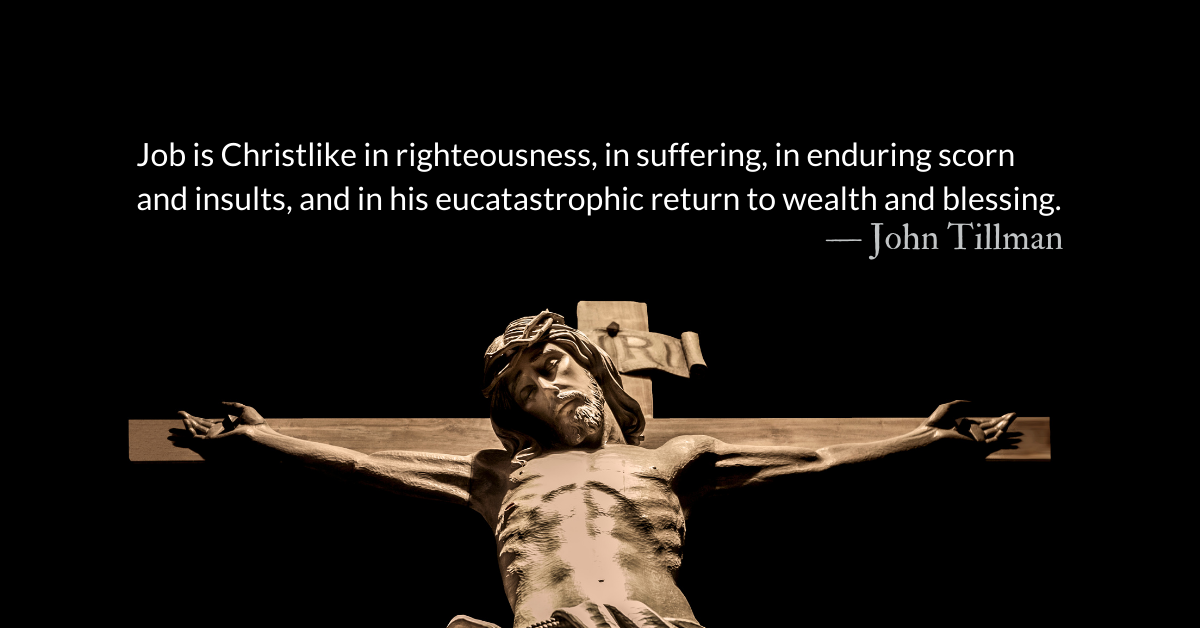
Job is Christlike in righteousness, in suffering, in enduring scorn and insults, and in his eucatastrophic return to wealth and blessing. 

Job is Christlike in righteousness. Job is not completely righteous and sinless in the same way as Jesus. (In all of these categories, Job is only like Christ, not equal to him.) God never called Job an evildoer, as his friends did, but challenged him to work justice and crush evil. When Job describes righteousness, he refers to actions to set free captives and help the poor and downtrodden, as Jesus did.

Job is Christlike in suffering. Job lost the power and comforts his wealth and position gave him. Jesus chose suffering over heavenly power and poverty over riches, making himself nothing, in our likeness, obedient to death. Job did not choose this suffering. Jesus did.

Job is Christlike in enduring of scorn and insults. Reading Job sometimes feels like scrolling through the worst insults and scorn from social media. And these are Job’s friends! Jesus endured scorn on Good Friday from voices that sang “Blessed is He who comes in the name of the Lord” just a few days earlier. Jesus is the despised and rejected one.

Job is Christlike in his eucatastrophic return. God’s command prevented Satan from killing Job but everything else in Job’s life died or was lost. Then, unexpectedly, everything was restored. The second half of Job’s life was better than before. God’s command would not allow Jesus to “see corruption in the grave.” The resurrection is the ultimate eucatastrophe.

If we follow Jesus, we cannot be surprised to step into the same situations. We must step forward to enact justice and righteousness. We must step into suffering and endure scorn. We step through the valley of death, knowing that resurrection and miraculous recoveries are often just around the corner.

May pits of suffering not make us ashamed. May piles of blessings not make us complacent. Job used both for God’s glory. May we not waste opportunities to make ourselves like Christ. Like Job, may we be a type or model of Christ for our community.

Divine Hours Prayer: The Refrain for the Morning Lessons
The same stone that the builders rejected has become the chief cornerstone. — Psalm 118.22

– From The Divine Hours: Prayers for Autumn and Wintertime by Phyllis Tickle.

Today’s Readings
Job 42 (Listen – 2:41)
Psalm 56-57 (Listen – 3:11)

Read more about Deliverance Through Suffering
Through suffering, deliverance comes. Through affliction, God speaks

Read more about Unexpected Victory
There is no one whose sufficient victory is more surprising than the eucatastrophe of the cross.

God’s Sufficient Justice

Scripture Focus: Job 40.6-14
6 Then the Lord spoke to Job out of the storm: 
7 “Brace yourself like a man; 
I will question you, 
and you shall answer me. 
8 “Would you discredit my justice? 
Would you condemn me to justify yourself? 
9 Do you have an arm like God’s, 
and can your voice thunder like his? 
10 Then adorn yourself with glory and splendor, 
and clothe yourself in honor and majesty. 
11 Unleash the fury of your wrath, 
look at all who are proud and bring them low, 
12 look at all who are proud and humble them, 
crush the wicked where they stand. 
13 Bury them all in the dust together; 
shroud their faces in the grave. 
14 Then I myself will admit to you 
that your own right hand can save you.

From John: This re-edited reflection from 2020, reminds us that children of God are expected to work justice on the Earth.

Reflection: God’s Sufficient Justice

By John Tillman

God dares Job to dress himself in splendor and work justice in the Earth by his own power. This may have seemed uniquely personal to Job. To use today’s vernacular, Job probably felt attacked. God’s challenge referred to Job’s earlier speeches and claims.

Job described dressing in a turban and robe that would proclaim his status and power. He claimed to have struck fear in the hearts of the wicked and to have carried out justice. (Job 29.7-17

Job was “the greatest among the people of the East.” (Job 1.1-4) This may have meant Job was a chieftain or king, but even if not, he was as wealthy as one and equally responsible for the carrying out of justice in his community. 

Earlier, in Heaven, God defended Job’s righteousness, but here, he seems unsatisfied. So, is Job righteous or not? 

Like many heroes of faith in scripture, we can point to much earthly good in Job’s life to emulate. But like all of them, Job’s earthly actions are insufficient to claim righteousness before God. 

Humans are capable of a certain level of justice and we are responsible before God to bring about justice. Justice comes first in Micah’s three-point list of what God requires: do justice, love mercy, and walk humbly. (Micah 6.8)

Job was arguably the most righteous person to ever live in scripture. Yet, scripture is clear that even the righteousness, or justice, of Job is as filthy rags compared to God’s glorious justice. Even the best of human justice is tainted. God still calls for it. 

Being righteous before other humans is easy. We just have to be slightly less evil at heart than the next guy. But when God is the next guy, on our best day, we have no chance of being righteous in our own power. We, like Job, are simply incapable. We must simply cover our mouths, and throw ourselves on the mercy of God.

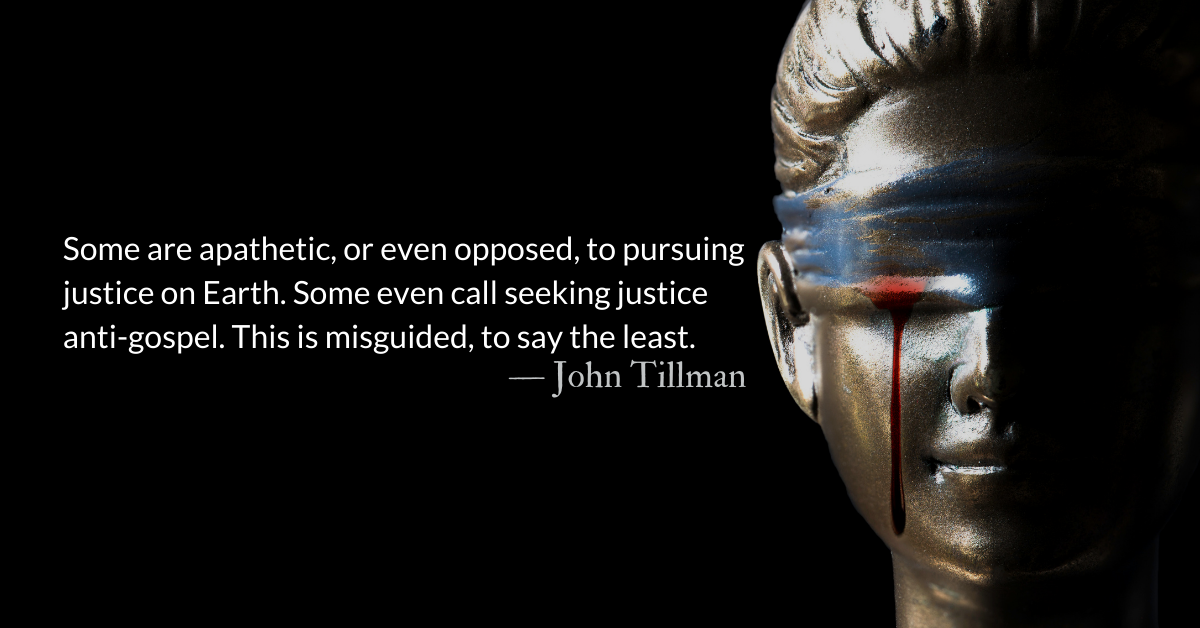
Because human justice is incomplete and imperfect some are apathetic, or even opposed, to pursuing justice on Earth. Some even call seeking justice anti-gospel. This is misguided, to say the least. 

“Thy will be done on Earth” is a prayer for God’s justice by God’s power, not our own. When we act on this prayer, we will find Christ working with us, imputing God’s sufficient righteousness and justice to us.

Divine Hours Prayer: The Request for Presence
I long for your salvation, O Lord, and your law is my delight. — Psalm 119.174

– From The Divine Hours: Prayers for Autumn and Wintertime by Phyllis Tickle.


Today’s Readings
Job 40 (Listen – 4:55)
Psalm 52-54 (Listen – 3:18)

Read more about Justice to Wormwood
Justice is very much the business of people of faith and when people ignore it or frustrate it…God notices.

Read more about Justice of God
Miroslav Volf writes that In order to maintain non-violence, we need a belief that God will act in vengeance on behalf of victims.

Prayers Before the Storm — Guided Prayer

Scripture Focus: Job 37.22-24
22 Out of the north he comes in golden splendor; 
God comes in awesome majesty. 
23 The Almighty is beyond our reach and exalted in power; 
in his justice and great righteousness, he does not oppress. 
24 Therefore, people revere him, 
for does he not have regard for all the wise in heart?”

Reflection: Prayers Before the Storm — Guided Prayer
By John Tillman

Elihu’s speech soars to its conclusion with a reflection on the beauty, power, and mysterious majesty of God.

Some interpreters have implied that Elihu’s speech is interrupted by God’s arrival in the storm. (Job 38.1) However, it seems to me that Elihu must have been aware of the storm of God’s presence blowing at his back and his final poetic lines announce God’s presence. The downdraft of a rising cumulonimbus supercell was likely licking at Elihu’s robes as he spoke. 

Elihu says his “heart pounds and leaps from its place…” Elihu’s voice cried in the wilderness, announcing the soaking downpour of speech that God was about to unleash. I imagine the winds lifting his words as he spoke of God’s majesty in storms, winds, and other powers beyond our understanding.

Let us pray heart-pounding prayers, crying out about God’s greatness. Let us announce his presence. Let us be awash in the downpour of his presence in the storm.

Pray this prayer of wonder inspired by Elihu’s speech:

Prayers Before the Storm
We pray, Lord, standing before the storm of your presence.
The life you sustain within us stirs, our hearts pound rushing blood through our bodies
Our breath gasps, taking in the freshness of the oncoming storm
The sudden coldness of the downdraft…
The enlivening smell of rain on the wind…

A cumulonimbus pillar of cloud moves toward us
Towering in royal power like a queen over a chessboard
Your voice thunders in marvelous ways we don’t understand
Hold nothing back when you thunder and speak.
We drop our defenses.
We rely on your mercy alone.

You are not like a human king.
Despite your great power, you do not oppress
Unlike man-made gods, you do not despise our weakness
You are as tender with us as with the newborn fawns you watch and the wild donkeys you set free. (Job 39.1-8)
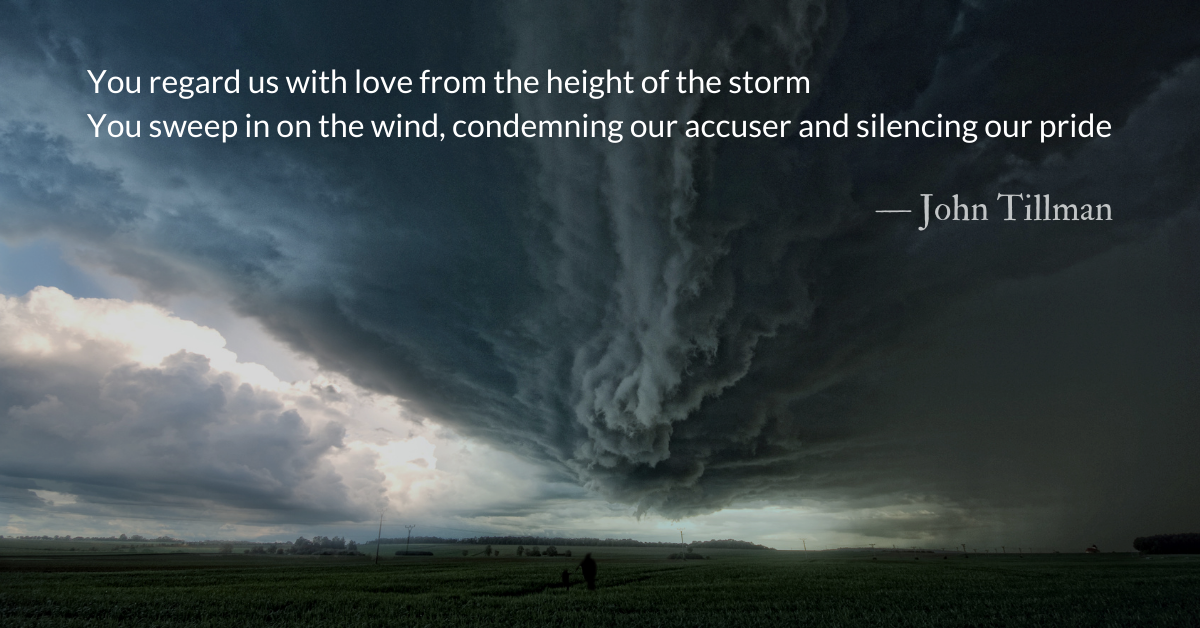
You regard us with love from the height of the storm
You sweep in on the wind, condemning our accuser and silencing our pride

May the echoes of your voice break rocks in every canyon and arroyo
May the refreshing snows and rain cover and wash our gullies and ditches
May the weak be protected and the powerful be warned
May the proud be struck and shaken
While the humble stand on a firm place
A foundation you provide that withstands winds and rushing waters

May we cry in the wilderness before you, announcing your mercy.

Divine Hours Prayer: The Call to Prayer
Come, let us sing to the Lord…For the Lord is a great God, and a great King above all gods. — Psalm 95.1,3

– From The Divine Hours: Prayers for Autumn and Wintertime by Phyllis Tickle.

Today’s Readings
Job 37 (Listen – 2:27)
Psalm 49 (Listen – 2:10)

This Weekend’s Readings
Job 38 (Listen – 3:33), Psalm 50 (Listen – 2:26)
Job 39 (Listen – 2:47), Psalm 51 (Listen – 2:19)

Read more about On Keeping Vigil
You have descended upon me, with great gentleness, with most forbearing silence, in this inexplicable night, dispersing light, defeating all desire. — Thomas Merton

Read more about Faith After the Storm
Jesus standing and commanding the storm is intimidating and disturbing. He is no longer the servile employee behind the desk of God’s complaint department.

Show Buttons
Hide Buttons
Spur a spiritual rhythm of refreshment right in your inbox
By joining this email list you are giving us permission to send you devotional emails each weekday and to communicate occasionally regarding other aspects of the ministry.
100% Privacy. We don't spam.