The Unknown Sage

Scripture Focus: Ecclesiastes 9.13-18
13 I also saw under the sun this example of wisdom that greatly impressed me: 14 There was once a small city with only a few people in it. And a powerful king came against it, surrounded it and built huge siege works against it. 15 Now there lived in that city a man poor but wise, and he saved the city by his wisdom. But nobody remembered that poor man. 16 So I said, “Wisdom is better than strength.” But the poor man’s wisdom is despised, and his words are no longer heeded. 
17 The quiet words of the wise are more to be heeded 
than the shouts of a ruler of fools. 
18 Wisdom is better than weapons of war, 
but one sinner destroys much good. 

Reflection: The Unknown Sage
By John Tillman

Who was this nameless poor man who saved his city from military aggression? What did he do? How did it save the city? We don’t know. That’s the point the teacher is trying to make. Wisdom is not always recognized or celebrated unless it comes from people we already think of as wise and worthy of respect.

The poor were then and are now considered by many to be unreliable, lazy, morally questionable. Even today, many people doubt the poor when they tell us about their own experiences. “Don’t give them money. They can’t be trusted.” Perhaps the better question we should ask is, who was the person in power who listened to the wisdom of the poor man? And how was he forgotten after wisdom he shared, saved the city?

We often distrust the word of “nobodies.” When a recommendation, a critique, or an accusation is spoken we often say, “Who is this?” Buried in that question are assumptions. We distrust people based on status. We are suspicious of critiques from those “below” us who we suspect have inferior understanding. Positional distrust can cut across many categories such as authority, status, wealth, age, race, gender, or denominational or political affiliation. “Her word isn’t trustworthy. She’s _________.” “Don’t listen to him. He’s _________.” It can cause us to read wisdom and call it foolishness. It can cause us to hear a blustering fool and call him wise.

The teacher describes the king of the city as blustering and shouting and says fools followed him. In contrast, the wise words of the poor man were quiet. Whatever weapons were bested by the poor man’s wisdom, they weren’t bested by force, volume, or vicious rhetoric. We would do well to retune our ears to listen for such quiet, yet powerful words.

Many places in our world are under siege—some literally, some metaphorically. Violent voices of brash, blustering, chest-beating, powerful leaders of our world shout out plans, war strategies, and lies.

May we listen to the lowly voices God chooses to send to us, speaking wisdom.
May we ask the Holy Spirit to give us ears to hear quiet wisdom that can silence weapons of war.
May we honor those who speak God’s quiet wisdom, both now and in the future.
May quiet wisdom be remembered long after the siege ramps of the violent are crumbling in dust.

*On March 25th, nine months before Christmas day, the church celebrates the lowly voice of Mary after hearing Gabriel’s announcement. We read her words as our prayer today.

Divine Hours Prayer: A Reading
My soul proclaims the greatness of the Lord, my spirit rejoices in God my Savior;
For he has looked with favor on his lowly servant… — Luke 1.46-48

– From The Divine Hours: Prayers for Springtime by Phyllis Tickle.

Today’s Readings
Ecclesiastes 9 (Listen – 3:13)
Psalm 114-115 (Listen – 2:18)

Read more about Servants in the Age of Showboats
We live in an age where the proud, unethical, immoral showboat leader is honored and glorified.

Read more about In The Face of Wonder
The freedom the world seeks is freedom to dominate, dictate, and destroy…May we seek instead the freedom to serve, to create, and to restore.
Appetite for Distraction

Scripture Focus: Ecclesiastes 6.9
9 Better what the eye sees 
than the roving of the appetite. 
This too is meaningless, 
a chasing after the wind.

Reflection: Appetite for Distraction
By John Tillman

Distraction has a meme. Of course it does.

The “Distracted Boyfriend” meme started out as a normal photoshoot. Photographer, Antonio Guillem, typically supplies images to iStock and other photo platforms. He set out one day in 2015 to take some images around the concept of infidelity using models he often collaborated with. They took many different images of the stages of a relationship slipping into infidelity but one image caught the imagination of the Internet. The male subject, walking with his girlfriend, looks back at another woman in a red dress. The man has an openly lustful gaze and the girlfriend an open-mouthed look of shock and disgust.

Creative people on the Internet started labeling the image to discuss distraction or abandoning one’s first love. By way of example, historically-minded meme creators made a series with the first image showing the man as Henry VIII, the woman in red as Anne Boleyn, and the offended girlfriend as Katherine of Aragorn. Successive images rotated the women through the cycle with Anne Boleyn being the girlfriend and Jane Seymore being the woman in red, then continuing through with Anne of Cleves, Katherine Howard, and Katherine Parr.

But the meme was rarely about sexual infidelity. Most of the time the people were labeled not as people but as things. A popular version labels the woman in the red dress as “new project” and the offended girlfriend as “all my unfinished projects.”

This meme struck a chord because we all recognize something universal within ourselves. We long for more. This makes us susceptible to temptation, distraction, dissatisfaction, and infidelity. Our eyes lead us astray when our hearts are not settled.

The teacher of Ecclesiastes knows something about distraction and temptation. He purposely tested himself in every area imaginable. The conclusion is that being satisfied with “what the eye sees” is better than having a “roving appetite.”

Our roving appetites, whether for sex, money, or power, will lead us to distraction before destruction. We need to have a settled eye, looking upon things that have true value, not upon the distractions of this world. With our eyes on the treasure in the field, we won’t invest in wickedness. With our eyes on the pearl of great price, no costume jewelry will suffice. With our eyes fixed on Jesus, we can let the world be offended that we would disdain its affections.

Divine Hours Prayer: A Reading
Jesus taught the people, saying: “Now sentence is being passed on this world; now the prince of the world is to be driven out. And when I am lifted up from the earth, I shall draw all people to myself.” — John 12.31-32

– From The Divine Hours: Prayers for Springtime by Phyllis Tickle.

Today’s Readings
Ecclesiastes 6 (Listen – 1:44)
Psalm 108-109 (Listen – 3:08)

This Weekend’s Readings
Ecclesiastes 7 (Listen – 3:37) Psalm 110-111 (Listen – 1:57)
Ecclesiastes 8 (Listen – 2:41) Psalm 112-113 (Listen – 1:49)

Read more about Wisdom in Houses of Mourning
We limited Jesus, the Bible, and prayer, to “when we have time” as if time was the issue and not our heart.

Read more about Our Opportunistic Opponent 
It is unwise to make too much of Satan…It is unwise to make too little of Satan.

Unsurprising Oppression

Scripture Focus: Ecclesiastes 5.8-10
8 If you see the poor oppressed in a district, and justice and rights denied, do not be surprised at such things; for one official is eyed by a higher one, and over them both are others higher still. 9 The increase from the land is taken by all; the king himself profits from the fields. 
10 Whoever loves money never has enough; 
whoever loves wealth is never satisfied with their income. 
This too is meaningless.

From John: As this re-written post from 2018 reminds us, we should never be surprised to find oppression, cruelty, poverty, or any other evil in the world. We also should never willingly be complicit in it or passively give approval to it.

Reflection: Unsurprising Oppression

By John Tillman

Solomon, the teacher of Ecclesiastes, says, “do not be surprised” to see oppression of the poor and systemic corruption in the government. Jesus, the teacher of Galilee, says the poor will always be with us. (Matthew 26.11) Either of them would be shocked to find their words abused today as endorsements of a laissez-faire attitude toward poverty and oppression.

Rather than an endorsement, Solomon’s statement is a confession of complicity. The profit of the corrupt system, and the guilt for it, passes up the chain of authority and distributes itself throughout the entire economic system to every citizen. The king himself profits from the fields and Solomon calls this profit, “meaningless.”

Christ’s words, often misquoted by politicians looking to cut social spending, reference an Old Testament passage everyone in the room would have instantly recognized. (Deuteronomy 15.11) The other half of the verse is, “Therefore I command you to be openhanded toward your fellow Israelites who are poor and needy in your land.”

This passage comes from the abandoned economic practices of Jubilee. (Deuteronomy 15.1-11) Under this system, debts (regardless of their origins or the wisdom of the debtors) were to be forgiven every seven years, including a complete reset of property rights once in a generation. (Leviticus 25.10-17)

There is little biblical evidence that the system was ever followed as God prescribed it. If it had been followed generational poverty would be impossible. However, the pull of meaningless profit and gain for gain’s sake was too strong for ancient Israel and is too strong for us today.

As the teacher says:
Whoever loves money never has enough;
whoever loves wealth is never satisfied with their income.
This too is meaningless.

The meaninglessness of accumulating wealth is a universal symptom of our sinful condition. We are all affected by it, from the top economic strata to the bottom.

The Bible doesn’t exist to dictate an economic system. Neither Capitalism nor Marxism are on trial. Our hearts are. The Bible commands us to be generous not just with tangible resources, but by influencing the way our culture thinks about poverty. Instead of condemning and blaming the poor for their own oppression, may we speak words of truth and comfort backed up with tangible aid.

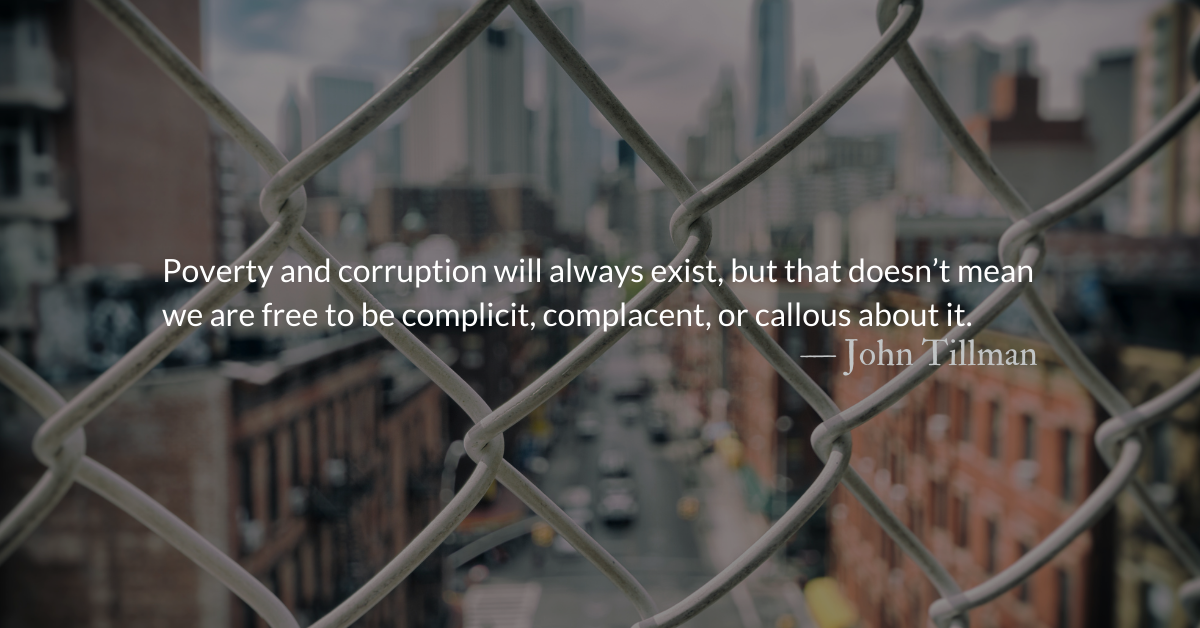
Poverty and corruption will always exist, but that doesn’t mean we are free to be complicit, complacent, or callous about it.

Divine Hours Prayer: The Refrain for the Morning Lessons
Let integrity and uprightness preserve me, for my hope has been in you. — Psalm 25.20

– From The Divine Hours: Prayers for Springtime by Phyllis Tickle.

Today’s Readings
Ecclesiastes 5 (Listen – 2:50) 
Psalm 107 (Listen – 4:12)

Read more about Stories of the Redeemed
What is your story of redemption? Tell it to someone who needs a turnaround.

Read more about Blood Spilled
We need the Holy Spirit to confront us with the enormity of injustice around us and to stop saying, “I am innocent. I have not sinned.”

What Time is It?

Scripture Focus: Ecclesiastes 3.1-8
1 There is a time for everything, 
and a season for every activity under the heavens: 
2 a time to be born and a time to die, 
a time to plant and a time to uproot, 
3 a time to kill and a time to heal, 
a time to tear down and a time to build, 
4 a time to weep and a time to laugh, 
a time to mourn and a time to dance, 
5 a time to scatter stones and a time to gather them, 
a time to embrace and a time to refrain from embracing, 
6 a time to search and a time to give up, 
a time to keep and a time to throw away, 
7 a time to tear and a time to mend, 
a time to be silent and a time to speak, 
8 a time to love and a time to hate, 
a time for war and a time for peace. 

Reflection: What Time is It?
By John Tillman

There is a time. There is a season.

There are many well-known poems in the Bible. The Psalm of the good shepherd. (Psalm 23) Paul’s poem about love. (1 Corinthians 13) The poem describing the creation of humans. (Genesis 1.27) The Lord’s prayer. (Luke 11.2-4)

The teacher’s poem about time and seasons, however, might be the most well-known biblical poem in our culture. No small part of its fame is that it was turned into a megahit song by The Byrds, released in 1969. The song landed in a turbulent era. It seemed that the song’s opposites were all flooding the world and contending against each other. 

Our time is not so different from that time. We see, hear, and feel all around us the elements of the song. Love and hate, war and peace, deconstruction and reconstruction, sowing and harvesting, mourning and joy, harm and healing. 

Reading a little further, we find that the teacher also tells us of another time and season. There will be a time “to judge every deed.” There will be a season when the unseen will be seen and both the righteous and the unrighteous will face a time of judgment.

What time is it? What season are we in?

Today, let us pray that we will understand the times and seasons that we find ourselves in using some scriptures focused on seasons.

Thank God for his assurance and presence in all seasons.
Ask him to depose wickedness (within and without us) and grant us wisdom.
He changes times and seasons;
    he deposes kings and raises up others.
He gives wisdom to the wise
   and knowledge to the discerning. (Daniel 2.21)


Pray for strength to prioritize gospel cultivation.
Preach the word; be prepared in season and out of season; correct, rebuke and encourage—with great patience and careful instruction. (2 Timothy 4.2)

Pray for grace to understand the present time.
And do this, understanding the present time: The hour has already come for you to wake up from your slumber, because our salvation is nearer now than when we first believed. (Romans 13.11)

Rest in him. He holds all things together.
But do not forget this one thing, dear friends: With the Lord a day is like a thousand years, and a thousand years are like a day. (2 Peter 3.8)

The time to do good is always now. Let us not be weary in it, for the time of harvest is coming. (Galatians 6.9)

Divine Hours Prayer: The Greeting
Our God will come and will not keep silence; before him there is a consuming flame, and round about him a raging storm. — Psalm 50.3

– From The Divine Hours: Prayers for Springtime by Phyllis Tickle.

Today’s Readings
Ecclesiastes 3 (Listen – 3:02) 
Psalm 105 (Listen – 4:02)

Read more about Miracles of Deliverance and Judgment
We pray for more than just miracles of weapons that do not prosper against the innocent. We pray for the even more miraculous deliverance of the hearts of evil leaders to change.

Read more about Why Do We Need the Leading of the Spirit?
The leading of the Spirit—O, how highly necessary is it! Who can be without it?

Over the Brink of Success

Scripture Focus: Ecclesiastes 2.10-11, 16-18
10 I denied myself nothing my eyes desired; 
I refused my heart no pleasure. 
My heart took delight in all my labor,
and this was the reward for all my toil.
11 Yet when I surveyed all that my hands had done
and what I had toiled to achieve,
everything was meaningless, a chasing after the wind;
nothing was gained under the sun.

16 I said to myself, “Look, I have increased in wisdom more than anyone who has ruled over Jerusalem before me; I have experienced much of wisdom and knowledge.” 17 Then I applied myself to the understanding of wisdom, and also of madness and folly, but I learned that this, too, is a chasing after the wind. 
18 For with much wisdom comes much sorrow; 
the more knowledge, the more grief.

Reflection: Over the Brink of Success
By John Tillman

Proverbs gives us expectations about wisdom and its outcomes. The wise prosper, find success, and are satisfied. Then Ecclesiastes dumps cold water on our optimism.

People love stories from the brink. We’ve all heard testimonies from those who approached the brink through drug use, alcoholism, sex, greed, or violence. They reached the edge, saw emptiness, and turned back. Ecclesiastes feels like one of those stories. However, Ecclesiastes is not about reaching the brink of failure or addiction. The teacher plunges over the brink of success and finds an equally empty void of meaninglessness. 

“All is meaningless,” says the teacher. “Trust me. You think wealth will satisfy you? Doing what you love? A great job? Impressive accomplishments? Unlimited sex? Sorry, folks. I did it all and it’s all meaningless.”

The word translated “meaningless” is difficult. Many Bible translations render it as “vanity.” It means something transitory or unsatisfactory. It’s figurative meaning is like vapor or breath. Ecclesiastes clarifies, saying it is like “chasing after the wind.” Imagine grabbing a handful of smoke. The smell of it might still be on your hands and clothes, but there is nothing substantial there.

How can Solomon, the teacher of the book, say “all is meaningless”? Isn’t one of the strengths of our faith that it gives us meaning? Is Solomon jaded and dissatisfied? Did he misuse the unique wisdom God gave to him?

The teacher sees the world as it is, up close, and to excess. Whether sex, wealth, or the wisdom (and foolish idolatry) of other cultures, Solomon drank deeply of it all. It was, at least partially, a lived-out experiment.

This experiment comes at a cost of grief. Humans bit the fruit in the garden because it was “useful for gaining knowledge.” (Genesis 3.6) Solomon takes a big bite of the world’s so-called knowledge, as do we all. 

It is uncomfortable to hear the success we long for is pointless, but it’s healthy. We can’t succeed our way to joy, pleasure ourselves into love, or spend our way into significance. Joy, love, and significance come to those who pursue the treasure of our gracious God, not the trophies of a ruthless world. (Matthew 13.44)

The wisdom of Proverbs and the wisdom of Ecclesiastes are not in conflict. Both call us to trust not in attainment of success but in attuning our lives to God’s voice and our actions his purpose.

Divine Hours Prayer: The Greeting
How great is your goodness, O Lord! Which you have laid up for those who fear you; which you have done in the sight of all. — Psalm 31.19

– From The Divine Hours: Prayers for Springtime by Phyllis Tickle.

Today’s Readings
Ecclesiastes 2 (Listen – 4:03) 
Psalm 104 (Listen – 3:37)

Read more about Solomon’s Folly
Most people seek to retest Solomon’s findings. “Sure, sure, wealth and pleasure are meaningless,” we say, “but let me try.”

Read more about The Identical Nature of Greed and Lust
Lust and greed are the exact same sin. One is concerned with material goods and one with flesh.

Show Buttons
Hide Buttons
Spur a spiritual rhythm of refreshment right in your inbox
By joining this email list you are giving us permission to send you devotional emails each weekday and to communicate occasionally regarding other aspects of the ministry.
100% Privacy. We don't spam.