Love Stronger Than Death

Scripture Focus: Song of Songs 8.6-7
6 Place me like a seal over your heart, 
like a seal on your arm; 
for love is as strong as death, 
its jealousy unyielding as the grave. 
It burns like blazing fire, 
like a mighty flame. 
7 Many waters cannot quench love; 
rivers cannot sweep it away. 
If one were to give 
all the wealth of one’s house for love, 
it would be utterly scorned. 

Hosea 1.2
2 When the Lord began to speak through Hosea, the Lord said to him, “Go, marry a promiscuous woman and have children with her, for like an adulterous wife this land is guilty of unfaithfulness to the Lord.”

Reflection: Love Stronger Than Death
By John Tillman

Today, we conclude Song of Songs and move, over the weekend, into Hosea. What a contrast!

From the idyllic, passionate love poetry in Song of Songs, we turn to the tear-stained legal documents and pleadings of a marriage in crisis. It’s like turning from a Hallmark love story to a gritty, true-crime documentary. 

The beloved’s poem about the strength of love is one of the most well-known passages of the Bible. It is often quoted as a positive. “Many waters cannot quench love” is on the mausoleum dedicated to Ida And Isidor Straus, who chose to die together on the Titanic as it sank, rather than be separated. Ida is reported to have quoted Ruth, “Where you go, I will go,” as she refused to get on a lifeboat without her husband. (Ruth 1.16)

However, there is also a warning within this passage. Love strong as death, like a blazing fire, unable to be quenched, unable to be bought off, or denied…this is a confession. Human love can be twisted, becoming sinful jealousy that destroys what it can no longer possess or takes with force what will not yield to it. This leads to rape, domestic violence, abuse, and often murder. This unyielding love can lead to wickedness in humans, but in God it is the motivation for the gospel. The holy jealousy of God leads not to destruction but to redemption and salvation.

Hosea is God’s stand-in depicting this. His anger and hurt are real and justifiable. His love burns. His jealousy rises. Hosea’s human love is as strong as death and by Jewish law, he could have demanded death for Gomer.

God chose, rather than let us sink in the titanic disaster of our sin, to sink himself. His love is so great, that he did not die with us, sinking into oblivion. Rather, he died instead of us and when he sank into the grave, it was only to lift us up after him.

God’s love is stronger than death. His love breaks the unyielding hold of the grave. His love burns through any barrier that would come between us. His love quenches the fires of sin that would burn us. His love gave all the wealth of his house, becoming poor that we can become rich. (2 Corinthians 8.9

Who could scorn this kind of love?

Music: “Love As Strong As Death” – Canticle of Plains by Kevin Max / Rich Mullins

Video: Overview of Hosea by The Bible Project

Divine Hours Prayer: The Request for Presence
Be pleased, O God, to deliver me; O Lord, make haste to help me. — Psalm 70.1

– From The Divine Hours: Prayers for Springtime by Phyllis Tickle.

Today’s Readings
Song of Songs 8Listen – 2:23)
Psalm 123-125(Listen -1:52)

This Weekend’s Readings
Hosea 1Listen – 2:08)Psalm 126-128(Listen -1:158)
Hosea 2Listen – 3:48)Psalm 129-131(Listen -2:03)

Read more about The Naked Emotion of God
Hosea. This shows us a God unashamed of shame, nakedly confessing his love for the unlovable.

Read more about He Stoops to Raise
He strips himself.
He lays aside
His Heaven
His throne
His clothes
His life


Love is Not a Panacea

Scripture Focus: Song of Songs 5.6-7
6 I opened for my beloved, 
but my beloved had left; he was gone. 
My heart sank at his departure. 
I looked for him but did not find him. 
I called him but he did not answer. 
7 The watchmen found me 
as they made their rounds in the city. 
They beat me, they bruised me; 
they took away my cloak, 
those watchmen of the walls! 

Reflection: Love is Not a Panacea
By John Tillman

After the consummation of their marriage, the beloved tells us of a frightening and disturbing dream.

Some interpreters feel this vision shows a cooling of the relationship after the marriage. The beloved hesitates to open to her lover for trivial reasons—not wanting to dirty her feet or retrieve her robe. In dreamlike fashion, once she does rouse herself to the door, he is gone. Then, searching for him in the streets she is harmed by the very watchmen who helped her search for her lover in a previous passage.

We should be careful analogizing the woman’s hesitation to mean indifference or sin on her part. These passages have been abused by some who interpret this as the woman refusing sexual relations with her husband and suffering the consequences. Women have often been harmed by misreadings of texts related to sexuality. Texts like this one are too often twisted to teach women that being sexually available anything less than one-hundred percent of the time will place blame for infidelity in their lap. This is poor reading of the text, to say the least. Why would we interpret sin on her part for being slow to rise and not sin on the man’s part for being absent in the first place? 

The passage doesn’t seem intent on blaming one partner or the other, but it does seem to imply that even between the most loving of couples there can be problems and difficult times. The beloved’s dream shows us that she fears loss, indifference, and separation. She struggles against difficult obstacles and unexpected challenges. “The course of true love never did run smooth” (A Midsummer Night’s Dream I.i.:137)

This realistic note in the midst of what is, at times, a near-erotic love poem is striking. This grounds the more lofty passages and short circuits any thought that life and love will always reach the heights of pleasure previously depicted. It cautions those who would enter marriage or sexual love flippantly or in naivete.

Love, especially sexual love, is not a panacea. There is a reason marriage vows often include “for better, for worse, for richer, for poorer, in sickness or in health.” Stay married long enough and worse will come. Poorer will come. Sickness will come. What you do then is a truer consummation of your love than what occurs on the wedding night.

Divine Hours Prayer: The Refrain for the Morning Lessons
I will walk in the presence of the Lord in the land of the living. — Psalm 116.8

– From The Divine Hours: Prayers for Springtime by Phyllis Tickle.

Today’s Readings
Song of Songs 5 (Listen – 2:43)
Psalm 119:121-144 (Listen – 15:14)

Read more about You’re The Top
In an image-obsessed culture, how do we healthily praise each other…process body image issues…outrageous cultural expectations of beauty?

https://theparkforum.org/843-acres/youre-the-to

Read more about Hitting the Mark of Reconciliation
The gospel has the power to resurrect dead relationships just as it has the power to resurrect our souls and our physical bodies.

You’re The Top

Scripture Focus: Song of Songs 4.2, 4
2 Your teeth are like a flock of sheep just shorn, 
coming up from the washing. 
Each has its twin; 
not one of them is alone.

4 Your neck is like the tower of David, 
built with courses of stone; 
on it hang a thousand shields, 
all of them shields of warriors. 

Reflection: You’re The Top
By John Tillman

The abundant praise of the bride uses over the top, lavish language with references that don’t always land for modern readers.

It’s not that unusual to compare our loved ones to things our culture values. Cole Porter’s 1934 song, “You’re The Top” is one example. The duet between complimentary lovers contains cultural references that might be enigmatic for today’s listeners.

You’re the top.
You’re a Waldorf salad.
You’re the top.
You’re a Berlin ballad.


The “Waldorf” salad was created in 1896 at the original Waldorf Hotel in New York City and swept the country as a new sensation and mark of refinement. Modern listeners might wonder why Germany’s capital is known for ballads, but the lyrics refer to famous American songwriter, Irving Berlin.

If we have difficulty deciphering metaphors written in our native tongue less than a century ago, we should have humility with older cultural references, written in a language we don’t speak. We don’t have to understand them completely, however, to realize every phrase carries the writer’s highest praise.

Who can live up to giving or receiving these praises? Who can live up to being called by Cole Porter, “the tower of Pisa,” or by Solomon, “the Tower of David”? Can we praise our own lovers in this way? Can we accept praise such as this? 

In my own life, I have a habit of pushing away compliments, especially about my appearance or talents. I drop my eyes, shake my head, and say, “no,” or I deflect with self-deprecation. Porter does this too. After saying his lover is the “smile on the Mona Lisa” he says, “I’m a worthless check, a total wreck, a flop”

In an image-obsessed culture, how do we healthily praise each other? How do we process body image issues and outrageous cultural expectations of beauty? Balancing humility and honesty while receiving compliments is complex. Neither self-inflated pride nor self-effacing despair are healthy.

We are liable to fail, not only in words we attempt to say but in attempting to live up to what our lovers say in return or what we feel our lovers expect.

Grace for ourselves and our loved ones is required. We must learn not only to love but to be loved and celebrated.

Leaning on and using the poetry and praise of others can help. Perhaps we can begin to say and accept from one another, “You’re the top.”

Music: “You’re the Top” performed by Sutton Foster and Collin Donnell

Divine Hours Prayer: The Refrain for the Morning Lessons
For who is God, but the Lord? Who is the Rock, except our God? — Psalm 18.32

– From The Divine Hours: Prayers for Springtime by Phyllis Tickle.

Today’s Readings
Song of Songs 4 (Listen – 2:46)
Psalm 119:97-120 (Listen – 15:14)

Read more about Sexuality and Spirituality
The Song should encourage us to apply holiness to our intimate sexual relationships.

Read more about Love Guided Thoughts
Oh what a happy spring of meditation, is a rooted, predominant love of God! Love him strongly, and you cannot forget him.

Meaning in Remembrance

Scripture Focus: Ecclesiastes 12.6-8
6 Remember him—before the silver cord is severed, 
and the golden bowl is broken; 
before the pitcher is shattered at the spring, 
and the wheel broken at the well, 
7 and the dust returns to the ground it came from, 
and the spirit returns to God who gave it. 
8 “Meaningless! Meaningless!” says the Teacher. j 
“Everything is meaningless!” 

Reflection: Meaning in Remembrance
By John Tillman

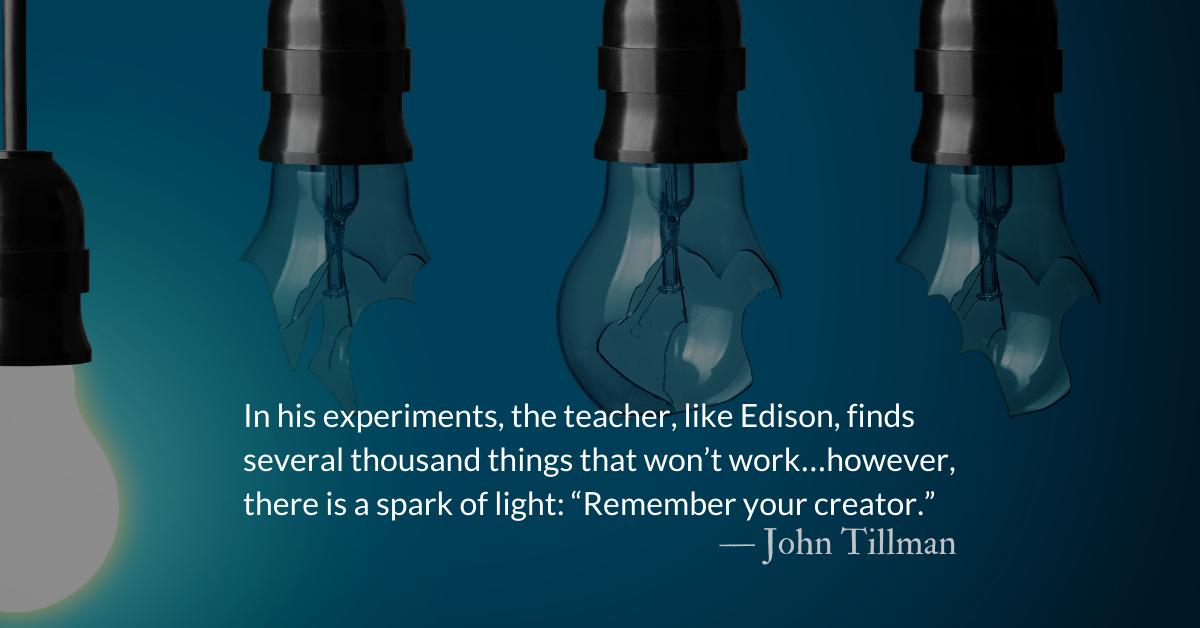
After many failures on a new kind of electric battery, an associate of Thomas Edison expressed dismay at having no results for their labor. Edison shot back, “We have plenty of results. We know several thousand things that won’t work.” Edison is known to have expressed similar sentiments throughout his career.

Ecclesiastes, in a way, is a journal of failed moral experiments and reads as if it was written over a long period, perhaps a lifetime. It begins, not with idealism but with a jaded, youthful cynicism. The teacher sets out, armed with wisdom, to solve the meaninglessness he sees. He makes himself both moral scientist and test subject. (Ecclesiastes 2.1)

In his experiments, the teacher of Ecclesiastes, like Edison, finds several thousand things that won’t work. Here at the end, we find the teacher still struggling with the problem he set out to solve. He never comes to a conclusion that fully satisfies him, however, there is a spark of light: “Remember your creator,” he says. “Remember your creator.”

Remembering is not just the recall of facts. Remembering is powerful. God often commanded the people to “remember.” Remembering can be an experience in which all the emotions, and even senses and sensations, participate. Passover was one of those times when remembering involved all the senses. The point was not for Israel to remember the facts of what God did, but to remember God’s identity and their own.

At the last Passover Jesus observed, he reoriented the meal around himself, saying, “do this in remembrance of me.” Then on the cross, a few hours later, the thief asked Jesus to “remember” him.

The light bulb moment of Ecclesiastes never quite comes, but the spark of hope lies in doing what God has already commanded us to do—remember him. 

The aged teacher’s exquisite closing poem pays poignant tribute to the realities of life and death and the importance of remembering God in youth, not just in old age. 

Remembering is a lifelong task and not merely a mental exercise. If we are to remember as Jesus commands, our remembrances must be both acts of testimony and demonstration. How do our remembrances testify and demonstrate God’s identity and our identity in him?

Let us remember Jesus. Remember him to ourselves. Remember him to our family and friends. Remember him to our community.

In this remembrance we find meaning.

Divine Hours Prayer: The Greeting
My mouth shall recount your mighty acts and saving deeds all day long; though I cannot know the number of them. — Psalm 71.15

– From The Divine Hours: Prayers for Springtime by Phyllis Tickle.

Today’s Readings
Ecclesiastes 12 (Listen – 2:38)
Psalm 119:1-24 (Listen – 15:14)

Read more about Over the Brink of Success
It is uncomfortable to hear the success we long for is pointless, but it’s healthy.

Read more about Forward-Looking Remembering
Remembering is not “living in the past” or “longing for the good ole days,” instead it informs our hope for a future that God has for us.

Absurd Little Bird

Scripture Focus: Ecclesiastes 10.20
20 Do not revile the king even in your thoughts, 
or curse the rich in your bedroom, 
because a bird in the sky may carry your words, 
and a bird on the wing may report what you say. 

Reflection: Absurd Little Bird
By John Tillman

Who needs spying birds when digital devices are listening? In modern life, this proverb might say, “Don’t discuss appliances near Alexa or your entire Facebook feed will be filled with Samsung ads.”

The idea of spying birds is ancient. Most ancient versions are inspired by Ecclesiastes. The idea is so prevalent in culture that a faux-conspiracy group based on this was created. “Birds Aren’t Real” is a parody of conspiracy theory groups such as Qanon. It claims that birds are CIA spy drones.

It started in 2017, when Peter McIndoe was struck by the absurdity of conspiratorial nonsense spouted by opposing political protestors. The slogan he created as a spontaneous joke became a movement. Many people, particularly Gen Z adults, played along, staging real protests for a fake cause. Why?

An additional way to translate the teacher’s frequent refrain “all is meaningless” might be to say “all is absurd.” The teacher explored wisdom, foolishness, and madness. The absurdities of life can be troubling, especially when leaders, friends, and family seem to be in their grip. What benefit is wisdom when so many are willing to follow foolishness like that which inspired “Birds Aren’t Real?”

Many Birds Aren’t Real participants acted out of frustration with friends and family captivated by Qanon and other absurd conspiracy theories. Poking fun at these conspiracies with their own fake conspiracy helped them “laugh at the madness, rather than be overcome by it.”

Birds are real and they don’t inform on people. Ecclesiastes’ practical advice isn’t meant to be interpreted literally. The proverb is not warning us against government or corporate spying. The proverb also does not mean to avoid criticizing leaders, even though abusive leaders attempt to imply this. If criticizing the king was a sin we’d have to throw out most biblical prophets.

The proverb does carry many truths. Powerful people will always use information (or misinformation) to their benefit—for oppression or selling appliances. Words spoken in private will often be shouted from the rooftop. (Luke 12.3) We need to be people of integrity, speaking public truth rather than private slander.

Confronting lies is a necessity amidst the absurdity of modern debate. Our concern should not be our fate when leaders hear the truth, but our community’s fate if leaders deny the truth.

However we stand for the truth, whether by sermon or satire, let us do so with integrity.

Divine Hours Prayer: The Small Verse
The people who dwelt in darkness have seen a great light.

– From The Divine Hours: Prayers for Springtime by Phyllis Tickle.

Today’s Readings
Ecclesiastes 10 (Listen – 2:33)
Psalm 116 (Listen – 1:34)

Read more about Facts and Harsh Realities
The Bible acknowledges these harsh realities side-by-side with aspirational faith that justice will be done.

Read more about The Commission of Truth
Leviticus 5.1 identifies a unique kind of sin—the sin of not testifying to the truth when it is called for.

Show Buttons
Hide Buttons
Spur a spiritual rhythm of refreshment right in your inbox
By joining this email list you are giving us permission to send you devotional emails each weekday and to communicate occasionally regarding other aspects of the ministry.
100% Privacy. We don't spam.