Mysterious Plea, Mysterious Peace

Scripture Focus: Philippians 4.2-7
2 I plead with Euodia and I plead with Syntyche to be of the same mind in the Lord. 3 Yes, and I ask you, my true companion, help these women since they have contended at my side in the cause of the gospel, along with Clement and the rest of my co-workers.

4 Rejoice in the Lord always. I will say it again: Rejoice! 5 Let your gentleness be evident to all. The Lord is near. 6 Do not be anxious about anything, but in every situation, by prayer and petition, with thanksgiving, present your requests to God. 7 And the peace of God, which transcends all understanding, will guard your hearts and your minds in Christ Jesus.

Reflection: Mysterious Plea, Mysterious Peace
By John Tillman

The church at Philippi was one with which Paul had a special relationship. The letter to them is joyous, intimate, and loving. At Philippi, Paul started the first church on the European continent. Lydia hosted this congregation and was its founding and leading member. The Philippian jailer and his family worshiped here. The former demon-possessed slave girl certainly would have been found there as well.

As Philippians enters its closing chapter, Paul and Timothy make a plea for unity to two feuding leaders. Who are these people, so influential that their disagreement is consequential enough, influential enough, that Paul and Timothy would call them out by name? Euodia and Syntyche—two co-workers who contended for the gospel at Paul’s side, now were contending against each other.

Many theorize about the nature of the conflict, but if Paul did not think it worth inclusion, we shouldn’t waste too much time theorizing. (Even if nerding out about those things can be entertaining…) If we trust God’s word, and we do, we trust that its omissions are not errors any more than its inclusions are.

What do we learn from this mysterious plea for unity?

1- Those who care passionately about the gospel can still disagree.
2- Disagreements don’t mean one’s salvation is in doubt.
3- Disagreements can be healthy, as “iron sharpens iron.” (Proverbs 27.17) We may learn better why we believe what we believe when we are challenged by differing interpretations.
4- Disagreements can become damaging internally (inside the church) and externally (in the wider world).

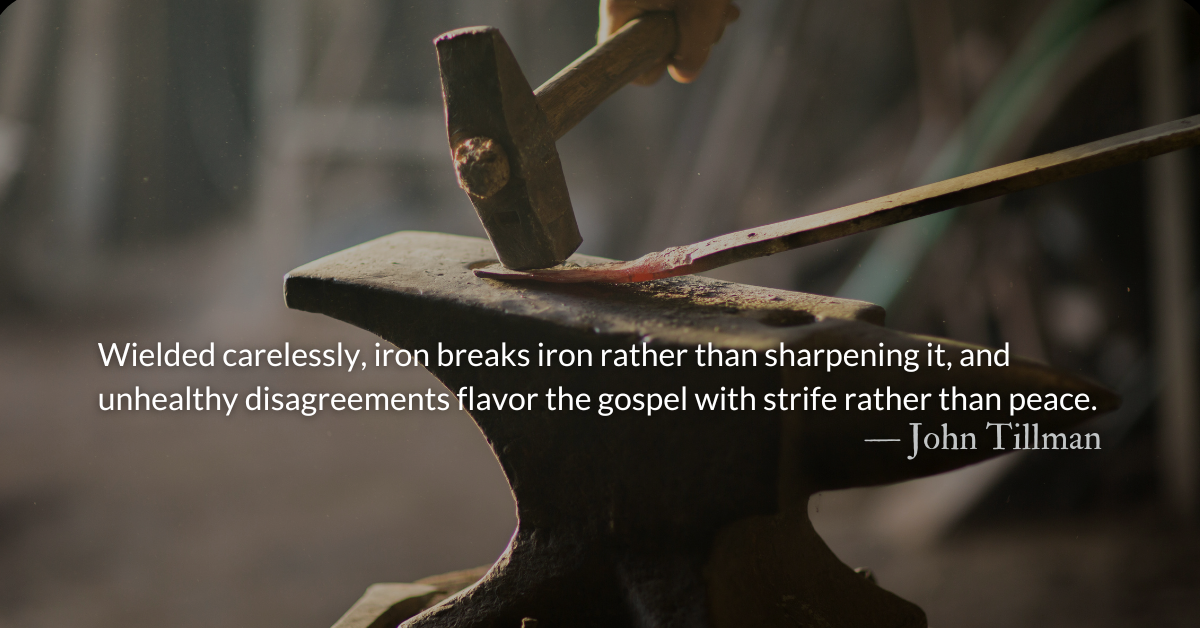
Wielded carelessly, iron breaks iron rather than sharpening it, and unhealthy disagreements flavor the gospel with strife rather than peace.

We certainly could use some unity in Christian circles today. Factions of evangelicalism seem constantly to be at one another’s throats rather than “greeting with a holy kiss.” (Romans 16.16) Some misuse scripture to normalize cruel words, mockery, and threats as “Jesus-like.” Our social media-driven world thrives on conflict but the gospel brings peace.

Rather than pursue conflict shaped by the world’s methods, let us keep reading Paul’s path to peace. Paul’s next words after issuing his challenge for unity are about rejoicing, gentleness, and overcoming anxiety through prayer. The result of this process will be peace, and not just between Euodia and Syntyche, but for us as well. The gospel provides mysterious peace for you and me that surpasses understanding.

Divine Hours Prayer: The Greeting
Show me your ways, O Lord, and teach me your paths.
Lead me in your truth and teach me, for you are the God of my salvation; in you have I trusted all the day long. — Psalm 25.34

– From The Divine Hours: Prayers for Summertime by Phyllis Tickle.

Today’s Readings
Ezekiel 17 (Listen 4:26) 
Philippians 4 (Listen 3:20)

Read more about The Thriving Tree
Jesus, the king planted by God upon Zion, is the tree that will thrive, bringing all the birds to his shade.

Read more about The Step After Surrender
A life that has been poured forth to Him must find its crown, its completion, in being poured forth for man
Prayer Beyond Petitions—Readers’ Choice

Readers’ Choice Bonus:
This is a “bonus” Readers’ Choice from 2018. Thank you for your readership. You don’t have to wait until next Summer to send Readers’ Choice selections. You can submit them all through the year at the following link: Submit a Readers’ Choice post today.

Today’s post was originally published, on June 6, 2018, based on Isaiah 38.2-3.
It was selected by reader, Susan Houg, Ft. Jones, CA: “I had just about bought into the false premise about prayer not changing things – except for oneself – when this essay posted. The Lord used it to revive my expectation, based on His character, teachings and history, that He is honored and glorified and, indeed, pleased when we bring our urgent as well as long-term needs to Him. Recently I had occasion to pray, “Even the wind and waves obey You. Please stop these winds from spreading this fire.” And you know what? That fire (McKinney) laid down and stayed within its containment lines. Firefighters considered it “unusual.””

Scripture Focus: Isaiah 38.2-3
Hezekiah turned his face to the wall and prayed to the Lord, “Remember, Lord, how I have walked before you faithfully and with wholehearted devotion and have done what is good in your eyes.” And Hezekiah wept bitterly.

Reflection: Prayer Beyond Petitions—Readers’ Choice
By John Tillman

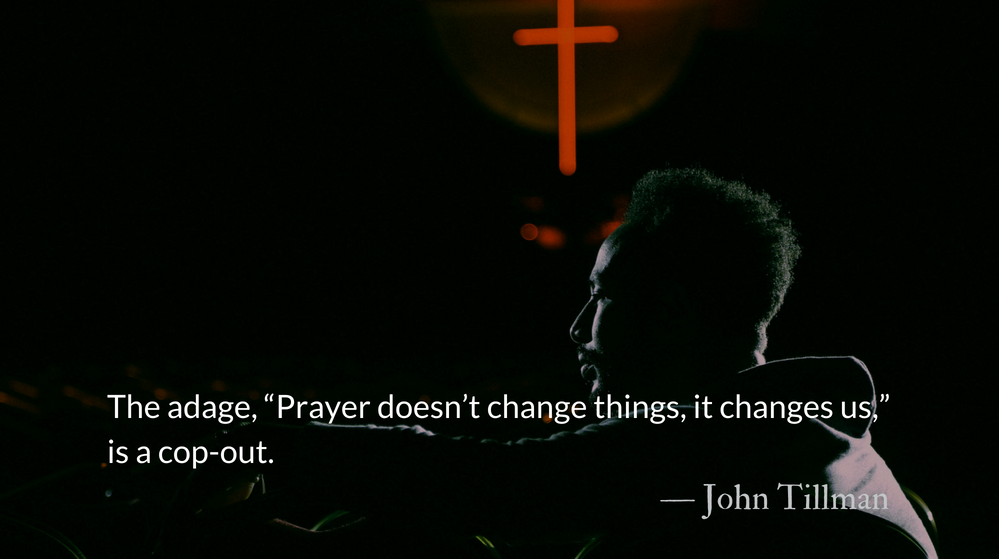
The adage, “Prayer doesn’t change things, it changes us,” is a cop-out.

If it is anything other than a cop-out it is at best a description of only part of what prayer is. It diminishes prayer to a self-counseling tool, a mere coping mechanism.

Todd Edmondson discusses this in his essay, Praying for a Change:

Such a perspective, however neat and tidy it might be, is profoundly unsatisfying and contradictory to what the Church has long held to be true.

When we envision prayer solely as something we do, as a work of human agency, it is almost impossible not to see it as a ritual designed for our benefit, as an incantation in which only the most superstitious or simple-minded people believe.

The healing of Hezekiah from his illness is a unique scriptural example of a prayer for change for several reasons.

There is not a formula to be applied in a prayer for change other than giving ourselves to a relationship with God. We cannot attribute success to Hezekiah’s words or the words of any recorded prayer. We must, instead, get to know Hezekiah’s God.

That our prayers to God would bring the realities of this world into contact with divine purposes, or that God would join us in our this-worldly struggles, should not strike us as odd or irrational, because it is exactly what God has been doing for thousands of years… Indeed, other methods of affecting change and other recipients of our trust—from politics to technology to military might—would seem to be far less proved than prayer, if our memories were not so short and our imaginations so easily manipulated by the kingdoms of this world.

It is more important that we know God through prayer than petition him. God answers Hezekiah’s unasked prayer through relationship. Our needs, like Hezekiah’s will be apparent to God, when we invest time in a relationship that goes beyond petition.

Divine Hours Prayer: A Reading
Jesus taught us, saying: “There is no need to be afraid, little flock, for it has pleased your Father to give you the kingdom.” — Luke 12.32

– From The Divine Hours: Prayers for Summertime by Phyllis Tickle.

Today’s Readings
Ezekiel 11(Listen 3:53)
Romans 14(Listen 3:28)

Read more about Finding God :: A Guided Prayer
Even today my complaint is bitter;
his hand is heavy in spite of my groaning.

Read more about Artful Prayers
May we live artfully in the power of the Holy Spirit, creating with our lives a prayer that may be seen, heard, felt.

When God Leaves the Building

Scripture Focus: Ezekiel 10.18-22
18 Then the glory of the Lord departed from over the threshold of the temple and stopped above the cherubim. 19 While I watched, the cherubim spread their wings and rose from the ground, and as they went, the wheels went with them. They stopped at the entrance of the east gate of the Lord’s house, and the glory of the God of Israel was above them. 
20 These were the living creatures I had seen beneath the God of Israel by the Kebar River, and I realized that they were cherubim. 21 Each had four faces and four wings, and under their wings was what looked like human hands. 22 Their faces had the same appearance as those I had seen by the Kebar River. Each one went straight ahead. 

Reflection: When God Leaves the Building
By John Tillman

Ezekiel’s visions of cherubim and “whirling wheels” are as confusing as they are captivating—as befuddling as they are beautiful.

Many study the details of Ezekiel’s vision. Many paintings, many theories, and many words have come from this imagery. Some think Ezekiel was hallucinating or on drugs. Some think his vision describes an alien spaceship. (Easier to believe in than God, I suppose?) But Ezekiel isn’t some poor, inept, ignorant, ancient fool. His literary skill is beyond ours. It’s better to admit we don’t understand what we are reading than to accuse him of not understanding what he saw.

What Ezekiel saw is less important than what he is telling us. In seeking to define the objects he described, many have missed the object of his argument.

The point of Ezekiel’s vision is not to describe the kind of vehicle God drives. The point is to tell us God is leaving. God is moving out—leaving the house David and generations of followers had worshiped in. The glory is departing from the temple. 

The “car”, if God drove one, is pulling out of the garage. No matter how well appointed the temple may be, without God’s presence, it’s as pointless as an empty garage. Its tools have no meaning. It smells vaguely of gasoline and rubber but there’s no horsepower, no purpose. It’s just an empty room.

God did not leave without reason or without many, many warnings and pleadings with his people. Yet people were surprised at God’s leaving. They missed the warnings. They ignored the pleadings.

If God can leave the Temple Solomon built, he can surely leave our churches, our organizations, and our nations. That’s the scary part. The beautiful part is that God didn’t leave his people. He just left their corrupted places. His people, including Ezekiel, were either already in exile or on their way. God went with them just as he was with them in Egypt. Then he heard their cries and brought them out, repentant and joyful.

Let us never be so prideful, so unheeding, that we are surprised to turn around and find that God has left the building. Let us never be so despairing over God abandoning a building, a country, or an organization that we forget that God remains close to his faithful remnant. Even if everything falls and burns, God can restore, if we will simply be faithful.

Divine Hours Prayer: The Small Verse
Open, Lord, my eyes that I may see.
Open, Lord, my ears that I may hear.
Open, Lord my heart and my mind that I may understand.
So shall I turn to you and be healed.


– From The Divine Hours: Prayers for Summertime by Phyllis Tickle.

Today’s Readings
Ezekiel 10(Listen 3:16)
Romans 13(Listen 2:35)

Read more about Hearts God Moves
In Ezra we will see God’s work to, stone by stone, reconstruct the Temple of Jerusalem to bear his name.

Read more about A Temple for Exiles
God is measuring out a temple of living stones which rest upon the chief cornerstone of Christ.

Truth That Surpasses the Legend

Scripture Focus: 1 Kings 10.1-7
1 When the queen of Sheba heard about the fame of Solomon and his relationship to the Lord, she came to test Solomon with hard questions. 2 Arriving at Jerusalem with a very great caravan—with camels carrying spices, large quantities of gold, and precious stones—she came to Solomon and talked with him about all that she had on her mind. 3 Solomon answered all her questions; nothing was too hard for the king to explain to her. 4 When the queen of Sheba saw all the wisdom of Solomon and the palace he had built, 5 the food on his table, the seating of his officials, the attending servants in their robes, his cupbearers, and the burnt offerings he made at the temple of the Lord, she was overwhelmed. 
6 She said to the king, “The report I heard in my own country about your achievements and your wisdom is true. 7 But I did not believe these things until I came and saw with my own eyes. Indeed, not even half was told me; in wisdom and wealth you have far exceeded the report I heard.

Matthew 12.42
42 The Queen of the South will rise at the judgment with this generation and condemn it; for she came from the ends of the earth to listen to Solomon’s wisdom, and now something greater than Solomon is here.

Reflection: Truth That Surpasses the Legend
By John Tillman

Solomon, with no enemies of consequence, settled in the peace established by his father, had great opportunity, great wealth, and was blessed with great wisdom. Using these gifts, he pursued God through the building of the temple. He also pursued answers to life’s great questions, as cataloged in Ecclesiastes.

Solomon, like many leaders, eventually fell into corruption, however, for a time, he was a great influence on the world. He was a legend in his own time. There are many legends of ruthless, rich, and powerful kings. Solomon’s legend, in contrast, was about “his relationship with the Lord.” 

The Queen of Sheba came to evaluate that legend. Like any noble visitor, the queen carried expensive gifts, but the most precious cargo to her was an exacting examination of puzzles and riddles. A doubter, she debated with Solomon, attended banquets, and observed his worship at the Temple.

It is likely that people we know have big and difficult questions about faith. We may feel queasy about people’s questions. We aren’t Solomon’s equal in any realm, much less that of wisdom. What if we don’t know the answers?

We don’t need to fear questions, even if we don’t know the answers. Someone greater than Solomon is here with us—Jesus.

Every time Jesus mentions Solomon, it’s to point out something greater than Solomon. A flower’s glamour exceeds Solomon’s robes and the wisdom of Jesus’ teaching exceeds that of Solomon.

We may not be as widely known as Solomon, as wealthy, or as wise. But followers of Christ have some commonalities with Solomon. Because of Christ, we are settled at peace with God the Father. We have no enemies of consequence who can break through his protection. We are blessed through the Holy Spirit with the wealth and wisdom of Christ. His mind, his love, and his wisdom are accessible to us. Using these gifts we can pursue God, serving and worshiping him in the temple of our bodies and that of the universal church. We also can proclaim that answers to life’s great questions are found through Christ in the Bible.

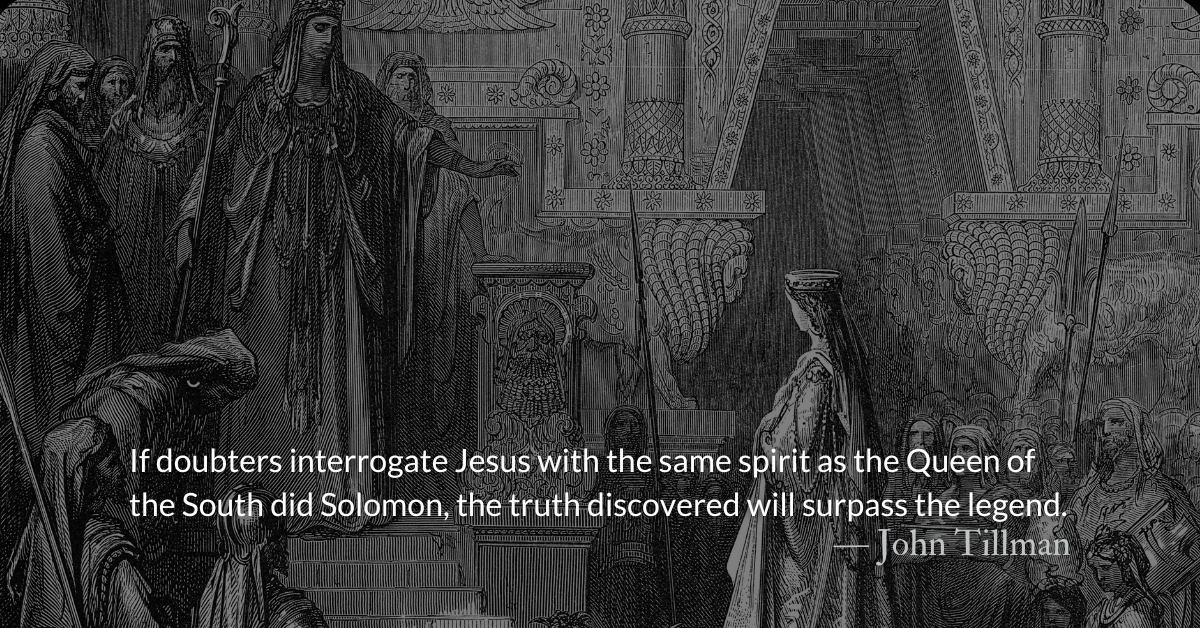
Accept unbelievers’ questions as precious gifts. When they express doubts, honor and respect their vulnerability. Humbly admit your own doubts or ignorance. Speak of Jesus—encourage them to seek him. If doubters interrogate Jesus with the same spirit as the Queen of the South did Solomon, the truth discovered will surpass the legend.

From John: A ministry I have become familiar with in the past couple of years that welcomes doubters and their questions as precious gifts is called Alpha. During the pandemic (when we had to do them on Zoom) I helped with launching the first Alpha courses at the church I attend and our church is still hosting them in person and now off-site in the community with great success. If you are in the DFW area, check out my church’s Alpha and if not, find one near you to attend and invite your doubtful friends to attend with you.

Divine Hours Prayer: The Greeting
I will confess you among the peoples, O Lord; I will sing praises to you among the nations.
For your loving-kindness is greater than the heavens, and your faithfulness reaches to the clouds. — Psalm 108-3-4


– From The Divine Hours: Prayers for Summertime by Phyllis Tickle.

Today’s Readings*
Ezekiel 7(Listen 4:32)
Romans 10(Listen 3:21)

This Weekend’s Readings
Ezekiel 8(Listen 3:21)Romans 11(Listen 5:23)
Ezekiel 9(Listen 2:05)Romans 12(Listen 2:58)

*We have diverted into 1 Kings and Ephesians for this week. Devotionals on our daily readings will continue next week.

Read more about Solomon’s Folly
None of us are Solomon but…Any of us can apply a God-given skill, like wisdom, in a foolish and sinful way.

Read more about God of the Weak and Doubtful
You who doubt… He calls. He loves. He holds out his hand, and trusts the gospel, to all of us doubters.

The Urban Sprawl of the City of God—Readers’ Choice

Readers’ Choice Bonus:
Today’s post was originally published, on May 20, 2022, based on Zechariah 2.3-11

It was selected by reader, Brian Bakke, Washington DC: 
“Thank you for this reflection. Thanks for sharing about the City of God. Thanks for the gift of sharing about the eternal City where all of us who are called by name will celebrate, worship, and live with our Lord and Savior forever and ever.

My father was a gifted teacher, author, and professor. He will forever be known for calling the Church back into the city. He was co-editor of the Word in Life Study Bible, which has thousands of notes that speak of God’s love for the city and the people who live there. He was an unknown pastor laboring in a small church in Chicago. Someone told someone, who told someone, who told someone, and my father was on the stage at Urbana in 1984. He wrote The Urban Christian, and Theology As Big as the City, and A Biblical Word for an Urban World.”

From John: After corresponding with Brian following the original publication of this devotional, I read Theology As Big as the City and found it to be inspirational and very much still relevant to ministry and the church today—perhaps even more relevant now than when it was first published. I recommend adding it to your reading list. 

Thank you for sending your selections of meaningful and helpful devotionals from the past 12 months. This is a bonus Readers’ Choice post for this week. Remember that you don’t have to wait to send a Readers’ Choice. You can submit them all year long simply by replying back to our emails or filling out the form found at this link.

Scripture Focus: Zechariah 2.3-11
3 While the angel who was speaking to me was leaving, another angel came to meet him 4 and said to him: “Run, tell that young man, ‘Jerusalem will be a city without walls because of the great number of people and animals in it. 5 And I myself will be a wall of fire around it,’ declares the Lord, ‘and I will be its glory within.’ 

6 “Come! Come! Flee from the land of the north,” declares the Lord, “for I have scattered you to the four winds of heaven,” declares the Lord. 

7 “Come, Zion! Escape, you who live in Daughter Babylon!” 8 For this is what the Lord Almighty says: “After the Glorious One has sent me against the nations that have plundered you—for whoever touches you touches the apple of his eye—9 I will surely raise my hand against them so that their slaves will plunder them. g Then you will know that the Lord Almighty has sent me. 

10 “Shout and be glad, Daughter Zion. For I am coming, and I will live among you,” declares the Lord. 11 “Many nations will be joined with the Lord in that day and will become my people. I will live among you and you will know that the Lord Almighty has sent me to you.

Reflection: The Urban Sprawl of the City of God—Readers’ Choice
By John Tillman

The angel who has been talking to Zechariah leaves him. However, at some distance away, a second angel intercepts the first with an urgent message, sending him back. “Run, tell that young man…” the second angel says.

Zechariah is told that the new Jerusalem will have no walls. This may not seem unusual to us. Most of today’s cities have no walls. The Dallas-Fort Worth metroplex, where I live, covers an area larger than the combined areas of Connecticut, Delaware, and Rhode Island. It is over 9,000 square miles of cities grown right into each other…and sprawling more every month out into the surrounding countryside.

In Zechariah’s day, however, cities without walls were defenseless. However, the angel of the Lord says that he, himself, will be a wall of fire around the city and its glory within. This image links to at least two things. 

On Mount Sinai, God appeared in a fiery cloud of glory. The people were too afraid to go near the mountain, but Moses entered this fire and experienced the glory of God.

In John’s Revelation, the City of God, the New Jerusalem, comes down from Heaven and has no need of sun or lamps because the Lord himself will be its light. His glory will fill the city. (Revelation 22.5; Zechariah 14.7; Isaiah 60.19)

The angel tells Zechariah that God will send him to us in this fire-walled, glorious city. He will come and live among us and many nations will become God’s people.

God has sent Jesus to us in this manner and for this purpose. Jesus is the entrance into all that God has for us. He is the gate and the wall and when we enter, he shows us God’s glory closer than Moses ever got to see. This is an “already and not yet” promise. We can experience it now in part, as through a veil like Moses wore, but then we will experience it more fully.

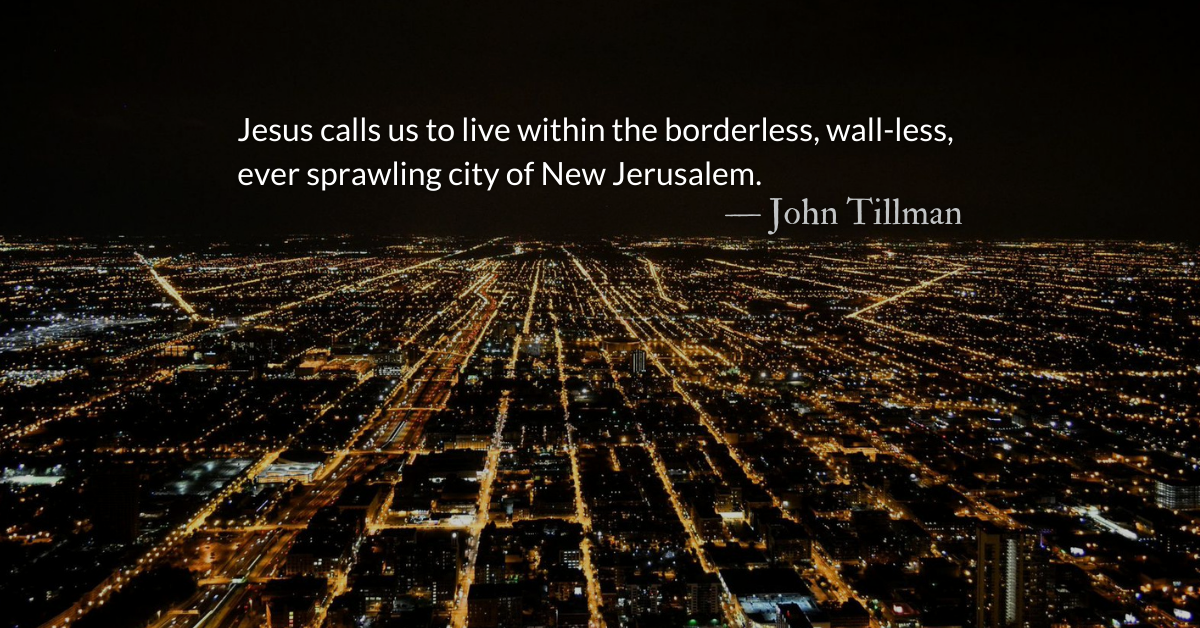
God is writing an Exodus narrative for us today. Jesus calls to us to escape the cities, systems, and empires we now serve. “Escape!”, he cries. “Escape from Babylon!” Jesus calls us to live within the borderless, wall-less, ever-sprawling city of New Jerusalem. As we anticipate the ultimate fulfillment of this promise, may we participate in work God calls us to which fulfills it in part.

Divine Hours Prayer: The Refrain for the Morning Lessons
The same stone that the builders rejected has become the chief cornerstone. — Psalm 118.22

– From The Divine Hours: Prayers for Summertime by Phyllis Tickle.

Today’s Readings*
Ezekiel 6(Listen 3:28)
Romans 9(Listen 5:15)

*We have diverted into 1 Kings and Ephesians for this week. Devotionals on our daily readings will continue next week.

Read more about Christ our Temple, River, and City
Christ is our city. He is our refuge and rest—our strong tower and protected place…

Read more about Hope Among the Traumatized
From our lives may there flow trickles of hope, which combine into a river that brings to life…

Show Buttons
Hide Buttons
Spur a spiritual rhythm of refreshment right in your inbox
By joining this email list you are giving us permission to send you devotional emails each weekday and to communicate occasionally regarding other aspects of the ministry.
100% Privacy. We don't spam.